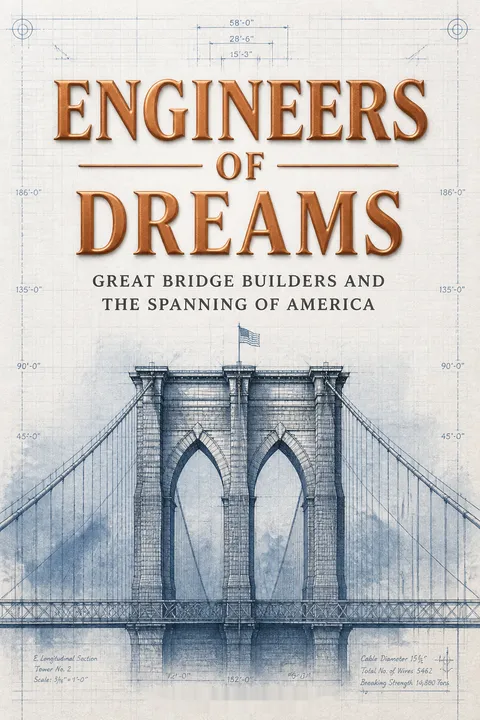


Key Takeaways
Bridges turn geography into a shared civic identity, not merely a route.
Crossings shape cities. Rivers and bays attracted settlements, commerce, and industry, but they also divided communities. Bridges made those divisions easier to cross and became landmarks that helped define places, from the Brooklyn Bridge in New York to the Golden Gate in San Francisco. The structure influences its surroundings, and the city gives the structure meaning. A bridge can frame an arrival, alter a skyline, or open land to new development.
Every crossing makes a claim. Even an ordinary rural bridge changes how people move through a landscape. Petroski treats each bridge as both a working structure and a public choice: its presence should benefit the people and places around it, while its design should respect the setting. The span is never isolated from its social and physical context.
What's striking is how the book makes infrastructure legible as civic culture. A bridge is not just a tool for reducing travel time. It changes which places feel close, which businesses can thrive, and what residents recognize as their city. That broader view also invites a useful question: who benefits from a new connection, and who bears its costs? A crossing can unite distant neighborhoods while disrupting nearby ones. Treating both effects as part of the design problem makes the bridge's civic meaning more honest.
Win trust and financing before steel can turn a bridge proposal real.
A design needs allies. A technically plausible bridge remains a drawing unless lawmakers authorize it, investors or taxpayers fund it, and affected communities accept it. In the nineteenth century, railroads often financed major crossings because they needed continuous routes for freight. Later, cities and states took on more responsibility as automobiles and commuter traffic grew. Even the St. Louis bridge faced a contest over who would control its charter and toll revenue.
Calculation became persuasive. Squire Whipple's bridge treatise showed engineers how to calculate forces in a truss and size its members before construction. That helped move bridge building from a craft grounded mainly in experience toward a profession able to explain, estimate, and defend designs. James Eads likewise wrote for ordinary readers, using familiar mechanical ideas to show why his proposed arch could work. Engineering had to persuade as well as calculate.
The bridge proposal resembles a public investment case: technical merit matters, but decision-makers also need a credible account of cost, benefit, risk, and responsibility. Petroski's stories show that communication is not decoration added after engineering. It is one of the mechanisms by which engineering becomes possible. At the same time, persuasion can be used to oversell uncertain benefits. Public explanation is strongest when it makes assumptions visible, not when it hides uncertainty behind impressive drawings or confident forecasts.
Learn the site with your senses, then let calculation discipline intuition.
Eads learned from the river. James Eads left school at thirteen to support his family, but read books on mechanics and engineering in a shopkeeper's library. After a steamboat sank, he developed a diving-bell system to recover cargo and took part in more than five hundred river-bottom explorations. He learned firsthand that Mississippi sand could shift, bury wrecks, and move beneath a diver's feet. That experience later informed his decisions about bridge foundations and river channels.
Experience has limits. For the St. Louis Bridge, Eads used pneumatic caissons, pressurized chambers that allowed workers to excavate below the riverbed while keeping water out. The method enabled deep foundations, but high pressure and rapid decompression caused serious illness and deaths. Practical knowledge helped Eads innovate, yet the work also exposed how much remained unknown about risks to workers.
Eads's career makes a useful distinction between information and knowledge. A map or equation can describe a riverbed, but repeated contact with a shifting river builds a different kind of understanding. In modern technical work, field observations can reveal where models are too neat or incomplete. But experience is not automatically safe or unbiased. The caisson story is a reminder that learning through trial can impose costs on workers, so practical ingenuity needs protection, measurement, and candid attention to harm.
Read disasters as evidence about assumptions, not verdicts on one bridge type.
The Tay failed in a storm. In 1879, high winds brought down part of Thomas Bouch's Tay Bridge in Scotland, taking a passenger train and its passengers into the water. The investigation found inadequate wind resistance and weak bracing and connections. The bridge had operated for over a year, but that success did not prove its design could withstand the forces it had neglected.
Quebec exposed another assumption. In 1907, the partly built Quebec Bridge collapsed, killing about seventy-five workers. Its lower chords could not carry the actual compressive load. The design team had underestimated the bridge's own weight and failed to update the calculations as the design changed. The different accidents exposed different weaknesses. Their lesson was not that a particular form, such as a cantilever, must always fail, but that unexamined assumptions can make a design fragile.
Failure analysis is most valuable when it resists the urge to find a single villain or a single defective technology. The Tay and Quebec disasters involved different structures, forces, and decisions, so their lessons are specific rather than interchangeable. Both also show how a bridge can appear successful until a rare condition tests it. Petroski's approach encourages a more precise question: what was assumed, what evidence supported it, and what changed? That question yields better learning than treating survival as proof of safety.
Give novel designs independent checks, enough time, and a capable staff.
Checking is part of design. Eads arranged for assistants to calculate the St. Louis Bridge and for mathematician William Chauvenet to review the results. The process recognized that a chief engineer could not do every calculation alone, and that a second perspective could catch mistakes. Large projects depend on a network of expertise, even when one engineer becomes their public face.
Responsibility needs resources. Theodore Cooper's Quebec Bridge work was poorly staffed and underpaid for its scale. He relied heavily on the contractor's design engineer and accepted calculations that should have been revisited as the bridge grew heavier. The inquiry found errors in judgment, but also described an organization that gave its consulting engineer too little time and support. A famous name cannot replace independent review, detailed checking, and enough qualified people to do the work.
This is a lesson in organizational design as much as structural design. A review system works only when reviewers have the authority, time, and information to challenge a proposal. Otherwise, multiple signatures may create the appearance of scrutiny without the substance. Petroski's cases also complicate the usual hero narrative: expertise is distributed, while accountability often gathers around the person with the grandest title. Good institutions make that imbalance visible and ensure that dissent can travel upward before construction makes correction expensive.
Choose the bridge form that balances site, cost, strength, and appearance.
No form wins everywhere. Eads chose an arch for St. Louis, arguing that it could span the river with fewer obstructions than a bridge supported by many piers. The Forth Bridge in Scotland used massive cantilever arms to cross a difficult estuary. In New York, Othmar Ammann's George Washington Bridge used suspension cables for a much longer span. Each form answered different demands: foundation conditions, shipping clearance, traffic, materials, cost, and construction method.
Appearance is part of the choice. The bare steel towers of the George Washington Bridge differed from architect Cass Gilbert's proposed stone-clad design. The stone was never built, leaving a form that later suspension bridges often followed. At Hell Gate, Gustav Lindenthal used stone towers and an arch to create a monumental entrance, while local conditions also shaped the structure. A bridge's beauty cannot be separated from what it must carry or where it stands.
The book avoids the false choice between engineering and aesthetics. Appearance can help a bridge belong to a place, but aesthetic ambition still has to answer structural and economic constraints. Conversely, a claim that function alone determines form can disguise choices about what a community values. Petroski's comparisons suggest that no bridge type is inherently elegant or crude. The stronger question is whether the form expresses its loads and setting clearly, while serving the people who must build, use, and maintain it.
Scale dreams to the traffic and politics that actually exist.
A grand plan can miss its moment. Gustav Lindenthal spent decades promoting a vast Hudson River bridge with railway and road capacity, elegant towers, and elaborate approaches. He believed engineering could solve the physical challenge, but the project struggled to secure financing and public support. Meanwhile, rail tunnels and changing traffic patterns weakened the case for his original plan.
Ammann narrowed the problem. Othmar Ammann, once Lindenthal's assistant, proposed a more focused crossing at 179th Street, shaped around expected traffic and a more manageable cost. The Port Authority eventually built his George Washington Bridge. The shift was not simply from one engineer's vision to another's. It reflected a changing balance among transport needs, finance, politics, and scale. A bridge can be technically possible and still be impractical if its users and backers do not match its ambitions.
Lindenthal's story is a warning against confusing the largest imaginable project with the best project for a particular moment. Long-term vision can be valuable, but a plan that cannot adapt to changing travel patterns risks becoming a monument to its designer's priorities rather than a useful public work. Ammann's more targeted proposal succeeded partly because it connected engineering scope to a plausible political and financial path. That does not make ambition wrong; it makes responsiveness part of ambition.
Reduce structural weight only when the load assumptions deserve trust.
Ammann priced flexibility. For the George Washington Bridge, engineers reasoned that a long span was unlikely to carry trucks bumper to bumper across every lane at once. They designed for a much smaller share of the theoretically maximum traffic load, which reduced the steel required in the deck, cables, towers, and anchorages. The book estimates that a more conservative traffic assumption could have added more than seven million dollars in steel, with total savings from the lighter design approaching ten million.
The bridge moved visibly. The slender structure was notably flexible, and its roadway could be felt vibrating. Ammann's design showed how assumptions about traffic could make a major bridge affordable, but that economy also depended on judging the likely load correctly. An assumption is not a fact just because it makes a design cheaper. It needs evidence, review, and clear limits on what the structure is expected to carry.
This is a vivid example of optimization: reducing material can free money and resources for other needs, but only if the model represents reality well enough. A conservative design is not automatically better if its cost prevents a useful project from being built. A lean design is not automatically better if the assumed traffic or behavior is wrong. Petroski's case invites decision-makers to ask not only how much a design saves, but which assumptions create the savings and how sensitive the result is when those assumptions fail.
Use engineering history to question elegant models before they become dogma.
A pattern appeared in bridge failures. Petroski recounts research by Paul Sibly and Alastair Walker that identified major bridge collapses around 1847, 1879, 1907, 1940, and 1970, roughly three decades apart. The failures involved different bridge forms, but each followed a period of confidence and ambitious development. The pattern is not a timetable for the next disaster. It is a prompt to notice how professional certainty can grow around new designs.
Tacoma challenged the model. The 1940 Tacoma Narrows Bridge oscillated in the wind and collapsed. Engineers had relied on analytical methods that did not adequately account for aerodynamic behavior. Earlier bridges had also suffered wind damage, but their histories had faded from working memory. The episode showed that a sophisticated calculation can still omit a force that matters. Historical examples help engineers ask what a model leaves out.
The useful part of a failure cycle is not its apparent predictability, but the institutional habit it exposes. Generations can inherit successful tools while losing the warnings that once accompanied them. A historical record functions like a long-term memory for a profession, especially when individual careers are shorter than the life of infrastructure. Still, patterns must not be mistaken for laws. The dates do not forecast a collapse; they make a case for treating novelty, confidence, and missing evidence as reasons to examine assumptions closely.
Fund inspection and upkeep as part of construction, not afterthought.
Opening day is not the finish. Bridges face traffic, weather, corrosion, and changing demands throughout their lives. Petroski reports that roughly one in five American highway bridges was considered structurally deficient at the time discussed. The Williamsburg Bridge suffered severe cable corrosion after its protection proved inadequate, while other New York bridges deteriorated when maintenance was deferred. By contrast, the Forth Bridge remained in strong condition after a century of regular care.
Maintenance needs a budget. Painting protects steel as well as changing its appearance, but inspection must identify damage rather than conceal it. Toll revenue helped fund ongoing work on the Golden Gate Bridge; toll-free structures often depended on public budgets that could be cut or delayed. A bridge's design therefore includes a practical question beyond strength: who will pay attention to it, and who will pay to keep it safe?
Maintenance is often politically invisible because success looks like nothing happening. That makes it easy to defer, even though deterioration compounds while budgets and attention move elsewhere. Petroski makes stewardship part of engineering rather than a separate administrative chore. The lesson extends beyond bridges: infrastructure is a continuing relationship between an artifact and the institutions responsible for it. A striking design without a credible maintenance plan may be less responsible than a modest structure whose inspection and repair are funded for the long term.
Analysis
Petroski's central achievement is to make bridge building a history of decisions rather than a parade of finished monuments. The structures emerge from a changing mix of physical constraints, materials, finance, public argument, professional rivalry, and individual temperament. Eads's immersion in the Mississippi gave him knowledge that formal calculation alone could not supply. Whipple's methods helped make calculation communicable. The failures of the Tay and Quebec bridges show that neither practical experience nor professional standing can compensate for neglected assumptions. The result is a history of engineering as social judgment conducted through material objects.
The narrative also complicates the familiar lone-genius account. Engineers such as Eads, Lindenthal, Ammann, and Steinman shaped bridges through their preferences and ambitions, but their work depended on assistants, contractors, public officials, financiers, and laborers. Recognition, however, often accrued to the chief engineer while risk and effort were spread across a much larger group. This is not merely a biographical wrinkle. It reveals how institutions decide whose knowledge counts and who receives credit when a project succeeds or fails.
The book's strongest warning concerns historical amnesia. The Tacoma Narrows collapse did not arise because engineers lacked mathematical skill. It arose in part because successful theory and elegant design had displaced attention to earlier evidence about wind. Yet the book does not argue that failure should be eliminated at any cost. Bridges compete with other public needs, and excessive conservatism can waste resources or prevent useful projects. The difficult task is to make uncertainty visible, build review into organizations, and match a design's confidence to the evidence behind it.
One limitation is the emphasis on famous engineers and record-setting spans. The narrative includes workers and community conflicts, but the scale of the engineering personalities can overshadow local disruption, everyday bridges, and the distribution of benefits. Still, that focus clarifies the book's governing insight: bridges are neither neutral machines nor pure works of art. They are durable negotiations between what a society imagines, what it can finance, what engineering can support, and what it is willing to maintain.
Review Summary
Readers generally enjoyed Engineers of Dreams, praising its historical depth and engaging storytelling about bridge builders and their challenges. Many appreciated the technical details and cultural insights provided. Some found the introduction repetitive and the pacing slow at times. Reviewers highlighted the book's focus on major American bridges and their designers, noting its ability to shed light on often-overlooked engineering achievements. While most found it informative, a few desired more technical explanations of bridge mechanics. Overall, the book received positive reviews for its unique perspective on bridge engineering history.
Glossary
Pneumatic caisson
Pressurized underwater foundation chamberA pneumatic caisson is a sealed chamber sunk into a riverbed or other underwater site. Compressed air inside keeps water out while workers excavate soil and reach a firm foundation. The method allowed engineers to build deep bridge piers, but workers faced dangerous pressure changes during entry and decompression.
Caisson disease
Illness from rapid decompressionCaisson disease is the illness workers can suffer when they leave a high-pressure work chamber too quickly. In the book's bridge-building accounts, workers developed cramps, paralysis, and sometimes fatal symptoms after working inside pressurized caissons. The condition became known as the bends, and doctors on the St. Louis Bridge project helped identify decompression as a major cause.
Deflection theory
Analysis of bridge movementDeflection theory is a method for analyzing how a suspension bridge's cables and deck interact as the structure bends under load. Because the bridge's movement changes how forces are distributed, the analysis can support lighter designs than simpler calculations allow. The method influenced major American bridges, though the Tacoma Narrows collapse showed that it did not by itself account for aerodynamic wind effects.
Factor of safety
Strength margin beyond calculated loadsA factor of safety is an added margin between the load a structure is calculated to carry and the load at which it would fail. Theodore Cooper criticized relying on an arbitrary multiplier instead of careful analysis, material testing, and inspection. The concept reflects an enduring design problem: safety requires reserve strength, but excessive reserve can make a bridge heavier and more expensive than necessary.
thirty-year cycle
Recurring interval between major failuresThe thirty-year cycle refers to a pattern identified in research by Paul Sibly and Alastair Walker. Major bridge failures occurred around 1847, 1879, 1907, 1940, and 1970, with roughly three decades between events. The pattern links failures to periods of confidence in developing bridge forms, but it is a historical observation, not a reliable forecast of when or where another collapse will occur.
About the Author
Other books by Henry Petroski




Download PDF
Download EPUB
.epub digital book format is ideal for reading ebooks on phones, tablets, and e-readers.








