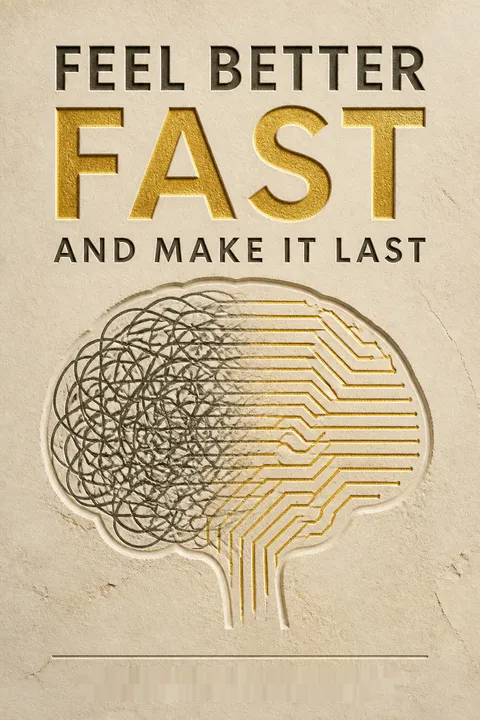


Key Takeaways
Calm the body's alarm before trying to reason your way out.
Regulate first, reflect second. Amen opens with Beth, a frightened patient whose pain and panic made an IV difficult to place. Instead of demanding that she calm down, he slowed his own breathing, guided her attention, and used relaxation and imagery. The lesson is practical: when the body is in fight-or-flight mode, clear thinking is harder. Slow belly breathing, progressive muscle relaxation, guided imagery, prayer or meditation, soothing music, and calming sensory cues are offered as quick ways to lower the alarm.
Build a rescue routine. The book recommends practicing these tools when calm, so they are easier to use under pressure. A simple starting point is ten slow breaths with a longer exhale, followed by imagining a safe place. These methods may ease distress, but they are not substitutes for emergency or medical care when symptoms are severe.
What's compelling is the shift from scolding a distressed person to changing the conditions that make self-control possible. The same principle applies outside a hospital: a heated argument often improves when someone pauses, lowers their voice, and gives the other person room to settle. These tools are accessible because they do not require sophisticated equipment. Their limits matter, too. A breathing exercise can help with ordinary stress, but it cannot diagnose the cause of chest pain, severe panic, or a medical crisis. Treat it as a first aid skill, not a complete treatment plan.
Treat mental distress as brain health plus life context, not a moral failure.
Join biology and behavior. The book's central claim is that lasting improvement depends on caring for the brain's physical health as well as changing thoughts, habits, relationships, and sources of meaning. Its BRAIN-XL framework organizes that work around the brain, rational thinking, attachments, inspiration, nourishment, an X factor such as individualized assessment, and love. Amen also describes four interacting dimensions of health: biological, psychological, social, and spiritual.
Look beyond blame. Rain, a child with severe impulsivity and aggression, improved after her care included dietary changes, supplements, and neurofeedback. The story illustrates why behavior may have causes beyond defiance, although one patient's progress cannot prove which intervention mattered most. Amen advocates SPECT imaging to investigate brain function, but notes that a scan alone cannot provide a diagnosis. The practical message is to consider multiple explanations and seek competent assessment when problems persist.
The framework is strongest when it broadens the question from 'What is wrong with this person?' to 'What conditions are shaping this person's behavior?' That stance can reduce shame and make families more curious and supportive. It also resists the false split between biology and biography: sleep, stress, relationships, and physical health all affect a person's experience. The caution is that a brain-based explanation can become another oversimplification if it is treated as a complete account. Imaging may help in selected clinical situations, but a striking scan is not proof that a particular pattern caused a behavior or that a specific intervention will fix it.
Give your executive brain a pause before impulses choose for you.
Use the inner brake. Amen calls the prefrontal cortex, or PFC, the brain's executive center. It supports planning, attention, judgment, empathy, and the ability to stop an immediate urge when it conflicts with a larger goal. The book emphasizes that this system continues developing into a person's twenties and can be disrupted by injury, stress, poor sleep, and substance use.
Make good decisions easier. Before a risky choice, define the goal, pause, and ask what the likely consequences are. The book's HALT reminder flags four vulnerable states: hungry, angry, lonely, and tired. Each can make sound judgment harder. Other useful practices include keeping a journal of triggers, planning limits before social events, and saying, 'I need time to think,' rather than agreeing on the spot. These are practical ways to create a gap between impulse and action.
The 'inner brake' metaphor makes executive function concrete. It also helps explain why a person's worst moment should not automatically be mistaken for their deepest values. A pause is not merely restraint; it gives goals, consequences, and other people's needs time to enter the decision. Yet self-control is not an unlimited resource, and the book's brain-centered language can make a complex capacity sound like one switch in one region. The useful application is not to blame a weak brake, but to notice when conditions such as exhaustion or anger are making careful decisions less likely.
Treat negative thoughts as claims to test, not commands to obey.
Name the mental intruders. Amen coined 'ANTs,' short for automatic negative thoughts, for reflexive thoughts that arrive uninvited and can intensify sadness, anger, or fear. He describes recurring patterns such as all-or-nothing judgments, focusing only on the bad, harsh self-labels, predicting disaster, guessing what others think, and blaming. The point is not to replace every painful thought with cheerful talk. It is to check whether the thought is accurate and useful.
Put a thought on trial. Marcus, a teenager who repeatedly called himself stupid, learned to write down these thoughts and question them. Testing showed his IQ was in the top one percent, a sharp contrast with his self-description. The book also offers the A-B-C model: an event occurs, a person interprets it, and that interpretation shapes the response. Recording the thought creates room to consider a fairer explanation before acting on it.
This is a memorable bridge between cognitive therapy and everyday self-observation. Giving a thought a label can make it feel less like an objective report and more like one possible interpretation. The method is most helpful when the alternative thought remains honest: a person can acknowledge real failure, grief, or unfair treatment without turning it into a global verdict on the self. It also has a boundary. Not every distressing thought is simply a thinking error; some reflect genuine danger or serious illness. Questioning thoughts complements, rather than replaces, practical action and professional support.
Turn change into small rehearsed actions, not a test of willpower.
Practice rewires routines. The book describes neuroplasticity as the brain's capacity to change with experience. Repeated actions can make a response more automatic, whether the response is helpful or harmful. Amen draws on BJ Fogg's Tiny Habits approach: attach a small action to a familiar cue, then celebrate completing it. The action should be easy enough to do even when motivation is modest.
Plan for the vulnerable moment. An 'if-then' plan specifies what to do when a predictable trigger appears, such as taking three slow breaths when irritation rises. The book also presents change as a process with stages, from not considering change through taking action and maintaining it, with relapse as a possible part of the process. Eloise's return to substance use became useful information when she traced it to lost sleep, irregular meals, stress, and conflict. Study a setback, adjust the plan, and restart.
This approach turns an abstract promise to change into a rehearsable response. It fits the logic of implementation planning: deciding in advance what happens at a cue reduces the need to invent a solution while under pressure. Small steps can also build confidence because success becomes observable rather than aspirational. The book's stronger claim that repeated behavior builds brain 'superhighways' is best treated as an image, not a literal map of guaranteed outcomes. Habits are shaped by opportunity, health, and social conditions as well as repetition. A tiny step helps, but it cannot remove every barrier.
Make relationships safer through attention, responsibility, and clear communication.
Connection is part of health. Amen argues that social bonds influence both well-being and resilience. His RELATING framework gathers relationship habits such as taking responsibility for one's contribution, showing empathy, listening, speaking assertively, spending time together, checking negative assumptions, noticing what is appreciated, and practicing forgiveness. A practical listening move is to restate what the other person said before responding, then ask whether the summary is accurate.
Notice what you reinforce. The book cites relationship researcher John Gottman's finding that stable couples tend to have about five positive interactions for each negative one. It also recommends focused time with children, even twenty minutes spent following the child's chosen activity without turning it into a lesson. The point is not to keep score. It is to make attention, appreciation, and direct communication more common than criticism, guessing, or withdrawal.
These practices treat a relationship as a pattern of interactions rather than a verdict on whether two people are compatible. That makes the advice concrete: listen for meaning, state needs plainly, and give attention to behavior worth repeating. The positive-to-negative ratio is a useful reminder that repair and warmth need to be visible, not assumed. It should not become a rigid quota or a reason to dismiss serious harm. In unequal or abusive relationships, safety and boundaries take precedence over mutual understanding, and forgiveness does not require reconciliation.
Process trauma with skilled support instead of numbing or avoiding it.
Pain can stay activated. The book describes trauma as an experience that can leave a person reacting to reminders as if danger were still present. Steven, who witnessed a deadly vehicle crash and had earlier traumatic experiences, struggled with shaking and sleep. The author reports that EMDR, a structured therapy in which a client recalls a distressing memory while following a therapist's alternating movements, helped him after eight hours of treatment.
Choose care to fit the problem. The book also discusses trauma-focused cognitive behavioral therapy, narrative exposure therapy, social support, and making room to feel grief rather than trying to suppress it. It warns that trauma symptoms, grief, and brain injury can overlap, so assessment matters. Posttraumatic growth is the possibility that some people find new purpose, relationships, or appreciation after trauma. It is a possibility, not an obligation. EMDR and other trauma treatments should be undertaken with appropriately trained professionals.
The humane contribution here is refusing to equate healing with forgetting or staying busy. Telling a coherent account of what happened, with support, can help distinguish a past threat from a present one. The discussion also rightly separates growth from a demand to find a silver lining; people should not have to turn suffering into a lesson to deserve care. A particular caution applies to techniques that invite someone to search for very early or forgotten memories. Memory is reconstructive, and suggestive questioning can create unwarranted certainty. Trauma treatment is safest when it is collaborative, paced, and guided by a qualified clinician.
Feed steadier energy with nourishing food, while testing sensitivities carefully.
Prioritize food quality. Amen argues that eating patterns influence energy, attention, mood, and physical health. His dietary guidance favors water, protein with meals, healthy fats, fiber-rich carbohydrates, and a variety of vegetables and fruits. He urges readers to reduce highly processed foods and sugary drinks, and to notice whether a particular food appears linked to symptoms. Victor, a patient with long-standing mood and sleep problems, felt better during an elimination diet and identified corn as a possible personal trigger when he reintroduced foods one at a time.
Personalize rather than assume. The story supports careful observation, not a universal ban on corn or other foods. The book also discusses meal timing and supplements, but supplements can interact with medicines, and restrictive diets can have costs. A food-and-symptom journal or clinician-guided elimination plan is more informative than removing many foods indefinitely. The broader practical aim is a sustainable pattern that supports health, not a perfect menu.
The most defensible idea is that food choices are part of the environment in which attention and mood operate. Replacing a sugary drink or routinely eating more minimally processed foods is a concrete experiment with several potential benefits. The individual elimination story is less conclusive: improvement after removing a food does not establish a specific biological cause, and self-testing can be influenced by expectation or other changes made at the same time. Broad restrictions may also make eating harder. Personal experimentation is most useful when it is measured, nutritionally adequate, and guided when symptoms are significant.
Protect joy by trading relentless stimulation for meaningful, shared rewards.
Pleasure needs direction. The book connects motivation and pleasure to dopamine-driven reward systems. Amen warns that repeated pursuit of intense rewards, including digital stimulation, can make ordinary pleasures feel less satisfying. He contrasts this with activities that offer meaning and connection, such as exercise, learning, volunteering, gratitude, and lasting relationships. The claim is not that every exciting activity is harmful, but that constant novelty can crowd out more durable sources of satisfaction.
Clarify what matters. Amen's One-Page Miracle is a written prompt to identify what a person wants in relationships, work, health, and other areas, then use those aims to guide daily choices. He draws on psychiatrist Viktor Frankl's life and work to show how purpose can help people endure hardship. Studies cited in the book associate a stronger sense of purpose with better health and longevity, though these associations do not establish that purpose alone causes those outcomes.
This distinction between a quick reward and a meaningful reward is useful for thinking about attention, technology, and motivation. A phone notification can offer a small, immediate payoff; time with a friend, skill-building, or service may be less intense but more connected to a person's values. The solution is not to treat pleasure as suspect. Enjoyment, rest, and play matter too. Nor should people be told that hardship becomes acceptable if they find its purpose. Meaning can support coping, but it does not erase material needs or the need for treatment.
Make brain care an act of love, not a private self-improvement project.
Health affects other people. Amen's closing argument reframes brain-healthy choices as care for both oneself and the people who depend on one's presence, energy, and judgment. Ray, a former football player, changed his own health habits while supporting his wife Nancy, who had dementia. Elly, who adopted new routines for exercise, food, learning, and social activity, later shared those practices with her children and grandchildren. Their stories show how example can travel through a family more directly than lectures do.
Think beyond the individual. The book also discusses epigenetics, the study of how environmental conditions can influence gene activity. That idea supports taking prenatal health and family environments seriously, but it should not be read as a claim that one person's choices determine descendants' fate. The practical lesson is simpler: model sustainable care, create supportive routines at home, and seek help before a problem becomes a crisis.
The closing emphasis on love gives health behavior a social reason to last. A routine shared by a family can change the available choices for everyone, while modeling sleep, movement, and thoughtful eating can be more persuasive than issuing rules. This is a stronger and more immediate argument than implying that each decision writes a family's genetic destiny. Epigenetic research concerns complex influences, not a moral ledger in which parents are responsible for every future outcome. The principle works best when care is generous rather than guilt-driven, and when people recognize that illness is not proof of insufficient love.
Analysis
The book's most useful idea is its insistence that emotional suffering is neither purely a matter of attitude nor reducible to a diagnosis. Its practical center is a layered model: stabilize the body, protect executive capacity, examine thought patterns, build supportive relationships, and choose routines that serve health and meaning. Patient stories make the argument vivid, particularly when a surprising medical problem changes the explanation for behavior. They also create a methodological hazard. A dramatic before-and-after account can show what happened in one case, but it cannot isolate which treatment caused the change or establish that the same approach will work for others.
That distinction is especially important around SPECT imaging. The book accurately describes it as a functional imaging method and says a scan alone cannot diagnose a patient. Its broader use to sort psychiatric conditions into brain types is a contested clinical proposition, not a settled standard for routine mental health assessment. Readers can preserve the book's valuable impulse to investigate medical contributors without assuming a scan is necessary or definitive. More generally, associations between diet, supplements, neurotransmitters, and mood do not automatically justify individual prescriptions. The author's own medical disclaimer is essential: supplements can interact with medicines, and trauma treatments or major dietary changes may require professional guidance.
The strongest practical recommendations are less technologically dramatic and more transferable: slow breathing, sleep and meal regularity, writing down unhelpful thoughts, preparing responses to predictable triggers, clear communication, and small repeatable actions. These interventions treat mental health as a system shaped by physiology, attention, relationships, and context. They should not be used to blame people for symptoms or substitute for evidence-based treatment, particularly in severe depression, trauma, addiction, or suicidal crisis. Read the book's promise of fast relief as an invitation to begin helpful action quickly, not a guarantee that complex pain will resolve quickly. Its lasting value lies in joining hope with curiosity, experimentation, and appropriate care.
Review Summary
Feel Better Fast and Make It Last receives mostly positive reviews for its comprehensive approach to brain health and mental wellness. Readers appreciate Dr. Amen's practical advice, scientific insights, and holistic strategies for improving mood and cognitive function. Many find the book informative and life-changing, praising its accessible language and actionable tips. Some critics, however, find it repetitive or overly simplistic. Overall, the book is recommended for those seeking to understand and optimize their brain health, with many readers reporting positive results from implementing Dr. Amen's suggestions.
People Also Read


Glossary
BRAIN-XL
Whole-person brain-care frameworkThe book's organizing framework for improving well-being through brain health and connected life domains. The letters refer to Brain, Rational Mind, Attachments, Inspiration, Nourishment, the X Factor, and Love. It combines biological care with thought habits, relationships, purpose, food, individualized assessment, and care for others.
BRIGHT MINDS
Brain-risk checklistA mnemonic for categories of risk that Amen associates with cognitive and brain health: blood flow, retirement or aging, inflammation, genetics, head trauma, toxins, mental health, immunity or infection, neurohormone problems, diabesity, and sleep issues. The checklist is intended to prompt attention to potentially modifiable risks, not to diagnose a condition.
ANTs
Automatic negative thoughtsAmen's term for uninvited thoughts that intensify distress and may distort an event. He groups them into recurring patterns such as all-or-nothing thinking, attention to only the negative, harsh labeling, predicting disaster, assuming knowledge of others' thoughts, and blaming. The suggested response is to write the thought down and test its accuracy.
Tiny Habits
Small cue-linked actionsA behavior-change method associated in the book with BJ Fogg. A person attaches a small, manageable action to an existing routine or reliable cue, then positively acknowledges completing it. The approach aims to make a new behavior easy to begin and repeat, rather than relying on high motivation or a sweeping commitment.
One-Page Miracle
Written purpose and goalsAmen's exercise for clarifying priorities and using them to guide behavior. A person writes what they want in areas such as relationships, work, finances, physical and emotional health, and spiritual life, alongside questions about strengths, sources of meaning, and contribution. The completed page is meant to be reviewed regularly.
RELATING
Relationship-skills mnemonicA mnemonic for habits the book recommends to improve relationships: responsibility, empathy, listening and communication, assertiveness, time together, inquiry into assumptions, noticing valued behavior, and grace or forgiveness. Its practical emphasis is on how a person participates in an interaction, not simply on assigning blame to either party.
EMDR
Guided trauma-memory processingEye Movement Desensitization and Reprocessing is a structured psychotherapy in which a client recalls a distressing memory while following alternating movements or another form of bilateral stimulation under a trained therapist's guidance. The treatment aims to reduce distress linked to traumatic memories and support more adaptive beliefs and responses.
Posttraumatic growth
Positive change after traumaA term associated with psychologists Richard Tedeschi and Lawrence Calhoun for reported positive changes that can follow the struggle with trauma. The book highlights possible changes in meaning, relationships, appreciation of life, new possibilities, and personal strength. It is presented as one possible response to trauma, not an expectation or measure of successful recovery.
Brain reserve
Buffer against brain stressAmen's term for the functional capacity he believes can help a person withstand injury, stress, or illness. In the book's model, health experiences and habits can increase or diminish this reserve, affecting how strongly a challenge disrupts daily functioning. It is an explanatory concept in the book, not a direct clinical measurement.
SPECT
Functional blood-flow imagingSingle photon emission computed tomography is a nuclear medicine imaging method that uses a radioactive tracer to create images related to blood flow and activity in the brain. Amen uses it to examine patterns that may inform clinical assessment. The book explicitly states that a SPECT scan cannot provide a diagnosis on its own and should be interpreted alongside other information.
FAQ
What's "Feel Better Fast and Make It Last" about?
- Author's Goal: The book, written by Daniel G. Amen, aims to help readers unlock their brain's healing potential to overcome negativity, anxiety, anger, stress, and trauma.
- Focus on Brain Health: It emphasizes the importance of optimizing brain health as a means to improve overall mental well-being and emotional resilience.
- Practical Strategies: The book provides practical, brain-based strategies and techniques to help readers feel better quickly and maintain those improvements over time.
Why should I read "Feel Better Fast and Make It Last"?
- Comprehensive Approach: The book offers a holistic approach to mental health, combining brain science with practical advice.
- Immediate and Long-term Benefits: It provides strategies for both immediate relief from anxiety and stress and long-term mental health improvement.
- Expert Insights: Written by a renowned psychiatrist and brain imaging specialist, the book is grounded in scientific research and clinical experience.
What are the key takeaways of "Feel Better Fast and Make It Last"?
- Brain Optimization: Optimizing brain function is crucial for overcoming mental health challenges.
- Behavioral Change: Small, consistent changes in behavior can lead to significant improvements in mental health.
- Gratitude and Positivity: Focusing on gratitude and positive thoughts can enhance emotional well-being and resilience.
What are the best quotes from "Feel Better Fast and Make It Last" and what do they mean?
- "When your brain works right, you work right." This quote emphasizes the central theme of the book: the importance of brain health in achieving overall well-being.
- "Today is going to be a great day." This mantra encourages readers to start each day with a positive mindset, which can influence their experiences and interactions.
- "Is the decision I’m about to make good for my brain or bad for it?" This question serves as a guiding principle for making healthier choices that support brain function.
How does Daniel G. Amen suggest we conquer anxiety in "Feel Better Fast and Make It Last"?
- Optimize Brain Health: Focus on improving the physical functioning of the brain through diet, exercise, and sleep.
- Challenge Negative Thoughts: Identify and counter automatic negative thoughts (ANTs) to reduce anxiety and improve mood.
- Use Calming Techniques: Employ techniques like diaphragmatic breathing, guided imagery, and meditation to manage stress and anxiety.
What is the ANT concept in "Feel Better Fast and Make It Last"?
- Definition: ANTs, or automatic negative thoughts, are spontaneous, negative thoughts that can lead to anxiety and depression.
- Identification: The book categorizes ANTs into different types, such as All-or-Nothing ANTs and Fortune-Teller ANTs, to help readers recognize them.
- Counteraction: Readers are encouraged to challenge and replace ANTs with more accurate and positive thoughts to improve mental health.
What role does gratitude play in "Feel Better Fast and Make It Last"?
- Enhances Well-being: Practicing gratitude can increase happiness, reduce stress, and improve overall mental health.
- Daily Practice: The book suggests writing down things you are grateful for each day to cultivate a positive mindset.
- Scientific Support: Research cited in the book shows that gratitude can decrease inflammatory markers and improve mood.
How does "Feel Better Fast and Make It Last" address the fight-or-flight response?
- Understanding the Response: The book explains the fight-or-flight response as a natural reaction to stress that can become problematic if chronic.
- Calming Techniques: Techniques like diaphragmatic breathing and visualization are recommended to counteract the fight-or-flight response.
- Brain Function: The book emphasizes the importance of calming the amygdala, a brain region involved in the fight-or-flight response, to reduce anxiety.
What are some practical strategies from "Feel Better Fast and Make It Last" for immediate stress relief?
- Diaphragmatic Breathing: Practice deep belly breathing to increase oxygen flow and calm the nervous system.
- Guided Imagery: Use visualization techniques to create a mental escape and reduce stress.
- Music and Nature: Listening to calming music and spending time in nature can quickly improve mood and reduce anxiety.
How does "Feel Better Fast and Make It Last" suggest we maintain long-term mental health?
- Consistent Habits: Develop and maintain healthy habits, such as regular exercise, a balanced diet, and adequate sleep.
- Ongoing Learning: Engage in lifelong learning and new experiences to keep the brain active and healthy.
- Social Connections: Foster strong relationships and social connections to support emotional well-being.
What is the significance of the BRIGHT MINDS mnemonic in "Feel Better Fast and Make It Last"?
- Risk Factors: BRIGHT MINDS outlines 11 major risk factors that can lead to cognitive decline and mental health issues.
- Preventive Measures: The book provides strategies to address each risk factor, such as improving blood flow and reducing inflammation.
- Holistic Approach: This mnemonic emphasizes a comprehensive approach to brain health, considering both physical and mental aspects.
How does "Feel Better Fast and Make It Last" integrate spirituality and mental health?
- Biblical References: The book includes Bible verses and spiritual practices, such as prayer and meditation, to support mental health.
- Spiritual Practices: Encourages practices like Loving-Kindness Meditation to foster positive emotions and reduce stress.
- Holistic Healing: Integrates spiritual well-being with physical and mental health for a balanced approach to healing.
About the Author
Other books by Daniel G. Amen


Download PDF
Download EPUB
.epub digital book format is ideal for reading ebooks on phones, tablets, and e-readers.








