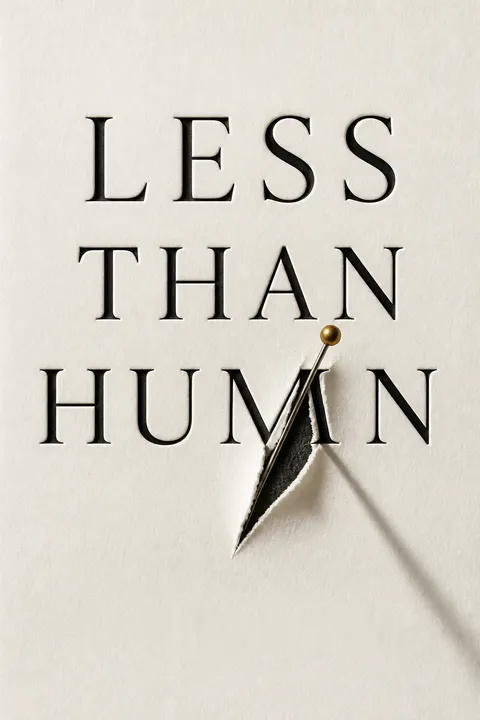


Key Takeaways
Atrocity begins when a neighbor is recast as a counterfeit human.
More than an insult. Dehumanization means conceiving of people as subhuman creatures, not simply disliking them, stereotyping them, or treating them cruelly. The distinction matters because it changes what seems permissible: harming a person feels wrong, while killing a supposed pest can seem necessary. In one account from Gaza, Israeli soldiers taunted Palestinian children as animals before shooting them. Hamas figures described Israelis as foxes to be hunted. The opposing groups used different justifications, but both cast human enemies as something less than human.
A common human risk. Smith argues that this is not a pathology unique to Nazis or any one nation. Allied soldiers, Japanese soldiers, enslavers, colonists, and perpetrators of genocide have all used this way of thinking. The danger lies partly in how ordinary it can feel to those who adopt it.
What's striking is the book's insistence that dehumanization is a judgment about what someone is, not merely a weapon used to hurt them. That distinction helps explain why polite language can coexist with brutality, and why a person may sincerely see violence as justified. It also cautions against treating the perpetrator as a monster outside the human community. That response offers emotional distance, but it repeats the same boundary-making move the book asks readers to examine.
Watch stereotypes harden into inherited, quasi-biological kinds.
Essence beneath appearance. Psychological essentialism is the intuitive belief that members of a kind share an unseen core that makes them what they are. Smith argues that people often apply this thinking to racial and ethnic groups, even though familiar racial categories do not map cleanly onto biological divisions. He calls such groups ethnoraces: populations imagined to share a heritable essence. Skin color may signal that essence, but it need not define it.
Janie's forced category. Lillian Smith recalled befriending Janie, a girl who looked white, then learning that officials classified her as Black and sent her away. The child’s appearance did not override the presumed identity beneath it. Such classifications also shift across time and place. Native Americans, for instance, were described differently as relations between settlers and Indigenous communities changed.
The distinction between the changing content of racial categories and the persistent habit of essentializing them is analytically useful. It explains how a category can be socially constructed and still feel like a biological fact to those using it. The account should not be mistaken for proof that racial thinking is fixed or universal in exactly the same form. The book's own examples show that institutions and historical power shape who gets classified, and what consequences follow.
Treat vermin metaphors as warning signals, not harmless decoration.
Language reveals a judgment. Political language often compares enemies to animals, parasites, or disease. Smith argues that such descriptions can express more than a colorful insult: they can reflect a belief that a group is literally beneath humanity. In Nazi Germany, Jews were repeatedly represented as rats and carriers of infection. Before the 1994 Rwandan genocide, propaganda called Tutsis cockroaches. In both cases, the image suggested a contaminant that should be removed.
Look at the target. The animal matters. A group portrayed as a predator is framed as a threat that must be fought; a group cast as vermin is framed as filth to be exterminated. These descriptions turn collective violence into apparent self-defense or sanitation, making further explanation seem unnecessary.
Metaphor analysis is valuable because it catches a shift in moral framing before a policy is openly described as extermination. Still, rhetoric alone does not cause mass violence. Political organization, coercive institutions, conflict, and access to weapons shape whether language becomes action. Treating every animal comparison as an imminent atrocity would blur meaningful differences. The more useful warning is cumulative: dehumanizing language becomes especially consequential when it accompanies exclusion, threats, and organized permission to harm.
Dehumanization can make cruelty feel like duty rather than wrongdoing.
Three routes to moral disengagement. Moral disengagement is the process by which people suspend the restraints that would usually inhibit harming others. Psychologist Herbert Kelman identifies three conditions that help: authority can authorize violence, routine can make it feel like ordinary work, and dehumanization can remove the victim from the circle of moral concern. These forces appeared in institutions from Nazi medical programs to Abu Ghraib.
A laboratory test. In an experiment by Albert Bandura and colleagues, students believed they could shock people whose performance they supervised. Students who heard the targets described in animalistic terms punished them more harshly than those who heard humanizing descriptions. The study suggests that labels can alter behavior, even when the situation offers no good reason to escalate punishment. It does not show that words alone explain atrocities.
The account links social psychology to institutional design: responsibility is easier to evade when orders come from above, tasks are fragmented, and victims are described as undeserving of concern. That connection is more illuminating than blaming violence on a handful of unusually cruel personalities. The laboratory experiment is suggestive, not a miniature genocide. Real-world violence involves relationships, incentives, and power that a controlled study cannot reproduce. Its strength is narrower: it shows that descriptions can shift the threshold for punishment.
Slavery is social death, not merely ownership of another person.
A person made a thing. Historian Orlando Patterson describes slavery as social death: the enslaved person is treated as someone without recognized standing in the community, rather than as a full participant in it. Ownership matters, but it does not capture the whole injury. Across societies, enslavers used practices also applied to livestock, including chaining, branding, and whipping. Some legal systems explicitly grouped enslaved people with animals.
The category shapes treatment. Frederick Douglass recalled being inspected and valued alongside horses, sheep, and pigs. The comparison was not just a metaphor; it organized how people were bought, controlled, and denied rights. Smith argues that this kind of treatment is easier to sustain when the enslaved are imagined as a lesser kind of human, or as animals in human form.
Social death draws attention to the relationships that make personhood effective: recognition, rights, and membership, not just inner qualities. That perspective helps explain why legal emancipation alone cannot instantly undo the social systems built around enslavement. It also invites care with analogy. Contemporary forms of buying and selling people or labor may share particular features with slavery without being identical to historical chattel slavery. The concept is strongest when it clarifies a specific denial of social standing.
Genocide often frames extermination as sanitation and moral repair.
Killing recast as cleansing. In many genocides surveyed by Smith, perpetrators depicted a targeted population as an infection threatening the body of society. During the Holocaust, Nazi leaders described Jews as disease carriers and presented mass murder as a duty to protect Germany. In Rwanda, propaganda compared Tutsis to insects and urged their removal. During the genocide of the Herero in German South-West Africa, a German commander argued that war against people he considered nonhuman could not be conducted humanely.
The image changes the action. If a population is treated as a contaminant, killing can be made to look like public hygiene rather than murder. Such ideas do not operate alone: governments, armed groups, and local institutions turn them into organized violence. The language helps make that violence seem legitimate to perpetrators and bystanders.
The sanitation theme reveals how moral language can be turned inside out: an act of mass destruction is presented as the defense of health, purity, or civilization. This framing may also help explain why perpetrators can describe themselves as decent while participating in atrocity. Yet no single metaphor accounts for why a genocide begins, or why particular people are targeted. The historical cases point to a partnership between ideology and political machinery, rather than a self-sufficient power of propaganda.
Human war turns inherited aggression into a cultural institution.
Chimpanzees raid, humans ritualize. Chimpanzees sometimes form groups that enter neighboring territories and kill isolated members. At Tanzania's Gombe National Park, conflict between the Kasekela and Kahama chimpanzee communities ended with Kahama's destruction. Smith compares this with raids by the Yanomamö of Brazil and Venezuela, who plan attacks within a network of social rules, rituals, and beliefs.
Similarity is not identity. Chimpanzee raids may illuminate a primate disposition toward violence against outsiders, but they are not equivalent to human war. Human groups can make alliances, define enemies through shared ideas, and prepare violence through elaborate cultural practices. Smith suggests that biological aggression may be a starting condition, while culture gives it human forms. The evolutionary account is a hypothesis, not a settled explanation of war's origins.
The comparison avoids two easy mistakes: pretending humans have no animal inheritance, and treating animal behavior as a direct template for human institutions. Its emphasis on culture matters because planning, ritual, and alliances give violence a social meaning beyond immediate aggression. The origin story remains speculative, as the author acknowledges. Similar behavior in related species cannot by itself establish a specific evolutionary pathway. The comparison is most useful as a reminder that predispositions constrain behavior without dictating its political form.
Killing can exhilarate a person and wound them at once.
Violence has two faces. Accounts from combatants describe the excitement and pleasure that can accompany killing. Others describe guilt, nausea, trembling, and lasting psychological distress. Smith calls the resulting tension an ambivalence, not simple hypocrisy: people can feel both impulses. Some soldiers hesitate to fire, while others experience the rush of combat; the same person may encounter both.
Moral injury. Psychiatrist Jonathan Shay and others use this term for psychological damage caused by perpetrating, failing to prevent, witnessing, or learning about acts that violate deeply held moral beliefs. A study of nearly 3,000 U.S. soldiers cited in the book found that those who reported killing in combat also reported more psychological symptoms. This association does not mean every soldier is affected in the same way, or that killing is the only source of trauma.
This tension complicates the popular picture of the perpetrator as either a remorseless monster or an innocent instrument of command. It allows for pleasure, social pressure, fear, and conscience to coexist without making them morally equivalent. The concept of moral injury also shifts attention from diagnosis alone to the meaning of an action within a person's moral world. Care is needed not to generalize from selected accounts or to treat distress as proof of virtue; people respond differently, and responsibility remains relevant.
Study how a story enlarges, or shrinks, the circle of humanity.
Stories move moral boundaries. Philosopher Richard Rorty argues that accounts of suffering can expand sympathy by helping people imagine the lives of strangers. Smith agrees that moral concern cannot be secured by abstract reasoning alone, but warns that emotionally powerful stories can also fuel hatred. Serbian leaders, Nazis, and Rwandan propagandists each presented their own community as endangered and their opponents as existential threats.
Knowledge is not a cure. Smith argues that research into dehumanization is necessary to identify how it works and how it might be resisted. But scientific knowledge can also be used to train people to see enemies as inferior. Understanding the mechanism does not guarantee humane action. It offers tools that can be used for prevention or for more effective violence, depending on political choices.
The challenge is not to replace emotion with data, but to make both answerable to evidence and to the people excluded from a story. A narrative of shared suffering can broaden concern, while a story of threatened innocence can narrow it and license retaliation. This is a useful corrective to the idea that empathy is automatically virtuous. The book's emphasis on research is persuasive, but research cannot choose its own ends. Prevention also depends on institutions willing to act when exclusion and organized harm become visible.
Analysis
The book's central contribution is a precise boundary around a word often used loosely. Dehumanization is not any form of disrespect, depersonalization, or cruelty. It is the belief that people who look human lack the essence that makes them human and belong instead to a threatening, lower kind. This definition connects familiar rhetoric to the moral permission structures that can support slavery, war, and genocide.
The argument's strongest move is to join levels of explanation without reducing one to another. Cultural history supplies the specific targets and stereotypes. Psychology explains why essence-based categories can feel more real than visible evidence. Institutions and propaganda mobilize those intuitions. The historical cases make clear that dehumanization is not a single cause of atrocity, but one mechanism that can help violence seem permissible, even virtuous.
The framework also has limits. Its extension of racial essentialism to diverse forms of group identity is illuminating, but risks making race so broad that distinct histories become harder to distinguish. The proposed evolutionary story, linking primate aggression, language, and the emergence of human kinds, is explicitly conjectural. And although the account explains how people may disengage morally, it does not supply a tested intervention that reliably prevents this process.
Those limits sharpen rather than erase the book's practical value. Its framework encourages close attention to who is described as a threat, what hidden nature is attributed to them, and which institutions make exclusion consequential. It also warns that awareness is not immunity. Condemning past perpetrators as inhuman can reproduce the same logic, while emotional appeals can mobilize either solidarity or vengeance. Understanding the mechanism is a necessary beginning, not a substitute for political judgment or action.
Review Summary
Less Than Human explores why humans dehumanize others, drawing on history, philosophy, and science. While praised for tackling an important topic, some reviewers found it repetitive or lacking in solutions. The graphic descriptions of atrocities were difficult for many readers. Some criticized the author's perspective as privileged or hypocritical regarding animal treatment. Overall, the book is seen as thought-provoking but uncomfortable, raising more questions than it answers about the human capacity for cruelty and the mechanics of dehumanization.
People Also Read






Glossary
Dehumanization
Seeing people as subhumanSmith uses dehumanization to mean conceiving of people as subhuman creatures rather than as human beings. It is a psychological judgment, not simply a form of cruel treatment, an insult, or a failure to recognize someone's individuality. The belief can make violence seem permissible by placing its targets outside ordinary human obligations.
Psychological essentialism
Belief in hidden group essencesPsychological essentialism is the intuitive belief that members of a natural kind share an unseen, stable feature that makes them what they are. This essence is assumed to explain typical traits and to persist despite changes in appearance. Applied to social groups, it can make ethnicity or race seem inherited, fixed, and informative about a person's character.
Ethnoraces
Essentialized social groupsEthnoraces are populations imagined to share a heritable essence that makes them a distinct kind of people. Smith uses the term because essentialist group thinking can attach not only to conventional racial categories, but also to ethnic, national, religious, or political identities. The category reflects how a group is conceived, not whether it has a clear biological basis.
Cultural pseudospeciation
Cultures treated as separate speciesErik Erikson's term for the tendency of human groups to develop distinctive identities and regard themselves as uniquely human or superior. The groups are not biological species, but may be treated as if they were separate kinds of beings. Smith distinguishes this group-making tendency from dehumanization, which further casts an outside group as subhuman.
Moral disengagement
Suspending restraints against harmMoral disengagement describes how people set aside the usual restraints against harming others. Smith discusses authorization by leaders, routinization that makes violence feel like ordinary work, and dehumanization that excludes victims from moral concern. These processes can operate together, reducing a perpetrator's sense of personal responsibility or guilt.
Social death
Exclusion from human standingOrlando Patterson's term for the condition of slavery understood as the denial of a person's recognized social membership and standing. An enslaved person may be treated as property and excluded from ordinary rights and relationships. Smith uses the concept to show that slavery involves more than legal ownership: it depends on making a person socially legible as a nonperson.
Moral injury
Damage from moral transgressionMoral injury is psychological harm associated with perpetrating, failing to prevent, witnessing, or learning about acts that violate deeply held moral beliefs. In the book, the term helps describe distress among people involved in combat and other violence. It is distinct from a simple measure of exposure to danger, though the experiences may overlap.
Great chain of being
Hierarchical order of lifeThe great chain of being is an older worldview that ranks existence from supposedly lower forms, such as matter and plants, up through animals and humans toward the divine. The ranking combines claims about what beings are with judgments about their worth. Smith argues that the idea of subhumanity depends on this kind of hierarchy.
Outgroup homogeneity bias
Seeing outsiders as more alikeOutgroup homogeneity bias is the tendency to see members of an outside group as more similar to one another than members of one's own group. Smith treats it as a contributor to stereotyping and group-based hostility, but not as sufficient by itself for dehumanization. A person can stereotype or denigrate another group while still recognizing its members as human.
About the Author
Other books by David Livingstone Smith

Download PDF
Download EPUB
.epub digital book format is ideal for reading ebooks on phones, tablets, and e-readers.








