

Key Takeaways
Keep measurement powerful without letting it define everything real
A revolution in knowing. In the seventeenth century, science made the world increasingly measurable, explaining physical processes and enabling technologies that earlier generations could scarcely imagine. The change was not simply new knowledge. It shifted attention from qualities, such as beauty or purpose, toward quantities that could be measured and used. Lachman calls the resulting dominance the reign of quantity. Its successes are real, but so are its limits: an abstract model can describe selected features of a living world without capturing everything people experience in it.
When method becomes creed. Scientism is the assumption that scientific methods can resolve every kind of question. Applied to love, meaning, or value, measurement may clarify some aspects while missing what makes them matter. The danger is not science itself, but treating its useful abstractions as the whole of reality. A universe that is described only in measurable terms can seem comprehensible yet purposeless, leaving people feeling unmoored.
The distinction between a method and a worldview is crucial. Measurement is powerful partly because it deliberately leaves out context, purpose, and felt experience. Trouble begins when those omissions are mistaken for proof that the omitted dimensions are unreal. This resembles the difference between a map and a territory: a precise map supports navigation, but no map contains the full life of a place. The critique is strongest when aimed at overclaiming, not at scientific inquiry. Scientific models can also reveal relationships and complexity, so the meaningful question is what a model explains, and what its design cannot address.
Use analysis and intuition as partners, not rival authorities
Two modes of knowing. Blaise Pascal distinguished the spirit of geometry, which reasons through definitions and steps, from the spirit of finesse, which recognizes patterns or meaning intuitively. The first can show how to solve an equation. The second helps people recognize beauty in music or grasp a social situation before they can explain why. Neither is a substitute for the other.
Knowledge beyond explanation. Michael Polanyi's term tacit knowing describes skills people can use better than they can verbalize. Riding a bicycle is an everyday example: a rider balances and adjusts without calculating each movement. Such knowledge is not automatically correct, but it is real and often essential. Lachman argues that intellectual life suffers when only explicit, measurable reasoning is treated as legitimate, while intuition is dismissed as mere feeling.
The contrast captures a practical feature of expertise: rapid judgment often rests on patterns learned through experience, while explicit reasoning can test and communicate those judgments. Research on skilled performance likewise distinguishes intuitive recognition from deliberate analysis, though intuition is more reliable in some environments than others. A chess expert may read a familiar position well; a confident guess in an unfamiliar, noisy situation may be worthless. The useful lesson is therefore not to trust every hunch, but to pair intuition with checks suited to the task. Analysis can audit a first impression, and intuition can alert analysis to what its categories overlook.
Treat imagination as a way of knowing, not an escape from reality
A faculty of contact. Lachman adopts a definition of imagination as the ability to grasp realities that are not immediately present. That includes picturing a possible future, sensing the significance of a landscape, or understanding what another person may be experiencing. Imagination can certainly produce fantasy, but its central role in this book is not to flee the real. It helps people perceive more of it.
Fantasy is not creation. Samuel Taylor Coleridge distinguishes imagination from fancy. Fancy rearranges materials already gathered through experience, like combining familiar features into an invented creature. Imagination, by contrast, can reorganize perception into a genuinely new understanding. The book's title refers to this neglected capacity: imagination as a source of knowledge, not just a workshop for make-believe. Its products still need judgment; vividness alone cannot establish truth.
Imagination is indispensable to ordinary reasoning, not merely to art. People use mental simulation to anticipate consequences, interpret incomplete information, and consider how a situation looks from another perspective. That makes imagination a cognitive tool with both constructive and distorting potential. The book's strongest move is to reject the false choice between imagination and reality. Its more controversial move is to treat some imaginative experiences as evidence of realities beyond the mind. Those claims call for standards of evaluation, since psychological vividness can explain why an experience matters without proving that its apparent source exists independently.
Read metaphor as evidence of how people inhabit a world
Words carry perception. The philosopher Owen Barfield studies how language changes over time. Words that now name abstract experiences often began with physical meanings: inspiration, for instance, is linked to breathing. Such histories suggest that thought is shaped by bodily life and by the metaphors people inherit. Language does not merely label a ready-made world; it can influence what people notice and how they experience it.
A participatory past. Barfield calls the earliest human relation to nature original participation: a condition in which people did not experience themselves as sharply separate from the world around them. He proposes that language and consciousness gradually shifted toward a more detached, literal outlook. Lachman presents this as a philosophical account, not a proven reconstruction of prehistory. Poetry can offer a modern echo of participation by making familiar things feel newly meaningful.
Metaphor is not decorative frosting on thought. Cognitive linguistics has shown how spatial and bodily language structures abstract concepts, making Barfield's attention to words especially fertile. His larger historical claim is harder to establish: figurative language does not by itself prove that early communities experienced nature as alive or spiritually infused. Still, the framework is useful without being taken literally. It invites readers to notice how habits of speech shape attention, and how a change in description can change what feels possible, valuable, or worthy of care.
Observe nature until patterns emerge, rather than forcing it into parts
Goethe's alternative science. Goethe wanted to study nature rigorously without reducing living things to isolated mechanisms. During his travels in Italy, he searched for the Urpflanze, or primal plant, a generative pattern he believed could help explain the many forms plants take. He thought careful observation of plants through their growth would make this pattern perceptible to an attentive observer.
Seeing actively. Goethe called this approach active seeing. It combines sustained observation with imagination, allowing the observer to follow a living process rather than freeze it into separate snapshots. His earlier study of Strasbourg Cathedral illustrates the method: after close attention to its form, he inferred the design principle behind its structure. Goethe did not argue that measurement was useless. He sought a complementary way to understand nature as an unfolding whole, with the observer involved in the act of knowing.
Goethe's method has a clear modern analogue in field science, where repeated observation can reveal patterns that a single measurement misses. It also anticipates a central methodological question: how much does an observer's framework shape what becomes visible? Attentive participation may generate insight, but it can also encourage projection. Goethe's observations are most persuasive when they produce claims that can be checked against the plant or structure itself. His approach is best understood as disciplined attention informed by imagination, not as a license to treat intuition as proof.
Explore inner experience carefully, without confusing vividness with truth
Jung meets an inner world. After breaking with Sigmund Freud, Carl Jung experienced intense dreams and visions, including a catastrophic flood that seemed to anticipate the First World War. He deliberately engaged with these images and encountered figures such as Philemon, whom he came to regard as possessing a life independent of his conscious self. Jung called this realm the objective psyche.
A reality between realities. Henry Corbin's Imaginal World names an intermediate order of reality, distinct from both physical objects and abstract ideas. Drawing on the Persian philosopher Suhrawardi, Corbin treats visionary experience as a possible mode of perception, not simply as fantasy. But the book also emphasizes discernment: imagination can wander into subjective invention. A powerful image may invite interpretation, yet its intensity alone does not establish that it reveals an independent spiritual world.
Taking inner experience seriously need not mean accepting every interpretation of it. Clinical psychology can recognize dreams and visions as psychologically consequential without deciding whether their figures exist outside the experiencer. That distinction protects both openness and rigor. Corbin's proposal adds a more ambitious possibility, that some images disclose a distinct mode of reality, but the book offers no generally accepted test for separating such disclosure from projection. A careful reader can still use the material fruitfully: ask what an image means, what it changes, and what independent reasons support claims about its source.
Protect beauty and symbolic art from a culture of mere novelty
Form holds experience together. Erich Kahler argued that artistic form expresses coherence between a person and the surrounding world. He worried that modern art's deliberate incoherence reflected a wider erosion of meaning. Kathleen Raine similarly saw a culture increasingly indifferent to beauty, and argued that art can remind people of an order richer than material facts alone.
Tradition as imaginative learning. For Raine, poetry and myth preserve symbols that can change how readers perceive. Her studies of Blake and Yeats connected their work to older philosophical traditions, including Platonism. Thomas Taylor, an eighteenth-century translator of Plato and Neoplatonist writers, helped make those ideas available to Blake, Coleridge, and other poets. The claim is not that every new artwork is empty, but that art loses something when shock or novelty becomes its only measure.
The link between artistic form and social coherence is suggestive: shared symbols can give people ways to recognize experiences that private language cannot easily hold. Yet judgments about cultural decline can mistake unfamiliar styles for evidence of collapse. Art that initially appears disruptive may later become legible, and beauty is not confined to inherited traditions. The durable insight is less a defense of any particular canon than a demand to ask what an artwork enables people to perceive. Does it deepen attention, reveal structure, or make experience more intelligible, rather than merely advertise its own novelty?
Imagine responsibly: shared worlds are shaped by what people attend to
Imagination has consequences. Lachman argues that imagination participates in the making of the experienced world. Wordsworth and Coleridge helped change how readers saw mountains: landscapes that Samuel Johnson had regarded as obstacles came to be valued as sources of beauty and reflection. That shift affected travel and attitudes toward preserving nature. The mountains did not need to change physically for their human meaning to change.
A discipline, not a panic. The book calls for responsibility toward imagination because images and values can shape choices, institutions, and environments. This is not a claim that every private thought magically alters external events. It is a reminder that repeated ways of seeing guide what people build, protect, or ignore. The needed balance is neither unrestrained fantasy nor analysis alone, but imagination joined to judgment and attention.
The mountain example makes a plausible social mechanism concrete: art changes attention, attention influences preference, and preference can affect economies and conservation. This is a more defensible account of imagination's world-making power than the stronger metaphysical claim that consciousness directly creates physical reality. It also gives the argument ethical force without demanding anxiety about every passing thought. Cultural images matter most when they become shared assumptions and guide collective decisions. The practical question is not whether imagination controls the world, but which visions are being amplified, and what forms of life those visions make easier to support.
Analysis
The book's argument is a sustained attempt to restore imagination to the status of a cognitive faculty. It does not ask readers to reject science. Instead, it challenges the assumption that measurable knowledge exhausts reality, and proposes that analysis and intuitive understanding are complementary ways of engaging with the world. Its narrative moves from the rise of modern science, through debates about perception and language, to Goethe's natural observation, Jung's inner visions, and the poetic traditions associated with Blake, Yeats, and Coleridge. This sequence makes an abstract claim tangible: different ways of knowing produce different experienced worlds.
The most compelling contribution is the insistence that imagination is already active in ordinary perception. Metaphor, skilled intuition, artistic attention, and the ability to see a landscape as meaningful all show that knowing is not merely passive data collection. The account also gives imagination an ethical dimension. If perception influences what societies value, then habits of attention help shape institutions and environments.
The argument is less secure when it moves from this defensible account of perception to claims about an independent Imaginal World or a participatory spiritual history of humanity. The book offers vivid testimony and philosophical parallels, but these do not settle whether visionary figures exist independently of the psyche, or whether early people literally experienced nature as ensouled. That distinction matters. Psychological meaning and metaphysical truth are related questions, not identical ones.
The strongest reading therefore treats the book as both a philosophy of attention and an invitation to metaphysical possibility. Its practical lesson does not depend on accepting every esoteric claim: measurement is powerful but partial; imagination can disclose relationships that analysis misses; and intuitive insight deserves both openness and scrutiny. The book's own ideal is not a return to premodern belief, but a creative partnership in which critical thought checks projection while imagination keeps thought connected to lived significance.
Review Summary
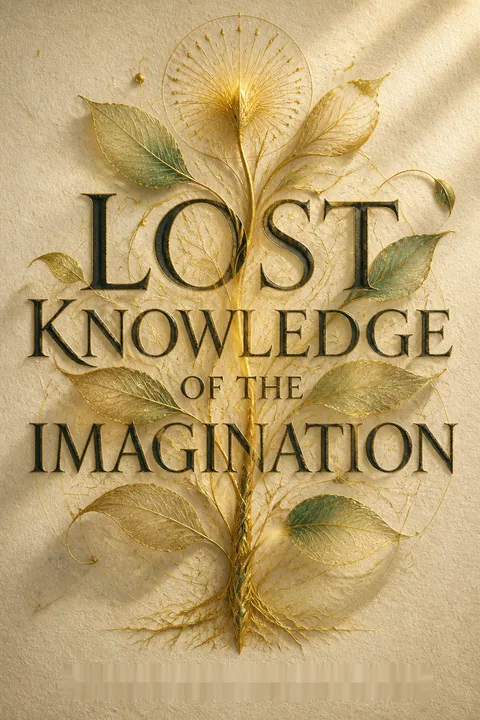
Lost Knowledge of the Imagination receives mostly positive reviews, praised for its exploration of imagination as a way of knowing distinct from scientific rationalism. Readers appreciate Lachman's synthesis of various thinkers and his argument for rehabilitating imagination's role in perception and creativity. Some find it dense but insightful, offering a counterpoint to materialist worldviews. Critics argue it caricatures science and has hidden far-right leanings. Most reviewers recommend it for those interested in consciousness, philosophy, and alternative ways of understanding reality.
People Also Read



Glossary
spirit of geometry and spirit of finesse
Analytical and intuitive knowingPascal's distinction between two modes of understanding. The spirit of geometry proceeds through definitions, steps, and explicit reasoning, making it suited to mathematics and clearly bounded problems. The spirit of finesse grasps relationships or meanings intuitively, especially in matters that resist exact definition, such as beauty, love, or freedom. Lachman argues that mature understanding needs both.
original participation
An undivided human-world relationOwen Barfield's term for a proposed early mode of consciousness in which people did not experience themselves as fully separate from nature. In this account, meaning was perceived as present both in the human perceiver and in the surrounding world. Barfield links the gradual loss of this relation to the development of more literal language and a sharper division between subject and object.
final participation
Conscious reconnection through imaginationBarfield's term for a renewed experience of participation in the world that differs from an unconscious, earlier unity. Through imagination, especially in poetry, a person can experience the connection between self and nature while remaining aware of that experience. It is not simply a return to an earlier state, but a conscious re-engagement with a world once treated as wholly external.
Imaginal World
An intermediate order of realityHenry Corbin's name for a realm that is neither physical matter nor abstract thought. Corbin treats it as a distinct order of being, encountered through forms of visionary or spiritual perception. The term distinguishes this proposed reality from the merely imaginary, which is usually understood as private invention. Lachman presents the idea as central to traditions explored by Corbin, Jung, and Suhrawardi.
active seeing
Imaginative, sustained observationGoethe's approach to observing nature through prolonged attention combined with imaginative reflection. Rather than isolate an object from its development and context, the observer follows its changing forms and seeks the organizing pattern within them. The approach treats perception as an active contribution to knowledge, while still requiring close attention to the phenomenon being observed.
esemplastic power
Imagination's power to unifyColeridge's term for imagination's ability to bring separate elements into a meaningful whole. Unlike fancy, which rearranges materials already gathered through experience, esemplastic imagination shapes them into a new perception or understanding. The term captures the book's central claim that imagination can produce knowledge by revealing relations among things, rather than merely inventing novel combinations.
responsibility of the imagination
Care for imagination's effectsThe obligation to recognize that imagination can shape individual choices and shared perceptions, rather than treating it as harmless private entertainment. In Lachman's account, imaginative freedom needs discernment and discipline: fantasy can distort, while attentive imagination can deepen understanding. The responsibility is not to fear every thought, but to consider which images and ideals are being cultivated and what actions they encourage.
About the Author
Other books by Gary Lachman



Download PDF
Download EPUB
.epub digital book format is ideal for reading ebooks on phones, tablets, and e-readers.








