

Key Takeaways
See occultism as a counter-history to scientific materialism
A changing boundary. The book argues that occultism became a distinct, marginal category as scientific reason rose to define legitimate knowledge. Older pursuits such as alchemy, astrology, and Hermetic philosophy had once attracted serious attention. In 1460, Cosimo de' Medici directed Marsilio Ficino to translate newly found Hermetic writings instead of Plato. Isaac Newton, later celebrated as a founder of modern science, devoted extensive effort to alchemy and biblical study.
What progress displaced. Scientific methods brought enormous gains, but the author argues that treating measurement as the only route to truth also pushed questions of inner life, value, and meaning aside. Writers and artists turned to occult traditions for an alternative account of human experience, not always because they accepted every supernatural claim, but because those traditions supplied symbols and ideas that materialism could not.
What's striking is that the book treats occultism not simply as a collection of unusual beliefs, but as a category created by changing standards of credibility. That distinction helps readers understand why the same practice could once be respected and later dismissed. The argument is strongest when aimed at scientism, the assumption that scientific methods explain every dimension of existence, rather than at science itself. The distinction matters: criticism of a worldview's limits need not reject its demonstrated strengths.
Read correspondences as bridges between matter and meaning
A world of signs. Emanuel Swedenborg's idea of correspondences holds that physical things express or reflect spiritual realities. The visible world is not independent of the invisible one, but connected to it through meaningful relationships. Swedenborg applied this idea to the human body: the face, speech, and posture could reveal qualities of the inner person, while the human being could be understood as a small-scale image of a larger spiritual order.
A poet's revision. Charles Baudelaire adapted this idea into a more open-ended artistic method. Nature's colors, sounds, and scents could suggest a deeper unity, but their meanings were not fixed like entries in a dictionary. For the poet, perception becomes an act of interpretation: a landscape or sensation can prompt associations that ordinary literal description might miss.
Correspondence gives the book a useful model for how artists turn perception into interpretation. It also explains why occult thought mattered to Symbolist poetry: objects could carry emotional or spiritual resonance beyond their practical use. The method works especially well as an invitation to notice patterns and associations. Its limit appears when every resemblance is treated as proof of a hidden cosmic system. Ambiguity can enrich a poem, while the same ambiguity makes a claim about objective reality difficult to test.
Treat imagination as a way of knowing, not mere escape
The Romantic reversal. William Blake and the Romantics resisted the view that imagination merely decorates reality. They treated it as a powerful human faculty that could disclose dimensions of experience overlooked by the senses alone. Goethe's early engagement with alchemy accompanied his broader interest in transformation, while Novalis turned inward, seeking a spiritual world through memory, longing, and dream.
Keep one foot here. E.T.A. Hoffmann offered a more balanced artistic model in what the book calls the serapiontic principle: imaginative or spiritual experience becomes convincing when it is anchored in recognizable everyday life. His stories let the uncanny intrude into ordinary settings instead of abandoning the ordinary altogether. Imagination, on this account, is not an excuse to evade reality; it is a way to perceive it differently.
The distinction between escape and expanded perception is central to the book's account of Romantic art. Hoffmann's method is particularly persuasive because it lets readers feel the tension between ordinary explanations and imaginative possibilities without forcing a verdict. This is also a useful standard for evaluating visionary writing: does it transform how the familiar world is seen, or merely replace it with private fantasy? Artistic power can establish emotional truth, but it cannot by itself establish supernatural fact.
Follow the occult from public reform into private inner worlds
Enlightenment ambitions. Some eighteenth-century occultists connected spiritual knowledge to hopes for social renewal. Mesmer's followers organized societies around his theory of animal magnetism, a subtle force believed to move through the universe and affect health. Cagliostro promoted an Egyptian form of Freemasonry that admitted women and Jews, presenting it as a path toward human regeneration.
A turn inward. Adam Weishaupt's Illuminati complicates the picture. Weishaupt was a rationalist who used the secrecy and hierarchy of Masonic organizations to advance political reform, despite opposing mysticism. After the French Revolution's violence and the rise of the Terror, many Romantic writers became less confident that society could be transformed through political schemes. The struggle shifted toward the mind, imagination, and individual consciousness.
The shift from social projects to inward exploration makes the book's chronology feel consequential rather than merely biographical. Secret organizations offered community and a means to imagine change, but their secrecy and hierarchy could reproduce the very power structures they opposed. Weishaupt's rationalist Illuminati makes that contradiction unusually visible. The inward turn offered artists a less direct route to freedom, though it also risked treating private transformation as a substitute for addressing public conditions.
Use occult symbols to make invisible experience artistically legible
Words as instruments. The book traces a strong connection between magic and writing. Rituals depend on correctly spoken words, while Kabbalistic traditions attach layered significance to letters and names. For poets, this creates a powerful analogy: language can do more than describe an experience; rhythm, image, and sound can alter how that experience is felt.
From spell to poem. Eliphas Levi described the magician's imagination and will as forces that could shape perception. Baudelaire and Arthur Rimbaud brought related ideas into poetry. Rimbaud linked vowels with colors and sought to push language into unfamiliar territory, imagining the poet as a visionary who breaks habitual perception. The book presents these practices as artistic experiments rooted in occult thought, not as proof that poems literally control nature.
The artist-magician analogy helps explain why occultism became more than a subject for writers: it offered a theory of what art itself might do. A poem can redirect attention, intensify sensation, and give form to what was difficult to name. Those effects are real without requiring a supernatural mechanism. Keeping that distinction clear preserves the force of the analogy while avoiding a common confusion, in which the emotional power of a symbol is mistaken for evidence that its hidden cosmology is true.
Romantic longing can enlarge perception and destabilize ordinary life
The ache of distance. German Romantics used Sehnsucht to describe an intense, often unattainable longing for something beyond ordinary life. Novalis made this longing central to his poetry. After his young fiancée Sophie died, he described a visionary experience at her grave and transformed grief into a mystical search for union beyond death.
When longing takes over. The same desire for another reality could become dangerous when everyday life lost its claim. Gerard de Nerval built a private mythology around his identity and pursued visionary experience; his later life included repeated mental crises. Hoffmann provides a counterweight: his art keeps the ordinary world in view even as it admits the fantastic. The contrast suggests that longing can deepen art, but abandoning the shared world entirely may leave a person without a stable point of return.
Sehnsucht names a tension many readers recognize: the sense that immediate life is real, yet incomplete. The book shows how that tension can generate art without making suffering itself a virtue. Novalis's grief became a source of poetry, while Nerval's imaginative life became increasingly difficult to separate from crisis. The distinction is important. A work can preserve the intensity of an altered or idealized experience, while the person's biography reminds readers that aesthetic meaning and psychological safety are not the same thing.
Notice when rebellion against convention turns suffering into spectacle
Darkness as a style. Baudelaire explored corruption, taboo, and ugliness not simply to celebrate them, but to confront what respectable society preferred to ignore. Rimbaud pushed rebellion further, deliberately disrupting his senses in pursuit of visionary perception. In A Season in Hell, he examined the damage and exhaustion of that experiment, then abandoned poetry while still young.
Real costs beneath the pose. J.K. Huysmans immersed himself in accounts of Satanism and occult practice while searching for an escape from what he saw as the squalor of modern life. Valery Briusov made a more troubling spectacle of occult power: his literary life entangled with destructive relationships, and women in his circle died by suicide. The book distinguishes symbolic rebellion from harmful conduct, even as it shows how easily the two can blur.
The section resists the easy idea that transgression is automatically liberating. Baudelaire's attention to moral ugliness can expose hypocrisy, while Rimbaud's self-disruption and Briusov's treatment of others reveal the costs of making danger into an aesthetic ideal. This is a useful distinction for readers drawn to extreme art: the work may transform disturbing material into insight, but the artist's suffering or cruelty should not be treated as proof of depth. Style can challenge conventions without excusing harm.
Separate transformative experience from evidence of supernatural claims
Experience and explanation. The book recounts people who interpreted unusual states as contact with a hidden reality. R.M. Bucke described a sudden experience of unity and joy, then argued that humanity was evolving toward cosmic consciousness, a higher form of awareness. August Strindberg interpreted coincidences and visual distortions during a period of illness as signs of unseen forces. Their experiences shaped their lives and writing, but the interpretations differ in how much they claim to establish.
A necessary distinction. The author places visionary episodes alongside occult theories, literary works, and accounts of mental distress. That range makes the history vivid, but it does not make every explanation equally reliable. A person can undergo a powerful, life-changing experience without that experience proving the existence of spirits, hidden masters, or a new dimension.
This distinction protects two things at once: respect for the person who reports an experience and care about what the report can establish. The book is most compelling when it treats visions as culturally and artistically consequential, rather than as automatic confirmation of occult doctrine. Strindberg's and Bucke's accounts also show why simple dismissal is inadequate: an experience may reorganize a life even when its cause remains uncertain. Meaningful impact and verified explanation are separate questions.
Modernists used occult systems to rebuild meaning from cultural fragments
A new artistic architecture. As modern writers and artists questioned inherited forms, occult systems supplied structures for connecting scattered experiences. Fernando Pessoa created heteronyms, distinct imagined authors with their own biographies and voices, turning a divided sense of self into a literary method. Andrei Bely drew on anthroposophy in Petersburg, where political unrest, dreamlike perception, and spiritual ideas collide.
A hidden map for a broken world. Malcolm Lowry built Under the Volcano around Kabbalistic imagery, shaping the Consul's final day through a symbolic structure of spiritual decline. Rene Daumal's unfinished Mount Analogue made an arduous mountain journey stand for the pursuit of knowledge. These works do not simply decorate modern life with occult references. They use esoteric patterns to give form to fragmentation, crisis, and the search for coherence.
The modernist examples show occult systems functioning as compositional tools as much as belief systems. A symbolic structure can hold together a fractured narrative, just as Pessoa's invented voices make divided identity productive rather than merely pathological. Such systems can create coherence without resolving the historical disorder that surrounds them. Their risk is the reverse: an elaborate symbolic map may make uncertainty look more settled than it is. The strongest works preserve both the pattern and the unresolved human conflict within it.
Analysis
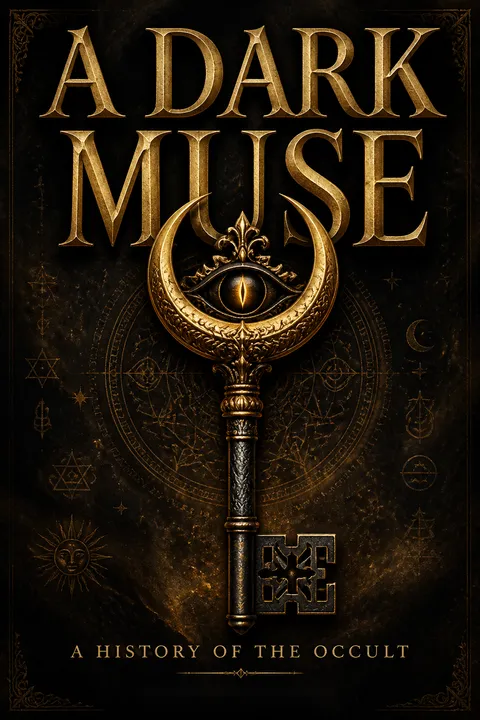
A Dark Muse is best read as a cultural history of occultism's changing role, not as a case for the truth of occult claims. Its central argument is that occult thought became newly marginal as scientific standards gained authority, then offered writers and artists a storehouse of alternatives: spiritual correspondences, hidden dimensions, transformed consciousness, and ways of speaking about meaning that materialist language seemed to exclude. The book's chronological arc matters. Enlightenment occultists often imagined social regeneration; after revolutionary violence, Romantic writers turned toward inner experience; fin-de-siecle artists made occultism part of aesthetic rebellion; modernists used esoteric systems as structures for fractured identities and narratives.
The book's strength is its insistence that literary history and occult history overlap. Swedenborg's correspondences help explain Symbolism, Mesmer's theories become material for fiction, and Kabbalistic structures shape Lowry's novel. The portraits also resist a simple division between fraud and genius. Figures such as Cagliostro, Blavatsky, and Crowley appear as performers, seekers, and cultural forces whose influence cannot be reduced to whether their supernatural claims were true.
The method has limits. Lachman's argument depends heavily on biographical anecdotes and interpretive connections, some of which he marks as speculation. A literary resemblance or a reported vision can demonstrate influence and meaning, but not the existence of the invisible world described. At times, the contrast between science and spirituality also risks making science seem more uniformly reductive than the book's own historical examples warrant. The most durable reading therefore separates three questions: what occultists believed, what artists made from those beliefs, and what evidence supports their claims about reality. That separation does not diminish the subject. It clarifies why the occult mattered, even when its powers remain unproven.
Review Summary
A Dark Muse is generally well-received, praised for its comprehensive overview of occult history and its influence on literature. Readers appreciate Lachman's engaging writing style and the book's focus on lesser-known figures. The book covers various periods of occultism, from Enlightenment to Modernist, and includes selected texts. Some criticize the fragmented structure and lack of depth in certain areas. Overall, it's considered a valuable introduction to the subject, offering insights into the connection between occultism and artistic expression.
People Also Read

Glossary
Occultism
Hidden knowledge traditionsAn umbrella term for traditions and practices concerned with hidden or esoteric knowledge, including alchemy, astrology, Kabbalah, ceremonial magic, and related spiritual philosophies. Lachman argues that occultism, in its modern sense, became marginal as scientific standards of knowledge rose. The book examines both occultists' beliefs and the influence those beliefs had on literature and art.
Correspondences
Links between spiritual and physicalIn Swedenborg's specialized usage, correspondences are relationships through which physical things express or reflect spiritual realities. The visible world is understood as connected to a higher spiritual order, rather than as separate from it. Writers such as Baudelaire adapted the idea into a poetic method, treating sensory details as suggestive signs whose meanings can remain open-ended.
Animal magnetism
Mesmer's universal subtle fluidFranz Anton Mesmer's theory that a subtle physical fluid connects people, the earth, and the stars. He believed illness resulted when this fluid was blocked and that practitioners could encourage its movement through techniques such as mesmeric passes. The theory was rejected by scientific authorities, but it influenced occult thought and literary depictions of altered states.
Serapiontic principle
The fantastic rooted in realityE.T.A. Hoffmann's artistic principle that imaginative or magical experience becomes convincing when connected to the recognizable outer world. Rather than abandoning ordinary life for a wholly private vision, a story lets the uncanny enter familiar settings. The principle describes a balance between realism and imagination that gives supernatural fiction psychological and literary force.
Sehnsucht
Longing for the unattainableA German Romantic term for an intense yearning that has no exact English equivalent. It suggests longing for something beautiful, distant, and perhaps impossible to attain. In the book, Sehnsucht helps explain Romantic attraction to spiritual worlds and idealized love, while also illuminating the risk of finding ordinary life disappointing by comparison.
Astral Light
Occult medium of imagesIn Eliphas Levi's account, the Astral Light is a subtle medium containing images and reflections. It is associated with imagination, dreams, and the magician's will. Levi used the idea to explain how visions might arise and how mesmerism could affect perception. The book presents it as an influential occult theory, not an established scientific finding.
Cosmic Consciousness
Awareness of universal unityR.M. Bucke's term for a form of consciousness he considered higher than ordinary self-consciousness. He described it as an awareness of the life and order of the universe, accompanied by intellectual illumination, moral exaltation, joy, and a sense of immortality. Bucke believed it represented a further stage in human evolution.
Theosophy
Modern esoteric spiritual synthesisThe movement associated in this book with Helena Blavatsky and the Theosophical Society. It combined spiritualist interests with ideas about reincarnation, cosmic evolution, higher consciousness, and hidden masters. Theosophy presented occult knowledge as compatible with a broader account of nature and human development, and strongly influenced fin-de-siecle culture.
Anthroposophy
Steiner's spiritual scienceRudolf Steiner's spiritual system, developed after his separation from the Theosophical Society. It gave greater emphasis to Christian and Western esoteric themes and presented spiritual knowledge as a form of science. In the book, anthroposophy influenced Russian writers, especially Andrei Bely, and informed his symbolic treatment of consciousness and history.
Heteronym
A fully imagined authorial identityFernando Pessoa's term for a literary identity with a distinct biography, personality, and writing style, rather than merely a pseudonym. Pessoa created several heteronyms, including Alberto Caeiro, Ricardo Reis, and Alvaro de Campos. Each allowed him to write from a different outlook, turning a divided sense of self into a deliberate literary practice.
About the Author
Other books by Gary Lachman
Download PDF
Download EPUB
.epub digital book format is ideal for reading ebooks on phones, tablets, and e-readers.








