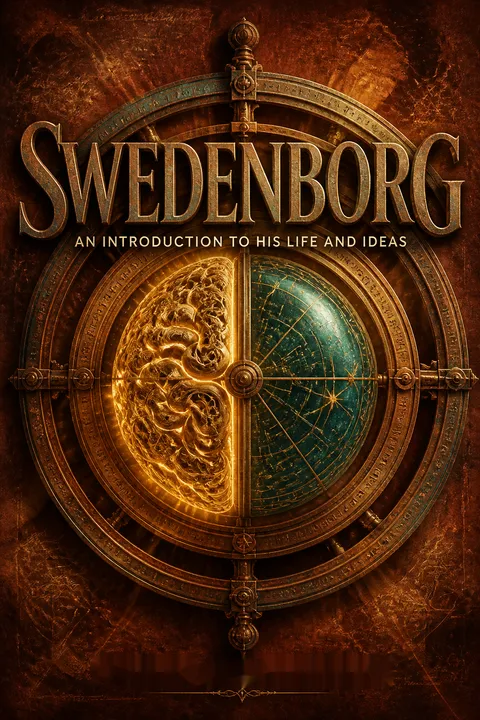


Key Takeaways
Read Swedenborg as a scientist who changed questions, not simply as a mystic.
Two careers, one investigator. Emanuel Swedberg, born in 1688, trained in mathematics, astronomy, medicine, and mechanics. He travelled through Europe to meet scientists, served Sweden’s Board of Mines and Parliament, and designed machines including a submarine and an aircraft. His ambitions were practical as well as intellectual: he wanted useful discoveries and recognition. Yet his deepest interest was always the nature of the soul and the structure of reality.
At fifty-six, after years of scientific work and a profound psychological crisis, he devoted himself to interpreting Scripture and recording journeys into spiritual realms. Lachman presents this not as a simple switch from reason to faith, but as a transformation within one unusually wide-ranging mind. Swedenborg’s story resists the neat labels of inventor, scientist, theologian, or mystic.
What's striking is how much Swedenborg unsettles the modern division between scientific and spiritual lives. In his era, natural philosophy had not yet hardened into today’s professional disciplines, so a single investigator could move from mine engineering to cosmology to biblical interpretation. That breadth can invite admiration, but it also makes quality uneven: polymathy is not proof that every claim is equally sound. The useful lesson is not that expertise is unnecessary, but that major questions sometimes cross disciplinary borders, and should be judged by the evidence appropriate to each field.
Treat the soul as a problem science can investigate, not dismiss.
A scientific search inward. In works such as The Principia and The Economy of the Animal Kingdom, Swedenborg tried to explain how an immaterial soul could act through a physical body. He studied anatomy through the published research of other investigators and proposed that brain structure could reveal how mental functions are organized. Lachman highlights Swedenborg’s early account of the cerebral cortex as central to consciousness and thought, as well as his discussion of the brain’s relation to breathing and bodily fluids.
Swedenborg believed such findings pointed toward a soul, while later materialist thinkers often treated brain activity as sufficient explanation. His anatomical writing contains prescient observations, but those observations do not establish his metaphysical conclusion. The lasting question is whether a description of the brain’s mechanisms fully explains subjective experience, or leaves something important unaccounted for.
The distinction between describing a mechanism and explaining experience remains central to philosophy of mind. Mapping neural activity can reveal what accompanies perception or memory without, by itself, settling why experience feels like anything from the inside. That gap is a legitimate research problem, not automatic evidence for a soul. Swedenborg’s strength is that he refuses to let a scientific method define in advance what kinds of answers are permissible. His weakness is the reverse temptation: treating an explanatory gap as support for a specific spiritual account.
Trace reality from infinitesimal parts to a universe of nested wholes.
A universe in layers. Swedenborg’s cosmology begins with dimensionless points, which he imagined as the link between the infinite and the material world. Their motion and increasing constraint form successive levels of matter, from particles and atoms to larger bodies. He called this pattern likepartedness: parts resemble wholes, and wholes can themselves be parts of something larger. The sun, for example, could be understood as a vast system built from smaller versions of its pattern.
His Doctrine of Series and Degrees describes distinct levels through which reality descends from the spiritual to the physical. Lachman compares this layered picture with later ideas such as holograms and fractals, where patterns recur at different scales. These are illuminating parallels, not proof that Swedenborg anticipated modern physics in full. His model’s appeal lies in its attempt to connect levels of existence without reducing them all to one kind of thing.
Nested systems are a powerful way to think about nature: cells compose organisms, organisms participate in ecosystems, and each level has patterns that cannot be understood by looking only at isolated parts. Systems theory gives a modern vocabulary for this intuition. The analogy has limits, however. A hologram’s properties do not validate Swedenborg’s spiritual cosmology, and resemblance between models is not evidence of historical prediction. The broader value is methodological: explanations should account for both the behavior of parts and the organization that emerges when those parts interact.
Let inward evidence unsettle the identity built around achievement.
Dreams disrupt the self-image. Swedenborg’s 1743-44 Journal of Dreams records a shift from travel notes and scientific concerns to dreams of danger, shame, temptation, and spiritual uncertainty. He often interpreted the dreams in relation to his research, but gradually came to see that his ambition and desire for recognition were part of the problem. The crisis was not simply dissatisfaction with work. It challenged his belief that intellect and personal effort could secure his own spiritual worth.
In April 1744, after weeks of intense dreams and distress, Swedenborg described an encounter with Christ and understood himself to have been given a new task: to explain Scripture’s inner meaning. The details and timing of this transformation are not entirely settled. Lachman notes that Swedenborg’s later retellings may combine experiences that his contemporary journals record separately, a reminder that spiritual turning points are also acts of memory and interpretation.
The journal is compelling because it shows a change in self-understanding as a process, not a polished conversion story. Modern psychology likewise treats dreams as possible material for examining emotional conflicts, though it does not require a single hidden message or divine source. The danger is reading every image as a reliable diagnosis: dreams are suggestive, but interpretation is shaped by the dreamer’s expectations and culture. Swedenborg’s record is most valuable when approached both as testimony to an intense inner life and as a document whose meaning he was actively constructing.
Map unusual experience before deciding whether it is revelation or illness.
A careful map of visions. Swedenborg distinguished several kinds of inner perception rather than describing every vision as the same event. He wrote about dreams, vivid imagery with his eyes closed, visions while awake, and experiences in which he felt fully present in a spiritual world. Lachman connects some of these reports to the hypnagogic state, the transitional condition between sleeping and waking, when dreamlike imagery can coexist with awareness of the surroundings.
Swedenborg also recorded trembling, despair, unusual smells, and periods of doubt about his sanity. He continued to work and interact with colleagues, who regarded him as capable. Those facts complicate a simple diagnosis, but do not settle what caused his experiences. The value of his account is its descriptive care: it invites attention to how states differ, while leaving open whether they were spiritual encounters, psychological events, or some combination.
Careful description is a sound first step in studying altered states. Sleep research, clinical observation, and contemplative traditions all benefit from distinguishing when an experience occurs, how long it lasts, and how it affects ordinary functioning. Those details can prevent both reflexive pathologizing and uncritical spiritual interpretation. Yet vividness and coherence do not prove that a vision corresponds to an external world. A humane approach can take the person’s experience seriously while withholding certainty about its cause, especially when historical records cannot supply clinical assessment.
Read nature as a spiritual language, not merely as scenery.
The world as correspondence. Swedenborg’s theory of correspondences holds that natural things relate systematically to spiritual realities. The physical world, in his account, depends on the spiritual world as an effect depends on its cause. A familiar example is sunlight and warmth, which correspond to divine truth and love. The Bible, especially Genesis and Exodus in his massive Arcana Coelestia, therefore has an inner meaning beneath its literal stories.
For Swedenborg, this was more than a poetic habit of finding metaphors. He believed the links were stable enough to form a language that could be interpreted. Lachman traces a looser artistic descendant in Charles Baudelaire’s poem “Correspondances,” where sensory impressions suggest hidden connections. The difference matters: Swedenborg sought a disciplined code for reading Scripture, while Symbolist poets used suggestive associations to evoke a reality beyond ordinary sight.
Correspondence offers a way to treat the visible world as meaningful without assuming that meaning is immediately obvious. This resembles semiotics, the study of how signs convey meaning, and ecological thinking, which asks how organisms and surroundings shape one another. But a code that claims fixed meanings needs a method for checking interpretations. Without one, almost any object can be made to signify almost anything. Swedenborg’s approach is distinctive because it treats symbolism as an organized structure, though the reader still has to decide whether his proposed correspondences persuade.
Judge a life by its governing loves, not its public mask.
Character shapes destiny. In Swedenborg’s account, the afterlife reveals what a person genuinely loves, rather than rewarding a public performance of goodness or belief. A person’s intentions and choices matter more than abstract knowledge alone. The world of spirits is an intermediate realm where the newly dead gradually confront their real character before moving toward heaven or hell.
This makes hypocrisy especially consequential. On earth, someone may say one thing while wanting another; in the spiritual world, inner motives become visible in speech, expression, and surroundings. Swedenborg’s idea of “true affections” turns the afterlife into a moral consequence of character, not a verdict imposed arbitrarily from outside. It also makes daily choices significant: what someone repeatedly values and does helps form the kind of person they become.
The emphasis on enacted values has a strong ethical logic. People often describe themselves through principles, but habits of attention, choice, and treatment of others provide a more reliable account of character. This aligns with virtue ethics, which evaluates a life through cultivated dispositions rather than isolated declarations. Swedenborg’s afterlife makes that idea vivid by removing the gap between appearance and motive. The challenge is that motives are mixed and can be difficult even for a person to understand. Moral judgment benefits from humility about how completely anyone can know another’s inner life.
Treat heaven as purposeful activity, not an eternal vacation.
Desire becomes a dwelling. Swedenborg describes heaven and hell as states of being that take on the appearance of places. People whose deepest loves turn outward toward the good move toward heaven; those organized around self-love and domination find themselves in hell. The landscape reflects the inhabitants: beautiful gardens and homes in heaven, degraded streets and foul surroundings in hell. The realms are not simply prizes and punishments assigned by a judge.
Heaven is also not endless rest. Angels have useful work, relationships, homes, and, in Swedenborg’s account, continuing married and sexual love. He argues that activity is essential to happiness. Hell, by contrast, is not attractive suffering inflicted on unwilling victims: its inhabitants remain attached to the desires that make their surroundings miserable. The picture is unsettling, but it makes eternity an extension of character rather than an escape from it.
This vision shifts the question from “What reward follows a good life?” to “What kind of life would fulfill a person’s deepest commitments?” That connects with accounts of well-being centered on purpose, contribution, and relationship rather than passive pleasure. It also avoids imagining heaven as simply earthly comfort with better scenery. Still, the model risks making suffering appear deserved whenever it reflects a person’s character. A careful reading should distinguish the book’s moral metaphor from claims about real people who endure hardship through circumstances beyond their control.
Keep Swedenborg's paranormal reports open to inquiry, not automatic belief.
Anecdotes that demand scrutiny. Swedenborg’s reputation rested partly on accounts of extraordinary perception. At a dinner in Gothenburg, he reportedly described a fire burning in Stockholm, about 300 miles away, including when it was extinguished. Other stories say he revealed a secret known to the Queen of Sweden and located a hidden receipt in a bureau. These reports attracted the attention of Immanuel Kant, who investigated Swedenborg’s claims and published a skeptical response.
Lachman argues that such stories should not be dismissed merely because they challenge a materialist worldview. That is a call for openness, not a demonstration that clairvoyance occurred. The accounts differ in how directly they were documented, and the hidden receipt story, in particular, depends on testimony passed along by others. The distinction between a striking report and verified evidence is essential to taking the claims seriously.
The best stance toward anomalous claims is neither ridicule nor credulity. Historical testimony can preserve evidence worth examining, but distance from the event, selective retelling, and missing records weaken confidence. Stronger evaluation would ask what was recorded before the outcome, who had access to the information, and whether independent accounts agree. This approach does not assume that ordinary explanations must be correct. It simply keeps the standard of evidence consistent, so a claim’s emotional force or the prestige of the person involved does not do the work of verification.
Ask what an ineffable vision reveals about attention and language.
Meaning outruns speech. Swedenborg says angelic speech can convey more than ordinary language can hold, and that he often could not recall its content after returning to everyday awareness. Lachman connects this difficulty with accounts by William James and P. D. Ouspensky, who described altered states in which many relationships and associations seemed to arrive too quickly to put into words.
Ouspensky’s example is an ordinary ashtray that suddenly seems connected to the history of its materials, manufacture, and use. The object has not changed; the observer’s attention has widened to include what is usually ignored. Lachman suggests that mystical experience may sometimes feel ineffable because perception expands faster than language can organize it. That explanation does not rule out spiritual interpretations, but it offers a practical question: what parts of ordinary experience are normally filtered from awareness?
This account makes ineffability less mysterious without making it trivial. Language is sequential, while perception can register many relations at once; trying to translate a dense experience into sentences can therefore flatten it. Cognitive science also distinguishes rapid pattern recognition from the slower process of verbal explanation. Still, a sense of unity or expanded significance does not guarantee that the conclusions drawn during the experience are accurate. The insight may concern attention itself: everyday objects contain histories and dependencies that disappear when perception narrows to immediate use.
Analysis
Lachman’s portrait turns on a difficult continuity: the same Swedenborg who designed machines and pursued anatomical explanations later reported conversations with angels and wrote a spiritual interpretation of Scripture. That arc is more interesting than a simple conversion narrative because the book presents the visionary as an investigator whose ambitions, methods, and sense of evidence change, rather than vanish. His dreams and crisis complicate the picture further. They give the reader a record of uncertainty, self-reproach, and shifting interpretation, not merely a finished theology.
The book’s central intellectual tension is whether modern materialism is a disciplined account of reality or an unexamined limit on what counts as real. Lachman is right to distinguish scientific practice from scientism, the belief that measurable physical processes exhaust every meaningful question. Yet the counterweight matters: an unresolved problem in consciousness does not establish a spiritual explanation, and resemblance between Swedenborg’s cosmology and later scientific models does not prove anticipation. Historical priority, conceptual analogy, and empirical confirmation are different claims. The book sometimes places them close together, so readers should keep those standards separate.
Its strongest contribution is interpretive rather than evidentiary. Swedenborg’s ideas about correspondence, moral character, and the afterlife offer a coherent way to read the world as expressive of inner life. Heaven and hell become vivid models of what sustained loves do to a person, while his interest in the body and brain prevents the spiritual from becoming purely abstract. The paranormal accounts remain the least secure part of the case, but they explain why Swedenborg drew attention from figures such as Kant and why his influence crossed theology, psychology, and literature.
The most productive reading is neither conversion nor debunking. It treats Swedenborg’s documented scientific work, his personal testimony, and his theological claims as different kinds of material, each requiring its own judgment. The result is a portrait of a thinker who presses a lasting question: whether experience is only an object to explain, or also a source of knowledge that careful inquiry must learn how to interpret.
Review Summary
The reviews for Swedenborg are generally positive, with readers appreciating the concise introduction to Swedenborg's life and ideas. Many found it well-written and accessible, praising Lachman's insights and connections to other thinkers. Some readers wished for more depth on Swedenborg's visions and writings, while others felt the comparisons to other philosophers were unnecessary. Overall, reviewers found it a good starting point for those interested in Swedenborg, though some suggested more comprehensive sources for deeper study.
People Also Read








Glossary
Doctrine of Series and Degrees
Levels of distinct realitySwedenborg’s account of reality as arranged in successive levels, with qualitative differences between them. A higher level is not simply a more complex version of a lower one. The doctrine explains how spiritual and mental realities might relate to bodily processes through intermediate stages, rather than through one continuous chain of physical causes.
correspondences
Natural things mirror spiritual realitiesThe principle that natural objects and events relate systematically to spiritual realities. For Swedenborg, the natural world derives from the spiritual world, as an effect derives from its cause. These relations form a symbolic language, which he uses to interpret the inner meaning of Scripture. His account presents correspondences as stable links, not merely free associations or poetic metaphors.
hypnagogic state
Transition between waking and sleepA state of consciousness at the boundary between sleep and wakefulness. Lachman uses the term to help explain Swedenborg’s reports of vivid imagery and spiritual perception while he remained partly aware of the ordinary world. The state can include dreamlike experiences, but identifying it does not establish whether Swedenborg’s visions came from psychological processes or an external spiritual realm.
world of spirits
Intermediate afterlife realmIn Swedenborg’s account, the realm entered by people after death, before they move toward heaven or hell. It is neither destination, but a transitional state in which people become aware of their true intentions and affections. As their character becomes clearer, they gravitate toward the spiritual environment that corresponds to their deepest loves.
Grand Man
Human-shaped spiritual universeSwedenborg’s image of the universe as a vast human form composed of spiritual communities and their inhabitants. Individual people and groups correspond to parts of this larger whole, linking the human body to the organization of the cosmos. The concept extends his recurring idea that a part can reflect, and belong to, a larger pattern.
conjugial love
Spiritual love within marriageSwedenborg’s term for an ideal form of married love that unites partners through affection, mutual understanding, and physical intimacy. He describes it as a lasting heavenly relationship rather than a bond limited to earthly life. In his account, it is a spiritual union expressed through marriage, not simply sexual desire or social convention.
About the Author
Other books by Gary Lachman






Download PDF
Download EPUB
.epub digital book format is ideal for reading ebooks on phones, tablets, and e-readers.








