

Key Takeaways
Test civil-rights legends against votes, laws, and enforcement.
Follow the record. Coulter argues that Republicans, not Democrats, drove key federal civil-rights measures and enforcement. She points to President Eisenhower sending troops to enforce school desegregation, President Nixon’s rapid expansion of school integration, and the 1964 Civil Rights Act, which she says received support from 82 percent of Senate Republicans and 66 percent of Senate Democrats. In Nixon’s first two years, she reports, the share of Black students in segregated Southern schools fell from nearly 70 percent to 18.4 percent.
Party labels shift. The book uses these episodes to challenge the familiar account that Republicans won the South by appealing to segregationists. Its historical case is more complicated than a party-by-party scorecard: political coalitions changed, and a vote or presidential action cannot by itself explain a party’s later record.
The strongest method here is to replace inherited political folklore with checkable evidence: votes, court decisions, and whether a law was actually enforced. That approach is useful well beyond this debate. Yet a historical tally is not a moral acquittal for either party, and the book’s emphasis on Republican achievements risks making a changing coalition look more consistent than it was. A careful reader can accept the challenge to simplistic partisan memory while still asking how each party treated civil rights across different periods and policy areas.
Never let a cropped video substitute for the whole event.
Context changes meaning. The book’s central media example is the 1991 arrest of Rodney King. Viewers repeatedly saw a television edit that omitted the first 13 seconds of an 81-second recording. Coulter says those seconds showed King getting up and moving toward an officer after police attempts to restrain him had failed. The broadcast version instead began with officers striking King, making the sequence appear to be an unprovoked attack.
The edit had consequences. The officers were acquitted in their state trial, and Los Angeles erupted in riots that left 54 people dead and caused extensive injury and property damage. Coulter blames the edit for distorting public understanding. The case shows how a fragment can become the story, even when jurors and viewers are judging different evidence.
Video feels like direct access to reality, but it is still a sequence selected by someone. The first frame, missing seconds, and repetition can make an ambiguous event seem self-explanatory. That makes transparent editing practices essential, especially when footage may shape public reaction or legal expectations. At the same time, an accurate clip alone cannot explain every cause of a riot. The book is persuasive about the danger of selective footage, but its allocation of responsibility is more certain than the evidence about a complex public crisis can comfortably support.
Make newsrooms publish the ending as loudly as the accusation.
False alarms linger. Coulter argues that allegations of racist attacks often received prominent coverage while corrections or investigative findings received far less. She describes the Columbia University claims of white student gangs attacking Black students in 1987, which a university investigation later contradicted. In the Tawana Brawley case, a grand jury concluded that the 15-year-old had fabricated a rape and assault story. The investigation cost New York taxpayers $643,801, according to the book.
Corrections matter. Other cases in the book follow a similar pattern: a dramatic allegation becomes national news, then the story fades when evidence undermines it. This imbalance can leave the original charge in public memory while the correction disappears. The book’s examples support a practical standard: give follow-up reporting comparable prominence, and clearly distinguish confirmed facts from allegations.
A correction is not a courtesy; it is part of the original report’s accuracy. When an accusation travels farther than its resolution, audiences inherit a distorted record and institutions can spend resources responding to claims that do not hold up. The book makes this asymmetry vivid through specific cases. Its own selection, however, concentrates on false allegations and gives little room to examples where racist conduct was established. The lesson is not to distrust accusers, but to make verification and visible follow-up routine for every consequential claim.
Give suspects and officers the same presumption of innocence.
Resist instant verdicts. In Coulter’s account of the 1985 shooting of Edmund Perry, early headlines emphasized that the Black teenager was an honor student headed for Stanford and cast doubt on Officer Lee Van Houten’s self-defense account. The book reports that 23 witnesses corroborated the officer’s account of Perry and his brother attacking him, and that a grand jury cleared Van Houten while indicting Perry’s brother for mugging.
Scrutinize both sides. Coulter uses this and other police encounters to argue that some media treated a racial accusation as proof while discounting evidence about a suspect’s conduct. The principle is broader than any one case: distinguish what is alleged, what is corroborated, and what a court or investigation concludes. A single case can expose bad reporting, but it cannot establish that police misconduct is imaginary or that racial bias never shapes law enforcement.
Due process is most meaningful when it protects people who are unpopular, accused, or politically inconvenient. Applying skepticism consistently can prevent a premature public conviction of either an officer or a civilian. The book’s case studies also show how a suspect’s biography can crowd out evidence about an encounter. But the reverse is possible too: police accounts deserve scrutiny, not automatic deference. The most reliable standard is not to decide which side deserves sympathy first, but to ask whether independent evidence supports each important claim.
Evaluate social policy by incentives, outcomes, and who bears the costs.
Good intentions need tests. Coulter argues that welfare rules and lenient criminal-justice policies introduced from the 1960s onward weakened family stability and public safety. She focuses on changes to Aid to Families with Dependent Children that removed requirements tied to a suitable home, including the presence of a husband. She also cites the rise in FBI index crimes from about 2 million in 1960 to nearly 5.9 million in 1973.
Count the consequences. The book describes a Philadelphia prison population cap that led to the release of 9,732 people over 18 months. They were later rearrested for thousands of offenses, including 79 murders and 90 rapes. Coulter’s argument is that reforms should be judged by what they cause, not the motives of their designers. These figures are striking, though they do not by themselves isolate the effects of any single policy.
The useful insight is methodological: policy should be evaluated against real outcomes, including costs borne by people with little political power. Incentive analysis can reveal effects that a program’s stated purpose misses. Still, a rise in crime alongside a policy change does not prove that the policy caused the rise. Family structure, employment, policing, and economic conditions interact. The book is right to demand evidence from results, but the same demand should apply to its own causal claims, ideally with comparisons that separate one intervention from other changes happening at the same time.
The Simpson verdict made racial identity compete with physical evidence.
A public turning point. In 1995, O. J. Simpson was acquitted of murdering Nicole Brown Simpson and Ron Goldman after a short jury deliberation. Coulter argues that the verdict, and celebrations of it, weakened the power of appeals to white guilt. She contrasts Simpson’s acquittal with detective Mark Fuhrman’s later felony conviction for perjury about whether he had used a racial slur years earlier.
The interpretation is disputed. The book presents the trial as a moment when many Americans concluded that racial identity had displaced evidence in public discussion. It cites a 2007 poll in which 53 percent of Black respondents said people unable to get ahead were mostly responsible for their situation, while 30 percent attributed it mainly to discrimination. The poll shows a shift in reported views, but does not prove the trial caused it.
The Simpson trial became a shared national spectacle in which different audiences watched the same proceedings and drew sharply different conclusions. That makes it a powerful case study in how trust in institutions shapes the meaning of evidence. The book’s account captures the public’s exhaustion with racialized argument, but its claim that the verdict was broadly liberating for Black America is an interpretation, not a settled result. A fair reading should hold two thoughts together: group identity can distort judgment, and one high-profile verdict cannot settle how race affects justice overall.
Treat racial accusations as claims to investigate, not political proof.
Separate warning from evidence. Coulter argues that Barack Obama’s campaign and sympathetic media revived racial grievance as a tool for shielding him from criticism. She focuses on repeated reports that Obama faced an unprecedented assassination threat because he was Black. At a 2009 hearing, Secret Service director Mark Sullivan said threats against Obama were not higher than those faced by the previous two presidents, despite widely repeated claims of a dramatic increase.
One finding has limits. The book also objects to allegations of racism over criticism of Obama, his policies, or his campaign. Its point is that racial intent should be demonstrated rather than presumed. The counterpoint matters: disproving a particular claim about threats does not prove that racism is absent, nor does a political motive make every allegation false.
Political rhetoric can turn an unverified suspicion into a social fact if it is repeated by influential institutions. The book usefully asks readers to identify the source of a claim and check whether official evidence supports it. That standard should be symmetrical. Claims of racism deserve investigation, but so do claims that racism is being invented for political gain. Treating either conclusion as automatic weakens public trust and makes it harder to recognize genuine discrimination when evidence does emerge.
Do not let every worthy cause inherit the civil-rights label.
Keep comparisons precise. Coulter argues that political movements broadened the meaning of civil rights to cover issues such as abortion, gay marriage, immigration, and gender-based violence. She examines the 1994 Violence Against Women Act, including its federal civil remedy for gender-motivated violence, which the Supreme Court struck down in 2000. The book objects to describing newer political causes as equivalent to Black Americans’ struggle against slavery and Jim Crow.
Expansion is not erasure. Coulter sees the broad use of civil-rights language as a way to gain moral force without explaining a policy’s merits. The strongest version of her point is that historical analogies should clarify rather than replace argument. But extending legal protections to new groups does not automatically diminish the history of Black civil-rights activism. The comparison itself needs careful definition, not a blanket veto.
Political language carries history, so comparisons to civil-rights struggles can lend a cause moral urgency while also flattening important differences. A sound analogy specifies what is shared, what is not, and what remedy follows. The book is right to resist using the label as a substitute for reasoning. Its own argument, however, sometimes treats expansion as appropriation by definition. Rights traditions can grow without claiming that every group’s experience is identical. The more useful test is whether the analogy illuminates the specific injustice and supports a proportionate remedy.
Replace racial theater with equal rules and outcomes people can measure.
Measure public safety. Coulter contrasts symbolic appeals to racial reconciliation with changes she associates with enforcement and accountability. She credits New York Mayor Rudy Giuliani with a sharp decline in crime, reporting that the city’s annual murder count fell from about 2,000 to 714 by the end of his tenure. The book also highlights Black figures who supported law enforcement and community safety, challenging the idea that only racial agitators spoke for Black Americans.
Fairness requires safeguards. The prescription is not simply tougher policing. It is to apply rules consistently, judge leaders by outcomes, and avoid treating citizens as political symbols or children who cannot be held responsible. The book’s examples show why public safety matters most to those living with violence. They do not remove the need to investigate misconduct or protect civil liberties.
This is the book’s most practical standard: evaluate leadership by whether people can live safely and participate as full citizens, not by the emotional performance of racial virtue. That connects governance to measurable public goods rather than symbolic representation alone. Yet enforcement is not self-justifying. A decline in crime is important, but so are the methods used to achieve it and the distribution of its benefits and burdens. Equal rules require both accountability for crime and meaningful checks on state power.
Analysis
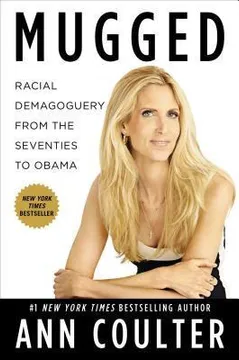
Mugged is a polemical history of American race politics from the post-civil-rights era through Barack Obama’s first presidential campaign. Its narrative has a clear arc: Coulter argues that once formal segregation ended, liberal institutions kept racial conflict politically useful by amplifying some allegations, neglecting corrections, excusing selected misconduct, and portraying criticism of Democrats as evidence of racism. The O. J. Simpson verdict serves as the hinge between an era of white guilt and the renewed racial rhetoric of Obama’s rise.
The book’s strongest contribution is its insistence that public narratives be checked against records. Its accounts of the Rodney King video edit, the Brawley investigation, and the unequal attention given to accusations and corrections raise serious questions about editorial judgment. It also usefully reminds readers that Black citizens are not a single political constituency and that safety, family stability, and fair treatment cannot be reduced to symbolic representation.
Its central weakness is that the evidentiary standard it demands of others is not applied evenly to its own conclusions. A collection of vivid cases can demonstrate that biased coverage or false allegations occurred, but cannot alone show how common they were. Nor does sequence establish that welfare policy caused family change, that a verdict ended racial group identity, or that contemporary criticism of Obama was generally free of racial motive. The book often treats liberals, Democrats, journalists, and Black political leaders as unified actors, while giving less attention to internal disagreement and competing explanations.
The best use of this book is therefore neither as a neutral history nor as a work to dismiss wholesale. It is a case study in how political identity shapes the selection and interpretation of evidence. Read it with a two-sided discipline: demand proof for claims of racism, and apply the same rigor to claims that racism has become merely a political fiction. That standard preserves the book’s valuable challenge to media complacency without mistaking its partisan interpretation for the whole historical record.
Review Summary
Reviews of Mugged are deeply divided along political lines. Supporters praise Coulter's research, humor, and historical analysis of civil rights legislation, arguing she effectively challenges liberal narratives about race and the Democratic Party. Critics condemn the book as poorly organized, factually questionable, and driven by partisan hostility rather than genuine analysis. Several reviewers note Coulter's sarcastic style as both a strength and weakness—engaging for supporters but alienating to potential persuadable readers. A recurring theme is that the book preaches to the conservative choir while failing to reach those who might most benefit from its arguments.
People Also Read









Glossary
Race demagoguery
Political use of racial grievanceCoulter uses this term for political messaging that, in her view, magnifies or manufactures racial conflict to gain influence, protect allies, or discredit opponents. She applies it especially to claims that criticism of liberal politicians or policies proves racism. The term expresses the book’s argument, not a neutral finding about any particular claim.
White guilt
Collective racial guiltIn the book, white guilt is the sense of collective moral responsibility that Coulter argues liberal commentators and politicians invoke to pressure white Americans into accepting particular political claims or policies. She presents the O. J. Simpson verdict as weakening that pressure. The concept is her interpretation of public attitudes, not a measured description of every white person’s beliefs.
Southern strategy
Claimed Republican Southern appealThe book challenges the standard account that Republican presidential candidates built lasting Southern support by appealing to white segregationists after the 1964 Civil Rights Act. Coulter compares election results across decades and argues that many Southern states continued to support Democrats, while Republican gains reflected broader political changes. The term refers to a contested historical interpretation, not a strategy whose existence or effects are settled by the book’s examples alone.
Download PDF
Download EPUB
.epub digital book format is ideal for reading ebooks on phones, tablets, and e-readers.








