

Key Takeaways
Stop waiting for a recipe; build financial skill through informed action.
The book offers examples, not instructions. Its premise is that people can learn financial principles, then adapt them to their own abilities and circumstances. The contributors did not begin as experts. Ed and Terry Colman, for instance, first cleared credit-card debt through business training, then tested investments before settling on rental property. Their path was not a template for everyone. It was evidence, in the authors’ view, that learning can widen a person’s choices.
Action makes learning concrete. Robert Kiyosaki frames the collection as a response to readers who wanted a step-by-step recipe. Rather than prescribe one, the stories show people acting, making mistakes, and revising their approach. The recurring lesson is to take responsibility for understanding money instead of waiting for an adviser, employer, or book to decide every next move.
What's useful here is the distinction between a principle and a prescription. A principle, such as checking whether an investment produces income, can travel across situations; a recipe can fail when prices, laws, or personal resources differ. The stories also make action feel learnable rather than reserved for insiders. Still, action alone does not validate a strategy. Confidence should follow evidence, not replace it. The strongest reading of the book is not that every reader should invest in property, but that financial decisions deserve active understanding.
Shift income from your labor toward assets that pay you.
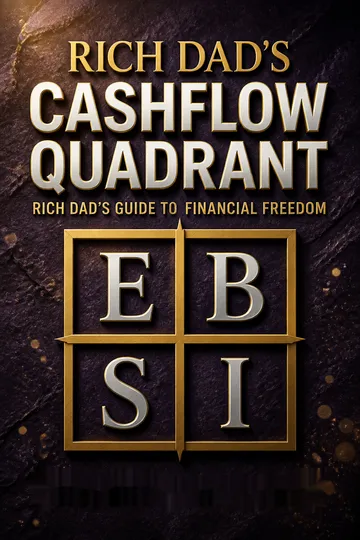
Track where income comes from. The book distinguishes earned income, paid for work, from passive income, produced by assets such as rental property, and portfolio income, produced by paper investments such as stocks. Its CASHFLOW Quadrant groups people by how they earn: employee, self-employed, business owner, or investor. The authors argue that greater financial freedom comes from moving toward business ownership and investment, where income need not depend entirely on personal hours.
The shift can be gradual. Many contributors kept their jobs while buying property or developing businesses. Wade and Carol Yamamoto, for example, sold a costly home and used the change in their housing costs to begin purchasing rentals. Their goal was not simply a higher salary, but more income from assets. The quadrant is best understood as a map of income sources, not a ranking of people or professions.
This framework makes a hidden feature of work visible: two people with similar incomes may have very different dependence on their next paycheck. That is a useful lens for planning, especially when time and family obligations matter as much as net worth. Yet the quadrant can oversimplify. Employees may have strong benefits and diversified savings, while business owners can face volatile earnings and concentrated risk. The practical question is not which label sounds superior, but how resilient the household remains if its main income source disappears.
Judge a property by complete cashflow, not by attractive rent.
Count every cost first. Cashflow means income left after operating costs and loan payments. Valerie Collymore initially calculated a rental home’s rent against its mortgage and management fee, then discovered that taxes, insurance, and repairs had been omitted. The property appeared slightly profitable but was not self-sustaining. Refinancing to a longer loan reduced payments, leaving about $24 a month at first, with a projected rise to about $71 after a rent increase.
Build reserves into the estimate. The book’s stronger examples include vacancy, maintenance, management, taxes, insurance, and future repairs rather than treating rent as profit. Michael Maritzen built a deliberately conservative spreadsheet before viewing properties, and walked away when the numbers failed his requirements. These accounts make analysis part of the investment, not paperwork to finish after falling in love with a house.
The difference between gross income and spendable cash is a basic accounting distinction, but the stories show how easily enthusiasm can erase it. A spreadsheet can also expose which assumptions are doing the work: occupancy, repairs, financing costs, and rent growth. The limitation is that even detailed estimates cannot eliminate uncertainty. Reserves and scenario testing matter because a property that works only under ideal conditions is not robust. The most disciplined investor is not the one with the prettiest forecast, but the one whose decision survives an unpleasant one.
Make risk smaller by investigating what could change the deal.
Replace guesses with questions. Dan McKenzie describes buying land near Austin after a real-estate downturn. The parcel seemed risky because development depended on access to drinking water. Instead of assuming the problem would resolve itself, he investigated who might provide water and why. A nearby development group was working on a solution with the city and a water cooperative. The area later grew, and he reported that land values rose substantially after water became available.
Study the whole setting. McKenzie evaluated seller motivation, property condition, financing terms, location, price, and relationships with people who knew the area. The point is not that every obstacle hides a profit. It is that a decision improves when the investor identifies what must happen for the plan to work, and what happens if it does not. Several contributors also stress that declining a bad deal is better than buying from fear of missing out.
This is a valuable way to define due diligence: investigate the causal chain behind an investment, rather than merely admire its apparent upside. The land example turns a vague bet on growth into a question about infrastructure and incentives. That kind of reasoning applies beyond property, wherever a plan depends on a bottleneck being removed. But a plausible explanation is not certainty. The water solution, timing, and eventual growth were not under the investor’s control. Good analysis clarifies uncertainty; it does not make uncertainty disappear.
Practice financial decisions before real money is on the table.
Use simulation to rehearse. CASHFLOW 101 is a board game designed to teach accounting, investing, and cashflow through repeated decisions with pretend money. Contributors say it helped them recognize the difference between assets and liabilities, compare possible deals, and become more comfortable with financial vocabulary. Ronald Hoard and his teenage son needed eleven hours to finish their first game. After repeated play, they could finish in about an hour.
Then test the lesson in life. The game did not make investments automatically successful. It gave players a low-stakes place to notice how choices affected income and expenses. Jake Colman, thirteen, learned from the game and his parents’ example, then started a candle business and eventually bought a rental home with family support. The collection also describes college students using a children’s version to teach younger pupils, turning learning into a cycle of practice and explanation.
Simulation is useful because it lets people make mistakes without paying the full real-world price. Explaining a decision to someone else can deepen that learning, as the student-led teaching project suggests. The key is to treat a game as rehearsal, not certification. A board cannot reproduce tenant disputes, financing conditions, local rules, or the emotional pressure of a large commitment. Practice can improve judgment, but a real transaction still requires current information, independent checks, and an exit plan.
Borrow only when the investment can withstand realistic costs.
Leverage magnifies both sides. OPM, short for other people’s money, refers here to borrowing from lenders or using seller financing to acquire assets. Several contributors used it to buy property with relatively little cash of their own. David Lukas reported investing about $2,000 in purchases totaling roughly $185,000, with eight rental units producing about $1,500 in monthly cashflow. Ronald Hoard bought a 37-unit complex for $425,000, put in $91,000, and reported monthly cashflow of about $3,809.
Debt does not make a deal good. Other contributors held properties that lost money each month, or discovered that repairs and management were costlier than expected. A tenant may help pay a mortgage, but vacancies, refinancing, and repairs still belong to the owner. The useful test is whether income can cover all costs under conservative assumptions, not whether the borrower can obtain a loan.
Leverage can make ownership possible sooner, but it also increases the consequences of weak assumptions. The book’s own cases show both sides: borrowing supported large reported cashflows, while negative-cashflow properties needed outside income to carry them. That tension is more instructive than treating debt as either inherently virtuous or inherently dangerous. The sound question is what must remain true for repayment to work, and how much room exists if those conditions worsen. Borrowing capacity is not the same thing as investing capacity.
Build systems and a capable team before your business owns you.
A busy owner may still own a job. In the book’s terminology, self-employed people often remain essential to daily operations, while a business owner builds systems that others can run. Ed Colman’s production service relied on his constant decisions, so he knew it would not grow independently without a new operating structure. Michelle LaBrosse faced a similar limit. After learning to sell, delegate, and develop repeatable processes, she reported company revenues rising from $25,000 in its first year to $250,000, then $2.5 million in its third.
Expertise should be shared. Contributors describe using accountants, attorneys, lenders, brokers, inspectors, and property managers rather than trying to do every job themselves. Terri Bowersock also used property partnerships and licensing to extend her furnishings business. These examples show that scaling depends not only on ambition, but on reliable operations, clear roles, and people with skills the founder lacks.
The shift from personal effort to a repeatable system is the difference between creating a more demanding job and building an organization. Delegation only works, however, when processes are clear and incentives are aligned. The book’s growth figures are striking, but they are individual reports, not a promise that a particular sequence will reproduce the same result. The generalizable lesson is narrower and stronger: document work, develop sales capability, and recruit expertise before growth overwhelms the person holding everything together.
Credentials and age do not decide who can learn financial skills.
Financial ability can begin late or early. Cecilia Morrison was in her late fifties, had no employer pension, and considered herself extremely cautious. After learning about business cashflow, she and her husband bought a laundromat using equity from their home and an assumed small-business loan. Stacey Baker, a high-school dropout and welfare recipient, recognized an opportunity to buy the medical practice where her friend worked. With a partner, bank financing, and seller financing, she reported leaving welfare when the purchase closed.
Young people learned by doing. Jake Colman developed small businesses before buying a rental property as a teenager. Terri Bowersock, who struggled with dyslexia, built a furniture-consignment business after drawing a plan for her first store. These stories challenge the assumption that formal education alone supplies financial competence. They do not show that background is irrelevant; each person relied on support, training, or partners.
The collection broadens the picture of who gets to participate in financial learning. It includes people who feel too old, too inexperienced, or insufficiently academic, and shows practical knowledge growing through responsibility. That is an important corrective to the idea that money management belongs only to specialists. At the same time, a moving success story can make a difficult transaction look easier than it was. Access to credit, trustworthy partners, local demand, and timing all shaped these outcomes. Capability matters, but so do conditions.
Make financial plans a shared household decision, not a private gamble.
Money choices reshape daily life. Wade and Carol Yamamoto worried about real estate and what friends might think if they sold their home. They bought it for $300,000, sold it for $260,000, and moved to a less expensive townhouse. The sale meant accepting a loss, but it also freed them to begin buying rentals. Their first two foreclosure condos were reported to produce cash-on-cash returns of about 45% and 37%, respectively.
Agreement came before the deal. The couple discussed what they wanted, what they could change, and what staying put would cost them. That conversation helped turn a financial decision into a shared plan rather than one partner’s leap of faith. Their story also shows that status and comfort can have real costs. A household should decide together what it is willing to trade, and what level of uncertainty it can carry.
A financial plan is also a relationship plan: it allocates money, time, risk, and control. The Yamamotos’ discussion made their choice more durable because both partners could explain the reason for the sacrifice. This matters especially when assets are illiquid or require ongoing attention. Still, a shared decision does not guarantee a sound investment. Couples benefit from separating two questions: whether the goal matters to both people, and whether the proposed numbers justify the risk.
Treat wealth as a tool for creating value and giving back.
Money is a means, not a moral verdict. Dan McKenzie grew up hearing that financial success was corrupt. His experience led him to distinguish hoarding money from creating something useful for other people. He came to view income as an exchange for value, and described greater financial security as a way to contribute rather than withdraw from society.
Teaching can multiply the benefit. David Hosei and Michael Slate helped create H.E.L.P., a student organization that used financial games to teach children about money management and entrepreneurship. The students’ model was simple: learn the material, teach it, and put it into practice. Other contributors supported schools, charities, and community causes. Across these accounts, financial independence is presented not just as escape from employment, but as more choice over how to spend time and serve others.
This framing gives the book a more substantial destination than simply accumulating assets. Value creation connects financial activity to usefulness, while giving back can keep wealth from becoming an end in itself. The teaching example makes that idea tangible: financial knowledge is treated as something to circulate. A necessary nuance is that generosity does not excuse poor stewardship, and wealth alone does not ensure social benefit. The strongest version of the argument joins competence with purpose: understand the consequences of money, then direct it toward goals beyond personal consumption.
Analysis
Rich Dad's Success Stories is an anthology with a shared thesis rather than a single continuous argument. Across stories from employees, entrepreneurs, parents, retirees, young people, and financial professionals, it repeats a recognizable sequence: a person feels trapped or financially unprepared, learns to read money differently, tests an opportunity, and gains confidence through action. The central contribution is psychological as much as financial. People who once saw money as either mysterious or morally suspect begin treating it as something that can be studied, measured, and directed.
The book is strongest when it describes the learning process rather than promising a particular outcome. Collymore’s mistaken rental calculation, the Colmans’ uneven properties, and Maritzen’s extensive expense model demonstrate why actual costs matter. The games offer a memorable bridge from abstract concepts to decisions. The stories also widen the imagined audience for financial learning: age, formal schooling, and prior income are not presented as prerequisites for beginning.
The main limitation is the form itself. Success stories are selected for success, so they cannot establish how often these strategies fail. Contributors report impressive returns, but the accounts are not independent audits, and the book notes that some events were fictionalized for educational effect. Its confident promotion of real estate and borrowing also risks making leverage appear safer than it is. Debt can amplify gains, but it magnifies losses and makes cash reserves, loan terms, and local conditions decisive. The book’s dismissal of conventional investing advice is similarly broader than its examples can prove.
Read the collection as a prompt to become an active, financially literate decision-maker, not as current investment guidance. Its durable questions are useful across strategies: What produces the income? What costs are missing? Who has relevant expertise? What could break the plan? And what purpose should greater financial freedom serve? The stories inspire agency; careful analysis must supply the guardrails.
Review Summary
Rich Dad's Success Stories contains real-life accounts of people applying Rich Dad principles to achieve financial independence. Reviews are mixed, with some finding inspiration in the stories while others criticize repetitive content and overt marketing. Positive reviews highlight the motivational aspects and practical examples, while negative reviews point out the book's US-centric focus and lack of new information. Many readers appreciate the diverse backgrounds of featured individuals but note that the strategies may not be universally applicable. Overall, the book serves as a supplementary resource for Rich Dad enthusiasts.
People Also Read








Glossary
CASHFLOW Quadrant
Four income-source categoriesA framework dividing work and investing into four categories: employee, self-employed, business owner, and investor. The book places employees and self-employed people on the left, where income is closely tied to personal work, and business owners and investors on the right, where systems or invested money can generate income. It is a way to classify income sources, not a measure of personal worth.
Rat Race
Work-dependent financial cycleThe book's term for a pattern in which people rely on wages or self-employment to cover expenses, leaving them dependent on continued work. In the CASHFLOW game, escaping this cycle means having passive income exceed expenses. The phrase expresses the authors' critique of income that stops when a person stops working.
Fast Track
Business and investor sideThe name the book gives to the business-owner and investor side of the CASHFLOW Quadrant. In this model, business systems or invested money produce income, potentially reducing dependence on personal labor. The term describes an aspiration within the book's framework, not a guarantee of quick wealth or low risk.
passive income
Income from owned assetsIncome the book associates with assets that produce money without requiring the owner to exchange every unit of income for personal working hours. Rental property is its main example, although several stories describe owners who still perform substantial work or rely on managers. The label therefore describes the intended income source, not necessarily a complete absence of effort.
OPM
Other people's moneyAn abbreviation for other people's money, used for funds borrowed from banks, lenders, or sellers to acquire an asset. Contributors use financing to buy properties or businesses with less cash of their own. OPM can increase an investor's ability to acquire assets, but loan payments remain obligations even when income falls.
cash-on-cash return
Annual cashflow versus cash investedA ratio used in the book to compare a property's annual net cashflow with the cash the investor put into the purchase. For example, annual cashflow of $1,200 divided by $10,000 invested equals a reported 12% cash-on-cash return. The figure depends on the accuracy of both the cashflow estimate and the amount counted as invested.
good debt
Debt used to acquire assetsThe book's label for borrowing used to acquire an asset expected to produce income, such as a rental property or business. It contrasts this with borrowing for consumer purchases that do not generate income. The distinction reflects intended use, not certainty: an income-producing asset can underperform while debt payments remain due.
CASHFLOW 101
Financial education board gameA board game created by Robert Kiyosaki to teach basic accounting, investing, and cashflow concepts through repeated decisions using pretend money. Players evaluate opportunities and try to make income from investments exceed expenses. In the stories, people use the game to build familiarity and confidence, then apply lessons to real decisions that require separate research.
Rich Dad Series





About the Author
Other books by Robert T. Kiyosaki





Download PDF
Download EPUB
.epub digital book format is ideal for reading ebooks on phones, tablets, and e-readers.








