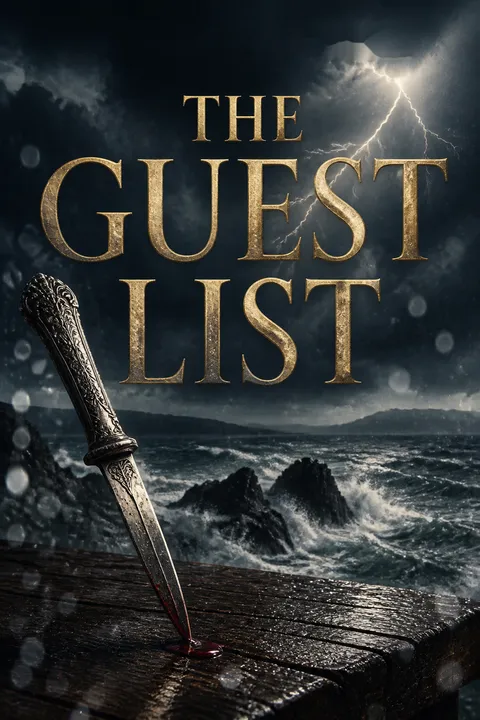


Plot Summary
Prologue
At the wedding reception on Cormorant Island, the lights fail as the storm batters the marquee. When power returns, the celebration looks wrecked: wine stains the linens, glass lies underfoot, and the red centre of the wedding cake has been cut open. The boats cannot leave until the weather clears.
Then a waitress runs in from the darkness, shaking too hard to explain what she saw. She manages to convey that there is blood outside and a body. The guests who had spent the day drinking and dancing are suddenly trapped together with the possibility that one of them has been killed.
The opening turns a wedding into a sealed room before the reader knows who is in danger. The storm is both practical barrier and psychological pressure: the guests cannot retreat into ordinary life or separate themselves from what they have done. The ruined cake and bloody footprints make celebration physically unstable, while the waitress, previously overlooked as part of the service, becomes the first person to carry consequential knowledge. Foley places the question of murder inside a social ritual built to display happiness, making the contrast between public performance and private conduct the novel's central suspense mechanism.
The Island Takes Attendance
Hannah and her husband, Charlie, cross from Connemara to Inis an Amplóra in a small boat that pitches hard enough to make Hannah sick. The boatman tells them that the island's peat once preserved the bodies of people killed in a massacre, and that its last residents left for the mainland.
The story unsettles Hannah, already travelling with private grief and a marriage strained by young children and money. On shore, Charlie's old friend Jules, the bride, welcomes them beside her new fiancé, Will Slater, a celebrated survival-show host. Hannah notices Charlie stiffen around Will, while she herself is unexpectedly drawn to the groom's looks and confidence.
The crossing makes arrival a bodily ordeal, not a picturesque transition. Hannah's nausea, the boatman's history and Charlie's tension establish three kinds of vulnerability before the wedding begins: physical, inherited and relational. The island's isolation also levels the guests. Jules can control the guest list and the design, but she cannot control the sea or the stories attached to the ground beneath her venue. Hannah's attraction to Will is especially revealing because it grows from the same need for recognition that marks her dissatisfaction at home. The novel's danger enters through ordinary human appetites, not through a supernatural threat.
A Note Beneath the Silk
Jules prepares for the wedding with the precision she applies to her lifestyle magazine, but a hand-delivered note telling her not to marry Will has lodged in her thoughts. She burns it, retrieves it, and keeps it hidden, unable to dismiss its accusation that he is dishonest. Her half-sister Olivia, chosen as bridesmaid, avoids trying on her dress, cuts her thigh in private and struggles to act interested in Jules's plans.
Jules presses her to cooperate, then tries to offer affection; Olivia cannot accept it easily. Their mother, Araminta, hints that Olivia has suffered more than Jules knows. The sisters' old rivalry and unequal childhoods leave Jules both protective of Olivia and resentful of the attention she receives.
Jules treats planning as a defence against the unpredictability of intimacy. The note threatens her not only with the possibility of a bad marriage, but with a loss of authorship over the future she has carefully arranged. Olivia's self-injury and withdrawal expose the limits of Jules's managerial style: her insistence on visible cooperation cannot reach the distress that Olivia conceals. Their conflict is not simple cruelty versus fragility. Both sisters carry old injuries shaped by a mother who was inconsistently present, and each reads the other's advantages as proof of being less loved.
The Cave Makes Room
After avoiding the rehearsal gathering, Olivia hides in the island's Whispering Cave, where Hannah finds her by chance. The two women admit, cautiously, that they feel out of place among Jules's polished guests. Hannah speaks about missing her former life before children; Olivia says she left university after a painful breakup and has not managed to tell her family what followed.
In a later visit to the cave, Olivia explains that she used a dating app while staying at Jules's London flat and met an older man named Steven. He made her feel sophisticated and desired, but she cannot yet bring herself to explain how the relationship ended. Hannah listens without forcing the missing details from her.
The cave reverses the social geography of the wedding. In the house and marquee, status is visible in clothes, money and old school affiliations; underground, Hannah and Olivia can speak without performing competence. Their connection begins because each recognizes the other's exile, though for different reasons. Olivia's partial disclosure matters as much as its content: shame has made silence feel safer than asking for help. Hannah's patience offers a countermodel to the wedding's coercive cheerfulness, but she does not yet know how much the younger woman is carrying. Trust arrives before full explanation.
Schoolboys Rehearse Survival
At dinner, Will's former Trevellyan's schoolmates revive their old drinking rituals and describe Survival, a tradition in which younger pupils were taken at night and left to find their way back. The men turn the story into entertainment, chanting their school motto and escalating a card game into a foul mixture of drinks.
Charlie joins despite Hannah's attempt to stop him, eager to belong to the group. The groom and his friends later find seaweed hidden beneath the newlyweds' bedding, a prank they associate with their school years. Will dismisses Jules's anger and blames his old friends. Johnno, his best man, cannot sleep; the island and the ritual have brought back memories he has spent years trying to suppress.
The schoolboys' rituals reveal how cruelty survives by being renamed tradition. The men remember the fear as a bonding experience because that account protects their adult identities from the fact that younger boys had little choice. Charlie's participation shows how exclusion can make even a responsible adult surrender judgment for temporary acceptance. The seaweed prank carries the same logic into the wedding: the men treat humiliation as harmless so long as the target is expected to laugh. Johnno's distress quietly contradicts the group's shared nostalgia, signalling that the past is not equally survivable for everyone.
The Bog Gives Way
On the morning of the wedding, Hannah walks toward the island's graveyard, calls home to check on her children, then loses her way across the peat. The ground gives beneath her boots and begins to pull her down. Duncan and Peter, two of Will's ushers, find her and haul her onto firmer ground, leaving her shaken and missing a boot.
The rescue makes the island's danger immediate rather than folkloric. Meanwhile, Hannah notices a cared-for grave belonging to a young girl lost at sea, and recognises how easily the island's history can be mistaken for decoration. She returns to the Folly wanting the safety of familiar people, but the people around her are becoming harder to trust.
The bog literalizes the novel's recurring fear of being consumed by what others cannot see. Hannah's apparent mistake is ordinary, but the landscape makes it lethal, and the rescue does not erase the vulnerability it reveals. Her call to her children briefly restores her strongest bond, yet the island quickly disorients her again. The grave of a child shifts local history from atmospheric lore to personal loss. By making danger depend on hidden ground rather than a visible attacker, the episode prepares the reader to distrust surfaces, including the guests' polished manners.
The Crown and the Vows
Before the ceremony, Jules asks her father, Ronan, whether he approves of Will. Ronan cannot give the reassurance she wants, and their argument exposes how much Jules still longs for a father who has often been absent. Furious, she smashes a vase in private, cleans the shards and restores her expression before walking to the ruined chapel. Olivia stands beside her as bridesmaid.
Jules reaches Will and completes the ceremony, appearing radiant to the guests despite the fear that crossed her face on the aisle. Her father later gives a complicated speech, admitting his failures and expressing pride in her, while warning Will to treat her well. Jules is moved, but the warning deepens the unease she has tried to master.
Jules's wedding is not simply a choice of partner; it is also an attempt to repair an old attachment. She wants Ronan's blessing while resenting her dependence on it, and his hesitant response punctures the controlled image she has built. Her private destruction of the vase gives anger a physical outlet, after which she carefully reconstructs the bride others expect. The ceremony therefore contains two versions of Jules at once: the woman performing certainty and the daughter still waiting to be chosen. Ronan's speech offers tenderness, but its warning makes public celebration carry a shadow of genuine concern.
Olivia Breaks the Surface
During the reception, Olivia leaves the crowd and enters the freezing sea in her bridesmaid dress. The current catches her, and Will runs in to pull her back before she drowns. Jules responds with anger, accusing Olivia of disrupting the wedding, while Hannah follows her to the Folly and tries to understand what happened.
The day has already exposed the secret Olivia has not told Hannah: after meeting Steven, she became pregnant, ended the pregnancy with her mother's help, and never told the man or Jules.
Hannah sees in Olivia the guarded distress of her older sister Alice, whose university boyfriend circulated an intimate video after Alice ended their relationship. Hannah does not yet know that the same man stands at the centre of both histories.
Olivia's entrance into the sea is not a neat symbolic cleansing. It is an impulsive attempt to escape unbearable scrutiny that becomes a genuine physical emergency. Will's rescue gives him the public role of hero, while Jules's anger shows how quickly fear can harden into blame. Hannah's recognition of Alice in Olivia makes empathy an act of memory: she remembers what silence cost her sister and refuses to treat Olivia's distress as mere theatrics. The parallel also tightens suspense, linking two women's private shame before Hannah has identified the man connecting them.
Johnno Names the Past
At the wedding breakfast, Johnno learns from Piers, the producer of Will's television show, that Will had told the production team Johnno had declined their offer to co-host. Johnno had never been told about the meeting. Drunk and furious, he gives a speech that begins as a joke about his too-tight borrowed suit and turns into a threat about the secrets he and Will share.
The ushers carry Will, blindfolded and bound, to the Whispering Cave, repeating their school ritual. Johnno returns alone and confronts him: years earlier, they had tied a younger pupil, Darcey Malone, to a cliffside rail for Survival. The rising tide killed Darcey, and Will persuaded Johnno to keep silent.
Johnno's anger has two sources that finally converge: Will's present betrayal over the television opportunity and their shared responsibility for Darcey's death. The fake confidence of his speech briefly lets him seize attention from the friend who has always owned the room. But carrying Will into the cave repeats the old ritual instead of repairing its harm. Johnno can name the truth, yet he still reenacts the power structure that buried it. The scene shows how guilt and loyalty can become mutually reinforcing restraints: each man has helped preserve the other's silence, though at very different cost.
Charlie Loses His Balance
After Johnno returns, Charlie fights Duncan at the bar when the ushers taunt him about the stag weekend. He then tells Hannah what he had hidden: the men gave him magic mushrooms, abandoned him naked on a cold island, and left him fearing he would die. He also admits that he slept with Jules after Ben was born, while Hannah was struggling with postnatal depression.
Hannah rejects his excuses and walks away, shaken by the discovery that her mild, familiar husband has concealed both humiliation and betrayal. The confession changes her reading of Charlie's flirtation with Jules and of his hostility toward Will. Their marriage, which had seemed merely tired, now has a wound neither can ignore.
The fight makes Charlie's suppressed humiliation visible, but disclosure does not automatically turn it into intimacy. His account of the stag explains why he has been drinking and why Will troubles him, yet the confession of infidelity reveals a separate choice that cannot be excused by peer pressure. Hannah must revise the story she has told herself about their marriage: her loneliness was not simply the exhaustion of parenting. Charlie's honesty arrives only after he loses control in public, so the truth is both necessary and belated. Trust becomes another uncertain terrain on the island.
The Cake Becomes a Weapon
At the dance, Hannah hears Will's university friends recall an intimate video used to punish a woman who ended a relationship. Their details fit Alice's experience, and Hannah realizes Will was the boyfriend who helped drive her sister toward suicide. At the same time, Olivia confronts Will near the cliffs and says she intends to tell Jules about their affair.
Will takes her phone, throws it into the sea and threatens to release explicit images of her; Jules overhears enough to understand the betrayal. When Will returns to cut the wedding cake, Jules smashes red velvet into his face in front of the guests. The act looks playful to the crowd, but it is the first public crack in their marriage.
The cake scene converts private knowledge into a public gesture. Hannah's discovery links Will's charm to a prior act of sexual coercion, while Olivia's confrontation shows that he still uses shame and intimate images to control women. Jules does not expose the truth aloud; instead, she interrupts the immaculate wedding image with a blow that can be dismissed as a joke. This ambiguity is psychologically precise. She has learned enough to act, but not yet enough to know what she will do next. The guests' willingness to read violence as celebration protects the ceremony and isolates its victims.
Aoife's Island Reckoning
As the storm knocks out the lights, wedding planner Aoife leads Will away from the marquee, claiming the generator needs attention. She reveals that Darcey Malone was her younger brother and that her husband, Freddy, was the pupil who hid in the dorm while Will and Johnno took Darcey.
Aoife had offered Jules a discounted wedding to bring Will to the island, where Darcey's grave and letters remain. She had hoped to question him, but overheard his conversation with Johnno and learned he felt no remorse. When Will dismisses her accusation and tries to leave, Aoife stabs him through the heart with the sharpened cake knife.
Aoife's professional invisibility has been a form of preparation. The woman who manages every guest's movement has quietly arranged the conditions for a private reckoning, using the wedding's bargain venue and its ceremonial knife. Her motive is not abstract justice: it is the loss of a brother, a mother's collapse and a childhood shaped by knowledge she could not act upon. Hearing Will deny responsibility turns a planned conversation into violence. The storm conceals the murder, but it also strips away the wedding's protections, leaving Aoife alone with the choice she has made.
A Wrong Man in Cuffs
The ushers search the storm-dark island after a waitress reports blood and a body. They find Jules's crushed crown and a single shoe, then discover Will dead beside the peat. Johnno arrives carrying the cake knife, having found it in Will's chest and pulled it free. He is sobbing and disoriented, but the other men restrain him, and the Gardaí arrest him for murder.
The old crime remains bound to him even though he did not kill Will. Back in the marquee, Jules embraces Olivia after admitting she knows about the affair; their anger gives way, briefly, to grief and sisterly closeness. Freddy and Aoife remain on the island as the guests wait for the police.
The apparent solution is deliberately unstable. Johnno is found with the weapon because he touched the body, and his history makes him an easy suspect; the novel's earlier revelations ensure that readers can distinguish guilt for Darcey's death from guilt for Will's. His arrest does not erase the past, but it shows how public judgment often follows the most legible story rather than the whole truth. Jules and Olivia's embrace offers a different kind of resolution: not forgiveness on command, but recognition after years of misreading one another. Their bond survives the collapse of the wedding's performance.
Epilogue
By morning, the storm has passed and the police have taken Johnno away, still suspected of killing Will. Olivia sits with the other guests, unable to decide whether shock or guilt is driving her fear that she might have acted during the blackout. Jules has reached for her rather than rejected her, and the sisters share a rare, unguarded embrace.
Hannah and Charlie leave the island separately in spirit, though together on the boat. Hannah now knows Will was responsible for the intimate video that helped destroy Alice's life. She has her answer, but her marriage remains damaged, and the chance to confront Will herself is gone.
The ending refuses the comfort of a fully repaired life. Olivia and Jules achieve a moment of closeness because Jules finally recognizes the harm her sister endured, but neither can undo the years of silence or the night's violence. Hannah's answer about Alice offers knowledge rather than closure; knowing who caused the wound does not heal it. Charlie and Hannah's return crossing mirrors their arrival, but the same boat ride now carries a marriage whose trust has been broken. Johnno's arrest likewise leaves justice unresolved, preserving the distinction between what the law suspects and what the reader knows.
Analysis
The novel treats the wedding as a machine for producing appearances. Jules designs every detail to project mastery, Will performs the gracious, capable groom, and the guests accept the event's scripts because those scripts let them avoid asking difficult questions. The island disrupts that arrangement through physical dangers that cannot be managed by money or etiquette. Peat gives way, the sea turns treacherous, and the storm disables the lights, making the setting a force that exposes how little control the guests actually possess.
Its most consequential secrets concern the ways people use intimacy as leverage. Will's charm and sexual attention make younger women feel chosen, then his possession of intimate images lets him convert their trust into silence. Hannah's past with Alice and Olivia's experience are not identical, but their parallel histories show how shame isolates victims and protects the person who caused harm. Hannah's delayed recognition also implicates the social appeal of Will's persona: she wants to be seen by him before she understands what his attention has cost other women.
The schoolboys' Survival game is the novel's clearest model of inherited violence. The boys call cruelty tradition, and the adult men keep repeating that language because admitting harm would require them to revise their identities. Johnno's guilt is real, but his lower status and self-contempt make him an easy vessel for collective blame. Aoife, by contrast, uses the wedding's logistics to create an encounter the law and the past never provided, then chooses vengeance over accountability. Her act gives the story a morally unsettling resolution: Will's harm is stopped, but the killing does not repair the damage or deliver public truth.
Ultimately, the book distrusts polished certainty. The characters who seem most composed conceal the most, while the people dismissed as unstable or awkward often perceive the danger first. Its most hopeful moment is not a verdict but the sisters' embrace, a small movement from performance toward recognition.
Review Summary
The Guest List is a thriller set on a remote Irish island during a glamorous wedding. Told from multiple perspectives, it follows various characters with secrets and motives for murder. Readers praised the atmospheric setting, complex characters, and suspenseful plot. Many found it reminiscent of Agatha Christie's works. While some felt the story was slow-paced or predictable, others enjoyed the twists and revelations. The audiobook version received particular acclaim for its full cast narration. Overall, it's a divisive but entertaining read that keeps readers guessing until the end.
People Also Read



Characters
Jules
The meticulous brideJules Keegan is a successful magazine founder who approaches her wedding as a carefully designed public event. She values competence, independence and control, partly because her childhood with an unreliable mother and an absent father taught her not to expect stability from others. Her sharpness can make affection feel conditional, especially to her half-sister Olivia, whom Jules both loves and envies. She is conscious of appearances, but not shallow: beauty, success and planning are ways she has learned to make herself secure. Under pressure, her anger and tenderness often arrive together, revealing how much she wants recognition from the family she insists she no longer needs.
Will
The survival-show groomWill Slater is a charismatic television host whose survival skills and polished appearance have made him a public figure. He moves easily between social worlds, adapting his manner to audiences and making strangers feel personally noticed. His relationship with Jules is intense and quickly becomes central to both their identities as a couple. Will is also shaped by an ambitious upbringing and a complicated history at Trevellyan's, where his father was headmaster. His self-possession can read as confidence, but it also leaves little room for vulnerability or for the possibility that others may see him differently than he sees himself.
Hannah
The uneasy plus-oneHannah is Charlie's wife, a former illustrator and mother of two who has spent years adapting her own needs around family life. She is warm and observant, but her self-deprecation makes it easy for wealthier, more polished people to unsettle her. The wedding exposes the gap between the lively young woman she remembers and the tired person she fears she has become. Hannah is drawn to attention and novelty, yet she is also capable of noticing another person's distress without demanding an immediate explanation. Her instinct to care is powerful, though it can make her responsible for feelings and crises that are not hers to manage.
Charlie
The divided husbandCharlie is a geography teacher, Hannah's husband and Jules's longtime friend. His mildness and practical decency have helped make him a steady partner and father, but he is less secure around wealth, status and the men from Will's school. Old loyalties draw him toward Jules even when he knows the intimacy makes Hannah uncomfortable. Charlie has difficulty naming shame and anger directly, so he tends to hide them until alcohol or provocation strips away his restraint. His devotion to his family is genuine, but affection alone does not prevent him from making choices that damage their trust.
Olivia
The troubled bridesmaidOlivia is Jules's nineteen-year-old half-sister and only bridesmaid. Sensitive and withdrawn, she has left university and become increasingly isolated from friends and family. She experiences emotion intensely but struggles to translate it into speech, often retreating rather than risking disbelief or judgment. Her history with Jules is complicated by the sisters' different childhoods and by Olivia's sense that she is still treated as a child. She is not simply fragile: she notices details, understands the costs of silence and retains deep affection for the sister with whom she so often clashes.
Johnno
The unruly best manJonathan Briggs, known as Johnno, is Will's oldest friend and best man. A former outdoor instructor with a large presence and an irreverent manner, he often plays the fool before anyone else can judge him. His background is less privileged than that of the other Trevellyan's boys, and their old hierarchy still shapes how he sees himself. Johnno values loyalty intensely, sometimes confusing it with the obligation to keep secrets. His jokes, drinking and bravado conceal a more troubled relationship with the past than his friends recognize.
Aoife
The vigilant wedding plannerAoife owns and runs the Folly with her husband, Freddy, and plans Jules and Will's wedding. She is observant, disciplined and skilled at making herself unobtrusive while tracking every practical detail. Her professional ideal is to create a perfect day that guests can inhabit as their own, though she knows that careful arrangements cannot control what people bring with them. An Irish woman who spent childhood summers on the island, Aoife has a private connection to its history. She carries grief without displaying it, and her calm manner should not be mistaken for indifference.
Freddy
The Folly's chefFreddy is Aoife's husband and the Folly's chef. A former restaurant owner, he takes pride in feeding people well and supports Aoife with a gentleness that steadies her when wedding pressures mount. He is less comfortable in confrontational situations and tends to stay close to the kitchen, where work gives him a defined role. His connection to the island reaches back to his school years, linking the couple's present home to an older personal history.
Araminta
The theatrical motherAraminta is Jules and Olivia's mother, a former aspiring actress whose romantic and professional choices left her daughters with sharply different memories of childhood. She is socially flamboyant and skilled at turning family occasions into performances. Her affection is real, but it often arrives wrapped in self-absorption or a story that makes her the centre. She understands that Olivia is suffering, though she does not always share the reasons with Jules.
Ronan
Jules's elusive fatherRonan is Jules's Irish father, a self-made property developer who grew up in Galway. He has built a successful life and a large family, but he has been an inconsistent presence in Jules's. His directness and forceful manner can make affection difficult to read, especially when his daughter most wants reassurance. He understands ambition and believes people should judge character carefully, though he is not always willing to offer the approval Jules seeks.
Mr. Slater
The headmaster fatherWill's father is the headmaster of Trevellyan's, the boarding school attended by Will, Johnno and their friends. He is formal, stern and conscious of the school's reputation. His authority shaped the boys' world, while his expectations helped define Will's drive to succeed. He is difficult to impress and treats discipline as a measure of character.
Alice
Hannah's brilliant sisterAlice is Hannah's older sister, remembered as academically gifted, ambitious and unusually conscientious. She set a high standard for herself and became a source of admiration in the family. Hannah's memories of Alice reveal both their affection and the painful limits of how well relatives can know one another. Alice's experiences at university continue to shape Hannah's understanding of shame, privacy and the need to speak before suffering becomes isolating.
Darcey Malone
The younger schoolboyDarcey Malone was a younger pupil at Trevellyan's and the brother of Aoife. He was small for his age and eager to be accepted by the older boys, particularly Will and Johnno. His letters and family connections link the school's closed world to the adults who gather on the island.
Femi
The level-headed usherOluwafemi, usually called Femi, is one of Will's former schoolmates and wedding ushers. Now a surgeon, he is perceptive and often acts as a mediator when the group grows aggressive. He remembers that Trevellyan's was not equally welcoming to all its pupils, and his sense of fairness makes him less comfortable with the group's nostalgic account of their school years.
Duncan
The taunting usherDuncan is one of Will's old school friends, an investor and a confident social presence. He enjoys provoking people and often helps turn group recollections into competitive games. His manner is buoyed by the security of money and status, and he treats old school rituals as proof of toughness rather than occasions to question what they did to younger pupils.
Angus
The anxious schoolmateAngus is one of the former Trevellyan's pupils at the wedding. Nervous around heights and eager to fit into the group, he often becomes the target of its teasing. He is more willing than some of the others to admit that their school traditions may have been harmful.
Peter
The reckless usherPeter Ramsay is one of Will's ushers, a party-loving former schoolmate who supplies drugs and pushes the group's celebrations toward excess. He is careless about how his choices affect other people and treats intoxication as part of the occasion.
Piers
The television producerPiers produces Will's survival television show and attends the wedding after Jules adds him to the guest list. His knowledge of the programme's casting history gives Johnno information that reshapes his understanding of Will's friendship.
Georgina
Duncan's polished wifeGeorgina is Duncan's stylish wife and part of the wedding's affluent social circle. She knows stories about the school traditions through her husband and observes the men with a mixture of amusement and unease.
Mattie
The island boatmanMattie ferries guests between the mainland and Cormorant Island. A local with a deep knowledge of the coast, he distrusts guidebook versions of the island's history and reads the weather more accurately than the forecasts.
Luis
The friendly dancerLuis is a guest and former Edinburgh teammate of Will. He meets Hannah on the dance floor and helps make her feel noticed. His memories of university social life contribute to what Hannah learns about Will's past.
Jethro
The blunt university friendJethro is Luis's friend and former teammate of Will. He speaks casually about their university years, unaware that his recollections will have a profound effect on Hannah.
Callum
Olivia's first boyfriendCallum was Olivia's first serious boyfriend at university. Their breakup left her lonely and vulnerable to seeking attention from someone older. He is part of the history Olivia struggles to explain to other people.
Plot Devices
Cormorant Island
The island as locked roomThe remote Irish island concentrates the wedding party and makes escape dependent on boats and weather. The bog, cliffs, caves and exposed shoreline create hazards that remain present even when the guests are indoors. Its history of massacre and shipwreck gives the island a reputation that the guests initially consume as atmosphere. As the storm intensifies, the setting becomes both a practical barrier to help and a pressure chamber in which old relationships and secrets cannot be avoided.
Trevellyan's Survival
A ritual that hides abuseThe boys' school tradition of abducting younger pupils and abandoning them at night supplies the novel's central buried crime. The older students describe it as a test of toughness, allowing them to disguise fear and coercion as camaraderie. Its ritual form repeats at the wedding when the ushers blindfold and carry Will away. The present-day reenactment exposes how the group preserves its hierarchy, while Johnno's memories reveal that one past Survival ended in a child's death.
The Hand-Delivered Note
A warning without a witnessThe anonymous note warning Jules against marrying Will introduces suspicion before the wedding has begun. Because it was delivered by hand, Jules cannot comfortably dismiss it as random online hostility, yet she has no name or evidence to test its accusation. She burns the paper, retrieves it and keeps it, letting the warning occupy her thoughts while she continues with the ceremony. The note represents knowledge that arrives without the social authority needed to make someone believe it.
The Whispering Cave
Confession chamber and trapThe cave gives Hannah and Olivia a secluded place to speak honestly when the wedding house makes both feel watched. Its echo turns their private disclosures into something that seems to return from the island itself. Later, the ushers use the same cave to replay the school's Survival ritual with Will as their captive. The location therefore holds two conflicting uses: a refuge for tentative trust and a stage for reenacting the coercion that binds the men to their past.
The Wedding Cake Knife
Ceremony conceals a weaponThe cake knife is introduced as an elegant serving tool, sharpened at Jules's request and placed beside the elaborate red velvet cake. Its ordinary role lets it remain visible without attracting suspicion. During the reception, Jules uses the cake itself to disrupt the image of a perfect marriage; later, during the blackout, Aoife uses the knife to kill Will. The instrument joins the wedding's staged sweetness to the violence the guests have failed to recognize.
FAQ
Synopsis & Basic Details
What is The Guest List about?
- Murder disrupts high-society wedding: A lavish wedding on a remote Irish island turns deadly when someone is murdered, leaving the guests trapped and suspicious.
- Multiple perspectives reveal secrets: The story unfolds through the viewpoints of various characters, including the bride, the wedding planner, and guests, each harboring their own secrets and motivations.
- Past and present collide: As the investigation progresses, long-buried secrets and past relationships resurface, creating a web of suspicion and revealing the dark underbelly of the seemingly perfect event.
Why should I read The Guest List?
- Intriguing mystery with twists: The novel offers a suspenseful and engaging mystery with plenty of red herrings and unexpected turns to keep readers guessing until the very end.
- Atmospheric setting enhances suspense: The remote Irish island setting, complete with a raging storm and a haunting history, creates a palpable sense of isolation and foreboding, heightening the tension.
- Complex characters with hidden depths: The story features a cast of well-developed characters, each with their own secrets, motivations, and vulnerabilities, making them both relatable and suspicious.
What is the background of The Guest List?
- Remote Irish island setting: The story takes place on a small, isolated island off the coast of Ireland, contributing to the sense of isolation and claustrophobia.
- Historical references to past inhabitants: The island's history includes a religious sect massacre and subsequent abandonment, adding a layer of mystery and superstition.
- Cultural context of Irish folklore: References to cormorants as symbols of bad luck and the tradition of keening for the dead enhance the eerie atmosphere and foreshadow events.
What are the most memorable quotes in The Guest List?
- Aoife's perspective on orchestrating happiness: "A wedding day is a neat little parcel of time in which I can create something whole and perfect to be cherished for a lifetime, a pearl from a broken necklace." This quote encapsulates Aoife's motivation and the illusion of perfection she strives to create.
- Mattie's ominous warning: "Nothing but ghosts." This quote, delivered by the boat captain, foreshadows the dark secrets and haunting past of the island, setting a tone of unease.
- Jules's reflection on Will: "Secret and unknowable, hidden from view?" This quote highlights Jules's growing suspicion about Will and the elusive nature of his true self, hinting at the deception at the heart of their relationship.
What writing style, narrative choices, and literary techniques does Lucy Foley use?
- Multiple POV creates suspense: Foley employs a multi-perspective narrative, shifting between characters to build suspense and reveal information gradually, keeping the reader guessing.
- Foreshadowing builds tension: The author uses subtle foreshadowing throughout the novel, hinting at future events and creating a sense of unease and anticipation.
- Atmospheric descriptions enhance mood: Foley's vivid descriptions of the island's landscape, weather, and history contribute to the novel's overall atmosphere of mystery and foreboding.
Hidden Details & Subtle Connections
What are some minor details that add significant meaning?
- Barometer foreshadows weather and mood: Aoife removing the barometer that swung from FAIR to CHANGEABLE symbolizes her attempt to control the uncontrollable and foreshadows the impending storm.
- The color of Jules's nails: Mum's nails are carmine, "as though her fingers have been dipped in blood," foreshadowing the violence and bloodshed to come.
- Olivia's razor blade: Olivia's razor blade is a symbol of her inner turmoil and self-harm, hinting at her fragile mental state and past trauma.
What are some subtle foreshadowing and callbacks?
- Cormorant symbolism foreshadows death: Charlie reading about the cormorant being a symbol of greed, bad luck, and evil foreshadows the impending death and the dark secrets of the characters.
- Survival game foreshadows the ending: The discussion of the "Survival" game at Trevellyan's foreshadows the deadly game of survival that unfolds on the island, with deadly consequences.
- Jules's comment about boats at midnight: Jules's comment about "boats at midnight" on the invitations foreshadows the guests' eventual escape from the island after the murder.
What are some unexpected character connections?
- Aoife and Darcey Malone connection: Aoife's connection to Darcey Malone, revealed later in the book, adds a layer of personal motivation to her actions and explains her deep-seated resentment towards Will.
- Hannah and Alice connection: Hannah's sister, Alice, was victimized by Will, creating a hidden link between the two women and fueling Hannah's desire for justice.
- Jules and Charlie's past relationship: The revelation of Jules and Charlie's past relationship adds complexity to their dynamic and creates tension in their present interactions.
Who are the most significant supporting characters?
- Aoife, the wedding planner: Aoife's knowledge of the island and her hidden agenda make her a key player in the unfolding events, driving the plot forward and influencing the actions of other characters.
- Olivia, the troubled bridesmaid: Olivia's secret affair with Will and her fragile mental state make her a catalyst for the drama, adding layers of complexity to the story and revealing the dark underbelly of the wedding.
- Johnno, the best man: Johnno's shared history with Will and his own struggles with guilt and regret make him a complex and compelling character, driving the plot forward and influencing the actions of other characters.
Psychological, Emotional, & Relational Analysis
What are some unspoken motivations of the characters?
- Jules's need for control: Jules's meticulous planning and desire for perfection stem from a deep-seated need for control, driven by her chaotic upbringing and a desire to create a stable and successful life.
- Will's desire for validation: Will's pursuit of fame and success is fueled by a need for validation, stemming from his strained relationship with his father and a desire to prove himself.
- Hannah's search for excitement: Hannah's attraction to Will and her willingness to engage in flirtatious behavior stem from a desire for excitement and a longing for the carefree days of her youth, as she feels trapped in the routine of motherhood.
What psychological complexities do the characters exhibit?
- Jules's control vs. vulnerability: Jules presents a strong, controlled exterior, but she is plagued by insecurities and doubts, particularly regarding her relationship with Will and her past with Charlie.
- Will's charm vs. ruthlessness: Will's charm and charisma mask a ruthless ambition and a willingness to manipulate others to achieve his goals, revealing a darker side beneath his golden exterior.
- Olivia's fragility vs. resilience: Olivia's fragile mental state and history of self-harm contrast with her moments of strength and resilience, as she grapples with her past trauma and tries to find her place in the world.
What are the major emotional turning points?
- Jules finding the note: Jules finding the note is a major turning point, casting doubt on her relationship with Will and setting the stage for the unraveling of secrets.
- Hannah realizing Will's connection to Alice: Hannah's realization of Will's connection to her sister's death is a major emotional turning point, fueling her desire for revenge and adding a layer of complexity to her character.
- Olivia's near-drowning experience: Olivia's near-drowning experience is a major emotional turning point, forcing her to confront her own self-destructive tendencies and ultimately leading her to seek help.
How do relationship dynamics evolve?
- Jules and Will's relationship unravels: Jules and Will's relationship, initially presented as a whirlwind romance, gradually unravels as secrets and betrayals come to light, revealing the cracks beneath the surface.
- Hannah and Charlie's marriage faces strain: Hannah and Charlie's marriage is tested by their individual desires and the resurfacing of old feelings, forcing them to confront their own insecurities and the challenges of long-term commitment.
- Jules and Olivia's sisterhood is tested: Jules and Olivia's complex sisterhood is tested by their shared history and the revelation of Olivia's affair with Will, forcing them to confront their past and ultimately find a path towards understanding and forgiveness.
Interpretation & Debate
Which parts of the story remain ambiguous or open-ended?
- The extent of Will's knowledge of the tide: It's unclear whether Will knew the tide would come in and drown the boy, or if it was a tragic accident, leaving the reader to question his true level of culpability.
- The true nature of Jules's feelings for Charlie: The extent of Jules's lingering feelings for Charlie remains ambiguous, leaving the reader to wonder if she truly loves Will or if she is settling for a more convenient match.
- The future of Hannah and Charlie's marriage: The ending leaves the future of Hannah and Charlie's marriage uncertain, as they must confront the betrayals and insecurities that have surfaced during the wedding weekend.
What are some debatable, controversial scenes or moments in The Guest List?
- The stag do hazing: The details of the stag do hazing are disturbing and raise questions about the nature of male friendship and the potential for cruelty within group dynamics.
- Will's manipulation of Olivia: Will's manipulation of Olivia is a controversial moment, highlighting the power dynamics in their relationship and the potential for abuse.
- The ending and Aoife's actions: The ending, with Aoife taking justice into her own hands, is debatable, raising questions about the morality of revenge and the consequences of taking the law into one's own hands.
The Guest List Ending Explained: How It Ends & What It Means
- Aoife seeks revenge for her brother: Aoife, driven by a desire for revenge for her brother's death, murders Will, believing him responsible for the tragedy.
- Justice vs. revenge theme: The ending explores the theme of justice versus revenge, raising questions about the morality of taking the law into one's own hands and the consequences of seeking retribution.
- Cycle of violence continues: The ending suggests a cycle of violence, as Aoife's actions perpetuate the cycle of pain and suffering that began with her brother's death, leaving the reader to ponder the possibility of breaking free from the past.
About the Author
Other books by Lucy Foley

Download PDF
Download EPUB
.epub digital book format is ideal for reading ebooks on phones, tablets, and e-readers.








