

Key Takeaways
Follow the handoffs: digital breakthroughs are built by collaborators
No lone inventor explains it. The computer and the Internet emerged through ideas passed between people, teams, and generations. Ada Lovelace saw possibilities in Charles Babbage’s proposed machine; wartime engineers turned theories into working computers; and later innovators built on their predecessors’ hardware, software, and networks. Credit is often disputed because invention rarely arrives as one clean, claimable idea.
The work is collective. The book follows projects from workshops and laboratories to universities, companies, and volunteer communities. At each stage, one person’s insight needed others to test, refine, build, or distribute it. The result is not that individuals do not matter. It is that their contributions become consequential through connection.
What's striking is how the history changes when invention is treated as a chain of contributions rather than a contest for a single winner. That view better explains why ideas recur independently and why some prototypes vanish while others reshape daily life. It also makes credit harder to allocate: a useful account must recognize both conceptual leaps and less visible labor. Collaboration is not automatically fair, however. Women who programmed ENIAC and many engineering teams were overlooked even when their work was essential. A shared project still needs deliberate recognition of who contributed what.
Join artistic imagination to mathematics to spot uses others miss
Ada saw beyond calculation. In 1843, Ada Lovelace wrote extensive notes on Babbage’s proposed Analytical Engine, a machine that could be reprogrammed using punched cards. She described a sequence of instructions for calculating Bernoulli numbers, an early published computer program, and grasped that symbols could represent more than quantities. If music or other content could be expressed symbolically, a machine could manipulate it too.
A wider imagination matters. Lovelace combined mathematical study with a poetic sense of possibility. Her term “poetical science” captured that blend. Babbage concentrated on calculation; Lovelace recognized a general-purpose machine could work on many kinds of information. Her contribution was neither solitary nor limitless, but her ability to see the larger implication was unusually consequential.
The valuable lesson is not that artistic sensibility guarantees technical insight. It is that different habits of thought can reveal different layers of a problem. Lovelace’s imagination helped her ask what symbols might stand for, while mathematical discipline let her describe operations precisely. That combination resembles translation: a new medium becomes powerful when its builders understand both its formal rules and the human meanings it might carry. The account also resists turning Lovelace into a flawless legend. Her insight was real, and so were the limits of her mathematics and the substantial work Babbage had already done.
Put theorists, engineers, and practical builders in the same room
Ideas need a working home. In 1937, several strands of modern computing converged: logic theory, binary arithmetic, electronic switches, and urgent military needs. No one discovery was enough. At Bell Labs, theorist Claude Shannon showed how electrical circuits could perform logical operations. George Stibitz then built a working calculator from relays and bulbs at his kitchen table. Their distinct contributions made the same broad possibility visible from different angles.
A team can finish the machine. John Atanasoff developed an electronic calculator in Iowa, but it never worked reliably and was abandoned when he left for the Navy. At the University of Pennsylvania, John Mauchly and J. Presper Eckert assembled a larger team that built the operational ENIAC. Bell Labs’ transistor team similarly paired theory with hands-on experimentation.
The comparison highlights a practical distinction between having a promising design and creating an invention that survives contact with reality. Institutions supply more than money: they create access to specialists, equipment, criticism, and continuity when one contributor leaves. Yet institutions do not guarantee innovation. Bell Labs and Penn produced breakthroughs because people with different expertise could exchange ideas and make decisions. The broader principle is to design teams around complementary capabilities, not simply recruit more talent. A tightly controlled organization can still suppress the very disagreement that makes diverse expertise useful.
Treat software as the machine's adaptable purpose, not an afterthought
Programs made machines versatile. Early computers were built for particular calculations or codebreaking. A universal computer, modeled by Alan Turing as a simple machine following instructions, could in theory perform any task expressible as a procedure. The next step was storing both instructions and data in computer memory, so a machine could change jobs without hours of manual rewiring. This stored-program design became central to modern computing.
Programmers shaped the hardware’s value. Grace Hopper wrote an early programming manual and developed reusable subroutines and a compiler, which translates human-readable code into machine instructions. At ENIAC, six women learned the machine from its diagrams and devised ways to program it. Their work was initially treated as secondary, though a computer’s usefulness depended on it.
Software is often mistaken for a layer added after the important engineering is done. This history shows the reverse: programming determines what hardware can become for its users. Reusable code and compilers also reduce the cost of applying an idea across different machines. The women programmers make the point sharper. Their assignment was undervalued partly because administrators misjudged its complexity, a reminder that status can distort assessments of technical work. Still, software cannot float free of its material conditions: memory, speed, and reliable hardware set the boundaries within which code operates.
Make exponential chip progress a target, not just a forecast
Smaller components changed the scale. The transistor replaced bulky vacuum tubes; the integrated circuit then placed multiple electronic components on one piece of silicon. Jack Kilby and Robert Noyce developed versions independently, while Noyce’s planar method helped make chips practical to manufacture. These advances enabled computers to shrink from room-sized machines to devices that could fit in homes and pockets.
A prediction became a production goal. Gordon Moore observed that the number of components that could fit economically on a chip was doubling at a rapid pace. The trend became known as Moore’s Law. Noyce helped reinforce it by accepting low prices for some chips, betting that wider use would increase production and reduce costs. Texas Instruments’ pocket radio and calculator also showed how a new product could create demand that had not existed before.
The story links engineering progress to market design. A cheaper component does not automatically produce a widely used technology; someone must imagine a product, lower its price, and build demand. Moore’s Law became influential partly because firms treated it as a planning target, directing investment toward continued miniaturization. That can make a trend self-reinforcing, but it can also make one measure dominate decisions. Progress in transistor counts is not identical to progress in usability, social benefit, or environmental cost. The useful lesson is to pair technical targets with a clear account of who benefits.
Design networks so messages survive broken links and central control
Packets made communication resilient. Packet switching breaks messages into small units that can travel along different routes and be reassembled at their destination. Paul Baran proposed this design for a communications network that could keep operating after damage. Donald Davies independently developed a similar approach and supplied the word “packet.” ARPANET adopted the method to connect research computers, with small routing machines handling the traffic.
Shared rules enabled connection. Vint Cerf and Bob Kahn developed TCP/IP, a common set of protocols for addressing packets and reassembling them across separate networks. The Internet’s design and its Request for Comments process, in which participants circulated proposals for discussion, favored distributed decision-making. Its military funding, academic collaboration, and open technical standards all shaped the system.
A network’s architecture is also a choice about power. Distributed routing makes a system more robust, while shared standards let independently managed networks connect. These properties support openness without making conflict disappear: different funders, designers, and users can value the same infrastructure for different reasons. Resilience also has limits. A system can route around a broken link, but access, ownership, and governance may still be concentrated elsewhere. The distinction matters: decentralizing how information travels does not by itself ensure that everyone can participate or that every participant has equal influence.
Make computers personal through hands-on access and intuitive design
Ownership changed the audience. In the 1970s, hobbyists and entrepreneurs brought computers into homes, challenging the assumption that only institutions needed them. The Altair kit was crude, but it gave enthusiasts a computer they could own and modify. At the Homebrew Computer Club, Steve Wozniak shared his design for the Apple I; Steve Jobs saw how to package and sell it. Their different strengths helped move computing beyond hobbyists.
The interface matters. Doug Engelbart demonstrated a mouse, graphical display, and collaborative editing system in 1968. Xerox PARC developed these ideas further, and the Alto showed what a personal computer could feel like. Jobs and Apple simplified and commercialized the graphical interface. The shift was not only smaller hardware. It was a machine ordinary users could approach without first mastering its internals.
The personal computer emerged from two impulses that can seem opposed: tinkering with technology and hiding its complexity behind an approachable interface. The Altair rewarded technical curiosity; the Macintosh sought to make that curiosity unnecessary for basic use. Both widened participation in different ways. This suggests that “personal” describes more than physical ownership. It also depends on whether a user can shape the machine’s behavior or must accept decisions made by its maker. Ease of use expands access, while sealed design can narrow control. The productive balance depends on the user and the task.
Decide who controls the software standard before signing the deal
Ownership shaped the market. Bill Gates and Paul Allen kept the rights to their BASIC software rather than letting the Altair’s maker own it outright. When IBM needed an operating system for its personal computer, Microsoft arranged a deal that let IBM use PC-DOS while Microsoft retained the ability to license related software to other manufacturers. That choice helped Microsoft’s software become a standard across many computers.
No single model wins every task. Apple tied its software closely to its own hardware, prioritizing a controlled user experience. Microsoft’s licensing strategy invited many hardware makers to use its operating system. Meanwhile, Richard Stallman’s free software project and Linus Torvalds’s Linux kernel demonstrated another approach: users could inspect, modify, and share code. Each model offered different incentives and kinds of control.
A licensing clause can shape an industry more than a technical specification. Control of a standard creates leverage: other firms can compete on hardware while relying on the same software foundation. But compatibility and scale come with tradeoffs, including dependence on the standard’s owner. Open development redistributes some control and invites contributions, yet it still requires coordination and maintenance. The comparison is not a moral ranking of proprietary and shared systems. It is a reminder that ownership rules determine who can build on an innovation, who can profit from it, and who gets to set its direction.
Give users authorship, and they turn networks into communities
People repurpose tools for connection. ARPANET was designed to share computing resources, but email quickly dominated its traffic. Bulletin boards, Usenet, and services such as The WELL let people find others with shared interests. The Web made it easier to publish and link information, while blogs, wikis, and Wikipedia expanded the public’s ability to contribute. Wikipedia’s open editing model grew far faster than the expert-reviewed Nupedia project beside it.
Peer production is shared creation. The term describes groups making useful work through voluntary contributions rather than relying only on market prices or managerial orders. Wikipedia contributors and open-source programmers gain other rewards, including recognition, learning, and the satisfaction of improving a shared resource. The result is not simply free access to content. Participants help produce and govern the resource they use.
The evolution from email to Wikipedia illustrates that communication technologies become socially meaningful through the practices users develop around them. A tool designed for one purpose may become a medium for something more valuable to its participants. Open contribution can also improve scale by allowing people with relevant knowledge to add it without waiting for formal approval. Yet a crowd is not automatically wise or welcoming. Shared projects need norms, ways to correct errors, and sustained volunteer effort. The central achievement is not the absence of governance, but governance that users can help shape.
Use computers to extend human judgment, not imitate all of it
A convincing performance is not proof of thought. Ada Lovelace argued that a machine could carry out instructions without originating ideas. Alan Turing answered with the Turing Test, an imitation game in which an interrogator tries to distinguish written responses from a human and a machine. Decades of debate have not settled whether successful imitation amounts to understanding. Deep Blue and IBM’s Watson showed how powerful machines can be at bounded tasks without demonstrating humanlike judgment.
Partnership can outperform rivalry. In a chess tournament, teams combining human players and computers beat the strongest solo players and machines. The human supplied strategy; the computer handled calculation. IBM also explored Watson as a support tool for doctors, presenting recommendations rather than replacing clinical judgment. This approach, called man-computer symbiosis, treats people and machines as collaborators with different strengths.
This is a more productive question than asking whether a machine is secretly human: what combinations of human and computational abilities improve a real decision? The examples show why competence should be evaluated task by task. Fast calculation is not the same as context, accountability, or moral judgment. At the same time, human intuition can be biased or poorly informed, so partnership should not mean treating people as infallible. The strongest design makes a machine’s evidence inspectable and leaves responsibility visible. Collaboration is valuable precisely because neither partner is sufficient alone.
Analysis
The book’s central achievement is to make digital history legible as a socio-technical process. Its narrative moves from Lovelace’s early account of symbolic computing through wartime machines, semiconductor laboratories, personal computers, networks, and online communities. Across these episodes, invention depends on more than a novel idea: it requires materials, skilled collaborators, funding, institutional permission, users, and rules for distributing ownership. The recurring contrast between Atanasoff’s unfinished machine and ENIAC’s working team makes implementation a historical force, not a footnote to conception.
The account is strongest when it refuses a false choice between individual genius and collective effort. Lovelace, Turing, Noyce, and Berners-Lee mattered, but their insights became consequential through collaborators and institutions. The book also treats design and governance as technical decisions. Packet routing, software licensing, graphical interfaces, and open editing each distribute power differently. Digital tools are therefore not neutral containers. Their architecture shapes who can connect, create, profit, or correct mistakes.
One tension remains. The narrative celebrates openness and peer production, but it also shows the importance of businesses that can fund manufacturing, standardize products, and bring ideas to mass users. Neither market incentives nor volunteer collaboration is sufficient across every stage. A further complication is that the story’s celebrated partnerships can obscure unequal recognition, especially for women programmers whose work was categorized as subordinate. Collaboration is an explanatory model, not a guarantee of justice.
The most durable implication is that innovation should be assessed as a system of feedback. People build tools, users repurpose them, and institutions respond to those uses. The resulting technology is neither fully planned nor purely accidental. It is shaped by technical possibility, cultural values, economic arrangements, and human needs interacting over time. That perspective helps explain why digital change can feel revolutionary while being assembled from many incremental handoffs.
Review Summary
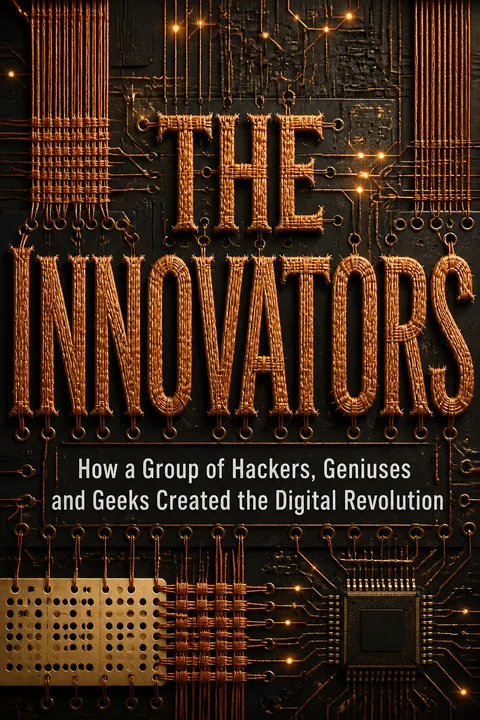
The Innovators is praised as an engaging history of the digital revolution, tracing key figures and collaborations from Ada Lovelace to modern tech giants. Readers appreciate Isaacson's storytelling and insights into innovation, though some find technical details challenging. The book highlights teamwork in technological progress and explores the intersection of arts and sciences. While comprehensive, some reviewers note an American-centric focus and occasional dry sections. Overall, it's considered an important work on the evolution of computing and the internet.
People Also Read









Glossary
poetical science
art joined to scienceAda Lovelace’s description of an approach that combines mathematical and scientific work with imagination and a sense of beauty. In the book, the term captures her ability to see that a calculating machine might manipulate symbolic representations of music, words, or other information, not only numbers.
Turing machine
model of a universal computerAlan Turing’s theoretical model of a machine that reads symbols, follows a finite set of instructions, and can perform any computation defined by a suitable procedure. Turing developed it while examining whether a mechanical process could decide mathematical questions. Its wider significance was the idea of a single general-purpose machine that could carry out many different tasks.
stored-program computer
computer stores its instructionsA computer architecture in which program instructions and data are held in the machine’s memory. Instead of manually rewiring a computer for each new task, users can load or modify instructions electronically. The design made computers much easier to reprogram and helped turn them into general-purpose machines.
Moore's Law
trend in chip capacityGordon Moore’s observation that the number of components that could be placed economically on an integrated circuit had been rising rapidly, initially at about a doubling per year. He later revised the expected pace to about every two years. The trend became both a forecast and an industry target for building more powerful chips at lower cost.
packet switching
messages travel as packetsA network method that divides messages into small units called packets. Each packet carries routing information and can travel through available network links independently. At the destination, the packets are reassembled into the original message. This approach uses shared lines efficiently and can keep communication moving when some links are unavailable.
TCP/IP
protocols connecting networksThe paired Internet protocols developed by Robert Kahn and Vint Cerf to let different packet-switched networks communicate. Internet Protocol specifies addressing and routing information for packets. Transmission Control Protocol helps ensure that packets arrive and are reassembled in the correct order, with missing information requested again.
Request for Comments
open technical proposalsA series of documents used by Internet developers to circulate proposed standards, questions, and technical decisions for discussion. Steve Crocker chose the deliberately modest name to avoid suggesting that a small group had authority to dictate rules. The process encouraged participation and helped establish a collaborative culture for developing Internet protocols.
man-computer symbiosis
human-machine collaborationJ. C. R. Licklider’s term for a close working partnership between people and computers. Humans contribute goals, hypotheses, interpretation, and judgment; computers handle calculations and other routinized operations. The idea contrasts with building machines primarily to replace human intelligence and emphasizes designing systems that help people think and act more effectively.
commons-based peer production
voluntary shared creationA production model in which people coordinate contributions to a shared resource without depending solely on market prices or managerial commands. The book applies the idea to projects such as Wikipedia and open-source software. Contributors may participate for varied reasons, including learning, recognition, community, or the satisfaction of improving something others can use.
Turing Test
test of conversational imitationAlan Turing’s proposed test for machine intelligence. An interrogator exchanges written questions and answers with a human and a machine, without seeing either, and tries to identify which is which. Turing argued that if the machine’s responses cannot reliably be distinguished from a person’s, insisting that it does not think becomes difficult. The test remains debated because imitation may not establish understanding.
FAQ
What's The Innovators about?
- Focus on Collaboration: The Innovators by Walter Isaacson explores the collaborative nature of the digital revolution, emphasizing that it was not the result of individual genius but a collective effort.
- Historical Context: The book chronicles contributions from key figures like Ada Lovelace and Alan Turing, highlighting teamwork and cultural forces that shaped technological advancements.
- Innovation Process: Isaacson delves into how creativity thrives in environments that encourage collaboration, showing that many technological breakthroughs stem from shared ideas.
Why should I read The Innovators?
- Understanding Digital Revolution: The book provides a comprehensive overview of the digital age's history, essential for anyone interested in technology and its evolution.
- Inspiring Stories: It offers engaging narratives about influential figures, such as Ada Lovelace and Alan Turing, which can inspire future innovators and entrepreneurs.
- Lessons on Teamwork: Emphasizing collaboration over individualism, the book offers valuable insights into how teamwork can lead to groundbreaking innovations.
What are the key takeaways of The Innovators?
- Collaboration is Key: Most significant technological advancements result from teamwork rather than the efforts of lone inventors.
- Interdisciplinary Approach: Combining arts and sciences is crucial, as seen in the works of innovators like Steve Jobs, who valued aesthetics in technology.
- Cultural Impact: Social and cultural forces, including government support and community-driven initiatives, create fertile ground for innovation.
Who are the main figures discussed in The Innovators?
- Ada Lovelace: Regarded as the first computer programmer, she envisioned a future where machines could manipulate symbols beyond mere numbers.
- Alan Turing: A pivotal figure in computer science, Turing developed the concept of a universal machine and contributed to breaking German codes during WWII.
- Bill Gates and Steve Jobs: Their rivalry and collaboration in personal computing are explored, showcasing how their different approaches shaped the technology landscape.
What is Ada Lovelace's contribution to computing as described in The Innovators?
- First Computer Programmer: Lovelace is credited with writing the first algorithm for Charles Babbage's Analytical Engine, pioneering programming.
- Visionary Insights: She foresaw that computers could go beyond calculations, likening them to a loom weaving patterns.
- Concept of Subroutines: Lovelace introduced subroutines, essential for programming, allowing for code reuse and modular programming.
How does Walter Isaacson define innovation in The Innovators?
- Collaborative Creativity: Innovation thrives on collaboration, where ideas are shared and built upon, rather than the result of solitary genius.
- Cultural Ecosystem: A supportive environment is crucial for breakthroughs, with social and cultural forces providing the atmosphere for innovation.
- Interdisciplinary Connections: True innovation often occurs at the intersection of different fields, combining technical skills with artistic sensibilities.
How does The Innovators explain the development of the internet?
- ARPANET Origins: The book details the creation of ARPANET, the precursor to the internet, funded by the military to facilitate communication between research centers.
- Key Contributors: Figures like J.C.R. Licklider, Bob Taylor, and Larry Roberts played crucial roles in developing concepts and technologies leading to the internet.
- Decentralized Network Design: The decentralized architecture of ARPANET made it resilient and adaptable, a principle foundational to the internet today.
What role did Xerox PARC play in the development of personal computing?
- Innovative Research Center: Xerox PARC developed key technologies like the graphical user interface and the computer mouse, crucial for personal computing.
- Collaboration and Creativity: The collaborative environment at PARC fostered creativity and experimentation, serving as a model for future tech companies.
- Commercial Missed Opportunities: Despite its innovations, Xerox failed to capitalize commercially, allowing companies like Apple and Microsoft to lead the market.
How does The Innovators address the concept of artificial intelligence?
- Turing's Perspective: Alan Turing's contributions to AI, including the Turing Test, are discussed, challenging the notion that machines cannot think.
- Limitations of AI: While machines can process information rapidly, they lack true understanding and creativity, a distinction critical in AI discussions.
- Human-Machine Collaboration: The future of AI lies in collaboration between humans and machines, enhancing creativity and problem-solving.
What impact did the Internet have on innovation according to The Innovators?
- Facilitating Collaboration: The Internet transformed collaboration, allowing unprecedented levels of communication and idea-sharing, accelerating innovation.
- Access to Information: It democratizes access to information, enabling more individuals to contribute to innovation, empowering a new generation of creators.
- Open Source Movement: The rise of open-source collaboration led to significant advancements in computing, emphasizing the importance of shared knowledge.
How does The Innovators illustrate the importance of teamwork in innovation?
- Examples of Successful Teams: Stories of teams at Bell Labs and Xerox PARC show how collaboration led to groundbreaking innovations.
- Shared Vision and Goals: Effective teams share common visions and goals, driving their collaborative efforts and fostering creativity.
- Learning from Each Other: Teamwork allows individuals to learn from one another, enhancing skills and perspectives, vital for sustaining innovation.
What are the best quotes from The Innovators and what do they mean?
- “The history of innovation is a history of collaboration.”: This encapsulates the book's central theme that teamwork and shared ideas are fundamental to technological progress.
- “Creativity is not a solitary act.”: Innovation often arises from collective efforts, challenging the myth of the lone inventor.
- “The most imaginative innovators of our time turned disruptive ideas into realities.”: Highlights the importance of vision and creativity in transforming ideas into practical technologies.
About the Author
Other books by Walter Isaacson








Download PDF
Download EPUB
.epub digital book format is ideal for reading ebooks on phones, tablets, and e-readers.








