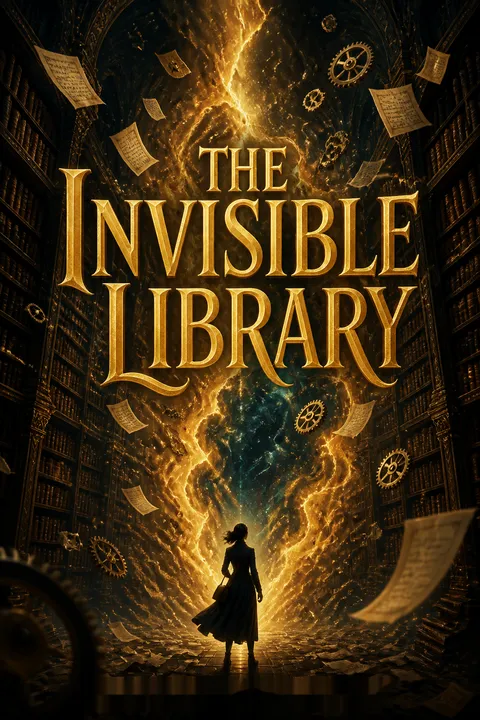


Plot Summary
The Servant's Escape
At a boys’ school that teaches the dark arts, Librarian Irene poses as a cleaning maid while searching for a rare manuscript. She finds it in the trophy room, but the alarm exposes her theft. A quick lie sends the school’s attention toward an invented burglar, buying her a head start before the gargoyles and hellhounds take up the chase.
Irene uses the Language, the Librarians’ power to command reality, to stop the stone creatures and burst a fire hydrant against the hound pursuing her. She locks herself inside the school library and opens a passage to the Library, escaping with the book. The manuscript proves to be a fairy tale, not a practical guide to necromancy, a reminder that stories are the real prize.
The opening defines Irene through the peculiar combination that will carry her through the novel: she is a tactical thinker, but her deepest attachment is not to danger or authority. It is to books as made things, each one a singular record of imagination. Her escape makes the Library’s abstract power physical, while her improvised lies and commands show that rules alone cannot protect her. She survives by reading the room as carefully as she reads a page. The book’s fictional form also establishes the novel’s central question: stories are not merely collectible objects when other powers believe they can alter reality.
A Trainee and Grimm
Back in the Library, Irene expects to deliver her prize and rest. Instead, her supervisor, Coppelia, assigns her to mentor Kai, a striking trainee who has spent five years in the Library and is eager to leave it. Their first task is to retrieve an 1812 Grimm manuscript from an alternate London.
Irene discovers that the world is quarantined for severe chaos: folklore creatures and strange technology have begun to distort its ordinary laws, and no dragons are recorded as containing the disorder.
Kai, raised in a different kind of world and trained in combat, treats the assignment as a chance to prove himself. Irene sees the danger more clearly, but Coppelia has supplied little explanation, leaving mentor and trainee to enter a hazardous mission with uneven knowledge.
The assignment sets up a conflict between two kinds of experience. Irene knows the Library’s procedures and the cost of chaos; Kai understands exclusion, risk, and the frustration of being kept from the life he once had. Their difference is not simply seniority. Irene’s sense of belonging is institutional, while Kai’s is unsettled and personal. Coppelia’s carefully limited briefing makes the Library itself part of the mystery: its agents are asked to serve an institution that does not always explain its purposes. The quarantined world then externalizes that uncertainty, making reality itself unreliable.
Bradamant's Bridge Challenge
As Irene and Kai cross the Library toward their exit, senior Librarian Bradamant intercepts them and demands the assignment, even offering to take Kai as well. Irene refuses, aware of Bradamant’s reputation for leaving students to shoulder blame.
The confrontation confirms that the mission has political stakes beyond the simple recovery of a book. At the authorized entrance, Irene and Kai meet Dominic Aubrey, the Librarian stationed in London. He explains that the book belonged to a dead collector, Lord Wyndham, who was a vampire, and vanished after Wyndham was murdered.
A glamorous cat burglar named Belphegor was seen fleeing the house. Dominic also describes a city of zeppelins, experimental machines, and supernatural factions, then supplies disguises and research notes. The pair enter with more leads than answers.
Bradamant introduces professional rivalry as a danger distinct from the monsters in the alternate. Irene’s refusal is grounded in responsibility: she will not surrender a junior simply because a senior has leverage. Dominic’s briefing converts the assignment into a detective plot, but the competing stories around Wyndham’s death prevent a clean division between fact and rumor. The city’s theatrical technology and supernatural inhabitants are not decorative world-building; they make evidence unstable. Irene must learn to distinguish genuine clues from a world that naturally encourages people to perform roles.
Silver's Golden Invitation
On arrival, Irene sends Kai to investigate the Liechtenstein ambassador while she searches Wyndham’s abandoned house. She finds a cold-iron safe hidden behind a painting and is interrupted by Lord Silver, a predatory Fae whose gloved hand burns when he touches the iron.
Silver wants the missing Grimm book too. Irene pretends to represent a secret society, persuading him that cooperation may help them both, and he gives her an invitation to the embassy ball.
Inside the safe, she finds Belphegor’s calling card, but its location makes the burglar’s guilt uncertain. Silver leaves with papers and a warning that he expects Irene at the ball. She has gained access to the most powerful Fae in London, but only by letting him believe she can be used.
Irene’s encounter with Silver turns performance into a survival skill. She recognizes that he sees people as roles in a drama centered on himself, so she offers him the part he expects: a subordinate with useful information. The cold-iron safe gives that performance a material basis, exposing a vulnerability beneath Silver’s glamour. Yet the calling card inside complicates rather than solves the murder. In this world, a clue can be staged, misplaced, or incorporated into someone else’s story. Irene’s investigative method must therefore account for the motives behind appearances.
Vale Joins the Hunt
Kai returns with news that Liechtenstein is a Fae stronghold and that Silver has held his post for decades. Before Irene can make sense of it, detective Peregrine Vale approaches them at dinner. He has followed Kai’s inquiries and recognizes that both parties are investigating the Fae.
A mechanical centipede bursts into the street, apparently targeting Vale; he disables it with an electrified sword, while Irene knocks down a disguised attacker trying to steal her bag. Vale connects the assault to the Fae and proposes an alliance.
Irene agrees, seeing that his access to London’s police and society can move their investigation forward. The attack also reveals that their cover is compromised, so she and Kai abandon their hotel and arrange to meet again after losing their followers.
Vale brings a disciplined, local intelligence into a mission that has so far depended on Irene’s improvisation. His deductions make him useful, but they also threaten the secrecy that protects her work. The mechanical centipede and attempted theft show how danger in this London often arrives in public, disguised as spectacle. Irene’s choice to cooperate is pragmatic rather than sentimental, though her growing respect for Vale complicates that distinction. Kai, meanwhile, is no longer merely the trainee being managed: his independent investigation has attracted the detective who may become their best ally.
Alberich's Warning Spreads
While evading the men tracking her through Covent Garden, Irene feels the Library’s mark burn and sees the same message appear across newspapers and printed goods: beware Alberich. She recognizes the name as that of a renegade Librarian who betrayed the institution and allied himself with chaos.
The warning makes the pursuit more than a London crime case. Irene reaches Kai, and they hide in a cheap hotel rather than return to their exposed rooms. The next morning they go to Dominic’s office, where they discover a human skin preserved in vinegar, still bearing the Library mark.
Before they can report the apparent murder, a chaos-powered trap catches Irene’s hand when she tries to open the Library door. Kai breaks the chain feeding the trap, freeing her but leaving her badly burned and cut off from the Library.
The warning collapses the distance between institutional legend and immediate danger. Irene has treated Alberich as a cautionary story, but the message and Dominic’s preserved skin make that refusal impossible. The trap also attacks the very means by which Irene ordinarily controls risk: her access to the Language and the Library. Kai saves her by noticing that the chain, not the lock alone, completes the trap’s power circuit. Their partnership begins to shift from supervisor and novice toward mutual dependence, though Irene still tries to preserve her composure as leader.
Vale's Terms of Trust
Kai carries the injured Irene to Vale’s rooms, where the detective shelters them and admits that Wyndham’s murder may connect to other stolen books and an explosion beneath the Opera. Vale is also investigating a family journal taken from his estranged family.
Irene decides he is too perceptive to manage with a partial cover story, so she explains that she and Kai serve a Library between alternate worlds. She tells him their target is the Grimm volume and identifies Alberich as their enemy, but withholds what she does not know about the book’s wider significance.
A test of her connection to the Library makes her bandages ignite and confirms that chaos still contaminates her. Unable to escape through the Library, Irene proposes attending Silver’s ball, using the invitation she secured to investigate the ambassador directly.
Trust here is a calculated risk, not a sudden surrender of secrecy. Irene tells Vale enough to make cooperation possible, while the gaps in her account reveal how little even a trained Librarian understands about her institution’s larger aims. Her injury makes the choice more consequential: she cannot simply retreat if the alliance fails. Vale’s own family history gives him reason to sympathize with divided loyalties, yet his questions about the Library’s authority foreshadow a genuine ethical dispute. He is not merely a tool for Irene’s mission; he has his own stake in what the book means.
Alligators at Silver's Ball
At the embassy ball, Irene and Vale gather rumors while Kai speaks with the elderly society insider Olga Retrograde. Bradamant appears unexpectedly, but before Irene can learn why, metal-armored alligators crash into the ballroom. Silver’s magic cannot stop them because cold iron protects their control devices.
Irene’s contaminated Language only locks one creature’s legs, sending it sliding toward her, so Kai rescues her and fights beside Vale. Irene asks Bradamant to use the chandelier’s electricity to disable the alligator mechanisms; the plan works, though guests and animals are killed.
When the police arrive, Silver identifies Bradamant as Belphegor and accuses her of stealing Wyndham’s book. Bradamant is taken for questioning, but first binds herself to return the book to Irene. Irene leaves with Vale and Kai, without knowing whether Bradamant is criminal, ally, or both.
The ball converts a social investigation into bodily catastrophe. Silver’s power fails against a prepared countermeasure, while Irene’s own ability is compromised by the chaos trap. She survives not by mastering the scene but by delegating: Bradamant supplies the working power, Kai protects her, and Vale fights. That dependence is emotionally difficult for a protagonist invested in competence. The identification of Bradamant as Belphegor makes the rivalry newly concrete, while her oath offers a narrow bridge between distrust and cooperation. The scene also exposes the cost of treating people as pieces in a dramatic contest.
Kai Commands the Thames
On the ride from the ball, Alberich takes control of Vale’s cab and seals its doors and windows, driving it toward the Thames. Irene recognizes that the chaos binding must be broken from within.
She defines herself in the Language as a Librarian, forcing the contamination out of her body; the expelled force shatters the cab, but the three passengers are left underwater. Kai calls on the river, which carries them safely to shore and reveals his true nature as a dragon. Vale recoils at the power in his city, while Irene steps between the men and insists Kai acted to save them.
Back at Vale’s home, she explains the Library and Alberich more fully, then links the book-filled rooms to the Library for protection. Kai and Irene agree to postpone their personal questions until the immediate threat is contained.
The river rescue changes the balance between Irene and Kai. Her recovery depends on an unprecedented act of self-definition, while his intervention exposes a nature he had carefully concealed. Each saves the other in a different register: Irene breaks the chaos binding; Kai commands the physical world. Vale’s alarm reflects the novel’s insistence that lawful power can be as unsettling as chaos. Irene’s decision to defend Kai and keep him within their working relationship marks a move beyond purely procedural loyalty. Still, she avoids a full reckoning with what his disclosure asks of her.
Bradamant's Poisoned Pin
The next morning, Bradamant joins Irene, Kai, Vale, and Inspector Singh, then admits she stole several books to disguise her attempt to take the Grimm volume. The copy she removed from Wyndham’s house was a fake; the real book must have been hidden elsewhere.
Singh’s records show Wyndham had a forgery made and sent a parcel to the Natural History Museum shortly before his death. At the museum, the parcel’s ledger reveals that the package was forwarded to Dominic Aubrey’s office. Bradamant stabs Irene with a curare-laced hatpin and leaves her behind, intending to claim the book first.
Vale and Kai revive Irene with a stimulant. She realizes the apparent Dominic they met may have been Alberich wearing the real Librarian’s skin, and that he has not found the book because he has not checked the incoming mail.
The investigation succeeds through the correction of a false object: Bradamant stole a convincing imitation, and the real book moved through ordinary institutional channels. The ledger is more valuable than dramatic testimony because it records a mundane chain of custody. Bradamant’s betrayal echoes her earlier professional rivalry, but now Irene can see its cost without reducing the woman to a simple villain. Her own deduction about Dominic’s skin emerges from accumulated inconsistencies, not a miraculous flash of intuition. Even drugged and helpless, Irene remains an investigator; she converts vulnerability into a usable hypothesis.
The Book Beneath the Dust
Vale and Kai find Irene and help her pursue Bradamant. At the museum, she turns stuffed animals against the werewolves chasing them, buying time to reach the roof. The trio commandeers a zeppelin and races toward the British Library, pursued by a flying attacker whose weapon chews through the airship.
Vale coordinates a dangerous landing, and Irene throws herself at Kai to save him from the final burst of metal. In Dominic’s office, they locate Wyndham’s package, and the 1812 Grimm volume contains the identifying eighty-seventh tale.
A swarm of silverfish then floods the room, drawn by a concealed machine. Irene spots the wire, and Kai smashes the device, stopping the swarm. Before they can escape, the woman who warned them about the insects takes Vale hostage and reveals herself as Alberich.
Irene’s desperate use of the Language to animate museum specimens is a deliberate departure from her preference for commands that follow nature. The action saves the group but makes her power ethically and practically difficult to contain. The zeppelin chase intensifies that cost: Vale’s judgment, Kai’s strength, and Irene’s reflexes all become necessary, and she risks herself to prevent Kai’s death. The real manuscript is finally within reach, yet its recovery immediately triggers another trap. Alberich’s reveal underlines the story’s most persistent danger: identity itself can be counterfeited, so competence depends on questioning even helpful appearances.
Library Against Alberich
Alberich holds Vale at knifepoint and demands the Grimm book and Irene’s birth-name. Irene sends Kai outside, disguising a warning to establish a dragon ward around the building. She delays Alberich with a false report, then acknowledges that Wyndham sent the book to Dominic.
Alberich admits he arranged Wyndham’s murder through the Iron Brotherhood and replaced Dominic after killing him. He offers Irene power to change worlds, but she refuses to pledge herself to him. Bradamant returns and shoots Alberich, yet the bullets only slow him.
When he prepares to unleash chaos, Irene commands him out of Jennifer Mooney’s stolen skin. His inhuman body is exposed, and Irene carves the Library’s mark into the floor with a shard of glass. The Library’s order drives Alberich toward Kai’s barrier and expels him from the alternate.
The climax makes Irene’s central choice more demanding than simple loyalty to the Library. Alberich’s offer names a real temptation: using preserved knowledge to intervene in worlds rather than merely collect their stories. Irene refuses because his promised reform is inseparable from coercion, murder, and self-aggrandizement. Her victory depends on combining systems rather than overpowering him: Bradamant’s gun, Kai’s boundary, and the Library’s authority each do something the others cannot. By using Alberich’s dependence on a stolen identity against him, Irene turns the novel’s recurring concern with performance into a tactical answer.
The Eighth-Eighth Story
With Alberich gone, Irene, Kai, and Bradamant confirm the genuine book and read its last tale. It describes a Library brother and sister; the brother discovers a secret in the mark on his back, leaves the Library, and turns against it.
A century later, his sister returns pregnant, and the Library hides her child in its deepest vaults. The story points toward Alberich’s personal motive and the possibility that his pursuit concerns his sister and her child, not only power over this alternate.
Irene returns to the Library badly injured, where Coppelia confirms Alberich cannot re-enter the world through chaos. Rather than let Irene rest, Coppelia assigns her to remain in London as Librarian-in-Residence and investigate the remaining questions. Kai stays with her, and Irene accepts the uncertain work ahead.
The final tale turns the book from an object of competing claims into a mirror held up to the Library’s own history. Its fairy-tale structure compresses an institutional secret into family relationships, suggesting that the Library’s supposedly neutral preservation has concealed human costs. Irene gains a motive for Alberich but not a complete explanation, so the ending preserves uncertainty instead of sealing the mystery. Coppelia’s assignment is both punishment and recognition: Irene is asked to keep investigating precisely because she has begun asking questions her institution prefers to leave unanswered. Her new post binds professional duty to a more personal appetite for truth.
Analysis
The novel’s central tension is not simply between a secret library and a rogue thief. It is between preservation and intervention. Irene begins with a clear professional conviction: the Library exists to save books, not to govern worlds or impose its idea of improvement. Alberich attacks that conviction by offering a more active purpose, and Vale makes the question harder by asking who authorized the Library to take what it wants. The book does not dismiss these challenges. Its resolution instead distinguishes the desire to help from the willingness to dominate. Alberich’s promised better worlds are inseparable from coercion, violence, and the assumption that his judgment should rule everyone else.
Books function as both evidence and living connections. Wyndham’s fake and real Grimms, the manuscript’s concealed route through the museum, and its final tale make reading an investigative act: details must be checked, provenance traced, and stories compared against what people claim. Yet fiction is not merely a passive record in this cosmology. The worlds themselves can move toward narrative patterns, and a book with a particular connection may matter beyond its pages. The Library’s collecting therefore has consequences, even when its agents insist that they are only preserving texts.
Irene’s development is measured by whom she allows into the case. At first, she relies on disguise, procedure, and compartmentalized knowledge. As danger strips those protections away, she tells Vale enough to secure cooperation, accepts Kai’s power without demanding ownership of his secret, and seeks Bradamant’s help when survival requires it. These choices do not make her suddenly trusting or morally certain. They make her more capable of acting amid incomplete information. The ending gives her a new post rather than a final answer, suggesting that responsibility begins where obedience stops being sufficient. Irene remains a Librarian, but she is now also an investigator of the institution that formed her.
Review Summary
Reviews for The Invisible Library are mixed, averaging 3.74/5. Many readers praise its imaginative premise—a secret interdimensional library staffed by spy-librarians collecting rare books across alternate realities—alongside its steampunk Victorian setting, witty humor, and enjoyable characters like Irene, Kai, and Vale. Critics highlight weak worldbuilding explanations, flat characterization, inconsistent pacing, and an overstuffed plot. While fans compare it favorably to Doctor Who and Thursday Next, detractors find the writing bland and the story underwhelming. Most agree the series shows strong potential for growth.
People Also Read






Characters
Irene
Book-hunting LibrarianIrene is a field Librarian raised around the institution she serves, and her love of books is more intimate than any abstract commitment to power or prestige. She is observant, strategic, and adept at adopting a cover identity, yet her composure can conceal uncertainty rather than resolve it. As a mentor, she tries to protect Kai without turning him into a passive instrument. Her professional instincts push her toward secrecy and efficient completion; her relationships with Kai and Vale gradually make those habits harder to maintain. Irene’s defining tension is between her genuine faith in the Library and her emerging curiosity about what its rules leave unsaid.
Kai
Restless new recruitKai joins Irene’s mission after years of training and enforced waiting in the Library. He is physically capable, socially adaptable, and alert to danger, but his ease can shade into impatience when he feels managed or underestimated. His background outside the Library gives him a sharper sense of what its rules cost: time, relationships, and the possibility of returning to a changed home. He respects loyalty and family in ways that initially make him judge Vale harshly. With Irene, he alternates between flirtation, defiance, and earnest care, testing whether their professional bond can hold alongside their growing trust.
Peregrine Vale
London's relentless detectiveVale is an aristocrat turned private detective whose intelligence is built on patient observation, inference, and a willingness to pursue uncomfortable conclusions. He is courteous without being compliant and treats Irene’s explanations as claims to be tested, not truths to accept. His estrangement from his family informs his attention to inherited obligations and the moral cost of leaving them behind. Vale is drawn into the case through both professional curiosity and a personal connection to a stolen family book. His relationship with Irene develops through mutual usefulness, disagreement, and a growing respect that neither can reduce to simple convenience.
Bradamant
Rival field LibrarianBradamant is an experienced Librarian who values results, status, and control over how a mission unfolds. She is polished, perceptive, and comfortable using social performance as a tool, but her confidence carries a history of resentment toward Irene. Their antagonism is shaped by a past mentorship in which Irene felt manipulated and blamed. Bradamant’s professionalism is real, even when her methods strain the bonds of trust between colleagues. She sees Irene as privileged and insufficiently ruthless, while Irene sees Bradamant as dangerous to work beside. Beneath their rivalry lies a shared devotion to the Library, though neither finds it easy to acknowledge.
Alberich
Renegade LibrarianAlberich is a feared former Librarian associated with chaos and with the violent disappearance of agents who cross his path. Even before Irene encounters him, his reputation shapes her decisions and makes the Library’s warning feel like a sentence already delivered. He is patient enough to exploit institutions and identities, but his ambition is also personal, driven by a history the Library has kept obscure. Alberich frames intervention as a means of improving worlds, which makes him more unsettling than a villain seeking power for its own sake. His challenge forces Irene to examine both the uses of knowledge and the authority of the Library.
Coppelia
Irene's exacting mentorCoppelia is Irene’s supervisor, mentor, and a senior Librarian with a talent for managing both people and institutional risks. She can be warm, dryly funny, and fiercely demanding, often blending affection with evaluation. Her assignments reveal that she values Irene’s capabilities even when she withholds information or declines to explain the larger strategy. Coppelia embodies the Library’s layered authority: protective toward younger agents, but not wholly transparent about what she knows.
Dominic Aubrey
London's resident LibrarianDominic is the Librarian assigned to London, working under cover in the British Library’s manuscript department. Scholarly and mildly nervous, he enjoys explaining the world’s unusual balance of technology, supernatural forces, and chaos. He supplies Irene and Kai with practical background and local identities, giving them a crucial foothold in the investigation. His role connects the Library’s distant bureaucracy to the immediate, physical risks of the alternate.
Lord Silver
Fae ambassadorSilver is the Liechtenstein ambassador and a powerful Fae whose charm carries an unmistakable threat. He treats social life as a stage and expects others to play roles in the drama he imagines himself directing. His interest in the Grimm book is entangled with his volatile relationship with Lord Wyndham and his rivalry with other factions. Silver’s glamour makes him persuasive, but his aversion to cold iron exposes the limits beneath his performance.
Inspector Singh
Police investigatorInspector Singh is a disciplined officer on exchange in London, suspicious of the Fae and attentive to the political machinery behind crime. He keeps records, cultivates informants, and distinguishes evidence from speculation even when the supernatural intrudes. His working relationship with Vale gives the investigation access to police knowledge, while his reserve toward Irene and Bradamant reflects a professional caution about outsiders.
Olga Retrograde
Society's keeper of secretsThe elder Olga Retrograde is a retired woman of pleasure and a formidable source of London gossip. She understands that information has a price and approaches new acquaintances with both curiosity and commercial instinct. Her knowledge makes her useful to people navigating high society, but her self-interest means no one can assume that she is a neutral informant.
Lord Wyndham
Vampire book collectorWyndham is a wealthy vampire and collector who keeps rare books largely for ownership and display. His murder and the disappearance of his Grimm volume set the investigation in motion. His dealings with Silver and his efforts to conceal the book make him a central absence around which the living characters form competing theories.
Plot Devices
The Language
Commands reality through wordsThe Language is the Librarians’ means of issuing precise commands to the world. It works most reliably when a command reinforces an object’s nature, such as opening a lock or stopping stone from moving. More unnatural instructions meet resistance and can cause dangerous consequences, especially when the speaker lacks precise vocabulary or is affected by chaos. Irene uses it to escape pursuit, defeat traps, and finally oppose Alberich. Its limits keep the power from becoming an effortless solution and make language itself a form of tactical judgment.
The Invisible Library
Preserves books across worldsThe Library exists between alternate worlds and sends agents to collect unique books, especially works of fiction that differ from one world to another. Doors connect it to particular places, but those connections can be blocked by chaos or accessed only by trained Librarians. The institution presents itself as a preserver rather than a ruler, and its neutrality shapes Irene’s professional identity. As the mission grows, the Library’s limited explanations and internal politics make its purpose less simple than its agents are taught to believe.
Order and Chaos
Makes alternate worlds unstableThe linked worlds sit along a spectrum between order and chaos. Chaos can distort ordinary laws, encourage supernatural beings to manifest, and interfere with a Librarian’s powers or access to the Library. Fae embody chaotic forces, while dragons are aligned with order and the physical world. The London assignment is dangerous because neither force fully contains the other. This cosmology provides the rules behind the vampires, Fae glamour, strange machines, Irene’s contamination, and the allies’ eventual defense against Alberich.
Grimm's Hidden Tale
Makes a rare book personalThe sought-after Grimm volume is identified by a particular story missing from ordinary copies. Its significance is not simply that it is rare: its final tale describes a brother and sister connected to a Library beyond the worlds. The manuscript shifts the mission from a contest over an artifact to a question about Alberich’s history and the Library’s concealed past. Because the tale offers clues rather than complete answers, it resolves the immediate pursuit while leaving Irene with new questions.
Stolen Skins
Conceals identity in plain sightIn the chaos-infested alternate, identity can be appropriated through the theft of a person’s skin. The preserved Librarian mark makes Dominic’s apparent death horrifying, while the characters initially lack enough evidence to understand what it means. The device turns a familiar source of trust, a colleague’s face and manner, into unreliable evidence. It also prepares the final confrontation, where Alberich’s dependence on another person’s skin becomes a vulnerability rather than merely a disguise.
Download PDF
Download EPUB
.epub digital book format is ideal for reading ebooks on phones, tablets, and e-readers.








