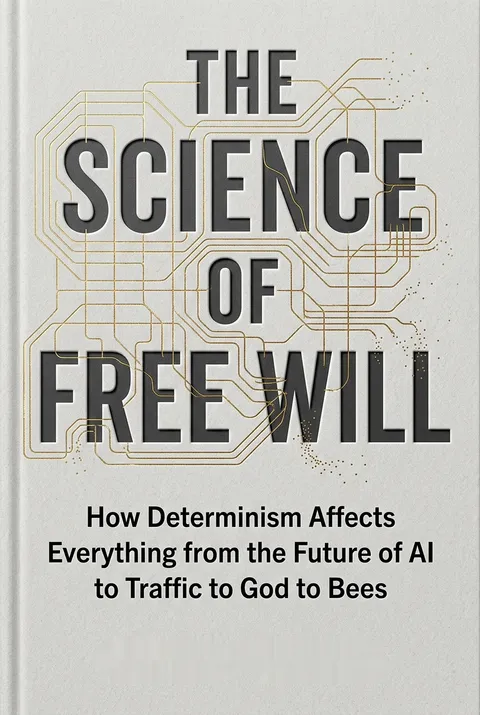


Key Takeaways
Treat free will as absent in theory but real in lived experience.
Two meanings, one debate. Varma separates Free Will In Theory (FWIT), freedom that would require breaking the physical chain of causes, from Free Will in Practice (FWIP), the inability to predict a person’s actions exactly before they happen. His opening story follows Jane, who changes her cafe order and then makes a difficult call to her brother. Neither decision disproves determinism: on Varma’s account, both arise from physical processes, yet remain unpredictable to Jane and everyone else.
Keep both levels in view. The distinction is meant to reconcile people who deny freedom under physical laws with those who experience themselves choosing. Varma argues that perfect predictability would rule out freedom, while real human behavior is never perfectly predictable. The practical experience of choosing therefore survives, even if the ultimate physical history is fixed.
The distinction is useful because it stops a metaphysical claim from erasing the familiar reality of deliberation. It also exposes a key question: does freedom mean being unpredictable, or does it mean acting for reasons and being able to respond to them? Those ideas often overlap, but they are not identical. A random event may be hard to predict without being an agent. Varma’s framework offers a clear map of the dispute, while its definition of practical freedom remains a choice of terminology, not a settled resolution of what freedom ought to mean.
Quantum probabilities do not automatically give humans control over choices.
Uncertainty is not agency. Varma argues that the physical laws underlying ordinary matter are deterministic, and that quantum probability does not by itself create a human power to choose. In his account, the wave function evolves according to deterministic equations. The Copenhagen interpretation describes measurement as a collapse to one observed outcome, but Varma treats collapse as a calculation rule rather than a controllable source of freedom.
Randomness cannot do the choosing. Even if a physical outcome were genuinely random, randomness alone would not show that a person directs it. A detector and the measured particle are both physical systems, Varma emphasizes, so measurement does not introduce a special human chooser outside nature. Quantum theory’s interpretations remain debated, but the practical point is narrower: unpredictable outcomes are not automatically evidence of intentional control.
This is a strong conceptual distinction. Chance and agency are different explanations: a coin toss can be uncertain without expressing anyone’s purposes. The argument usefully prevents the word randomness from doing the philosophical work of the word choice. Its limitation is that the book presents one interpretation of quantum mechanics with more certainty than the debate warrants. Readers can retain the central caution without accepting that quantum theory has conclusively settled determinism: indeterminacy, if present, would still need to be connected to reasons, control, and action.
A deterministic system can still defeat every shortcut to prediction.
Three barriers obstruct forecasts. Varma calls the inability to predict a system exactly the Practical Limit to Prediction, the Chaos Limit to Prediction, and the Computational Irreducibility Limit to Prediction. The practical barrier is the sheer amount of information required: predicting a person even one second ahead would involve their body and everything able to affect it within roughly one light-second, about 300,000 kilometers. Chaos makes tiny differences in starting conditions grow into large changes. Computational irreducibility means there is no shortcut to a result; the system must run.
Simple rules can hide immense complexity. Rule 110, a cellular automaton with a small set of rules for changing black and white cells, can perform any computation a universal computer can. Its output can be difficult to predict without carrying out the steps. For Varma, human choices are similarly fixed by causes but computationally out of reach.
This is the book’s most memorable bridge from physics to lived experience: deterministic does not mean forecastable. The three barriers also clarify why better data alone may not solve prediction problems. Still, the examples establish different kinds of difficulty, not one universal impossibility theorem for every human action. Some behavior is reliably forecastable in restricted settings, and useful approximate predictions are common. The framework works best as a warning against mistaking complete causal explanation for practical omniscience, rather than as proof that no meaningful prediction of people is possible.
Explain people at human scale, not only through their particles.
Useful causes come in layers. A physical account of a person describes particles and their interactions. It does not, by itself, explain why someone struck another person, whether the victim was hurt, or what a court should do. Those questions require higher-level concepts such as intention, injury, law, and responsibility. Varma calls these explanations modular: they treat complex collections of physical events as usable units, much as a programmer can use a computer chip without calculating every electron inside it.
Responsibility remains practical. If a person’s actions have physical causes, society’s responses do too. Varma argues that determinism does not prevent communities from restraining harmful conduct, setting rules, or protecting others. The proximate cause may be a person’s action; the ultimate physical history behind it is not a useful replacement for explaining the action at the level where human institutions operate.
The emphasis on explanatory levels is a valuable corrective to reductionism. A chemical description and a legal description can both be accurate because they answer different questions. This also offers a pragmatic account of responsibility: rules can shape behavior even if behavior has causes. A further distinction helps keep the issue precise. Holding someone accountable can mean protecting others, deterring harm, or supporting rehabilitation; it need not mean claiming that the person was an uncaused first mover. Whether accountability should also express deserved blame is a separate moral question.
Small disturbances can trigger traffic jams, election swings, and policy myths.
Nonlinearity defeats everyday intuition. In heavy traffic, one driver’s brief braking can trigger a slowdown that spreads backward through a line of cars. The traffic wave can persist even when no crash or obstruction is visible. Varma uses the Rule 184 cellular automaton, a simple model in which cars move forward when space is open, to show how stop-and-go patterns emerge from basic rules.
A curve is not a policy answer. The book also uses the Laffer curve, which plots tax rates against revenue. Under its simplified assumptions, a zero tax rate produces no revenue, and a 100 percent rate gives people no incentive to work, also producing no revenue. The curve must rise and fall, but those endpoints alone do not reveal the best tax rate. Revenue and economic growth are different outcomes, and their ideal rates need not match.
The traffic example makes emergent effects tangible: the visible jam can be far removed from the small event that began it. The economic example similarly asks readers to separate a mathematical possibility from a political slogan. That distinction matters because a curve’s endpoints do not tell policymakers its actual shape or where a real economy sits on it. Varma’s broader lesson about nonlinear systems is strong; specific tax conclusions require empirical evidence about behavior, institutions, and public spending, not geometry alone.
Look for intelligence in behavior, not brain size or human likeness.
Small brains can do surprising work. Varma collects studies describing bees that learn to distinguish patterns, count, and play with balls. A bee’s brain is about two cubic millimeters, yet it supports navigation, memory, and flexible behavior. He also describes a cockroach fitted with an electronic device that stimulates its antenna nerves. The insect initially turns in response, then begins ignoring the unnatural signal after about 15 minutes.
Physical patterns can still be complex. The examples support Varma’s view that minds and behavior arise from physical arrangements, not from a special substance added to matter. He also argues that the same principle applies to identity: a person remains recognizable as their cells are replaced because what matters is the continuing organization of the system, not the persistence of every original atom.
These examples widen the reader’s sense of what biological cognition can look like. They also support a useful scientific habit: do not assume that human-like abilities require human-sized brains or familiar behavior. A caution is needed, however. Learning or adapting to stimulation is evidence of flexible behavior, but it does not by itself establish consciousness or free will. The book sometimes moves quickly between those claims. Keeping them separate preserves the force of the animal examples without making them prove more than the observations can show.
Demand accountable interfaces when powerful AI internals remain opaque.
Capability can outpace explanation. Varma contrasts explicit software, whose rules are written by programmers, with statistical AI, which learns patterns from data. Systems such as AlphaFold can produce valuable results even when people cannot easily explain how the model reached them. As models grow more capable, Varma expects their internal reasoning to become harder to interpret, not easier.
Opacity changes who holds power. When an AI knows far more than its user, the gap resembles the used-car market in economist George Akerlof’s lemons example: buyers cannot judge quality, so good products may disappear alongside bad ones. Varma worries that opaque systems in areas such as sentencing, hiring, or medicine could make mistakes difficult to detect and challenge. Human oversight is not a guaranteed fix either, since people can miss machine errors or override correct outputs.
The book connects technical opacity to institutional problems, which is more useful than treating explainability as a purely engineering concern. When a decision affects someone’s liberty or livelihood, the person needs a way to contest it, even if a model’s internal logic cannot be translated into a neat story. That does not require every model to be fully transparent. Independent audits, outcome monitoring, and clear responsibility for decisions can provide other safeguards. The risk is real, but opacity should prompt stronger governance rather than the assumption that useful AI must be abandoned.
Choose your next action, then stop treating the past as editable.
Determinism is not a reason to sit still. Varma distinguishes ultimate causes, stretching back through physical history, from the immediate reasons people use to act. In daily life, effort, care, and decisions remain part of the causal chain. A person still has to study, work, or repair a relationship to discover what follows from those actions.
Regret cannot reverse an outcome. Once an event has happened, replaying it cannot change it. Varma compares this with the sunk-cost principle: money already spent should not distort a decision about what to do next. Regret can still be useful when it teaches someone how to act differently, but it cannot recover a missed chance by itself. He also argues that the universe need not supply a purpose; people can choose what gives their lives meaning.
This closing move turns determinism from a theory about the past into a practical stance toward the present. It pairs acceptance of what cannot be changed with attention to actions that remain available. That resembles a distinction in decision theory between judging a choice by the information available at the time and judging it only by its eventual outcome. The nuance is important: regret can carry information about harm, values, or avoidable patterns. The point is not to suppress it, but to convert it into learning instead of treating it as a time machine.
Analysis
The book’s central achievement is a shift in the question. Rather than asking only whether human choices escape physical causation, Varma asks whether a caused action can be predicted in advance. This makes the distinction between theoretical and practical freedom vivid, and gives computational irreducibility a starring role: a system may follow rules while producing outcomes that cannot be reached by a shortcut. Cellular automata, phantom traffic jams, animal behavior, and AI opacity all help make that abstract idea concrete.
The same shift creates the book’s main vulnerability. Unpredictability is not obviously the same property as freedom. Weather can be unpredictable, as can a complex program, but neither appears to deliberate. A human may be predictable in some situations and still act intentionally. The book’s definition captures a real feature of choice, surprise to the chooser included, but it does not settle whether agency also requires reasons, self-control, or responsiveness to alternatives.
The scientific case also needs careful framing. The book treats determinism in fundamental physics as settled and presents wave-function collapse as unnecessary. Quantum theory’s mathematical machinery is extraordinarily successful, but what it says about underlying reality remains a matter of interpretation. Probability in predictions does not establish free will, yet neither does the book’s preferred interpretation prove that all fundamental processes are deterministic. The strongest conclusion is therefore conditional: if physical events are deterministic, complexity can still make exact prediction unavailable.
The practical implications are more robust than the metaphysical certainty. Legal systems can prevent harm and shape conduct without resolving ultimate desert. AI systems can be useful while remaining difficult to explain, which makes oversight, contestability, and responsibility essential. The book is most persuasive when it separates levels of explanation and warns against confusing causation with predictability. Its boldest claims invite debate, but its central question remains valuable: what kinds of freedom matter when no one can calculate the future from outside the world?
People Also Read








Glossary
Free Will In Theory
Freedom beyond physical causesVarma’s term for free will understood as the ability to act outside the deterministic physical laws governing the universe. He argues that this kind of freedom cannot exist if every event, including human action, follows from prior physical states and laws.
Free Will in Practice
Freedom through unpredictabilityVarma’s term for the practical freedom associated with actions that cannot be predicted exactly before they occur. On his account, a person can be physically determined and still experience meaningful choice because neither the person nor an observer can calculate the action in advance.
Computational Irreducibility
No shortcut to an outcomeA property of a computation whose result cannot be found by a shorter method than carrying out its steps. Varma applies the idea to complex systems, arguing that even simple rules can generate behavior that must unfold before its outcome is known.
Principle of Computational Equivalence
Complex systems share computational powerA proposal associated with Stephen Wolfram that many systems whose behavior is not obviously simple may have equivalent computational sophistication. In the book, it supports the idea that simple rule systems, brains, and other complex processes can all produce behavior that is difficult to predict.
Practical Limit to Prediction
Too much information to modelVarma’s name for the obstacle created by the enormous amount of physical information needed to predict an event exactly. Forecasting a person’s behavior would require modeling the person and all relevant interactions with the surrounding environment, not just the person’s internal state.
Chaos Limit to Prediction
Tiny errors amplifyThe prediction barrier arising when small differences in a system’s initial conditions produce large differences in its later behavior. Varma uses chaotic systems such as a double pendulum to show why knowing the governing rules may still fail to yield reliable long-range forecasts.
Download PDF
Download EPUB
.epub digital book format is ideal for reading ebooks on phones, tablets, and e-readers.








