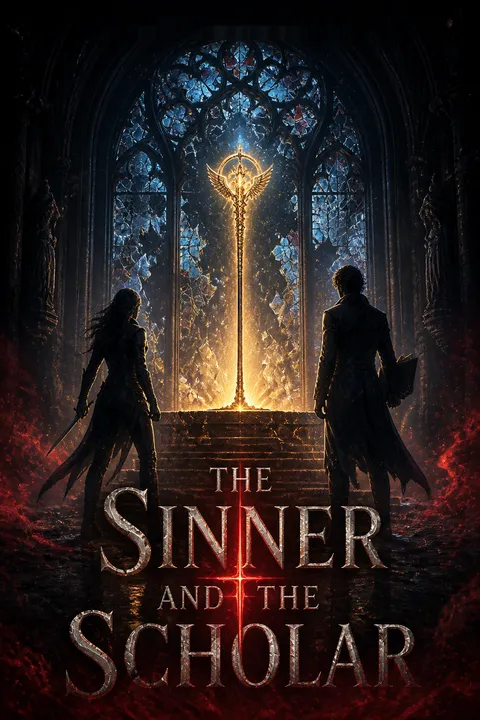


Plot Summary
Prologue
Rain falls over Cardinal City as a solitary street preacher rings a bell and warns that the seals are failing. Disease, war, famine, death, and an Antichrist will follow, the preacher predicts, while ordinary people pass without stopping.
The signboard carries a second warning on its reverse, asking passersby to reckon with their own wrongdoing. The prophecy sounds like one more stray voice in a wet city, but its sequence will gather meaning as the story moves from a single possession toward a world where evil can cross into the streets.
The prologue places apocalypse in public view and makes indifference part of the threat. The preacher has no authority that the crowd recognizes, so the warning can be dismissed as spectacle. The two-sided sign links cosmic catastrophe to personal accountability: the approaching seals matter, but so does the question of how people live before they break. This structure also prepares the novel's tension between prophecy and evidence. The warning is visible from the start, yet its meaning only becomes legible through the characters' encounters with demons, relics, and the choices that divide them.
A Demon at Purgatory
Thea, a trained assassin for the Hildegard Sisterhood, enters a nightclub called Purgatory to investigate a husband whose behavior has alarmed his wife. She clears two armed guards and a local kingpin from her path, then draws the suspected target into a dark alley. When he attacks her, his eyes turn entirely black and his voice becomes inhuman.
A crucifix confirms what she has never wanted to believe: demons are real, and so is the hell she has feared since childhood. Thea freezes, then stabs him with a blessed dagger. A dark presence escapes the dying man's body, leaving him dead and a strange symbol on his wrist. She takes his severed hand as evidence and heads home.
Thea's first encounter turns her professional certainty into spiritual terror. She knows how to bait and kill dangerous men, but possession makes her usual categories useless: the body before her is both an aggressor and a possible victim. Her pause is not cowardice so much as a collision between training and a new moral fact. The severed hand preserves the mark as evidence, while the escaping presence proves that killing a host does not necessarily end the danger. Her fear of hell also changes from an abstract burden into a practical threat that she must confront.
Five Saints Arrive
Thea returns to the abbey covered in blood and demon vomit, only to find that the Sinners' rooms have been cleared and their belongings crammed into shared cells. The Reverend Mother has concealed the reason for the change until a limousine and Raven's motorcycle reach the front steps together.
Team Saint, the Vatican's male counterpart to the Sisterhood, has come to live and work alongside them. The Sinners resent the takeover, while Wesley, the group's British scholar, privately intends to learn their organization before dismantling it.
Thea and Wesley trade distrust at their first meeting, with his curiosity about the mark on the severed hand cutting through her contempt. Their forced coexistence begins under a roof neither side trusts.
The abbey is both home and institution, so reallocating its rooms is not a neutral logistical choice. The Sinners read the cleared cells as evidence that their authority is being erased, while the Vatican presents the arrangement as support. Wesley's secret mission confirms that this mistrust has a real basis, even as the story gives him room to question the assumptions behind it. The confrontation also makes gendered power concrete: the men arrive with official legitimacy, while the women have been trained to operate in the shadows. Their shared quarters turn that political conflict into daily intimacy.
The Gospel Rejoins
After a murder of crows shatters the bathroom window, Wesley pulls Thea away from the glass and uses a marked card to drive the birds off. Thea dismisses his geomancy as a trick, but the scorched card and the vanished mark on her shoulder leave questions she cannot settle. In the archives, she finds her half-blank manuscript beside a matching leather-bound volume in Wesley's trunk.
The five Sinners press the halves together until they lock into one book, and a flash of light knocks them unconscious. When they wake, the pages are filled with a lost Gospel of Mary Magdalene and a prophecy about Sinners, Saints, relics, and breaking seals. The women hide the book from Team Saint.
The joined manuscript converts the conflict from a dispute over institutional authority into a shared encounter with evidence neither order can explain away. Only the five women who touch it participate in its transformation, linking their solidarity to a capacity they have not yet understood. The text's recovery also unsettles the Church's account of women: the lost gospel is not merely a relic but testimony suppressed by men. Thea's choice to conceal it is strategically understandable, though it repeats the secrecy that has already poisoned cooperation. The prophecy offers direction, but its ambiguity invites both insight and dangerous overconfidence.
Marks Beneath Skin
Thea skips Wesley's classes and searches the archives for meaning in the prophecy. When she finally lets him help, he identifies one symbol as Lilith's mark and another as a sign associated with Vepar and Pestilence. Thea realizes the mark she carved during a lesson had more branches than the drawing Wesley first showed her, but she will not explain why.
Wesley gives her a small protective charm, asking her to keep it on. Their arguments begin to mix with an attraction neither can manage cleanly: he offers knowledge, while she resists the vulnerability of needing it. Meanwhile, Wesley conceals his own reasons for joining the merger, including his plan to use the prophecy to find a relic for someone he loves.
Knowledge becomes an intimate exchange before either character is willing to call it trust. Wesley's scholarship gives Thea tools she lacks, yet his guarded agenda makes every act of help potentially strategic. The charm embodies that ambiguity: it is care offered by a man who still has reasons to use her. Thea's refusal to disclose her mark reflects a deeper habit of treating vulnerability as a liability. Their attraction grows through interpretation and challenge, not through a sudden escape from conflict. In this relationship, learning another person's language is inseparable from deciding whether to believe them.
Prue's Borrowed Body
That night, Thea wakes paralyzed by a presence that taunts her through a nightmare. When she breaks free, she finds her roommate Prudence feverish and grotesquely transformed, with black eyes and rotting flesh. The other Sinners see the same horror, but Team Saint and the Reverend Mother see only a sick woman.
The five women restrain Prue while Wesley draws a geomantic circle around her, containing the force inside. Father Angelotti's exorcism cannot identify or remove it, and the demon turns Prue's body against herself. The women reveal their gospel and their ability to see demons' true forms. Wesley concludes they need a higher-ranking demon's knowledge to save Prue, and proposes summoning Asmodeus.
Prue's possession exposes a perceptual divide that is also a divide in authority. The Sinners' new Sight makes them witnesses to a horror others cannot verify, so their claims risk being mistaken for panic or delusion. Their decision to tell the Reverend Mother about the gospel marks a first, costly retreat from secrecy. Yet the containment circle also shows that cooperation can work when Wesley's knowledge supports the women's physical courage. Prue is not a problem to solve at a distance; she is a friend whose body is being damaged while everyone argues over what can be seen.
Asmodeus Names a Cure
The Sinners and Wesley summon Asmodeus inside a chalk-and-salt circle. The prince of hell appears as a seductive man to the women, though Wesley sees a monstrous three-headed beast. He says an angelic relic, the healing staff of Raphael, can restore Prue's body, but he does not know where it is. He advises them to keep her in a coma while they search.
Asmodeus toys with the circle, weakening its lines while distracting the group, and Wesley breaks the seal to send him away before he escapes. The Reverend Mother authorizes the risk. Thea locates the staff in the British Museum, then prepares to travel without telling Team Saint. Wesley discovers her plan and insists on going with her.
The summoning makes expertise useful but not sufficient. Wesley can construct the circle, yet his unfamiliarity with Asmodeus lets the demon exploit their attention and nearly escape. The discrepancy between the forms seen by the Sinners and Wesley deepens the novel's concern with perception: even competent witnesses do not share a single reality. Asmodeus provides a lead rather than a solution, forcing the group to act under uncertainty. Thea's decision to leave secretly shows that she still equates responsibility with solitary action, while Wesley's insistence on accompanying her begins to challenge that reflex.
Across Cardinal City
On the journey to Cardinal City, Thea learns why Wesley hunts demons: at twelve, he watched one drag his uncle into hell, and the Church later gave him a way to study what others dismissed. He learns more about her loneliness and her fear that her life as a Sinner leaves no place for a family.
Their fragile closeness breaks when they rescue a puppy from traffic and briefly pretend to be its parents; Thea mocks the hope the scene awakens in her. To reach Alice, an ex-Sinner connected to the Deadly Seven, they take back streets and try to attract the heroes by generating deadly sin. Envy's premonition brings the group to them first. Alice agrees to help and provides a private jet for London.
The journey lets each character glimpse the life the other has been trained to dismiss. Wesley's history explains his belief that knowledge can prevent another loss, while Thea's reaction to the puppy reveals a longing she has filed away as impossible. Their pretend family is both a tactical misdirection and an accidental rehearsal of intimacy. Alice's appearance connects the cloistered Sisterhood to a wider world of allies and alternatives. Thea accepts practical help, but her quick retreat from emotional hope shows that dependence still feels more dangerous to her than a demon hunt.
Rain in the Alley
Before the group can leave Cardinal City, a storm gathers around a woman in a white business suit. Thea sees the possessed figure's true shape: a diseased mermaid, with smaller fishlike demons emerging from her sores.
Wesley recognizes Vepar, the entity that took his uncle, and steps between it and Thea. Envy's lightning cannot harm the creatures, so Wesley uses holy water and a fire-bearing crucifix to weaken Vepar while Thea destroys the minions with her blessed dagger.
She kills the possessed woman to stop Vepar, then sees the demon's darkness escape. Wesley realizes the lesser demons have crossed into the physical world, something that should not be possible. Thea leaves shaken by the thought that the human host may have been innocent.
The fight escalates the stakes from individual possession to a breach in the world's underlying rules. The demonic minions are not simply manifestations inside human hosts; they can now occupy physical space. Thea's killing of the possessed woman also fractures the moral clarity that once made her work bearable. Her targets were supposed to be predators, but this host may have been an ordinary person whose body was taken. Wesley's recognition of Vepar ties his childhood trauma to the present crisis, making his protective move both tactical and personal.
The Kiss and the Texts
On the flight to London, Thea and Wesley stop treating their attraction as a game and sleep together. Afterward, Wesley withdraws, hiding the sores spreading across his palms after he touched Vepar. Thea calls Mercy for advice, then searches Wesley's phone while he sleeps. His messages to Zeke reveal a plan months in the making: Wesley helped send the lost gospel to the Sisterhood so he could follow the prophecy to the relic.
He intends to steal the staff and use it on Zeke, whose terminal illness he believes is his fault, before Thea can save Prue. The discovery turns their intimacy into another possible betrayal. At the British Museum, Thea keeps her plans to herself and watches Wesley for signs of what he will do.
The intimacy does not resolve the characters' distrust; it makes the cost of secrecy higher. Thea has long used seduction as a controlled instrument, but this encounter is different because she wants mutual care and fears what that desire exposes. Wesley's retreat revives her expectation that closeness is a prelude to abandonment. His messages confirm that his devotion to Zeke is genuine, but also that he has treated Thea's agency as an obstacle to his plan. Betrayal here is not a simple disguise for malice. It is loyalty narrowed so severely that it harms another person.
The Knife and Museum
Outside the museum, Thea confronts Wesley with the messages and stabs him in the abdomen, carefully avoiding a vital organ. He admits that Vepar has been pursuing him for years and that the charm he gave her protects its wearer from demonic influence.
Wesley was still willing to risk his life to save Zeke, but Thea leaves him in an alley and enters the museum alone. She uses a paid power-station fire to black out the city, cuts through the museum's glass roof and the relic's display case, and takes the wooden staff.
Its light fills her with an unexpected sense of wholeness. As alarms sound, she strikes two guards unconscious and escapes over the roof. On the street, she sees another preacher's warning, then returns to find Vepar looming over Wesley.
Thea's violence is both tactical and emotional. She punishes Wesley for planning to take her choice away, but her decision to leave him alive preserves the possibility that his motives are more complicated than his betrayal. The heist demonstrates the competence the Sisterhood has cultivated in her: she uses infrastructure, timing, and her physical agility to exploit a national museum's defenses. Yet the relic's response is not merely a weapon reward. Its warmth offers a bodily experience of acceptance that Thea has rarely permitted herself. The preacher's return suggests that the prophecy is now tracking the characters in real time.
The Staff Turns
Vepar uses Thea's own contemptuous words to tempt her to abandon Wesley. Thea recognizes that the demon is echoing the shame she already directs at herself and chooses to protect him. While she fights Vepar's smaller creatures, Wesley turns the rainwater to wine with a blood-powered spell, weakening the demon and freeing Thea.
She presses Raphael's staff to his wound, and its light heals him, including the old scars on his hands. Together they force Vepar to reveal the name of the demon inside Prue: Loimós Leviathan, the Horseman of Pestilence. Thea then drives the staff into Vepar, whose body breaks apart in light and ash. The pair escape before police reach the museum, carrying the relic and a name that may save Prue.
Thea's decisive change is not that she stops being capable of violence, but that she distinguishes punishment from protection. Vepar weaponizes her self-loathing by borrowing her voice; resisting the demon therefore requires her to reject a familiar account of herself. Wesley's spell and Thea's staff work together, turning their different skills into a genuine partnership. The healing does not erase the consequences of their choices, but it gives Wesley a future he thought was already lost. Learning Pestilence's name converts a vague prophecy into actionable knowledge, though the encounter leaves the larger threat unresolved.
A Safehouse Promise
At the Sisterhood's old London safehouse, Thea and Wesley compare what they know about the gospel and admit that the relic matters to her in a way it does not to him. It heals Wesley but does not close Thea's bruises and cuts. As he cleans and tends her injuries, each confesses love and describes the home they had once assumed was out of reach.
A strange creature crawls from beneath the car in the garage. Thea recognizes it as one of Vepar's fishlike minions, but her earlier strike with the staff seems to have transformed it. She names the small creature Jinx and refuses to abandon it. Wesley agrees to bring it along. Their return to the abbey is delayed by the power outage and airport congestion.
The safehouse turns the romance from an impulse into a mutual decision. Wesley's care for Thea's injuries reverses the pattern in which she assumes responsibility for everyone while refusing help herself. The staff's failure to heal her keeps the relic from becoming a simple cure-all and leaves her dependent on ordinary tenderness. Jinx extends that choice beyond the couple: Thea responds to a former enemy creature with curiosity rather than extermination. The delays also preserve suspense, since the person they hope to save remains at the abbey while the couple has found a temporary refuge.
The Wildcat Remembers
While Thea and Wesley are still travelling back, Leila takes her turn watching Prue and tries to keep herself occupied by cleaning her revolver. Zeke's return unsettles her because he behaves as if he does not recognize her. Leila finally lets him see her anger.
A memory explains its source: as children in an orphanage, she was bullied for being small and isolated, and Zeke fought the older boys who were using her teddy bear as a ball. He had given her the nickname Wildcat, a reminder that someone once saw her as more than a target. Now she believes he has forgotten the bond that mattered to her. She walks away rather than explain herself, leaving their shared past unresolved.
Leila's anger is a defense against the humiliation of having treasured a relationship that the other person may no longer remember. Her childhood memory makes Zeke's present indifference feel less like a minor insult and more like a collapse of continuity. The teddy bear and nickname function as evidence that she once received protection without having to earn it through competence. As an adult, she can fight, but she still struggles to ask for recognition directly. The scene gives the wider story a quieter counterpart to Thea and Wesley's reunion: intimacy can be injured by silence as surely as by deliberate betrayal.
The Abbey Breaks Open
Thea returns to find Prue levitating and bound, with the named Pestilence demon resisting the staff and Father Angelotti's prayers. As the ritual intensifies, Asmodeus emerges from Prue's mouth, revealing that the staff has opened his prison rather than simply cured her. Prue, badly injured, refuses further treatment and dies after Asmodeus stops her heart.
A mockingbird appears at the window, which the five women take as a sign that Prue is free. Thea uses the staff to heal Zeke, then the team discovers Jinx has followed them. In the dining hall, the nuns attack one another and the Monsignor is found crucified. Asmodeus vanishes outside. Wesley recognizes the attack as the Horseman of War beginning its work.
The ending grants no clean victory. The staff can heal, but power cannot override Prue's exhaustion or protect her from Asmodeus's decision. Her death tests the Sinners' promise to protect their own and leaves them with grief rather than a triumphant rescue. The mockingbird offers consolation, not proof, allowing faith to remain emotionally meaningful without becoming certainty. Thea's healing of Zeke turns the relic's promise into a real act of care, while the dining-hall violence immediately exposes the cost of an incomplete victory. Asmodeus's emergence and the revelation of War widen the story's conflict from possession to social fracture.
Epilogue
In another rain-soaked city street, a woman struggles forward with a bell and a warning sign as her cough worsens. People brush past her without pausing.
She collapses, and the rain washes the chalked message from her board before anyone stops to help. The prophecy's age of sin has arrived, not in a grand vision but in a crowd that keeps moving around a person in distress.
The epilogue returns to the prologue's public preacher, but turns warning into physical collapse. The crowd's indifference now carries greater weight because the novel has shown what happens when people ignore vulnerable hosts, dismissed witnesses, and signs of danger. The storm erases the message even as its prediction becomes true. This is not a resolved apocalypse but an opening of the next crisis: the world has entered the age the preacher feared, and ordinary human neglect remains one of its most visible symptoms.
Analysis
The novel makes its supernatural conflict inseparable from its institutional one. Demons exploit the same conditions that make human systems dangerous: secrecy, unequal authority, and the isolation of people who are already vulnerable. The lost Gospel of Mary Magdalene is therefore more than a prophecy engine. Its suppression gives the present crisis a history, suggesting that false accounts of women have helped preserve the divisions the demons now intensify.
Thea and Wesley embody competing survival strategies. Thea has learned to make herself useful, hard, and self-punishing; Wesley turns grief into study and then into secret plans to save the people he loves. Both strategies begin as attempts to prevent helplessness, but each can become controlling. Thea's self-reliance denies her care, while Wesley's loyalty to Zeke leads him to treat Thea's choice as expendable. Their relationship becomes meaningful when they stop confusing sacrifice with love and begin sharing risk rather than assigning it to one another.
The story also refuses to make moral clarity depend on purity. The Sinners are trained killers, yet they protect one another and recognize abuse. Saints carry expertise and spiritual authority, yet they conceal motives and misjudge the women. The possessed hosts complicate the ethics of violence further: a demon's presence does not make the human body a legitimate target. Thea's grief after killing a host shows that competence cannot erase moral injury.
Finally, the ending distinguishes victory from rescue. The staff defeats Vepar and heals Wesley, but it cannot grant Prue the future she no longer wants, nor can one recovered relic end the wider threat. The mockingbird offers comfort without certainty, while Asmodeus's arrival and the dining-hall violence reveal that the prophecy is still unfolding. The novel's central wager is not that love makes danger disappear, but that cooperation and self-forgiveness can keep fear from making the divisions worse.
Review Summary
The Sinner and the Scholar receives polarized reviews averaging 3.82 stars. Fans praise its unique blend of paranormal romance with religious themes, comparing it to Buffy and The Da Vinci Code. Readers love the badass female assassins (Sinners) forced to work with male counterparts (Saints), the enemies-to-lovers romance between Thea and Wesley, and feminist undertones challenging patriarchy. Critics cite choppy pacing, rushed romance development, insta-lust, and problematic handling of misogyny. Some felt the religious themes were heavy-handed or that the plot lacked depth. The steamy scenes and found family dynamics earn consistent praise from positive reviewers.
People Also Read




Characters
Thea
The Sinner who questionsThea is a sharp, bookish assassin trained by the Hildegard Sisterhood to use beauty, deception, and violence against dangerous men. Raised without a stable family, she treats competence as protection and guilt as something she can purge through pain. Her dry humor and command of ancient texts sit beside a private longing for safety, affection, and a life not organized around death. She is suspicious of outside authority, especially male institutions, because she has seen how easily power excuses abuse. Her defining tension is between self-reliance and the desire to trust someone without surrendering her judgment.
Wesley
The reluctant infernal scholarWesley is Team Saint's British scholar of demonology and occult history. His spectacles, pocket watch, and academic habits disguise a childhood shaped by the disappearance of his uncle and years in which adults dismissed his account of demons. He is methodical, loyal, and more physically capable than his scholarly appearance suggests, but his fear of losing people makes him secretive and self-sacrificing. Wesley believes research can turn helplessness into action. His attraction to Thea unsettles his inherited certainty about the Sisterhood, forcing him to question whether institutions can be judged apart from the people they have used.
Prudence
The wounded veteranPrudence is the oldest active Sinner, an experienced operative who helped train Thea and offered her a sense of belonging when she first arrived at the abbey. A survivor of captivity and assault, she relies on exercise, routine, and dark humor to manage what she has endured. Her affection for birds and fondness for Elvis reveal a gentler private life than her disciplined work suggests. She is an important model for Thea: practical, protective, and capable of making a younger girl feel less alone.
Mercy
The team's brazen leaderMercy is a red-haired Sinner whose humor, sexual confidence, and appetite for pleasure make her seem carefree. Beneath that performance is a decisive leader who can move quickly from teasing to operational command when danger threatens her sisters. She is protective without being sentimental and knows how to use irreverence to keep fear from taking over. Her ability to acknowledge desire without pretending it makes her pure contrasts with Thea's habit of converting longing into shame.
Raven
The psychic with a bladeRaven is a sharp-eyed Sinner with a rainbow-tipped ponytail, a cigarette habit, and psychic visions. Her apparent recklessness is paired with a strong instinct for danger and a willingness to act before others understand what she has sensed. She distrusts outsiders and rarely makes vulnerability easy to read. Raven's loyalty to her sisters is often expressed through action rather than explanation, and her private perceptions make her a bridge between the Sisterhood's practical training and the supernatural events it is only beginning to understand.
Tawny
The sweetness with teethTawny is a freckled, soft-spoken Sinner whose sunny manner can conceal a fierce temper and a history she keeps private. She tends to manage anxiety through food and withdrawal, but she is far from passive when someone she loves is threatened. Her gentleness is not innocence; it is a chosen surface over anger and pain. The tension between her sweetness and her capacity for violence makes her one of the Sisterhood's least predictable members.
Leila
The guarded weapons expertLeila is a Chinese-American Sinner, skilled with firearms and disciplined in her training. Her dry humor and need for personal space keep most people at a distance, while her precise attention to weapons gives her a sense of control. Leila carries old feelings about abandonment and recognition beneath her combative surface. She is not naturally open about affection, which makes small signs of loyalty and shared history especially important to her.
The Reverend Mother
The Sinners' stern protectorThe Reverend Mother leads the Hildegard Sisterhood with a cane, a sharp tongue, and a pragmatic understanding of its precarious position. Unlike some of her predecessors, she treats the Sinners as people rather than disposable tools. She keeps information close when she believes it will prevent conflict, though secrecy can also deepen mistrust. Her authority rests less on physical force than on knowing how to make the institution adapt without abandoning the women who depend on it.
Zeke
The haunted gunmanZeke is Team Saint's weapons specialist, a streetwise fighter whose irreverence masks profound losses. His baby sister was killed by a demon, and his years on the streets left him suspicious of institutions and wary of emotional dependence. He stays with the team despite having reasons to abandon its cause. Zeke tends to meet tenderness with jokes or provocation, but his loyalty is real, and his past connects him to people and choices he has not fully faced.
Father Francisco Angelotti
The exorcist priestFather Angelotti is Team Saint's exorcist, a muscular priest whose clerical clothes conceal tattoos and a past that does not fit conventional expectations of holiness. He is practiced in ritual, prayer, and the physical strain of confronting possession. His commitment to protecting hosts is evident in the effort he brings to his work. The Sinners initially judge him by his role and appearance, but his presence complicates their assumptions about who can serve the Church.
Saint Dominic
The team's only SaintDominic is the one member of Team Saint recognized as genuinely saintly, a quiet and physically imposing presence. He speaks little in the Sinners' company, but his attention to the group and his actions during danger show that restraint is not indifference. His role gives the team a moral and spiritual center, though the story does not reduce holiness to certainty or authority. Dominic's calm contrasts with the Sinners' suspicion and the other Saints' more visibly complicated histories.
Alice
The escaped Sinner allyAlice left the Sisterhood and now lives in Cardinal City with the Deadly Seven, while also holding a powerful position in a technology empire. She is blunt, physically formidable, and unwilling to let Thea confuse self-punishment with duty. Her perspective offers a glimpse of life beyond the abbey without pretending that leaving erases the past. Alice knows the Sinners' habits from the inside and can challenge Thea with affection rather than institutional authority.
Parker
The Deadly Seven's leaderParker is the powerful leader of the Deadly Seven and Alice's partner. He is protective of her, wary of unfamiliar people, and willing to hear Wesley out when Alice is ready to dismiss him. His place in Cardinal City's network gives the Sinners access to resources they cannot easily obtain themselves.
Asmodeus
The tempting demon princeAsmodeus is a charismatic infernal figure who treats danger as an occasion for performance and bargains as a kind of entertainment. His seductive manner conceals a calculating intelligence; he studies the people who summon him and looks for weaknesses in their boundaries. He is neither a reliable ally nor a simple monster, and his knowledge of divine objects makes him useful even when his motives remain suspect.
Vepar
The plague-bearing demonVepar is a powerful demon associated with disease, water, and the manipulation of vulnerable people. It exerts influence through fear and private taunts, often making its victims believe that their worst thoughts are true. Its connection to Wesley's childhood gives the entity a personal reach beyond the immediate supernatural crisis. Vepar's methods show how demonic power can work through psychological pressure as well as physical violence.
Mary Magdalene
The suppressed apostleMary Magdalene appears through the recovered gospel and prophecy rather than as a living character. Her account presents a woman whose closeness to Jesus and capacity for spiritual insight challenge the male authorities who framed her legacy. The Sinners read her as a source of testimony and recognition, especially because they too have been labeled impure and untrustworthy. Her voice becomes a historical counterweight to the institutions shaping the present.
The Monsignor
The Vatican's elder envoyThe Monsignor is the senior Vatican representative who accompanies Team Saint to the abbey. He is physically frail, formal, and dependent on Wesley to translate and manage introductions. Beneath his ceremonious manner is an experienced church official accustomed to navigating institutional authority.
Sister Margaret
The quiet abbey sisterSister Margaret is a gentle, observant nun at the abbey. She offers Thea calm company beside the lake and listens without demanding that Thea explain herself perfectly. Her quiet presence represents a form of care distinct from the Sisterhood's discipline and the Saints' instruction.
Father McBride
The Sinners' confessorFather McBride is the abbey's resident priest, responsible for hearing the Sinners' confessions and overseeing their chosen forms of penance. He is uneasy around their work but tries to respond with compassion rather than condemnation. His role sits uneasily between pastoral care and a system that teaches the women to punish themselves.
Jinx
The strange little creatureJinx is a small, scaled creature with bright eyes, sharp teeth, and a translucent frill along its back. Curious and easily attached, it follows Thea and Wesley after appearing near their London safehouse. Its strange appearance makes it difficult to classify, but Thea responds to it with protectiveness rather than fear.
Plot Devices
Mary's lost gospel
A suppressed map to the crisisThe manuscript is divided between the Sisterhood's archives and Wesley's supplies. When the five Sinners bring its halves together, the pages fill with a lost Gospel of Mary Magdalene and a prophecy connecting women, men, relics, demons, and the breaking seals. The gospel gives Thea a framework for interpreting events and points toward the divine objects needed to confront the rising threat. It also carries political weight: its account challenges the Church's historical dismissal of Mary and the authority built on that dismissal. The book therefore operates as evidence, prophecy, and a test of whether the two teams can share knowledge.
The five women's Sight
Truth hidden in plain sightAfter touching the reunited manuscript, Thea, Mercy, Raven, Tawny, and Leila can see demonic forms that other characters perceive as ordinary human appearances. The Sight lets them recognize the rot and creatures inside Prue, and later the true shape of Vepar and its minions. This difference gives them an essential advantage, but it also isolates them: their evidence can look like delusion to the Reverend Mother and the Saints. The device ties their perception to the gospel without immediately explaining how the ability works or what else it may reveal.
Raphael's healing staff
Power shaped by intentionThe wooden staff is hidden in the British Museum and responds to Thea with light and warmth. Asmodeus explains that it can heal a host's body, but the characters must learn that its power depends on more than possession of the relic. Thea uses it to restore Wesley after Vepar's attack and later to destroy the demon, while its failure to heal her own injuries shows that it is not an unlimited answer. Its different effects on bodies and demons make it a tool whose meaning depends on judgment, purpose, and the limits of what divine power can repair.
Geomancy and true names
Rituals that contain dangerWesley uses chalked symbols, salt, cards, blood, and spoken rites to create barriers and summon supernatural forces. His circle temporarily contains the demon possessing Prue, while the summoning ritual brings Asmodeus into the training room. These techniques are powerful but not foolproof: a careless line or a demon's deliberate interference can undo them. Learning an entity's true name gives the team a way to identify and constrain it, making research as important as weapons or prayer. The device grounds the occult action in preparation while preserving the possibility of failure.
The protective charm
A small gift with consequencesWesley's charm is presented to Thea as a good-luck token, but it protects its wearer from demonic influence. He urges her to keep it close without explaining its full significance, partly because he knows she might reject it if she understood its purpose. The charm turns affection into a practical safeguard and becomes a material sign of the trust neither character can yet state openly. Its meaning is entangled with Wesley's secrecy: the gift is genuinely protective, but withholding the truth also repeats the pattern of making decisions for Thea.
The Sinner Sisterhood Series Series
About the Author






Download PDF
Download EPUB
.epub digital book format is ideal for reading ebooks on phones, tablets, and e-readers.








