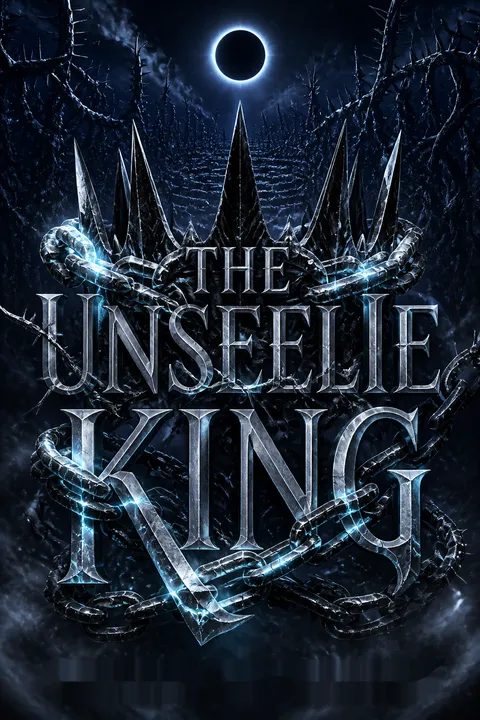


Plot Summary
A Crown in Mourning
After Oberon, the Seelie King, dies from the cursed dagger Valroy used, his widow Titania buries him beneath an ash tree and takes up the lonely work of ruling. Abigail wakes in Valroy's empty bed with the silver crown that makes her Unseelie Queen, while Valroy is Titania's prisoner, her guardians have vanished, and her friend Anfar is missing.
Her only company is Puck, the court spymaster trapped in a dog's body. When Abigail wishes aloud that she could free him, her new power restores Puck to his human form. He stays beside her, joking and pretending to stumble until she laughs, then helps her face a court and a crisis she never wanted.
The story opens by making political succession inseparable from intimate loss. Titania has lost the partner who steadied her, while Abigail inherits authority without preparation or consent. Puck's release makes that power tangible, but the scene resists treating sovereignty as instant mastery: Abigail's wish works before she understands what she can do. Puck's deliberately foolish performance also establishes humor as practical care, not mere comic relief. He cannot solve the queen's dilemmas, but he can interrupt the isolation that might otherwise make them unbearable.
Iron in the Heartwood
Puck reveals that Titania has driven iron spikes through Valroy's joints and fastened him to a tree with barbed chains. Abigail insists on seeing him despite the risk, and arrives to find him bleeding, his wings torn and soldiers guarding the clearing. She uses her deadly flowers to drive the guards back, then gives Valroy water and cleans what wounds she can.
Titania draws Abigail aside and proposes peace between the courts, with Abigail ruling the Unseelie in Valroy's place. Abigail refuses to abandon her husband. Titania then makes her purpose plain: she intends to kill Valroy, though she does not yet know how. Valroy tells Abigail that his Maze holds the answer to his death.
The tree turns an abstract conflict into a bodily dilemma: Abigail can see exactly what her love costs, yet freeing Valroy could unleash the war Titania fears. Her care for him is neither a denial of his violence nor a political solution; it is a refusal to treat him as disposable. Titania's offer reveals a different kind of moral danger. She frames control as peace and assumes Abigail can simply replace the man she loves. Valroy's riddle shifts the struggle inward, suggesting that understanding him, not merely overpowering him, will determine what happens next.
The Sea Gives Anfar Back
While Abigail confronts the queens' impossible bargain, Perin searches the coast for Anfar, the sea monster Cruinn wounded during the wedding chaos. He finds Anfar tangled in seaweed beneath the waves and drags him to his cabin, where he cleans and binds the injuries. As he waits beside the cot, Perin recognizes that his fear is not merely duty or gratitude: he has come to care deeply for Anfar.
Abigail later reaches the cabin with Puck and discovers her friend alive. She addresses the Unseelie court, rejects the guardianship of Bayodan and Cruinn, and refuses to punish them herself, leaving their fate to Valroy. When she learns Anfar is recovering, she lets friendship, rather than the throne, dictate her next concern.
Perin's rescue gives the novel a quieter counterpoint to its royal crisis. He cannot claim Anfar as a responsibility assigned by prophecy or rank; he searches because he chooses to, then discovers that his own attachment frightens him. His modest self-image makes care feel like presumption, especially beside Anfar's immense power. Abigail's court address follows a related logic: she refuses to use authority as permission for vengeance. Both scenes test whether loyalty means obedience or freely chosen protection, a question that becomes increasingly consequential as the former allies take sides.
A Head That Will Not Fall
Titania orders a saw and axes brought against Valroy, hoping to sever his head, but repeated blows fail to kill him. The queen leaves to seek a way to destroy him, and Abigail finds Valroy mutilated from the attempt. At the Morrigan's altar, Abigail challenges Titania's wish to keep torturing him, then asks the goddess for guidance.
A vision carries Abigail to a weapon-studded oak rooted in a lake of blood. She recognizes the place not as a thing, but as someone she knows, and collapses under the revelation. Puck warns that Titania is moving Valroy to the Lake of Sorrows, where prisoners are slowly dissolved. Abigail wakes knowing she must face the lake before Titania's plan becomes permanent.
Titania's failed executions expose the limit of ordinary force, while Abigail's vision changes the question from how to kill Valroy to what Valroy is. The image of weapons embedded in a living tree condenses violence into a history of attempted solutions, each one unable to reach its target. Abigail's recognition arrives through bodily shock rather than a clean explanation, making knowledge feel dangerous before it becomes useful. The Lake of Sorrows supplies the immediate deadline: even a supposedly painless punishment can be a form of prolonged annihilation, and inaction becomes a choice with its own violence.
The Maze Has a Heart
At the Lake of Sorrows, Abigail finds Valroy broken and chained, with Titania preparing to sink him beneath its surface. The vision has shown Abigail that Valroy is the Maze itself. As she shields them with the Gle'Golun, he confirms that he began as an ancient force of darkness and took a living form through the Morrigan's bargain.
His original purpose was to destroy the Seelie and the human world, and he has never stopped wanting that destruction. Abigail now understands the danger she loves, yet she cannot leave him to an endless prison. When Titania's soldiers attack, Abigail fights to keep them back, and her refusal to surrender Valroy starts the battle.
The revelation does not transform Valroy into a misunderstood innocent. It makes his destructive purpose more legible without making it harmless. That distinction is central to Abigail's choice: love grants her knowledge of his origins, not an excuse to endorse them. The scene also reverses the logic of a conventional cure. Abigail does not free him because she believes she can reform him, but because she cannot accept Titania's supposedly merciful erasure. Her decision therefore carries both tenderness and peril, making the ensuing battle a consequence of attachment rather than a victory over moral uncertainty.
Roots Turn the Battle
Abigail's flowers hold back the Seelie soldiers, but her reluctance to kill leaves her outnumbered until Puck brings Bayodan, Cruinn, Perin, and the wounded Anfar into the fight. Abigail's power shifts into a monstrous, antlered form, while Anfar's sea-beast roar drives the remaining Seelie back. Titania retreats, and Valroy is freed from his chains.
Back at court, he sentences Bayodan and Cruinn for their betrayal. Abigail intervenes: Bayodan loses an arm, while Cruinn is spared Valroy's intended torment and must answer for injuring Anfar. Abigail also demands that Cruinn apologize and repay Anfar. Valroy accepts the reduced punishment, though his thirst for revenge against Titania remains. He and Abigail return to his Maze to recover.
The rescue succeeds because power is distributed across an uneasy network rather than concentrated in a single champion. Abigail can summon lethal growth but hesitates to kill; Anfar's frightening form and the others' arrival alter the battlefield. Afterward, Abigail's intervention does not erase betrayal or demand that Valroy become gentle. Instead, she narrows punishment to a cost she can bear and insists that Anfar's injury be acknowledged. Her influence is real but negotiated, not absolute. The compromise suggests a way to limit Valroy's violence without pretending that his appetite for vengeance has disappeared.
Titania's Last Crown
After receiving a vision from Dagda, Titania decides to prevent Valroy from choosing the manner of her death. She invites Abigail to the Lake of Sorrows, apologizes for her actions, and admits that Oberon's loss has left her afraid and alone. Titania drinks wine she has poisoned herself, then places the golden Seelie crown in Abigail's hands and names her successor.
Abigail holds Titania as she dies and destroys the lake afterward, ending the prisoners' suffering. When the Seelie court questions her right to rule, Abigail declares that she will oppose Valroy if he attacks their people. Valroy arrives seeking Titania, learns Abigail has inherited the crown, and carries her away to the Maze when she refuses to join his conquest.
Titania's final act is an attempt to reclaim agency after grief and failed force have narrowed her options. By choosing her own death and transferring the crown, she refuses to let Valroy define the ending of her life or the future of her court. Abigail's compassion does not require agreement with Titania's earlier methods; she accepts the burden while also ending the Lake's slow violence. The new crown makes her loyalty structurally divided. She can love Valroy and still oppose his project, so the romance now has a political boundary neither character can ignore.
The Queen in Chains
Valroy locks Abigail in a ruined part of the Maze with an iron collar, intending to keep her from resisting his invasion. As Winter spreads through Tir n'Aill, Abigail's skin and eyes turn pale blue, reflecting her connection to the changing seasons. Valroy sees the change as evidence of a power she has not yet mastered, but he keeps her captive.
He offers to spare Tir n'Aill for a thousand years if she joins him in reclaiming Earth and driving out its humans. Abigail refuses. Outside the Maze, Anfar, Perin, Bayodan, Puck, and the Seelie hearth elf Uri begin plotting her rescue and trying to organize resistance. Anfar knows that opposing Valroy means betraying a friend, but Perin stands with him.
Captivity makes the emotional contradiction of the romance material: Valroy's claim that he wants to protect Abigail is enacted through confinement and control. Her desire for him remains, but it does not convert coercion into consent or erase the consequences of his choice. The seasonal change offers a second, developing source of power, one linked to the world rather than to Valroy's domain. Meanwhile, Anfar's decision to oppose his oldest companion echoes Abigail's refusal. Love in this story does not consistently mean alliance; sometimes it means accepting the risk of standing against someone one still loves.
The Prisoners' Ruse
Anfar and Perin enter the Maze with Puck, Bayodan, and Cruinn, who copies Abigail's appearance to fool Valroy. Puck picks the iron collar's lock, and Bayodan leads the real Abigail through a portal toward the Seelie. Cruinn stays behind in disguise, while Anfar and Perin pretend to accept Valroy's plans.
The deception fails when Valroy notices that the false Abigail's breath does not mist in the cold. He attacks Anfar and Perin, then scatters Cruinn into countless glass fragments. Puck later finds the injured men trapped in shifting stone corridors. Remembering a hag's instruction, Perin urges them to take only left turns, and the route finally leads them out with help from a headless guide.
The escape depends on performance, trust, and a piece of cryptic guidance that becomes practical only under pressure. Cruinn's imitation lets Abigail move, but the physical clue of breath exposes the imposture, showing how the Maze's master notices details its visitors cannot control. The friends' plan succeeds only partly: Abigail is free, while the others absorb the danger meant to delay Valroy. Perin's remembered instruction turns his earlier vulnerability into a contribution. His role is not to outmatch the king, but to notice the rule that lets the trapped men find a way through.
Spring Before the Battle
On the night before the final battle, Abigail meets Valroy at the Morrigan's altar. They grieve together and acknowledge that the next meeting will be war, though neither can abandon their purpose. At dawn, Abigail lays Titania to rest beside Oberon's ash tree. She then calls Spring into the winter landscape, revealing her growing command of life and the seasons.
Uri gathers Seelie fighters, while Bayodan, Anfar, Perin, and Puck prepare to stand with them. Abigail leads the assembled force toward the Maze, despite knowing Valroy has promised to strike at sunset. The two courts meet in the uncertain interval between day and night. Their armies face each other, and Abigail sends her flowers against the oncoming Unseelie host.
The sequence joins private farewell, public mourning, and military preparation without allowing any of them to cancel the others. Abigail gives Titania a proper burial even though Titania was once her adversary, then uses her power to end Winter rather than merely survive it. That act signals a form of authority based on renewal, distinct from Valroy's dominion through fear. The coming battle nevertheless resists a simple opposition between life and death: Abigail's flowers can destroy, and Valroy's attachments are genuine. Her leadership depends on holding those contradictions in view while asking others to risk themselves beside her.
The Heart Beneath the Maze
As the armies clash, Abigail leaves the battlefield and follows the roots into the Maze's ancient temple, guided by the same left-turn pattern Perin recalled. At its center stands the blood-rooted oak from her vision, studded with weapons: Valroy's living heart. Valroy pursues her and wounds her, then pins her down with a dagger ready to kill her.
Abigail tells him to do what he must. He cannot strike, drops the blade, and breaks down beside the tree. Abigail could destroy the oak and end him, but instead proposes a new game: Valroy may keep pursuing conquest, while she alone will oppose him, and neither may use armies to make others suffer. He accepts, leaving the larger war unresolved but limiting its victims.
The climax makes understanding consequential: Abigail reaches the tree because she has learned how the Maze behaves, but knowledge alone cannot decide whether she should use it to kill. Valroy's refusal exposes a limit within the identity he treats as destiny. He remains dangerous and unwilling to renounce conquest, yet he cannot make Abigail's death the price of victory. Her wager does not cure him or settle their conflict. It creates a personal contest that contains, rather than resolves, his violence, a compromise whose moral value lies partly in the lives it may spare.
Epilogue
Abigail rules the Seelie while Valroy agrees to keep their conflict between the two of them, and both courts accept a fragile end to open war. Anfar and Perin build a life together by the sea. Bayodan searches for the pieces of Cruinn, who is slowly reforming from scattered glass.
Later, Abigail appears in the human world as Abby, carrying an old rifle and traveling with Puck in dog form. She tells a passing man that her family once lived on the land where a witch's ruined home stood, then vanishes into the fields. The larger conflict remains possible, but Abigail has chosen to keep meeting it on her own terms.
The epilogue refuses a clean, permanent peace. Abigail's agreement with Valroy limits the scale of harm without changing the source of their conflict, and the human world's looming wars suggest that danger can migrate beyond the courts. The brief domestic glimpses matter because they show what the struggle protects: Perin and Anfar's chosen intimacy, Bayodan's patient loyalty to Cruinn, and Abigail's continued movement through human history. Her encounter with Hubert also returns the story to the land and to ordinary lives, where the fae remain close enough to alter a stranger's path but not fully explained by human legend.
Analysis
The novel's central problem is not whether love can redeem a monster, but whether love can remain ethically meaningful when the beloved continues to choose destruction. Abigail never receives a clean route from attachment to safety. Valroy's affection is real, yet his imprisonment of her and his plans for conquest remain coercive and lethal. The story preserves that contradiction instead of explaining it away. Abigail's eventual bargain limits Valroy's violence, but does not persuade him to abandon his nature or settle the conflicts that produced the war.
The courts' political structure mirrors the couple's intimate imbalance. Abigail becomes queen through power she did not seek, then must learn to act without confusing mercy with passivity. She can forgive Bayodan and Cruinn while demanding accountability, oppose Titania's methods while mourning her, and oppose Valroy without denying her love. Those decisions present leadership as the practice of making distinctions under pressure. Her growing command of seasons and living roots gives her a form of authority different from Valroy's force, though her flowers are themselves capable of terrible harm.
The secondary romance between Anfar and Perin offers a quieter model of intimacy. Perin's practical care and Anfar's fear of being desired create a relationship that depends on explicit trust rather than rank or spectacle. Their tenderness does not remove them from danger, but it gives them a reason to endure it together. By contrast, Valroy and Abigail's romance remains bound to pursuit, resistance, and power. The ending does not resolve that tension into conventional peace. It turns a war between peoples into a continuing contest between two people, a fragile containment whose success depends on Abigail's continued ability to stand against someone she refuses to stop loving.
Review Summary
The Unseelie King receives polarized reviews averaging 3.93/5 stars. Critics cite disappointing character development, particularly Abigail's indecisiveness and inability to commit to choices. Many find Valroy's cruelty excessive and unacceptable, questioning why Abigail loves him despite his abusive behavior. Reviewers criticize the rushed, anticlimactic ending and problematic consent issues throughout. Some mention rape threats and violence as dealbreakers. However, supporters praise the dark fantasy worldbuilding, complex character dynamics, and unconventional resolution. Side characters Anfar and Perin receive positive mentions. Overall, readers either love the morally-gray villain romance or find it toxic and poorly executed.
People Also Read

Characters
Abigail Moore
Reluctant double queenOnce a human farmer's daughter and hedge witch, Abigail enters fae politics without the instincts or ambition of a born ruler. Her defining strength is not fearlessness but a stubborn refusal to let fear make every decision for her. She loves Valroy while recognizing the danger he poses, and her compassion extends even to people whose choices have hurt her. That generosity can look like uncertainty, yet it also lets her imagine forms of justice beyond simple retaliation. As a queen, she must learn to treat power as responsibility rather than proof that she belongs. Her central tension is how to remain merciful without becoming complicit.
Valroy
Unseelie war kingValroy rules the Unseelie with the confidence of a warrior who expects fear to be the most reliable form of loyalty. He is theatrical, cruel, and quick to turn affection into a contest, but his attachment to Abigail is sincere rather than a performance he can simply switch off. He wants her beside him without wanting to relinquish the aims that make her oppose him. His charm and tenderness coexist with coercion and a vast appetite for destruction, so intimacy never makes him safe. Valroy's deepest conflict is not whether he feels love, but whether that feeling can alter what he believes himself made to do.
Titania
Grieving Seelie sovereignTitania is a formidable ruler whose authority rests on long practice, sharp judgment, and a fierce commitment to the survival of her people. Her grief for Oberon unsettles the certainty with which she has managed the court for centuries. She sees Valroy as an existential threat and is willing to take severe measures against him, often treating the cost to individuals as secondary to the fate of the whole. Beneath her regal discipline lies a need for companionship and a fear of facing the future alone. Her relationship with Abigail is shaped by both political rivalry and the possibility of kinship.
Puck
Time-skipping spymasterRobin Goodfellow, known as Puck, is a half-Seelie trickster whose awareness jumps across moments in time. He speaks and behaves unpredictably, but his jokes often serve a precise purpose: breaking tension, testing trust, or keeping someone from collapsing into despair. As a spymaster, he notices openings others miss and can move through dangers that would stop a conventional courtier. His chaotic manner hides a more solitary intelligence and a longing for connection. Puck is not a dependable source of orderly explanations, but his loyalty is expressed through action, especially when Abigail and her friends are in danger.
Anfar
Abyssal sea monsterAnfar is a powerful sea creature, the son of Leviathan and a close companion to Valroy. His frightening nature contrasts with a guarded sensitivity that he rarely trusts others to see. Loss has left him inclined toward isolation, and he struggles to believe that anyone could desire him without fear or pity. His bond with Perin challenges that expectation, while his loyalty to Valroy makes every political choice painfully personal. Anfar's strength is immense, but it does not protect him from grief, insecurity, or the cost of betraying someone he has long treated as family.
Perin
Selkie sailor and caretakerPerin is a selkie and former sailor whose practical habits make him the steadiest presence among more powerful and volatile fae. He cooks, tends wounds, and notices when someone is pretending not to need help. His modest view of himself makes it difficult to imagine that Anfar could love or want him, even as his actions repeatedly prove his courage. Perin does not seek a throne or a heroic identity; he chooses to remain beside people he cares about. His grounded perspective becomes especially valuable when grand plans and prophecies leave everyone else overwhelmed.
Bayodan
Goat-legged guardianBayodan is an imposing Unseelie courtier and one of Abigail's protectors. He is deliberate, strategic, and willing to accept personal cost when he believes it will preserve someone else's life. His choices are governed by a stern idea of duty, though that idea can place him in conflict with the person he is sworn to serve. As a mate to Cruinn, he is more tender than his imposing appearance first suggests. Bayodan's steadiness makes him a source of counsel, but his willingness to act without permission complicates the trust Abigail places in him.
Cruinn
Shapeshifting courtierCruinn is a shapeshifter whose glass-like body gives their presence a fragile, uncanny beauty. They are devoted to Bayodan and protective of Abigail, but their instinct to solve danger through deception can cause deep injury to those they mean to protect. Cruinn is resourceful, emotionally expressive, and capable of remarkable imitation, qualities that make them valuable in court intrigue. Their relationship with Bayodan offers a rare picture of mutual devotion among the Unseelie. They are driven by loyalty, though the story makes clear that loyalty does not automatically make every choice harmless.
Oberon
Seelie king and husbandOberon is Titania's long-time partner and the Seelie King, remembered as a warm presence beneath the couple's frequent quarrels. His shared history with Titania gives her rule an intimate foundation, not just a political one. The court's customs and the grief surrounding him reveal how deeply his life was woven into Seelie identity.
The Morrigan
Goddess of war and fateThe Morrigan is an ancient goddess associated with war, death, and the forces shaping fae destiny. She rarely offers clear guidance, making her influence difficult to distinguish from a test or a trap. Abigail seeks her counsel when ordinary judgment fails, while Valroy sees divine design behind the suffering that binds them.
Dagda
Father of living thingsDagda is an ancient god invoked by the Seelie for guidance and protection. His presence is felt through visions and the natural cycles rather than through ordinary conversation. For Titania, turning to him is an admission that her own political skill may not be enough to protect her people.
Uri
Hearth elf organizerUri is a practical Seelie hearth elf whose self-deprecating manner hides a strong sense of responsibility. She is more comfortable with cooking and household work than battle, but she still helps rally a resistance when the court is disorganized. Her warmth gives Abigail a welcome reminder of ordinary friendship amid royal crisis.
Marcus
Abigail's former husbandMarcus belongs to Abigail's former human life, before Tir n'Aill and the courts. His treatment of their shared home shapes her memory of betrayal and the precariousness of ordinary security. He remains a point of contrast to the vast, supernatural conflicts that later define her days.
Lord Gregory
Headless guideLord Gregory is an eccentric, headless fae noble who helps guide Anfar, Perin, and Puck out of the Maze. His unusual appearance and matter-of-fact manner make him memorable, but he serves mainly as a practical ally at a moment when the fugitives need a way out.
Plot Devices
The Maze of Shadows
A labyrinth that conceals truthThe Maze is both a shifting landscape and the central puzzle Abigail must learn to read. Its paths respond to their master, frustrate ordinary navigation, and make escape depend on more than strength. The left-turn instruction planted earlier becomes a literal route through its corridors. The Maze also holds the story's deepest revelation about Valroy and gives the climax a physical destination. Its design ties intimate knowledge to survival: the characters who understand its rules can move through a danger that overwhelms those who merely attack it.
The Twin Crowns
Power split between two courtsThe silver Unseelie crown and the golden Seelie crown mark authority over opposing courts. Abigail's connection to both makes her political position unprecedented and impossible to keep neutral. Each crown brings obligations that pull against her marriage: Valroy expects partnership in conquest, while the Seelie need protection from it. The crowns are not merely symbols of rank. They make her divided loyalties visible to every courtier and turn private choices into public acts with consequences for two peoples.
The Gle'Golun
Flowers that consume the livingAbigail's deadly flowers grow in response to her power and can restrain, destroy, or defend. They first give her a way to protect Valroy without relying on a conventional weapon, then become essential to the battles that follow. Their beauty does not soften their function: the blooms can devour a person or tear through the Maze's living structure. They embody the tension in Abigail's own power, which can preserve life and end it with the same roots. Her growing command over them marks her transformation from frightened outsider to ruler capable of acting.
The Lake of Sorrows
A prison disguised as mercyThe Lake of Sorrows is used by the Seelie to hold enemies beneath its surface, where they remain conscious as their bodies slowly dissolve. Titania describes this fate as painless, but its prolonged isolation makes it a form of punishment rather than release. The lake forces Abigail to confront the difference between preventing immediate violence and offering genuine mercy. It also creates the crisis that drives her to learn what Valroy is, choose whether to rescue him, and later use her own power to end the prisoners' suffering.
The Bleeding Oak
The heart that can be destroyedThe ancient oak surrounded by blood and embedded weapons appears first in Abigail's vision, an image she cannot initially interpret. It later proves to be the vulnerable center of Valroy's existence, and the reason the Maze riddle matters. The weapons record repeated attempts to end him, while the tree's living roots connect his fate to the labyrinth around it. At the climax, Abigail must decide whether to destroy the oak and kill the being she loves. The tree makes that moral decision concrete: ending the war by force would also end Valroy.
Maze of Shadows Series
About the Author
Other books by Kathryn Ann Kingsley


Download PDF
Download EPUB
.epub digital book format is ideal for reading ebooks on phones, tablets, and e-readers.








