

Plot Summary
The Storm Breaks Open
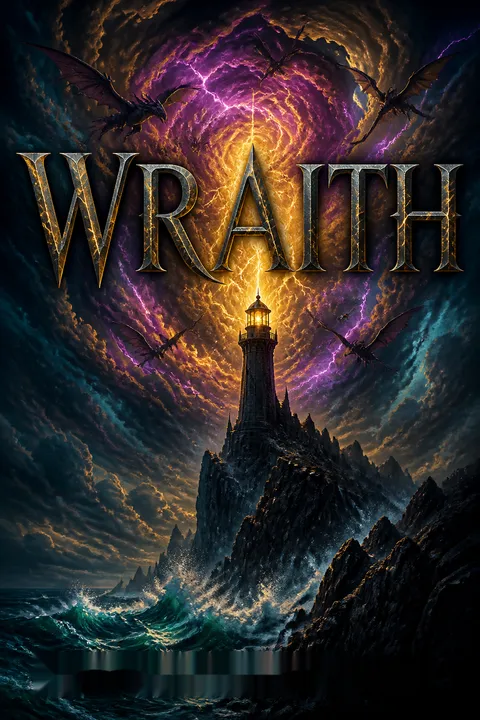
Nelle wakes in Mage Soran Silveri’s lighthouse to a magical storm pouring across the Hinter Sea. Soran leaves the shelter to fold his spell-bound wyverns into paper before the storm can reclaim them. Nelle climbs the cliff to rescue one stranded creature, then spots a child on a raft among the rocks.
Soran warns her that no one can survive the storm, but she dives in anyway. Together they haul the child from the waves and race back to the lighthouse as the magic crashes over them. Queen Dasyra’s protections hold, shutting the storm outside. Nelle and Soran survive, but the child’s impossible survival leaves them with a new danger to understand.
The storm makes perception itself a survival skill. Nelle must distinguish physical danger from the magical assault that her senses experience as burning and thunder, and her learned discipline lets her act while terrified. Soran’s instinct is to preserve the lighthouse and its wards, while Nelle’s is to save the vulnerable figure in the water. Their disagreement is not simply caution versus courage: each is trying to protect life, but Nelle refuses to let uncertainty become an excuse for abandonment. Her rescue also draws Soran out of isolation and makes their survival a shared responsibility.
The Child Writes Life
Once the child wakes, Nelle calms his terror by holding him close and singing the lullaby her father once used for her. The boy later recognizes magic in Dasyra’s endlessly renewing bread and, with Nelle’s quill, creates a delicate new wyvern by drawing a story rather than copying Soran’s formal spell.
Soran suspects the child is an ibrildian, a mortal-fae hybrid, and possibly the long-lost son of King Lodírhal and Queen Dasyra. Before they can learn more, the boy opens the lighthouse door into the still-raging storm, grows his small wyvern into a mount, and flies away. Nelle and Soran are knocked down by the storm’s force, and Soran carries her back to safety.
The child’s magic unsettles the distinction between literacy and creation. Soran treats spells as disciplined structures of words and power, while the boy’s intuitive storytelling makes an image real without following the rules either adult understands. Nelle’s lullaby offers a quieter model of magic: she steadies him through remembered care rather than mastery. His departure leaves both adults with a loss they cannot interpret, and it foreshadows the possibility that Nelle’s own unconventional approach to magic may be more than a poor imitation of Soran’s craft.
The Rose Book Betrayal
When the storm passes, Nelle sees that the bridge back to Wimborne is failing. She has come to Roseward under orders from Mage Gaspard, who threatened her father unless she stole Soran’s Rose Book, the spellbook containing the Thorn Maiden. Rather than confess, Nelle smears fae poison on her lips and kisses Soran, leaving him unconscious long enough to take the book.
She rows back through the Veil believing she has saved him by giving Gaspard a chance to bind the creature. But time runs differently across the worlds: a year has passed in Wimborne. Sam and Cloven’s men meet her on shore and escort her to Gaspard, who takes the book while claiming Nelle’s father is alive.
Nelle’s betrayal grows from coercion, but the story does not let coercion erase her agency. She chooses the strategy she believes might protect Soran and her father, then pays for it with intimacy, trust, and time. The poison reverses the meaning of a kiss: an act she hopes will spare lives becomes the instrument of a devastating breach. The Veil’s time distortion makes her sacrifice even less controllable. Nelle returns thinking she has completed a task; instead, she finds that the world she left has moved on without her.
Home Has Changed
In Draggs, Nelle discovers that her father, Mixael Beck, is alive, but he has married their former landlady, Mahilda Dirgin, and no longer has a place for Nelle in his household. She accepts work as a washerwoman and tries to bury Roseward in routine. Eight months later, a delivery to Lady Ryvelle’s townhouse exposes a new horror: a Miphato has been torn apart in bed, and Nelle hears of another mage killed the same way.
She breaks into the room and recognizes the work as the Thorn Maiden’s. Fearing Gaspard has failed to contain the Noswraith, Nelle infiltrates his quarters. His new scars and evasive answers confirm that the monster is loose, so she agrees to meet him at the Tyrane fortress.
The return home strips Nelle of the story she had told herself about rescue. Her father survived, but survival has made him dependent on a new household, and there is no simple restoration of their old life. The laundry job gives her a place in the city while also reminding her how easily she can be socially diminished. The murdered Miphato breaks that fragile arrangement. Nelle’s forbidden knowledge, once a liability she hoped to conceal, becomes the only means of recognizing a threat that respectable institutions have not yet understood.
The Mother Releases Her
At the fortress, Gaspard’s body speaks with the Thorn Maiden’s presence. She admits that she has been using him to kill mages who might expose her, then orders her men to seize Nelle. Nelle escapes by jumping from the battlements into the sea. On the beach, she dreams of her dead mother, Seroline, who releases her from the promise to protect Mixael.
The vision gives Nelle permission to choose a life beyond that inherited burden. She remembers Sam’s urgent warning and reaches him at the East Gate. Sam has broken from Cloven and reveals that Gaspard gave him the Rose Book to hide, with orders that would keep its location secret even from himself. Sam hid it in Nelle’s old attic.
The mother’s vision reframes obligation as something that can be inherited without being permanent. Nelle has treated care for her father as a duty that cancels every other choice; Seroline’s imagined release lets her distinguish love from self-erasure. Sam’s return offers another kind of obligation, rooted in shared guilt and trust rather than family command. He has remained in Wimborne because he cannot simply abandon the danger, but Nelle now has to decide whether accepting his help means repeating old patterns or making a deliberate choice to protect others.
The Book Beneath the Mattress
Nelle and Sam retrieve the Rose Book from her old attic, but Mixael and Mahilda catch them before they can leave. A man working for Cloven bursts in and chokes Mixael against the wall. Nelle drops the book to attack him, and the Thorn Maiden takes hold of her father, piercing him with thorns and turning his gentle face into a threat.
Soran arrives in time to stun the possessed attacker and drive the creature from Mixael. Nelle learns that Sam escaped through the broken attic window with the book. Soran does not trust her, but when she explains that the Thorn Maiden has returned, he insists on finding Sam and the spellbook before the monster can destroy it.
The attack turns Nelle’s private guilt into immediate physical danger for the people she loves. Her father is not an abstract hostage or a motive from the past; he is the body she must watch the Thorn Maiden invade. Soran’s arrival saves Mixael, but it does not repair trust. Nelle and Soran are forced into cooperation before either is ready to forgive the other. The broken window and Sam’s escape keep the Rose Book in motion, making the search for it a test of whether this damaged group can act together under pressure.
Blood on the Spellbook
At the wash house, Nelle writes a rough spell that lets her project herself into the Nightmare Realm and wield a magical ax. She and Soran reach Sam, but Cloven’s men ambush them and use Nelle as leverage. Sam comes down from the rooftops with the Rose Book to protect her. One of Cloven’s men stabs him, and Cloven tears the book’s binding apart as Sam dies beside it.
Nelle kills Cloven in a burst of grief; Soran’s spell blasts away the Thorn Maiden’s presence from his body. With the Rose Book destroyed, Nelle and Soran understand that the monster is no longer held by its original spell. They must find the mind from which its influence is spreading.
The destruction of the book and Sam’s death collapse the couple’s remaining distance from consequence. Nelle’s attempt to repair her earlier betrayal has cost the life of someone who returned for her, and the physical book that might have restored the old order is gone. Her killing of Cloven is not presented as a clean transformation into a warrior; it is an act of grief and rage that leaves her newly implicated in violence. The next objective must therefore be more difficult than recovering an object: they must confront the source of the damage itself.
A Prison in His Flesh
Soran traces the Thorn Maiden’s influence to Gaspard, who admits that he pulled the creature from the Rose Book and tried to contain her within his own body. She used his mind to reach other victims and killed the mages who challenged him. Soran offers a stronger bialaer, a containment spell, and draws the Noswraith out of Gaspard into himself.
Nelle reaches the tower window and attacks the creature’s phantom form with the story-made ax, but Soran tells her to stay back. He then throws himself from the tower, carrying the bound monster toward Roseward, where she will have no other minds to possess. Gaspard survives, and Nelle learns that Soran may still be alive.
Soran’s choice is both an act of responsibility and a repetition of his defining danger: he assumes that his body should absorb what others cannot bear. The bialaer gives him a way to restrict the Thorn Maiden without pretending he can destroy the harm he caused. Nelle’s projected ax demonstrates that her improvised storytelling can affect a nightmare across realities, but Soran still tries to exclude her from the final risk. Their conflict over protection remains unresolved, even as they begin to share the same enemy.
The Ring Finds Roseward
Nelle rows toward Roseward, but the island disappears into the Hinter Sea. She remembers the spell ring Soran made for her and follows its thread, tugging until she feels a response from the far end. Meanwhile, Soran reaches the lighthouse, releases most of his wyverns by letting them take their spells into themselves, and leaves for Dornrise.
Nelle’s ring finally guides her back to the island, where she finds Soran at his family’s ruined manor, the Thorn Maiden still knotted inside him. She chooses not to return to Mixael, trusting that he can continue his life without her, and joins Soran. As they face the night, he tells her how his jealousy over Helenia and his brother led him to create the monster.
The ring converts a relationship into a practical lifeline: a small, shared piece of magic gives Nelle a route through a sea that has erased every visible landmark. Her return is not a passive rescue, because she chooses to leave her father’s world and meet the danger on Soran’s ground. The wyverns’ release marks Soran’s attempt to free what he can before the coming battle. At Dornrise, his confession replaces the romance’s incomplete history with its moral cost: the monster is not an alien accident but a creation shaped by possessiveness and grief.
The Story of Helenia
Soran explains that he and his twin brother, Ithan, both loved Helenia, a penniless girl his family had taken in. Soran expected her to wait for him while he pursued other lovers and forbidden magic; she chose to marry Ithan instead. On her wedding day, Soran found her alone, and their renewed affair ended when Ithan stabbed her.
Grief and jealousy drove Soran to write a spell that recreated the idealized woman he wanted, but his hatred entered the work and became the Thorn Maiden. She escaped into Dornrise and slaughtered his family before Soran understood what he had made. Nelle refuses his plan to surrender to the creature. She asks him to teach her the binding and returns to the lighthouse to write it.
Soran’s confession exposes the difference between love and possession. He treated Helenia’s future as something he could claim while reserving freedom for himself, then attempted to remake her as a being whose devotion would never challenge him. The Thorn Maiden is therefore not simply an embodiment of grief; she is grief distorted by entitlement and given the power to act. Nelle’s refusal to let Soran decide her fate answers this history directly. Her commitment is not blind absolution, but a choice to hold him accountable while still believing he can help end what he began.
Nelle Writes the Ending
As night falls, Nelle writes a binding spell in her own rough, inventive style while projecting herself into Dornrise. Soran holds the Thorn Maiden inside the bialaer until Nelle’s phantom ax cuts the spell’s connection to him. The creature emerges in physical form and attacks the lighthouse, while Soran draws her attention by appearing to yield to her Helenia-like seduction.
Nelle reaches the monster’s burning core and severs its stem, then crushes the rose and completes her binding. The force of the spell devastates Dornrise, but Dasyra’s protections keep the lighthouse standing. At dawn, Nelle finds Soran gravely wounded but alive. Her spell will not hold forever, yet it has bought them time.
The climax makes Nelle’s imperfect craft an ethical alternative to Soran’s original act of creation. His first spell tried to make another person conform to his longing; hers turns her own experience into a tool for limiting harm. The story form is not powerful because it is polished, but because she accepts uncertainty and keeps writing. Soran’s performance of surrender draws the Thorn Maiden into reach, while Nelle acts on the insight that the creature’s power has a core. Their victory is temporary and costly, which prevents the binding from becoming a simple erasure of responsibility.
A Prince’s Bargain
King Lodírhal arrives on Roseward intending to execute Soran and Nelle for the deaths caused by the Noswraith. Before he can act, the once-lost child returns as an adult riding the story-made wyvern. He identifies himself as Castien, Lodírhal and Dasyra’s son, and claims the bound spell as part of his duty to contain Noswraiths.
Castien persuades his father to spare the pair and take them to Vespre to serve in the prince’s library. Lodírhal also removes the nilarium curse from Soran’s hands. Soran brings the crippled blue wyvern with them, while the other wyverns fly free. Nelle and Soran leave Roseward together, carrying the spellbook and the consequences of their survival into a new life.
The ending turns punishment into an uneasy form of restitution. Castien does not declare Soran and Nelle innocent; he gives them a future in which their abilities can be used to protect others. Lodírhal’s decision remains politically and emotionally coercive, yet it also breaks Soran’s isolation and restores his hands, the instruments through which his original harm began. The freed wyverns provide a smaller counter-image to the bound Noswraith: creations can be released rather than possessed. Nelle’s partnership with Soran is therefore not escape from the past, but a shared commitment to live with it differently.
Analysis
Wraith treats magic as an ethical practice of making, not simply a weapon or a measure of talent. Soran’s original spell gives form to a possessive fantasy: he wants to restore an idealized beloved who will never choose differently from him. The Thorn Maiden’s violence is therefore continuous with the emotional structure that created her. Gaspard repeats the error on a smaller scale when he assumes he can contain and use a power whose consequences he refuses to respect.
Nelle’s magic offers a countermodel. Her writing is rough and her understanding incomplete, but she works through attention, improvisation, and responsibility to other people. The book’s repeated contrast between formal spellcraft and story-making suggests that expertise alone does not determine whether creation is wise. What matters is the maker’s willingness to see the people affected by the work. Nelle’s binding succeeds not because she becomes a better version of Soran, but because she approaches magic as a narrative she must shape while accepting uncertainty and risk.
The romance develops through a parallel question: can protection exist without possession? Soran repeatedly tries to send Nelle away, believing that isolation is the only responsible way to keep her safe. Nelle insists that her choices belong to her, even when she understands the danger. Their eventual partnership depends less on erasing betrayal than on replacing unilateral control with shared decisions. The story does not make Nelle’s courage proof that she cannot be harmed; it makes her courage a claim to participate in the risks of her own life.
The time shift across the Veil gives that choice a concrete cost. Nelle returns to a father who has built a precarious life without her, while Soran remains tied to an island and a past he cannot outpace. Their final future is not a restoration of the lives they lost. It is a demanding form of atonement, in which their gifts become useful through service to others. The wyverns’ release offers the novel’s clearest image of that change: creation need not mean ownership, and care can sometimes mean letting what one made go free.
Review Summary
People Also Read





Characters
Peronelle Beck
Resourceful half-fae snatcherKnown as Nelle, Peronelle is a quick-witted survivor raised in Wimborne’s poorest district by a daring mother and a gentle, impractical father. Her mother taught her to climb, fight, assess risk, and make herself useful in a dangerous world. Nelle’s half-fae heritage gives her an unusual affinity for magic, though she initially understands little about it. She is blunt, funny, and stubborn, with a protective instinct that repeatedly outruns her caution. Her sharpest conflict is between loyalty to the people who need her and the right to decide what her own life should contain. She mistrusts grand claims, but can recognize courage and tenderness even in people she has reason to fear.
Soran Silveri
Scarred, exiled mageSoran is a former Miphato, a trained mortal mage exiled to Roseward after forbidden magic brought catastrophe into his life. A fae curse has left his hands coated in nilarium, and his face bears the physical history of his punishment. Brilliant, disciplined, and deeply ashamed, he has spent years containing the danger he created. He is inclined to confuse responsibility with solitary suffering, keeping others at a distance because he believes closeness will expose them to harm. Nelle unsettles that self-protective logic. His guarded affection and his fear of repeating old mistakes make him both a capable mentor and a man who must learn that protection cannot mean choosing for someone else.
Sam Rallenford
Loyal rooftop snatcherSam is Nelle’s childhood friend and fellow thief, a fast, athletic snatcher who knows how to vanish across rooftops. He has a warm streak and a strong instinct for danger, but his loyalty is complicated by years of working under Cloven and hoping that criminal opportunity might lead somewhere better. Sam wants to protect Nelle, though he often struggles to say plainly what he feels or to break from the people who have power over him. His value to the story is not simply as a companion: he carries knowledge, makes independent choices, and repeatedly has to decide whether safety means fleeing or standing beside someone.
Mage Gaspard
Ambitious Miphato rivalGaspard is a Miphato mage who studied forbidden magic alongside Soran. He is intelligent and capable, but his ambition is sharpened by a persistent sense of being second to his more gifted friend. That envy makes power look like a remedy for humiliation, even when pursuing it requires using other people. He recruits Nelle under threat to obtain Soran’s Rose Book, then tries to master the dangerous spell it contains. Gaspard’s intelligence does not protect him from self-deception; he can see the risks and still persuade himself that he will be the exception. His history with Soran mixes rivalry, admiration, resentment, and genuine attachment.
The Thorn Maiden
Mind-rooting NoswraithThe Thorn Maiden is a Noswraith, a living nightmare able to spread through minds and use human bodies as extensions of its will. It appears through roses, thorns, and seductive forms that exploit desire, fear, and emotional vulnerability. Its influence can make ordinary people seem coordinated while stripping them of control, and its attacks reach both mind and body. The creature is dangerous partly because it does not behave like a conventional enemy with a negotiable goal. It seeks expansion and possession. Its intimacy with its victims is part of the threat: it can imitate what they long for, making resistance feel like a refusal of comfort.
The child
Storm-tossed hybridThe child arrives alone on a wrecked raft during the magical storm, hungry, frightened, and unable to communicate easily with Nelle and Soran. His unusual purple eyes and instinctive recognition of magic mark him as different, but his behavior is also unmistakably that of a vulnerable child. He responds to Nelle’s care, bonds with a wyvern, and approaches spellmaking through images and stories rather than formal instruction. His presence changes the scale of the storm and opens questions about the hidden history of fae and mortal bloodlines.
King Lodírhal
Sovereign of AurelisLodírhal rules the fae kingdom of Aurelis and carries the authority of a king who helped shape the uneasy peace between fae and mortals. He is proud, beautiful, and severe, accustomed to treating law and punishment as instruments of state. His history with Soran is defined by the sentence that confines the mage to Roseward, while his relationship with his family complicates his public hardness. Lodírhal can be moved by reason, but he rarely welcomes the experience. His presence makes private choices answerable to political history.
Queen Dasyra
Mage and fae queenDasyra is a legendary mortal mage who became queen among the fae and acts as a protective presence between her former people and her adopted world. Her protections in Roseward, including the lighthouse wards and replenishing provisions at Dornrise, continue to help long after she established them. She is not physically present for much of the story, but her choices shape the shelter available to Soran and Nelle. Dasyra represents a form of power built through foresight and maintenance rather than spectacle.
Mixael Beck
Nelle’s gentle fatherMixael is Nelle’s loving but impractical father, a refined man whose temperament is ill-suited to the harshness of Draggs. He meets the world with gentleness and a tendency to hope for the best, which can leave him vulnerable to people more forceful than himself. His affection for Nelle is real, but he cannot always provide the protection she needs. Their relationship is shaped by care, separation, and the difficult distinction between helping a loved one and carrying their life for them.
Cloven
Draggs crime bossCloven is a criminal boss who uses promises of money and advancement to keep desperate people under his control. He has known Nelle since childhood and understands her family history well enough to exploit it. His loyalty is transactional, and he treats Sam as a subordinate even when Sam tries to leave his crew. Cloven’s influence shows how coercion can be made to look like opportunity in a city where few people have better choices.
Castien
Fae prince and spell-tellerCastien is a striking, perceptive figure whose magic works through the telling of stories. He is more irreverent in manner than the authority surrounding him, but his wit serves a political purpose: he can challenge his father without pretending the danger is small. Castien understands that powerful magic creates obligations, especially when it threatens whole communities. His unusual approach to spellmaking parallels Nelle’s instinctive craft while giving it a different scale and history.
Seroline Beck
Nelle’s fae-blooded motherSeroline was a bold, adventurous woman who taught Nelle practical skills for surviving danger. Her half-fae heritage is part of Nelle’s inheritance, but so is her insistence that a person must make choices for herself. Memories of Seroline help Nelle assess risk and keep moving when she is afraid. The vision of her mother also gives Nelle a way to reconsider an old family promise without denying the love behind it.
Helenia Theran
Soran’s first loveHelenia entered the Silveri household as a young ward after her father’s death. Beautiful, ambitious, and more practical than Soran’s idealized memory allows, she wants a future with security and recognized status. Her relationship with Soran is shaped by attraction, secrecy, and a mismatch between what each believes the other owes. She is important to the story as a person with desires of her own, not merely as an object of romantic longing.
Ithan Silveri
Soran’s twin brotherIthan is Soran’s twin and the heir to Dornrise. The brothers share a childhood but develop a rivalry sharpened by pride, jealousy, and competition for Helenia’s affection. Ithan’s place in the family connects Soran’s private heartbreak to the tragedy that later shapes Roseward.
The blue wyvern
Soran’s loyal spell-beastSoran’s blue wyvern is ungainly, greedy, and deeply attached to its master. It lives as a spell written on paper, yet behaves with the stubborn appetites and loyalties of a creature made of flesh. Its comic thefts of food soften the lighthouse’s bleak routine, while its persistence gives Soran a companion through years of isolation.
Kyriakos
Noxaurian fae lordKyriakos is a powerful fae lord of Noxaur whose household becomes entangled with Nelle’s mission and Soran’s desperate attempt to protect her. He treats people as instruments of ambition and desire, revealing the dangers Nelle faces beyond Roseward. His political defiance of the Pledge helps set the larger conflict in motion.
Mahilda Dirgin
Mixael’s landlady-wifeMahilda Dirgin is the former landlady who marries Mixael after Nelle disappears. Sharp-tongued and protective of her own household, she sees Nelle as an unwelcome disruption. Her practical harshness contrasts with Mixael’s gentle optimism and reflects the precarious bargains people make to avoid destitution.
Mistress Ainsley
Strict laundry mistressAinsley runs a wash house with a demanding but fair hand. She values punctual labor and does not welcome distractions, yet she offers Nelle a legitimate way to earn money and rent a room. Her workplace gives Nelle a fragile foothold in Wimborne after her return.
Plot Devices
The Rose Book
Binds a living nightmareSoran’s red spellbook contains the written work that keeps the Thorn Maiden contained. Its power depends on the meeting of language, thought, and magic, so damaged pages threaten the binding even before the book is destroyed. Gaspard’s desire to possess it drives Nelle’s original mission, while Sam’s hiding place turns the book into a source of danger for Nelle’s family. When Cloven breaks it, the old solution disappears and the characters must find another way to contain the creature. Its importance is not just magical: it embodies Soran’s creative responsibility and the consequences of treating power as private property.
The Hinter Sea
Separates worlds and timeThe Hinter Sea lies between mortal Wimborne and the fae-connected island of Roseward. Crossing it is dangerous, and the Veil can shift or vanish, leaving travelers unable to rely on ordinary maps or distance. Time also passes unevenly: Nelle experiences a brief stay on Roseward, then returns to find a year has gone by in Wimborne. This device makes every journey emotionally costly. Characters can remain devoted to someone while returning to a world that has continued without them, and a visible island may still be impossible to reach.
Quill and Story Magic
Makes written imagination realMortal magic draws power from the quinsatra and gives it form through words written on a page. Soran’s training produces precise, structured spells, while Nelle’s half-fae instincts lead her toward hurried, inventive writing. The child’s story-based spellmaking gives her a new model: an image or narrative can become a living creation even when it does not follow conventional grammar. Nelle uses this principle to form a magical ax, project herself into another reality, and compose a new binding. The device turns literacy into agency while keeping every act of creation morally charged.
The Bialaer
Contains a threat in fleshA bialaer is a containment spell that binds a dangerous magical being to a limited part of a person or object. Gaspard uses a flawed version in an attempt to control the Thorn Maiden, allowing her to spread through his mind and exploit other people. Soran’s stronger spell draws her into himself long enough to carry her back to Roseward, where she has fewer minds to invade. The spell causes visible physical suffering and is not a cure. Nelle must eventually cut its magical connection so that she can bind the creature anew.
Soran’s Spell Ring
Guides Nelle across the VeilSoran gives Nelle a nearly invisible ring linked to him by a thread of magic. It can alert him when she is in danger, but Nelle later discovers that she can also follow the thread back toward its source. When Roseward disappears from the sea, the ring gives her a direction and proof that Soran is still alive. The device makes their connection concrete without making it easy: Nelle still has to row across a dangerous, shifting expanse, and the thread can break. Its practical function grows out of trust established before their relationship is secure.
The Scarred Mage of Roseward Series


About the Author





Download PDF
Download EPUB
.epub digital book format is ideal for reading ebooks on phones, tablets, and e-readers.








