

Key Takeaways
Find the story's real subject at the character's midpoint reckoning
Look inward at center. A novel's midpoint is not necessarily a dramatic event. Bell's “Mirror Moment” is an instant within a scene when the protagonist confronts either who they are becoming or how impossible the struggle appears. In Casablanca, Rick's bitterness toward Ilsa forces a reckoning with the selfish person he has become. The rest of the film tests whether he can recover his capacity for sacrifice. In Gone With the Wind, Scarlett recognizes that saving Tara will demand a harder, more determined version of herself.
Use it as a compass. Ask what the protagonist sees in that moment, and what question it raises for the rest of the story. The answer can clarify the plot's deeper subject, whether the conflict is mainly internal or external.
What's useful here is the distinction between a midpoint event and a midpoint meaning. Plot events change circumstances; an inward reckoning shows readers how those circumstances are changing the person at the center. That distinction connects structure to character psychology without asking writers to choose between the two. The method is a strong diagnostic, though it should not be treated as a stopwatch test: stories with unusual forms or ensemble leads may place their deepest turn elsewhere. The practical question is not whether a scene lands at precisely 50 percent, but whether the story has a central moment that concentrates its conflict.
Make failure feel like a death the protagonist can recognize
Raise personal consequences. Bell uses “death stakes” to mean a threat that feels existential to the protagonist, not necessarily a threat to their body. Physical stakes put life at risk. Professional stakes threaten a calling or career. Psychological stakes threaten the character's ability to live meaningfully or remain true to a central need. A detective may risk being unable to continue the work that defines him; lovers may believe separation would leave their lives permanently diminished.
Match the stakes to the story. A comedy can use a seemingly minor conflict if the character experiences it as catastrophic. Oscar Madison's untidy habits are part of the life he values, so Felix moving in feels like an assault on his world. The reader need not agree with the protagonist's assessment, but must understand why the loss matters to them.
This framework explains why danger alone does not create emotional urgency. A physical threat can feel abstract, while a threatened identity can grip readers if the story has shown what that identity means. The useful test is whether the consequences arise from the protagonist's particular values, rather than being pasted onto the plot as generic peril. There is a limit, however: treating every setback as life or death can flatten emotional scale. Stories need contrast. Small irritations, pauses, and ordinary pleasures help the decisive threat feel genuinely decisive.
Use two irreversible thresholds to turn structure into pressure
Give the story its supports. Bell describes a first “Doorway of No Return” as the event that pushes the protagonist out of ordinary life and into the central conflict. The second is a crisis, discovery, or setback that makes the final confrontation possible or unavoidable. Together, the thresholds give a three-act story a clear beginning, sustained struggle, and decisive end.
Make each door consequential. In The Hunger Games, Katniss volunteers to take her sister's place, committing herself to a deadly contest. In The Silence of the Lambs, Clarice's dealings with Lecter lead her toward information that can help locate the kidnapped girl. The first turn should arrive early, generally before the novel's first fifth. The second should change what the protagonist can do, or what they must face.
The threshold model is useful because it makes structure causal rather than decorative. Each turn changes the protagonist's available choices, giving the next stretch of story a reason to exist. It also helps writers identify a common problem: a middle full of incidents that never alter the central contest. Yet a threshold need not be a spectacular plot twist. A quiet decision can be irreversible in practice if it commits the character to consequences they cannot simply evade. The test is meaningful loss of the old option, not fireworks.
Connect the midpoint, the character's past, and the ending
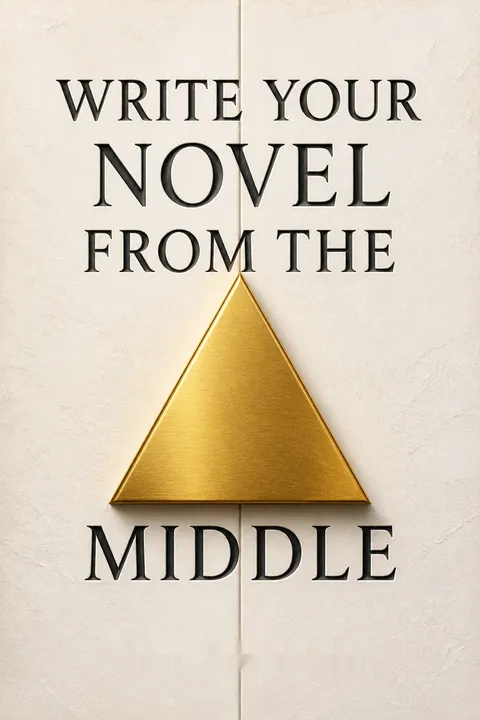
Build a three-point engine. Bell calls the connection among a protagonist's pre-story psychology, midpoint reckoning, and final transformation the “Golden Triangle.” The midpoint is its anchor: it reveals the inner conflict that gives both the character's history and eventual change their meaning. Backstory is then selected for relevance, rather than added as a biography detached from the plot.
Work from any corner. In Lethal Weapon, Martin Riggs enters the story grieving his murdered wife and contemplating suicide. At the midpoint, he describes himself as valuable only for his ability to kill. His final change becomes legible when he gives away the bullet he had kept for suicide. His past, self-assessment, and ending all point toward the same struggle: whether he can find a reason to live.
The triangle functions like a compact theory of character: earlier experience shapes a present self-conception, and the ending tests whether that conception can change. This is close to how psychological accounts of identity emphasize the stories people tell about themselves. For writers, the benefit is selectivity. Backstory earns its space when it illuminates the protagonist's present choices. The method can become too tidy if every memory is forced to explain one trait, though. Characters also contain contradictions that resist a single, clean causal account.
Prove inner change through an action readers can see
Turn realization into evidence. An ending should not rely only on a character announcing that they have changed. Bell recommends finding a visible action that demonstrates the new self. In A Christmas Carol, Scrooge's renewed generosity is shown through concrete choices: helping the Cratchit family, supporting charity, and repairing family ties. In Lethal Weapon, Riggs gives Murtaugh the bullet he once reserved for himself. Each action makes an inward shift observable.
Design backward if needed. A writer can imagine the final proof first, then plant the relevant object, relationship, or habit earlier so the action feels earned. A powerful gesture often carries more weight than a speech because it costs the character something or reverses an established behavior.
Visible change gives readers a form of evidence. In everyday life, people judge intentions partly through behavior, especially when words and conduct conflict; fiction can use the same expectation. A carefully planted object or repeated action also creates satisfying recognition, as the ending transforms something familiar into proof of growth. The risk is reducing development to a symbolic prop. The gesture works only when the story has established the inner struggle and the choice has real consequences. Otherwise, the image reads as a neat emblem rather than earned change.
Give plotters, pantsers, and hybrids one shared story compass
Keep the process flexible. Bell's method is meant for writers who outline, discover the story while drafting, or combine both approaches. Plotters can establish the central reckoning and ending before building a detailed outline. Pantsers can draft freely, then pause after roughly 10,000 words to identify the protagonist, the central problem, and the change the story might require. A writer between the two can begin with only the midpoint and the ending.
Let the compass correct course. The key is not to lock every scene in place. It is to know what the protagonist's central struggle is, so a promising detour can be kept and a lifeless one reconsidered. The framework can also begin with genre, character, or theme, then connect those starting points to the same core conflict.
This is a productive answer to the false choice between planning and spontaneity. Cognitive work often benefits from both generative exploration and later evaluation, and the method assigns each a place without demanding one temperament. It treats structure as orientation rather than a scene-by-scene contract. That flexibility matters because writers differ in how they discover material. Still, a compass cannot tell whether a scene is vivid, surprising, or well written. Structural coherence is a foundation for invention, not a substitute for it.
Feed ideas deliberately, then give each scene a concrete objective
Build an idea pipeline. Bell advises collecting possibilities through questions, headlines, occupations, borrowed old plots, striking titles, or imagined first lines. Keep the raw ideas, return to the promising ones, and develop them into short pitches that name the lead, the problem, and the stakes. Before drafting a scene, define its “3 Os”: the viewpoint character's objective, the obstacles, and the outcome. He favors an outcome that often complicates the character's position.
Make room for discovery. Bell also describes quiet visualization, handwritten notes, and thinking about the next scene before sleep, then recording ideas in the morning. These practices invite unplanned connections without making inspiration a prerequisite. A scene can be prepared enough to give the imagination direction, while still leaving space for an unexpected turn.
The pipeline reduces the pressure to find a perfect idea on demand. Collecting first and judging later separates creative generation from selection, a distinction useful in many forms of problem-solving. The scene questions then shift attention from vague intention to observable action and resistance. That combination is more practical than waiting passively for inspiration. The caution is that a checklist can manufacture activity without emotional purpose. An objective and obstacle make a scene functional, but the writer still needs to ask why this encounter matters to the character and to the reader.
Let pleasure in the telling sharpen the voice on the page
Follow the story's energy. Bell treats voice less as a trick of sentence style than as the writer's pleasure in telling a particular story. That pleasure can come from being excited about the premise, exploring a character's history, or writing during the hours when the mind feels most alert. If a passage becomes lifeless, a short break or a fast, low-editing burst may help the writer rediscover the scene's momentum.
Protect the work's freshness. Bell also recommends picturing the finished book and its future readers as a way to sustain effort. The aim is not to force cheerfulness into every paragraph. It is to choose material that genuinely engages the writer and to avoid polishing sentences so early that the act of discovery disappears.
Voice is often easier to recognize than define, and the idea of pleasure offers a useful route into it: readers can sense the writer's attention, curiosity, and appetite for the material. This resembles the way enthusiasm can make an explanation feel more inviting without changing its factual content. The point is not that joy guarantees quality. Some scenes are difficult by design, and professional work includes revision through frustration. But sustained disinterest is valuable information: perhaps the scene, the character's desire, or the writer's approach needs rethinking.
Show emotion in behavior, and reserve summary for quieter moments
Let readers infer. Showing presents action and speech so readers can interpret a character; telling summarizes what happened or names an emotion. When Sam Spade glances at his watch while a grieving woman cries in The Maltese Falcon, the small gesture reveals impatience more sharply than an explanation would. Bell's rule is proportional: the more intense the moment, the more valuable it is to dramatize it. Summary remains useful when showing every transition would make a novel bloated.
Make exposition natural. Dialogue and interior thought can convey background, but characters need a believable reason to mention or consider it. A uniform waiting at the cleaners can reveal a parent's job more naturally than a conversation that explains facts both speakers already know. If exposition feels inserted, another scene or viewpoint may carry it better.
Showing asks readers to participate in interpretation. A gesture can carry several meanings at once, making a character feel more complex than a list of traits. The film analogy is helpful, but fiction has tools cinema lacks, including interior thought and flexible narrative distance. The strongest prose moves between modes rather than obeying an absolute ban on telling. Summary can create speed, establish context, or deliberately shape a reader's judgment. The craft question is where inference adds emotional force and where explanation serves clarity.
Make trouble escalate around a flawed, worth-following lead
Start the engine early. Bell studies John McPartland's noir novel Big Red's Daughter as a compact lesson in page-turning. Its returning soldier, Jim Work, is decent but imperfect, and trouble begins almost immediately with a car collision, a fight, and an attraction to Wild, the girlfriend of dangerous Buddy Brown. Events keep tightening around him rather than giving the story a long warm-up.
Keep tension human. Buddy is volatile and threatening, but a glimpse of his brutal past complicates the reader's response. The plot also compresses events into a short span, raises physical danger, and preserves emotional turns within the action. Bell adds that a satisfying ending should leave a sense of completion, not simply stop once the immediate problem is solved.
The example shows that speed is not merely short chapters or constant violence. Momentum comes from linked consequences, uncertainty about what a character will do, and emotional reasons to care about the outcome. A morally compromised antagonist can heighten that uncertainty because readers must hold danger and human vulnerability together. The principle has limits: relentless escalation can numb readers if every beat is equally loud. Pacing needs variation, and sympathy should not erase accountability. A page-turner earns speed by making each new complication matter.
Analysis
Bell's central contribution is a practical change of starting point. Instead of asking only what happens at the beginning or how the plot ends, the writer asks what the protagonist discovers about themselves or their odds at the story's center. That question links plot mechanics to meaning. The surrounding tools then radiate from it: existential-feeling stakes give the conflict emotional force, two major thresholds create forward motion, and the character's past and final behavior make the arc coherent.
The book's strongest feature is its accommodation of different working styles. The method does not require a pantser to become a meticulous outliner, or a plotter to suppress invention. It offers a shared diagnostic that can be applied before drafting or during revision. Its examples, from Rick's moral reckoning to Riggs's discarded suicide bullet, make abstract structural claims visible and memorable.
The framework is best understood as a heuristic, not a universal law of narrative. Some compelling novels distribute transformation across an ensemble, resist a single climax, or deliberately unsettle conventional act structure. Bell's own advice allows such experimentation after writers understand the underlying expectations, but the book's confidence in the midpoint can overstate its necessity. The more durable principle is functional: a story benefits from a central pressure point that clarifies what is at stake inside the protagonist, even when that point does not fall at the exact midpoint.
The craft tips broaden the book beyond architecture. Idea collection, scene objectives, selective dramatization, and attention to the writer's enthusiasm address the daily work that structure alone cannot solve. Taken together, they offer a model of writing as both design and discovery. The outline supports coherence; the imagination supplies surprise; revision decides which surprises belong.
Review Summary
Write Your Novel From The Middle receives mostly positive reviews, praised for its concise and practical approach to storytelling. Readers appreciate Bell's focus on the "mirror moment" at the story's midpoint, finding it helpful for both plotters and pantsers. Many consider it a valuable resource for understanding story structure and character development. Some criticize the book's brevity and repetition, while others view its conciseness as a strength. Overall, reviewers recommend it as a useful tool for writers seeking to improve their craft.
People Also Read




Glossary
Mirror Moment
Midpoint self-assessmentA moment near the center of a story when the protagonist confronts either what kind of person they are becoming or how overwhelming the opposition appears. It is an internal reckoning within a scene, not necessarily a major external plot event. The moment helps reveal what the story is fundamentally examining.
The Golden Triangle
Character arc structureA framework connecting three elements of a protagonist's arc: their pre-story psychology, their central Mirror Moment, and their final transformation. The midpoint clarifies the conflict that makes the character's past and ending significant. Writers can begin with any of the three points, then develop the others until they reinforce a coherent story.
Doorway of No Return
Irreversible story thresholdA major turning point that pushes the protagonist into a new phase of conflict, making a return to the previous situation impossible or untenable. Bell applies the idea twice: the first threshold launches the central struggle, while the second precipitates or enables the final confrontation.
death stakes
Existential-feeling consequencesBell's term for consequences that make failure feel like a form of death to the protagonist. The threat may be physical, professional, or psychological. The character need not literally die; the conflict must endanger something so central to their life, identity, or purpose that losing feels devastating.
Opening Disturbance
Early disruptionAn early change, challenge, or trouble that interrupts the protagonist's ordinary situation. It gives the opening movement and signals that something is wrong or shifting, while the first Doorway of No Return later commits the protagonist to the larger conflict.
signpost scenes
Key structural scenesBell's planning term for scenes a writer expects to include as major waypoints in a novel. They can include the opening disruption, major turning points, a central reckoning, a darkest moment, the final battle, and transformation. They provide an outline's basic supports without requiring every intervening scene to be planned in advance.
3 Os
Scene planning questionsA scene-planning technique that asks for the viewpoint character's objective, the obstacles blocking it, and the outcome. The outcome commonly complicates the character's position rather than providing an easy win. The questions help ensure that a scene contains action and conflict instead of merely delivering information.
SUES
Unexpected scene elementAn acronym for “Something Unexpected in Every Scene.” Bell uses it as a prompt to invite surprise into scene construction. After establishing a character's objective and obstacles, the writer considers an unanticipated development that can unsettle the expected outcome, deepen conflict, or open a more interesting direction.
Q Factor
Emotional reason to continueBell's label for the emotional push that helps a protagonist keep fighting or make the right choice near the climax. It may arise from a meaningful reminder, an earlier relationship, or words from a trusted character. Like a useful tool introduced early, it gains force when the story has already prepared the emotional connection.
FAQ
What's "Write Your Novel From The Middle" about?
- Unique Approach: The book introduces a novel method for writing fiction, focusing on starting from the middle of the story rather than the beginning or end.
- For All Writers: It caters to plotters, pantsers, and those in between, offering strategies that can be adapted to any writing style.
- Core Concept: The central idea is that the midpoint of a story reveals what the narrative is truly about, providing clarity and depth.
- Practical Guidance: It provides actionable advice and techniques to help writers structure their novels effectively.
Why should I read "Write Your Novel From The Middle"?
- Innovative Method: It offers a fresh perspective on novel writing that can enhance creativity and storytelling.
- Versatile Application: The method is applicable to various writing styles, making it a valuable resource for any writer.
- Improved Storytelling: By focusing on the midpoint, writers can create more cohesive and engaging narratives.
- Expert Insights: Written by James Scott Bell, a seasoned author and writing instructor, it provides credible and practical advice.
What are the key takeaways of "Write Your Novel From The Middle"?
- Midpoint Focus: The midpoint of a story is crucial for understanding its true essence and direction.
- Three Types of Death: Stories should involve stakes of physical, professional, or psychological death to engage readers.
- Golden Triangle: The book introduces the concept of the Golden Triangle, which includes pre-story psychology, the Mirror Moment, and transformation.
- Flexible Structure: Writers can use the method at any stage of their writing process, whether they prefer outlining or spontaneous writing.
How does the "Write From the Middle Method" work?
- Mirror Moment: Identify a pivotal moment in the middle of the story where the character reflects on themselves or their situation.
- Golden Triangle: Use the Mirror Moment to explore the character's pre-story psychology and their ultimate transformation.
- Organic Unity: This method helps create a cohesive narrative by ensuring all parts of the story are interconnected.
- Adaptability: It can be applied to different genres and writing styles, allowing for creative freedom while maintaining structure.
What is the "Golden Triangle" in "Write Your Novel From The Middle"?
- Three Points: The Golden Triangle consists of pre-story psychology, the Mirror Moment, and transformation.
- Pre-story Psychology: Understand the character's background and motivations before the story begins.
- Mirror Moment: A critical point in the middle where the character reflects on their journey and challenges.
- Transformation: The character's change or growth by the end of the story, completing the narrative arc.
What are the "Three Types of Death" stakes mentioned in the book?
- Physical Death: The character faces a threat to their life, common in thrillers and action genres.
- Professional Death: The character's career or calling is at risk, adding tension and urgency to the narrative.
- Psychological Death: The character risks losing their sense of self or purpose, crucial for emotional depth.
- High Stakes: Incorporating one or more of these stakes ensures the story remains engaging and impactful.
How can the "Write From the Middle Method" benefit plotters?
- Structural Support: It provides a solid framework for outlining, ensuring the story remains cohesive.
- Focus on Midpoint: Plotters can use the Mirror Moment to anchor their outlines and guide the narrative.
- Enhanced Depth: By understanding the character's transformation, plotters can create more nuanced story arcs.
- Flexibility: The method allows plotters to adjust their outlines as the story develops, maintaining creative freedom.
How can the "Write From the Middle Method" benefit pantsers?
- Guided Exploration: Pantsers can write freely while using the Mirror Moment to find clarity and direction.
- Organic Development: The method encourages spontaneous writing while ensuring the story remains cohesive.
- Character Insight: By focusing on the character's transformation, pantsers can create more compelling narratives.
- Midpoint Anchor: The Mirror Moment serves as a reference point, helping pantsers stay on track.
What are some writing tips for plotters, pantsers, and tweeners in the book?
- Idea Generation: Become an idea factory by regularly brainstorming and nurturing creative concepts.
- Daily Writing: Enhance productivity with techniques like morning pages and focused writing sessions.
- Voice Development: Cultivate a unique voice by writing with joy and authenticity.
- Show, Don't Tell: Use showing techniques to create vivid and engaging scenes, avoiding excessive exposition.
What is the "Magical Midpoint Moment" in "Write Your Novel From The Middle"?
- Character Reflection: The midpoint is a moment where the character looks at themselves and assesses their journey.
- Narrative Clarity: It reveals what the story is truly about, providing direction and depth.
- Emotional Connection: This moment deepens the bond between the character and the audience.
- Story Cohesion: It serves as a central point that ties the beginning and end of the story together.
What are the best quotes from "Write Your Novel From The Middle" and what do they mean?
- "The midpoint moment...tells us what the novel or movie is really all about." This emphasizes the importance of the midpoint in understanding the core of the story.
- "Structure is translation software for your imagination." It highlights the role of structure in transforming creative ideas into a coherent narrative.
- "A great novel is the record of how a character fights with death." This underscores the significance of high stakes in storytelling.
- "The true midpoint is not a scene. It's a moment within a scene." It clarifies that the midpoint is a subtle yet powerful turning point in the narrative.
How does "Write Your Novel From The Middle" address different writing styles?
- Inclusive Approach: The book caters to plotters, pantsers, and tweeners, offering strategies for each style.
- Adaptable Method: The Write From the Middle Method can be applied at any stage of the writing process.
- Flexible Structure: Writers can use the method to enhance their natural writing style while maintaining narrative cohesion.
- Creative Freedom: The method encourages exploration and spontaneity, allowing writers to find their unique voice.
About the Author
Other books by James Scott Bell
Download PDF
Download EPUB
.epub digital book format is ideal for reading ebooks on phones, tablets, and e-readers.








