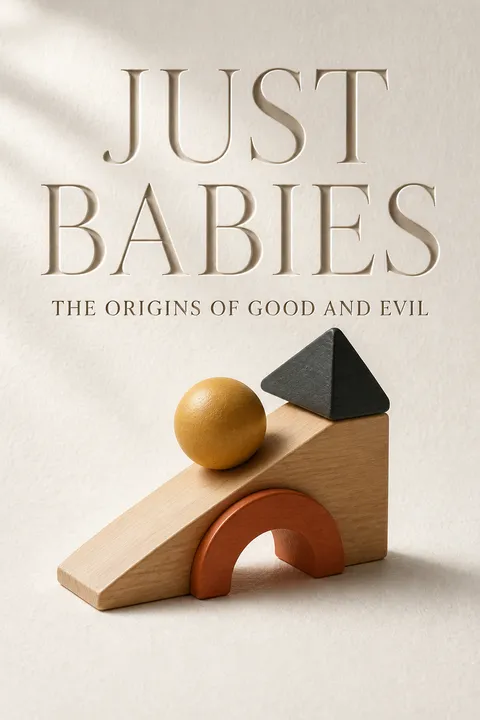


Key Takeaways
By six months, babies already prefer helpers over hinderers
A social preference appears early. In puppet experiments, a character either helped another climb a hill or blocked its progress. Six- and ten-month-olds generally reached for the helper, while three-month-olds reliably preferred a neutral character to a hinderer but did not yet favor the helper over neutral. Similar preferences appeared when puppets either returned a ball or stole it. These choices suggest an early capacity to evaluate social behavior, before children can explain what they see.
Not a finished moral code. Bloom calls this early ability a moral sense: a basic capacity to distinguish helpful from harmful actions. It does not mean babies understand ethical principles or reliably behave well. Their preferences were inferred from looking and reaching, and researchers designed controls to check that infants responded to the social interaction rather than colors or motion alone.
What's striking is how early social evaluation appears, and how carefully the studies distinguish a preference from a fully developed moral judgment. The finding fits a broader developmental picture: human infants arrive prepared to notice agents, goals, and exchanges, rather than learning social life from scratch. Still, reaching toward a helper cannot reveal exactly what an infant understands. A preference may be an important precursor to moral thought without being morality in the adult sense. Treating the result as a foundation, rather than proof that babies possess mature ethics, preserves both its wonder and its scientific limits.
Feeling another person’s pain does not guarantee that you will help
Empathy and compassion differ. Empathy is the experience of resonating with another person's feelings; compassion is concern for that person and a desire to relieve their suffering. A crying infant can make another infant cry, and toddlers may comfort someone who appears hurt. But sharing distress does not automatically produce helpful action. A person might leave to escape the discomfort, or even enjoy a rival's misfortune.
Concern needs judgment. A bystander who sees a child struggling in shallow water may rescue her without first imagining the child's fear. Conversely, a person can feel deeply for one patient and unfairly move that person ahead of others who need treatment just as much. Bloom therefore treats compassion as a vital moral motive, but not a complete guide to moral action.
This distinction matters well beyond infancy. Emotional resonance can make suffering vivid, but vividness is not the same as good judgment: a nearby individual can command more attention than many unseen people. The argument also cautions against treating empathy as a universal remedy. In professional settings, care must often be paired with procedures that protect fairness, such as consistent standards for allocating scarce help. The strongest account is not that emotion should be suppressed, but that emotional concern needs rules capable of extending care beyond whoever happens to feel most immediate.
Audit fairness claims for hidden status competition
Equality is an early expectation. Infants notice unequal distributions, and young children often prefer equal divisions. In one experiment, children aged six to eight would rather discard a leftover eraser than let one of two workers receive more. Add that one worker did more, however, and children often award that child the extra eraser. Their equality preference is real, but it can make room for effort and other considerations.
Self-interest changes the picture. Swiss children in a candy-sharing game were much less likely to give up a treat as toddlers than as older children. Other studies found that children often objected to receiving less than a peer, while advantaged children were less bothered. Some even sacrificed their own reward to prevent another child from getting more. Fairness, then, includes equality, self-protection, and status comparison, not one simple impulse.
The tension between equality and status helps explain why fairness debates feel so personal. People may defend equal treatment in principle while reacting most strongly when they themselves lose ground. This does not make fairness insincere; it shows that moral ideals and self-interest can operate together. The useful question is not whether someone is perfectly impartial, but whether a proposed rule can be defended when positions are reversed. That test exposes favoritism without assuming that every unequal outcome is unjust, since effort, need, and circumstances can also matter.
Punishment can protect cooperation, but outrage often wants payback
Fairness has a punitive side. In the Ultimatum Game, one person proposes how to divide money and the other can accept or reject the offer. Recipients often reject a very small share, even though rejection leaves them with nothing. Their anger may enforce a norm against treating others as inferior, but it also looks like retaliation. In a Public Goods Game, people contribute to a shared pot that benefits everyone, creating an incentive to free-ride.
Sanctions can change behavior. In one version, participants could pay to reduce the earnings of people who contributed little. About 80 percent punished at least once, and cooperation increased. Yet costly punishment is not universal in real communities, and some societies show retaliation against punishers instead. Bloom argues that third-party punishment may often extend personal revenge and empathy, rather than arise from a separate, impartial instinct for justice.
Punishment can stabilize cooperation when people expect others to exploit shared resources, a problem familiar from taxes, public services, and collective projects. But the same impulse can become mob justice when anger outruns evidence or proportion. The distinction between enforcement and vengeance is therefore institutional, not merely emotional: transparent rules, reliable evidence, and avenues for appeal help keep punishment from becoming status combat. The account also leaves a live question about motivation. People may punish to avenge victims, uphold norms, deter future harm, or signal their own virtue, and these motives can coexist.
Notice how quickly social labels become moral borders
Groups form with little prompting. At a summer camp study called Robbers Cave, boys first bonded in separate groups, then became hostile when researchers arranged competitions between them. Shared problems later helped bring the groups together. In another line of research, adults assigned to arbitrary groups based on which abstract paintings they supposedly preferred favored their own group when distributing money, even when they gained nothing personally.
The cue need not be race. Children also show preferences for familiar languages and accents. Research described here suggests that racial bias is not fully present in preschoolers: it becomes more likely in settings where racial categories organize social life, and it is weaker in more diverse schools. A distinction becomes powerful when people around a child treat it as meaningful. Group loyalty can attach to skin, speech, clothing, or any category made socially important.
The striking implication is that prejudice does not require deep historical hatred to begin. Ordinary categorization can become a moral boundary when institutions, adults, or competition teach people that a label predicts allegiance. That makes group bias neither inevitable nor trivial: it is responsive to social design. Contact across groups can weaken prejudice when people meet as peers and cooperate, but mere proximity is not guaranteed to do so. The quality of interaction matters, as does whether rules and leaders signal that shared membership is more important than inherited divisions.
Treat disgust as an alarm, not as proof that someone is immoral
Disgust begins as protection. Reactions to spoiled food, bodily waste, and signs of disease can help people avoid contamination. Young children do not initially share many adult disgust responses, but these reactions develop as they grow. The danger comes when revulsion spreads from substances to people. Bloom describes how Nazi rhetoric portrayed Jewish people as dirty and subhuman, turning disgust into a justification for exclusion and cruelty.
Revulsion can distort judgment. Experiments in the book found that people made harsher moral judgments after exposure to unpleasant settings, smells, or images. Disgust sensitivity also correlated with greater disapproval of some sexual minorities. This does not mean every disgust reaction is harmful or that every taboo lacks a reason. It means that feeling repelled cannot, by itself, establish that another person's harmless behavior deserves condemnation.
Disgust is useful as a fast warning system, but warning systems are designed to prioritize caution, not fairness. The same reflex that helps avoid pathogens can misclassify unfamiliar people as contaminants. That makes disgust especially risky when it enters law or public policy, where private aversion can become coercion. A practical safeguard is to ask what concrete harm a disputed act causes, and whether that harm can be demonstrated independently of revulsion. The emotion may alert people to examine an issue, but it should not settle the issue.
Build bridges from family loyalty to unfamiliar strangers
Concern has a social radius. Bloom organizes moral relationships around kin, members of one's community, and strangers. Family bonds are especially powerful, and people often feel duties to relatives that they would not owe to an unknown person. Infants also prefer familiar caregivers, while young children are often wary of strangers. The book argues that natural moral concern does not begin as equal affection for everyone.
The boundary can move. A stranger may become part of a community through friendship, shared work, or a story that makes their life more imaginable. Bloom calls the range of people whose wellbeing counts the moral circle. Its size is not automatically a measure of virtue: expanding concern can create difficult conflicts, and family obligations remain meaningful. The challenge is to recognize partiality without mistaking it for a complete account of what anyone deserves.
This account offers a useful correction to moral theories that treat family preference as an embarrassing exception. Caregiving relationships are not interchangeable with anonymous contact, and a society depends on people accepting special responsibilities to children, partners, and relatives. At the same time, partiality can shield neglect or exclusion when outsiders are treated as if their suffering matters less. The productive aim is not emotional sameness toward everyone. It is a widening capacity to recognize claims beyond one's closest circle, while making explicit when special obligations are justified and where they stop.
Put a face and name on distant suffering before asking for help
Specific people draw attention. People are more moved by a recognizable individual than by a large, anonymous group. In studies discussed by Bloom, participants gave more to help a named, pictured child than to help a group of eight children described without personal detail. The disparity suggests that concern does not rise neatly with the number of lives at stake. A vivid case can feel more urgent than a much larger but abstract need.
Make the distant concrete. The Good Samaritan story asks readers to treat an injured outsider as a neighbor, not merely as a member of a distant category. Faces, names, and individual histories can help make that shift. But personal stories should not be the only basis for decisions. They can focus attention, while fair procedures are still needed to compare needs and distribute limited resources responsibly.
This is a powerful design insight for charities, journalism, and public health: information works differently when it presents a person rather than a statistic. Specificity can motivate action, but it can also bias allocation toward the most photogenic or narratively compelling case. A responsible approach pairs individual stories with population-level evidence. The story opens the door to concern; the data help determine scale and priority. In that sense, emotion and analysis need not compete. Each corrects a weakness in the other.
Model the generosity you want children to copy
Custom teaches through repetition. Children learn many moral habits by watching what people around them do, not by first reasoning through a rule. In charity experiments, children who saw another person donate more often donated more themselves. Explicit preaching was less effective in some studies, and children could imitate selfish behavior too. In one set of experiments, they copied a parent's small gift more strongly than a very generous one.
Culture supplies moral examples. Repeated contact between groups can reduce prejudice under the right conditions, and stories can make unfamiliar lives easier to imagine. Religion also has mixed effects: the research reviewed here links charitable participation more strongly to involvement in a religious community than to particular beliefs. None of these influences guarantees kindness. Customs can normalize generosity, but they can also pass along cruelty and exclusion.
The emphasis on modeling connects moral development to social learning: values are not only announced, they are demonstrated in routines and relationships. This makes everyday conduct consequential, especially for children who cannot yet evaluate adult explanations independently. It also complicates the idea that moral progress comes from better slogans. Institutions and communities shape what people see as normal, and those norms can shift in either direction. Stories and contact are most constructive when they encourage perspective-taking without replacing scrutiny of the rules a community asks people to accept.
Use reason to widen moral concern beyond inherited instincts
Innate feelings are a beginning. Babies show early capacities for social evaluation, sympathy, and fairness, but they do not arrive with a universal moral philosophy. Their concern is limited, and inherited responses can favor insiders, status, and disgust. Bloom argues that adults add imagination and reasoning, allowing people to question customs and defend rules that apply beyond their immediate interests.
Impartiality can be learned. A parent who asks a child to imagine how a harmed playmate feels is doing more than eliciting empathy. The child is also being asked to accept that other people have claims too. Reasoning about harm, fairness, and consistency has helped people reject practices once treated as normal, including slavery. Emotion gives moral concern its force; reflection can test whether that concern has been distributed arbitrarily.
The strongest version of this argument does not portray reason as a cold substitute for emotion. It treats reflection as a way to inspect the reach and consistency of emotional commitments. People need some concern before a moral question matters to them, but principles can reveal that concern has been allocated selectively. Bloom's account is optimistic about deliberation, though not every argument is persuasive or unbiased. Reason can also rationalize existing loyalties. Its moral value depends on whether people are willing to expose their favored beliefs to challenge and consider how rules look from another position.
Analysis
Just Babies offers a layered account of morality rather than a choice between nature and nurture. Early social preferences and distress responses provide raw materials; attachment, group life, and cultural imitation shape their targets; reflection can then challenge the boundaries that instinct supplies. This structure explains why people can be generous in one relationship and indifferent in another without being simply good or bad. It also shifts the question from whether morality is innate to which parts are innate, and what those parts can and cannot accomplish.
The strongest evidence is developmental and comparative. Infants react differently to helping and hindering, and young children notice unequal allocations. Yet these findings rely on looking time, reaching, or brief choices in artificial settings. Such measures support claims about expectations and preferences, but they cannot establish that infants possess adult-like concepts of obligation, guilt, or justice. The book is at its most persuasive when it calls these capacities foundations, not miniature versions of a mature ethical system.
The evolutionary account is illuminating but should be handled carefully. Kin care, reciprocal cooperation, and group loyalty plausibly explain why moral concern is unevenly distributed. They do not by themselves explain every cultural norm, and evolutionary stories can sound more certain than the evidence warrants. Bloom's emphasis on learning and reason helps avoid treating contemporary morality as a direct readout of ancestral needs. Historical change matters: the same human capacities can sustain exclusion in one setting and reform in another.
The moral circle is a useful image, though enlargement is not a simple ladder toward goodness. Extending concern to more beings can create conflicts over scarce resources and competing rights. The practical lesson is therefore not to abandon partial loyalties, but to examine them, make their costs visible, and build procedures that prevent proximity, disgust, or group identity from deciding every case. Moral maturity is neither pure instinct nor pure logic. It is the disciplined revision of instinct by evidence, imagination, and reasons that others can inspect.
Review Summary
Just Babies explores the origins of morality in infants and young children through psychological experiments. While some reviewers found the book insightful and thought-provoking, others felt it strayed from its premise and lacked depth. The book examines concepts like empathy, fairness, and disgust, and how they relate to moral development. Bloom argues that humans have innate moral tendencies from birth, but reason and experience shape our ethical frameworks as we grow. Despite mixed opinions on its execution, many readers found the topic intriguing and the writing accessible.
People Also Read


Glossary
moral sense
early social evaluationA basic capacity to evaluate other people's actions as helpful or harmful, kind or cruel. In the infant studies, it is inferred from looking or reaching preferences toward characters who help or hinder. It is not a complete ethical system, a guarantee of good behavior, or proof that babies understand moral rules as adults do.
moral circle
who counts morallyThe range of individuals whose wellbeing a person treats as morally important. Bloom describes concern as often strongest for family, extending to community or group members, and weakest toward strangers. The circle can expand through contact, imagination, and reasoning, but a larger circle does not automatically resolve conflicts among competing needs.
empathy
sharing another's feelingsA capacity to experience or imagine another person's emotional state, such as feeling distress when someone else is hurt. Bloom distinguishes empathy from compassion: resonance may prompt care, but it can also lead someone to withdraw, favor one vivid case unfairly, or take pleasure in a rival's pain.
compassion
concern that seeks reliefConcern for another person's suffering, often accompanied by motivation to reduce it. Compassion differs from empathy because it does not require experiencing the other person's feelings. It is an important source of helping and comfort, but it can conflict with fairness when emotional closeness leads to unequal treatment.
Ultimatum Game
bargaining with rejectionA behavioral economics task in which one participant proposes how to divide a sum of money and another can accept or reject the offer. If the recipient rejects it, neither participant receives money. Recipients often reject very unequal offers, showing that people may sacrifice personal gain to protest unfair treatment.
Dictator Game
unilateral resource sharingA task in which one participant decides how much of an assigned resource to give to another person, who cannot reject the decision. People often share some amount, but the result may reflect generosity, concern about appearing selfish, or other pressures. The game alone cannot identify a participant's motive.
Public Goods Game
shared contribution dilemmaA group task in which participants choose whether to contribute resources to a common pool that benefits everyone. Each person can gain by withholding a contribution while others pay the cost, creating a free-rider problem. Some versions allow participants to spend their own resources to penalize low contributors.
minimal-group studies
bias from arbitrary groupsExperiments that assign people to groups with little meaningful basis, such as a supposed preference for one painter or a randomly given shirt color. Participants often favor their assigned group when sharing resources or judging behavior. The studies demonstrate how social context can give arbitrary categories psychological importance.
moral dumbfounding
judgment without clear reasonA pattern in which people feel strongly that an act is wrong but struggle to give a coherent explanation when familiar harms, such as coercion or injury, are removed from the scenario. The term is associated with Jonathan Haidt's research on moral intuition. It illustrates that some judgments arise from immediate reactions rather than articulated reasoning.
contact hypothesis
contact can reduce prejudiceThe proposal that interaction between members of different social groups can lessen prejudice, especially when people meet on relatively equal terms and cooperate toward shared goals. The book uses this idea to explain why children in diverse schools may show less racial bias than children in more homogeneous settings.
Macbeth effect
cleansing after moral threatA set of findings suggesting that reminders of moral wrongdoing can increase people's desire for physical cleansing, and that cleansing can ease feelings such as guilt. Related experiments found that bodily actions used in a wrongdoing can shape which cleaning product people prefer. The effect illustrates the psychological link between physical cleanliness and moral purity.
FAQ
What is Just Babies: The Origins of Good and Evil by Paul Bloom about?
- Exploration of morality’s roots: The book investigates how morality develops from infancy, arguing that some moral capacities are innate rather than solely learned from culture.
- Interdisciplinary approach: Paul Bloom combines developmental psychology, evolutionary biology, and philosophy to explain the origins of good and evil in humans.
- Key themes: Topics include empathy, fairness, disgust, family bonds, and the role of reason in moral development, showing how both kindness and cruelty emerge from our nature.
Why should I read Just Babies by Paul Bloom?
- Insight into human nature: The book offers a compelling account of why people can be both wonderful and horrible, shedding light on the origins of good and evil.
- Scientific and philosophical integration: Bloom makes complex ideas accessible, blending cutting-edge research with philosophical reflection for a broad audience.
- Practical relevance: Understanding the moral life of babies can inform parenting, education, and social policy, helping readers appreciate and nurture the foundations of morality.
What are the key takeaways from Just Babies by Paul Bloom?
- Morality is partly innate: Humans are born with foundational moral capacities, including a sense of right and wrong, empathy, fairness, and justice.
- Morality is complex: Our natural moral sense includes both kindness and cruelty, shaped by evolutionary, developmental, and cultural factors.
- Moral progress requires reason: While babies have moral sentiments, adults use intelligence and deliberation to transcend innate biases and achieve moral insight and progress.
What are the main moral capacities that babies possess according to Just Babies?
- Innate empathy and compassion: Babies show early signs of empathy, such as distress at others’ pain and spontaneous helping behaviors.
- Sense of fairness: Even infants react to unequal distributions of resources, showing expectations of fairness and negativity toward unfairness.
- Moral evaluation: Babies can distinguish between prosocial and antisocial behaviors, preferring helpers over hinderers, indicating a rudimentary moral sense.
How does Paul Bloom define the "moral sense" in Just Babies?
- Capacity for moral judgment: The moral sense is the ability to distinguish between good and bad, kindness and cruelty, similar to an external sense like hearing or seeing.
- Beyond mere behavior: It involves making disinterested judgments about right and wrong, not just an impulse to do good.
- Philosophical roots: This concept echoes Enlightenment thinkers who believed morality is an innate part of human nature.
How does Just Babies explain babies’ understanding of good and evil?
- Experimental evidence: Studies using looking-time and reaching measures show that babies as young as three months prefer helpful characters over hinderers.
- Social evaluation: Babies expect individuals to approach helpers and avoid hinderers, indicating early social reasoning about others’ behavior.
- Negativity bias: Younger babies are more sensitive to badness (hindering) than goodness (helping), a pattern also seen in adults.
What role do empathy and compassion play in morality according to Just Babies by Paul Bloom?
- Empathy vs. compassion: Empathy is feeling what another feels, while compassion is caring about another and wanting to alleviate their suffering.
- Empathy is not sufficient: Psychopaths may understand right and wrong but lack empathy and compassion, leading to immoral behavior despite cognitive knowledge.
- Complex relationship: Compassion motivates moral actions, but empathy can be chosen or avoided, and sometimes empathy exists without compassion or vice versa.
How does Just Babies address fairness, status, and punishment in moral development?
- Innate fairness bias: Babies and young children show a preference for equal distribution of resources and expect fairness in rewards.
- Status and hierarchy: Human societies balance egalitarianism with status concerns, often through social mechanisms like ridicule or coalition-building.
- Punishment and revenge: Moral psychology includes desires for revenge and third-party punishment, which help enforce cooperation but can also lead to cycles of retaliation.
How does Paul Bloom explain the role of disgust in morality in Just Babies?
- Disgust as adaptation: Disgust likely evolved to protect humans from harmful foods and pathogens, with heightened sensitivity in certain contexts like pregnancy.
- Moral judgments: Disgust extends to moral domains, especially sexual morality, influencing judgments about behaviors like incest and homosexuality.
- Moral implications: Inducing disgust makes people judge moral transgressions more harshly, but Bloom warns that disgust is an unreliable moral guide and can fuel prejudice.
What is the significance of family and kinship in moral psychology according to Just Babies?
- Family as moral foundation: Morality originally evolved to regulate relationships within small groups, especially kin, where cooperation and altruism have evolutionary benefits.
- Prioritizing kin: People naturally prioritize family and in-group members over strangers, reflecting evolved biases in moral concern.
- Fictive kinship: Humans also create “fictive kin” relationships, such as chosen families, showing the flexibility and importance of close bonds in moral life.
How does Just Babies by Paul Bloom address the expansion of the moral circle and moral progress?
- Moral circle concept: The “moral circle” describes how humans have gradually extended moral concern from family to strangers, other races, and even animals.
- Drivers of expansion: Personal contact, stories, and cultural exposure help broaden empathy and reduce prejudice, facilitating inclusion of more individuals.
- Limits and challenges: Expanding the moral circle is complex and can create new conflicts; reason and deliberation are crucial for navigating these dilemmas.
What role does reason play in morality according to Just Babies by Paul Bloom?
- Reason complements emotion: While moral intuitions and emotions are foundational, reason allows humans to reflect, justify, and refine moral principles.
- Developmental evidence: Children engage in moral deliberation, debating fairness and justice with peers, showing that reasoning emerges alongside innate moral sentiments.
- Moral progress: Bloom argues that reason is essential for overcoming biases and achieving moral progress, challenging the idea that morality is only about gut feelings.
About the Author

Download PDF
Download EPUB
.epub digital book format is ideal for reading ebooks on phones, tablets, and e-readers.








