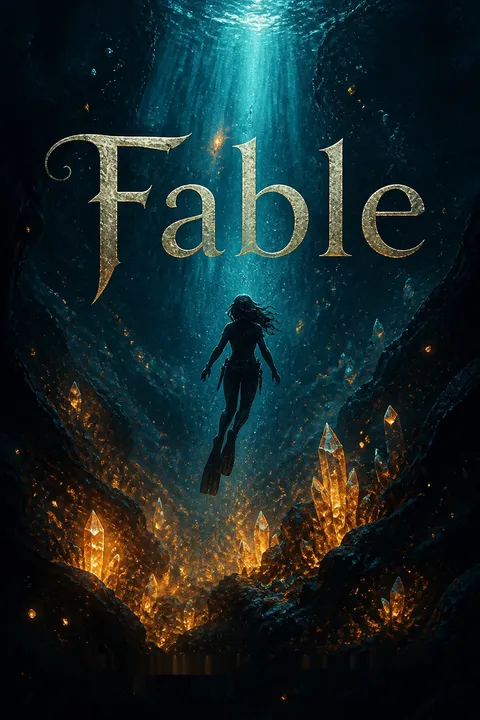


Plot Summary
Four Years on Jeval
Fable survives by diving Jeval’s reef for pyre, a valuable stone she can trade to passing ships. Four years earlier, after the storm that sank the Lark and killed her mother, her father, Saint, left her on this island with a scar on her arm and a promise that she would receive what was hers if she survived and found him again.
Now she needs only a little more coin to cross the Narrows to Ceros. Koy, a young ferryman with a boat and dependents to protect, keeps trying to leave her behind and asking what she plans to do with her earnings. Fable hides her gems and money, obeys Saint’s hard rules, and keeps her destination secret.
Jeval makes survival both a physical skill and a discipline of concealment. Fable’s diving expertise keeps her alive, but the more consequential inheritance is Saint’s training in mistrust: she hides money because generosity has never been reliable and treats every exchange as a possible trap. Her goal is not simply escape. She has organized four years of labor around a promised reckoning with the father who abandoned her. That promise keeps her moving, while also narrowing her imagined future to one encounter. Koy’s attention signals that her private plan is becoming visible, making the very success that might free her increasingly dangerous.
Koy's Reefside Betrayal
When Koy follows Fable to the reef and grabs her underwater, he demands to know where she has hidden her pyre. She breaks free, strikes him with the skiff’s scull, then hauls his unconscious body aboard rather than leaving him to drown. The choice costs precious time. On shore, she finds her camp ransacked, and Koy’s friends have taken everything they could reach.
Her remaining coins are still concealed in a tree hollow, so she binds the purse to her hand and steals Speck’s boat while he sleeps drunk on the beach. Koy wakes and gives chase. Fable reaches the Marigold, a trader she has dealt with for two years, and offers West her money and pyre for passage. He accepts, and she leaves Jeval.
Fable’s rescue of Koy is a small act with a large cost: she refuses to let another person die, even when self-preservation would justify it. That instinct complicates the code she has inherited from Saint, who taught her that attachment creates danger. Her escape depends on precisely the opposite qualities, quick judgment and a capacity to risk herself for another life. West’s acceptance of her payment is not rescue without terms. It gives her a route off the island, but places her inside a crew that has not agreed to carry her. Freedom arrives as a transaction whose consequences she does not yet understand.
The Marigold's Passenger
The Marigold’s crew resents West’s decision to take on a passenger. Willa, the ship’s bosun, makes clear that Fable will earn her food and hammock; Auster gives her nets to mend, and Hamish warns her away from the ship’s property. When West diverts from the expected route, Fable realizes the crew is hiding something.
The others test her by throwing a copper into deep water and assuming she will refuse a dangerous dive. A current drags her across the reef, but she finds the coin and returns injured. Auster then feeds her for the work she has done. Fable tells Willa and Paj that she is seeking Saint for a job, carefully keeping their relationship secret.
The crew’s tests turn the ship into a compressed version of the Narrows, where a person’s worth is measured through labor, risk, and the ability to protect private information. Fable answers humiliation with competence, but the dive nearly kills her and exposes the cost of proving herself on other people’s terms. Auster’s meal matters because it is offered as payment for work rather than pity, a distinction Fable can accept. Her partial truth about Saint is a calculated compromise: she gives the crew enough information to explain her journey while preserving the one fact that could make her valuable or vulnerable.
Secrets Beneath Dern
At Dern, West orders Fable to stay aboard, so she slips into the village after dark. Searching the Marigold first, she finds Saint’s crest painted beneath the helmsman’s rug, evidence that the ship is a shadow vessel operating under a false identity.
In town, she sees Willa sell her jeweled dagger and learns how much it matters to West. He hires Fable to recover it, and she bargains it back from a village dealer with the ring, coins, bracelet, and buckles she has gathered.
At the merchant’s house, she recognizes that supposed emeralds are forsterite fakes. Her warning draws unwanted attention to her gem-sensing ability. West is furious, while Zola, a powerful rival trader, makes clear that the Marigold’s crew has already attracted dangerous rumors.
Dern converts Fable’s talent from a private survival tool into a liability. Her ability to identify false stones protects the crew from a bad trade, yet it also marks her as someone worth watching. The hidden crest shows that the Marigold’s apparent identity is only one layer of its operation, while Willa’s dagger reveals how objects can carry emotional value beyond their market price. Fable understands both forms of value, but she has not yet learned when revealing that understanding is dangerous. Her instinct to help is genuine; in a world built on secrecy, however, even a useful truth can expose the person who sees it.
Storms Carry Her Homeward
Before the Marigold leaves Dern, its crew opens a crate and finds Crane, a member of Zola’s crew, bound inside. Willa confirms the decision to seal him back in, and the crew throws him overboard. Soon after, a violent storm batters the ship. Auster is swept into the sea, and Paj jumps after him; Fable helps haul both men back aboard.
The bow anchor tears free and lodges in the reef, so Fable dives down and breaks it loose despite West’s objections. The damaged ship finally reaches Ceros. On the crowded dock, Fable glimpses Saint, now a powerful trader with a fleet of ships. He recognizes her but keeps walking, leaving her to decide whether to pursue the man whose promise brought her across the Narrows.
The crate and the storm place the crew’s moral choices beside the sea’s indifferent violence. Crane’s execution is deliberate, a punishment administered by people who understand the codes of the Narrows; the storm, by contrast, threatens everyone without judgment. Fable responds to both by acting, rescuing Auster and freeing the anchor even when West orders her away. These acts demonstrate practical courage, but they also force her to witness how readily this crew accepts death as a tool. Her arrival in Ceros does not restore the home she imagines. Saint’s refusal to acknowledge her publicly turns a long-awaited reunion into a new rejection.
The Inheritance Saint Withheld
Fable reaches Saint’s post and finds traces of her mother, Isolde, among his maps and belongings. A memory fills in what she could never understand: after the Lark sank, Saint and the navigator Clove rescued her, then Saint carved the reef’s route into her arm and left her on Jeval. When she finally faces him, Saint gives her a map to the wreck of the Lark, declaring its cargo her inheritance.
He refuses her request to join his crew. He also reveals that West’s visits to Jeval were his orders, and that the Marigold’s trade had quietly supported her survival. Fable realizes her independence was partly managed from afar. She leaves with the map and her mother’s necklace, angry that Saint has again chosen her future for her.
Saint’s inheritance is at once material provision and emotional refusal. The wreck contains wealth, but what Fable asks for is recognition and a place in her father’s life. He answers the request she did not make, offering a resource that can secure her future without requiring intimacy. His hidden support through West complicates her understanding of survival: she did endure Jeval through her own skill, yet the conditions around her were partly shaped by someone else. The scar embodies that contradiction. It is both evidence of Saint’s control and a practical chart she can use independently, so the mark of abandonment becomes an instrument of agency.
West's Ship Goes Dark
After leaving Saint, Fable drinks alone and encounters Zola, who warns that West and the Marigold are in danger. Willa finds her and takes her back to the crew. By morning, someone has slashed every sail on the ship and killed the guards on the dock. West is missing. Willa and Fable search Ceros, first questioning the tavern keeper, then visiting Willa’s mother in Waterside.
Her mother confirms that West came by, and Fable realizes West is Willa’s brother, a secret the siblings have kept even from their crew. A barefoot boy leads them to a pile of crates, where they find West badly beaten. Zola has attacked him, leaving the Marigold unable to sail and its crew without the money to replace the sails.
The sabotage attacks more than a vessel. It threatens the fragile structure that allows the crew to remain together and exposes how much West’s leadership depends on hidden obligations. Willa’s secret is not a decorative twist; it explains why she follows him despite resentment over the life he chose for her. Fable learns that intimacy in this world often has to operate through practical care, such as West bringing food to his mother. The search makes Fable a participant in that care rather than a passenger observing it. Her growing loyalty is tested by the discovery that protecting one person may bind her to the dangers surrounding an entire family.
Fable Names Her Price
Saint visits West but refuses to finance new sails, insisting that the helmsman must repair his own mistakes. West plans to spend the crew’s carefully hidden reserve, their stake for buying their freedom.
Fable interrupts with another option: she can lead them to a fortune under the sea, if they take her on as their dredger. When West refuses, she reveals that Saint is her father and that she is a gem sage, trained to recognize stones by their qualities rather than tools.
The crew understands why Saint’s ship kept visiting Jeval. Fable promises enough wealth to clear the Marigold’s debts, and West finally agrees to support her place aboard. He warns that he cannot afford to care about her; she accepts the risk rather than return to a life alone.
Fable’s disclosure is a strategic breach of the promise that has protected her, but it is also an attempt to create a relationship through explicit terms rather than concealment. She does not ask the crew to trust her simply because she is Saint’s daughter. She offers a skill and a way out of debt. West’s resistance is partly protective, partly a defense of the crew’s trust against manipulation. Their bargain makes the emotional stakes legible: belonging is not granted by blood or need, but negotiated through contribution, risk, and the willingness to be known. Fable begins to choose the people who will share her danger.
Eight Hundred Coppers
The crew formally votes Fable aboard, each member contributing a copper as a sign of welcome. To obtain the eight hundred coppers needed for sails, Fable visits Saint at his morning tea and offers him Isolde’s sea-dragon necklace, which he had retrieved from the Lark. Saint accepts the trade, though he warns her not to use her mother’s memory against him again.
The crew takes the money to a licensed sailmaker, who refuses to work for them because Zola has threatened the city’s craftsmen. Auster and Paj lead them to Leo, a former Bastian sailmaker hiding behind a tailor’s shop. Leo agrees to make sails without guild permission. The deal is risky, but it gives the Marigold a chance to leave port before Zola can finish destroying it.
The crew vote makes belonging visible through a small, repeated act of exchange: each person contributes what Fable once had to earn alone. Yet the money that secures the ship comes from a harsher bargain. Fable uses an object tied to her mother and her father’s grief, turning inherited intimacy into capital. Saint’s warning confirms the emotional cost, even as his payment helps her build a future beyond him. Leo’s covert labor introduces another form of survival, one based on skill pursued outside official approval. The chapter’s commerce is never merely economic. Every coin buys time, loyalty, or freedom, and every transaction leaves someone exposed.
Outrun the Luna
Leo finishes the replacement sails in secret, but before the Marigold can settle back into port, Zola’s men approach with torches, intending to burn the ship. The crew raises anchor and releases the dock lines while Fable races below to free the last one. She leaps for the swinging ladder as the ship pulls away. One attacker catches her boot and starts climbing after her.
West dives into the harbor, reaches the ladder, and stabs the man before he can drag Fable down. The Marigold clears the dock under its new sails. Zola watches from the Luna, while Saint stands apart on shore and sees Fable leave with the crew he once controlled. The ship is moving again, but its freedom depends on a dangerous voyage to Tempest Snare.
The escape converts Fable’s choice to join the crew into an irreversible public act. Saint’s money has helped equip the ship, but it is now carrying people who are no longer obeying his arrangements. Zola’s attack makes that separation costly, while West’s intervention turns protection into an action rather than a promise. Fable’s leap onto the ladder echoes her earlier escape from Jeval, but the meaning has changed: she is no longer fleeing alone toward a ship that might accept her. She is risking herself to remain with a crew she has helped save. The pursuit also makes economic independence inseparable from physical danger.
Into Tempest Snare
Fable’s scar is a map of Tempest Snare, the reef maze where the Lark sank. With the Marigold’s hull cleared of barnacles and the crew following her directions, she guides the ship through narrow channels and a perilous right-angle turn that nearly scrapes its hull. At the inner atoll, she and West dive to the wreck.
The ship still holds the cargo that Saint left behind, and Fable finds the locked store of gems and metals. Before they open it, West kisses her underwater. Their moment does not erase the dangers waiting above, but it changes what the voyage means to Fable. She has led the crew to her inheritance, and the wreck that marked the end of her childhood becomes the first place where she and West choose closeness.
Tempest Snare externalizes the story’s central problem: a route can be known, but it cannot be made safe. Fable’s scar, once a sign of Saint’s power over her body, becomes navigational knowledge that the whole crew must trust. West’s decision to follow her instructions is therefore both practical and relational. The underwater kiss takes place in a space temporarily removed from the Narrows’ contracts, ledgers, and surveillance. It is not a solution to their problems; it is an honest interruption in a world that trains people to hide what matters. The Lark’s cargo offers economic possibility, while the wreck itself forces Fable to approach the grief she has long treated as a sealed chamber.
Tea Before Goodbye
The crew sorts the Lark’s haul, including pearls, precious metals, and a black opal, then trades a limited portion in Dern without attracting the authorities. The proceeds can cover the Marigold’s debts and support an independent trade.
At a celebratory meal, West tells Fable about his childhood, his sister Marigold, the violence he has survived, and his love for her. She asks him for honesty, and he agrees. The next morning, Fable meets Saint for tea.
He admits that he left her on Jeval because he believed life beside him would put her in greater danger, and he confesses the depth of his love for Isolde. Fable leaves without absolving him, but with a clearer understanding of his fear. She retrieves West’s ring and heads back toward the ship.
The recovered fortune changes the crew’s leverage, but it cannot settle the emotional debts that made the voyage necessary. West’s confession replaces calculated withholding with a deliberate offer of vulnerability; Fable’s request for honesty establishes a different rule for their relationship. Saint’s explanation arrives too late to undo the years of abandonment, yet it gives Fable a way to distinguish his fear from indifference. The meeting is not reconciliation through forgiveness. It is a moment of mutual recognition that permits her to leave without continuing to wait for the father she hoped he would become. Her future now rests on chosen ties, not on his approval.
Clove on Zola's Ship
On her way back to the Marigold, Fable encounters Zola in a quiet alley. He recognizes her resemblance to Isolde and condemns her choice to sail with West. Three men block her escape. Fable runs, fights one attacker, and reaches for a knife, but the group overwhelms her and knocks her unconscious. She wakes bound to a mast aboard the Luna, bruised and unable to see the crew clearly.
Then a man descends from the rigging. His face and the way he carries himself are unmistakable: Clove, the navigator who helped save her from the Lark and whom she believed was gone. He is alive, but Fable is captive on Zola’s ship, and the book ends before she can learn why Clove is there or what Zola intends.
The ending turns apparent closure into a new crisis. Fable has just left Saint with a more accurate understanding of his love and chosen the Marigold as her home, only to be seized by the rival whose violence has shadowed the crew throughout. Clove’s return destabilizes her account of the past: the person she mourned may know more about the Lark’s sinking and Saint’s decisions than she does. The revelation does not resolve the mystery; it converts it into immediate danger. Structurally, the novel closes by denying Fable the safety of a completed inheritance. Her knowledge, skills, and alliances must now be tested in the hands of an enemy.
Analysis
Fable is organized around the question of whether survival can be separated from belonging. Jeval teaches her to hide food, coin, skill, and affection because each can be taken from her. Saint’s rules help her endure, but they also make dependence feel like a moral failure. The Marigold offers a different economy, not a gentler one: its crew still trades in risk, secrecy, and violence, yet its members share work and make decisions together. Fable’s place aboard must be earned, then accepted, then continually negotiated.
The sea gives this conflict physical form. Diving requires control over breath and time; storms punish anyone who mistakes control for mastery. Tempest Snare is especially important because Fable’s route through it comes from the scar Saint carved into her. The mark cannot be separated from abandonment, but using it for her own purpose changes its meaning. In the wreck of the Lark, inherited grief becomes practical knowledge and a possible source of freedom.
The novel also resists easy moral accounting. Saint supports Fable from a distance while withholding the intimacy she wants. West has protected people through choices that are sometimes brutal. Fable herself lies, steals, and risks lives, yet her capacity to save Koy and help the Marigold complicates the rules she was taught. The story does not claim that love makes such acts harmless. Instead, it asks what responsibility looks like when every choice has a cost. By the end, Fable has found a crew, a livelihood, and a more honest bond with West, but not security. Zola’s capture and Clove’s return interrupt any simple resolution. The novel’s emotional movement is therefore not from danger to safety, but from isolation toward chosen connection. Fable cannot make the Narrows safe. She can decide who stands beside her when the next storm arrives.
Review Summary
Fable receives high praise for its vivid world-building, atmospheric writing, and compelling characters. Readers appreciate the seafaring adventure, found family dynamics, and slow-burn romance. Many find the protagonist, Fable, to be a strong and relatable heroine. The book's pacing and plot twists keep readers engaged, though some feel the romance develops too quickly. Most reviewers are eager for the sequel due to the cliffhanger ending. Overall, it's considered an entertaining and immersive young adult fantasy that appeals to fans of pirate stories and adventure.
People Also Read






Characters
Fable
Jeval-born gem diverFable is a skilled diver raised among the dangers of Jeval after growing up aboard her parents’ ship. She can read gems through their color, light, and resonance, and she survives by treating tools, money, and information as things that must be protected. Her sharp bargaining and practiced lies are forms of self-defense, not signs that she feels nothing. Beneath them is a powerful longing for family and a stubborn belief that she deserves a future she has chosen. Her central psychological conflict is between the self-reliance that kept her alive and the trust required to belong to other people. She is observant, brave, and capable of mercy even when mercy puts her at risk.
West
Guarded ship's helmsmanWest commands the Marigold with a quiet authority built from years of sailing, bargaining, and surviving the streets of Ceros. He is disciplined, strategic, and deeply protective of his crew, but he often disguises concern as coldness because attachment gives others leverage. His history as a Waterside stray shapes his loyalty to the people who share his ship and his complicated respect for powerful traders. West is not morally innocent: he can accept violence and make choices that leave lasting damage. His tension lies in knowing that responsibility sometimes requires harm while fearing that care will become another form of debt. Fable’s directness challenges the control he relies on.
Saint
Powerful trading captainSaint is a formidable trader whose empire rests on exacting discipline, strategic secrecy, and a talent for making people dependent on his arrangements. He teaches rules as tools for survival, yet his own grief and fear complicate the hard principles he enforces. His love for Isolde shaped his life, while his relationship to Fable is marked by protection that can feel indistinguishable from control. Saint rarely explains himself plainly, preferring to shape circumstances from a distance. He believes that danger can be managed by limiting what people know and how close they come to him. His strength as a leader is also his weakness as a father figure: he can provide resources more readily than tenderness.
Willa
Scarred ship's bosunWilla is the Marigold’s bosun, responsible for sails and rigging, and the only woman among its core crew. Her burn-scarred face makes her history visible, but she refuses to let strangers decide what the mark means. Blunt, capable, and wary of easy sentiment, she knows how precarious a woman’s safety can be in the Narrows. Her fierce loyalty to the people she loves sits beside resentment about the choices made for her. Willa often tests others before offering trust, yet she recognizes loneliness because she has lived with it herself. She serves as Fable’s sharpest guide to the crew’s internal rules and the emotional costs of belonging.
Auster
Kind-hearted ship's strykerAuster is the Marigold’s stryker, responsible for provisions, traps, and much of the practical work that keeps the crew fed. His easy manner and quiet generosity contrast with the harsh economy of the Narrows, though he is no stranger to danger. He gives Fable food when her labor has earned it and helps hold the crew together through small acts of care. Auster has a deep affinity for seabirds and a close bond with Paj, but he protects that private life from outsiders. His warmth is not naïveté. It is a deliberate way of making a hard existence more livable.
Paj
Careful ship's navigatorPaj navigates the Marigold with instruments, calculations, and a watchful understanding of the sea. He can be teasing and suspicious, especially when someone new enters the crew, but his caution is rooted in responsibility rather than cruelty. He trusts West’s leadership while retaining his own judgment, and he is quick to act when another crew member is in danger. Paj’s bond with Auster is deeply important to him, though they keep it private in a world where affection can be used as leverage. His precision gives the crew a counterweight to West’s instinct and Fable’s specialized knowledge.
Hamish
Crew's meticulous coin masterHamish manages the Marigold’s money and records, bringing order to a crew whose survival depends on careful accounting. He is suspicious of theft and alert to financial risk, but his caution is practical rather than cold. Hamish measures what storms, damaged goods, and hostile traders will cost before anyone else can pretend the losses are small. His ledgers make the crew’s obligations visible, and he helps turn their plans into workable numbers. He is reserved, observant, and more willing to trust when someone demonstrates that they understand the consequences of a bargain.
Isolde
Fable's gifted motherIsolde was a gifted dredger and gem sage who taught Fable to dive, handle gemstones, and listen for the qualities others could not detect. Born in Bastian, she brought knowledge of the Unnamed Sea into Saint’s world in the Narrows. Her warmth offered Fable a model of affection different from Saint’s guarded discipline. Isolde’s presence persists through memories, tools, and the sea-dragon necklace she wore. She is not merely a lost parent in Fable’s recollections: her expertise shaped the skills that make Fable valuable, while her love remains the standard against which Fable measures the possibility of home.
Clove
Fable's former navigatorClove served as navigator aboard the Lark and was one of the adults who cared for Fable during her childhood at sea. He taught her practical skills, including the beginnings of pickpocketing, and offered the patience and affection she did not always receive from Saint. His presence links Fable’s memories of the Lark to the life she is trying to build in the Narrows. Clove represents a gentler kind of authority: instruction given with care rather than as a test of obedience.
Zola
Rival Narrows traderZola is an established trader whose influence is waning as stronger competitors reshape the routes and markets of the Narrows. He understands that reputation and fear can protect an operation when money and political power are no longer enough. His polished manner can turn threatening without warning, and he treats other crews as rivals to be managed or punished. Zola’s history connects him to both Saint’s business and Isolde’s past, giving his interest in the Marigold wider consequences than a simple dispute between captains.
Koy
Jeval's predatory ferrymanKoy owns a skiff and makes his living ferrying Jeval’s dredgers to the reefs. He supports his grandmother and siblings, a responsibility that makes him resourceful and dangerous in a place where everyone competes for survival. He sees Fable’s growing success as an opportunity to gain control over her finds. Koy shows how scarcity can turn obligation into both motive and excuse.
Speck
Drunken Jeval ferrymanSpeck is a ferry operator whose boat offers Fable a more dependable route to the reefs than Koy’s skiff. His drinking makes him unreliable in personal matters, even as his boat gives him a steady source of income. He embodies Jeval’s rough economy, where access to a vessel is a form of power.
Fret
Elderly shell traderFret is an old Jeval trader who can no longer dredge but still searches the shallows for rare shells. He sells Fable the tools that make independent diving possible, while his rumor about her scar helps shape how the island treats her. His help and self-interest remain tangled, reflecting the uneasy bargains that govern Jeval.
Leo
Hidden Bastian sailmakerLeo is a skilled sailmaker from Bastian who survives in Ceros under the outward identity of a tailor. He is cautious about guild rules and the dangers of being seen helping the wrong crew, but he still takes on work that can restore the Marigold. His craft gives the crew a route around a formal market closed by intimidation.
Holland
Bastian gem-trade powerHolland is an influential Bastian trader whose reach over the gem trade shapes the political and commercial pressures of the Narrows. She is discussed as a force that can alter who is allowed to trade and which crews can survive. Though absent from the action, her influence sets the scale of the conflicts around Zola and Saint.
Plot Devices
Saint's Five Rules
A code for survivalSaint’s rules teach Fable to keep a knife close, avoid debt, assume every benefit has a cost, build lies from truth, and conceal what matters most. They are practical lessons for life among traders, where trust can be exploited and a careless disclosure can endanger a crew. Fable uses the rules to hide her coins, disguise her goal, and protect her identity. Their deeper function is psychological: they give her a sense of control after her father leaves her on Jeval. As the story progresses, the rules become both tools and constraints, especially when she must decide whether survival is enough without connection.
Gemstone Resonance
A rare sense for stonesFable can recognize gemstones through their color, light, vibration, and feel. Her mother taught her to distinguish true stones from imitations, a skill ordinary traders try to reproduce with specialized lamps and lenses. This ability lets Fable locate pyre beneath reef rock, identify fake emeralds, and judge valuable cargo. It also makes her conspicuous: once other traders see what she can do, they may try to recruit, exploit, or threaten her. The ability is not presented as a simple shortcut to wealth. It is learned knowledge rooted in family and labor, and using it forces Fable to weigh the benefit of being useful against the danger of being noticed.
The Scarred Reef Map
A route written on skinThe raised scar on Fable’s arm is revealed as a map of the channels through Tempest Snare, the dangerous reef labyrinth where the Lark sank. Saint carved the route into her after the wreck, leaving her with a physical record she can carry even when she has no charts. The map is both a practical inheritance and evidence of Saint’s control over her life. Its meaning changes when Fable uses it to guide the Marigold rather than relying on her father to lead her. It enables the central expedition while making the body itself a record of grief, instruction, and the possibility of independent action.
The Shadow Ship
A false face for tradeThe Marigold presents itself as a small trading vessel, but the crest concealed beneath West’s rug connects it to Saint’s larger operation. A shadow ship lets its owner conduct sensitive work without openly attaching the main fleet’s reputation to every action. The device explains how a young crew obtained a ship and access to ports, while also creating a web of debts, orders, and secrets. Fable initially understands the hidden identity as evidence that the crew serves Saint. She later learns that the crew’s relationship to its patron is more complicated, involving independent side trade and the desire to own the ship outright.
Debt and Crew Shares
Freedom counted in coinIn the Narrows, passage, food, repairs, trade licenses, and even a place on a ship are governed by bargains. The Marigold’s crew keeps a reserve intended to buy its freedom from Saint, while storms and Zola’s interference repeatedly threaten to consume it. Fable’s discoveries and the Lark’s cargo change what the crew can afford, and its vote to take her on makes membership more than a matter of payment. The accounting is a plot engine, but it also exposes the emotional logic of the novel: people fear owing because debt can become control. The crew’s challenge is to convert shared risk into a form of belonging that no ledger can fully measure.
FAQ
Synopsis & Basic Details
What is Fable about?
- Survival on a brutal island: Fable, abandoned on the island of Jeval, must dive for pyre and navigate a dangerous society to survive and seek her father.
- A journey across the Narrows: Fable secures passage on the Marigold, a ship with a mysterious crew, embarking on a journey filled with secrets and danger.
- Confronting a complex past: Fable's quest to find her father leads her to uncover hidden truths about her family and the world she inhabits.
Why should I read Fable?
- Intriguing world-building: The novel creates a vivid and dangerous world of dredgers, traders, and shadow ships, drawing readers into its unique setting.
- Compelling character development: Fable's journey is marked by growth and resilience, making her a relatable and inspiring protagonist.
- High-stakes plot and suspense: The story is filled with twists, turns, and dangerous situations, keeping readers engaged and eager to uncover the truth.
What is the background of Fable?
- A world of trade and piracy: The story is set in a world where trade routes are fiercely contested, and piracy is a constant threat, creating a dangerous and unpredictable environment.
- The Narrows and the Unnamed Sea: The geographical setting is crucial, with the Narrows being a treacherous stretch of water between the mainland and the Unnamed Sea, a place of both opportunity and peril.
- A culture of superstition and survival: The characters' beliefs in sea demons and the importance of luck highlight the harsh realities of their world, where survival often depends on superstition and cunning.
What are the most memorable quotes in Fable?
- "Nothing is free.": This recurring phrase encapsulates the harsh reality of Fable's world, where every action has a price and nothing is given without expectation of repayment.
- "You weren't made for this world, Fable.": This quote, spoken by Saint, highlights the central conflict of Fable's identity and her struggle to find her place in a world that seems determined to break her.
- "You want something in this life, you take it.": This quote, spoken by Willa, embodies the fierce determination and survival instincts that drive the characters in the Narrows.
What writing style, narrative choices, and literary techniques does Adrienne Young use?
- First-person perspective: The story is told from Fable's point of view, allowing readers to deeply connect with her thoughts, emotions, and experiences.
- Vivid sensory details: Young uses rich descriptions of the sea, the ships, and the characters' surroundings, creating an immersive and atmospheric reading experience.
- Foreshadowing and suspense: The narrative is filled with subtle hints and clues that build tension and keep readers guessing about the characters' true motivations and the story's outcome.
Hidden Details & Subtle Connections
What are some minor details that add significant meaning?
- The scar on Fable's arm: The scar, initially a mark of abandonment, becomes a map to the Lark, symbolizing her connection to her past and her path to the future.
- The Marigold's crest: The flower inside a wreath with a five-pointed star is not just a symbol of the ship but a clue to its true origins and its connection to Saint.
- The adder stones: The adder stones in West's quarters, meant to ward off sea demons, foreshadow the dangers he faces and the superstitions that govern the Narrows.
What are some subtle foreshadowing and callbacks?
- The mention of Zola: Early mentions of Zola and his crew foreshadow the conflict that will arise later in the story, highlighting the dangers of the Narrows.
- The description of the Lark: The descriptions of the Lark as a grand ship with a large crew foreshadow the reveal that it is Fable's inheritance and a key to her future.
- The recurring image of seabirds: The seabirds, often associated with lost traders, foreshadow the themes of death, loss, and the interconnectedness of the sea and its inhabitants.
What are some unexpected character connections?
- West and Willa's sibling bond: The revelation that West and Willa are siblings adds a layer of complexity to their relationship and explains their fierce loyalty to each other.
- Auster and Paj's relationship: The subtle hints of a deeper connection between Auster and Paj reveal a hidden layer of intimacy and loyalty within the crew.
- Fable and Clove's past: The reappearance of Clove on Zola's ship reveals a connection to Fable's past and adds a layer of complexity to the story.
Who are the most significant supporting characters?
- Willa: As the Marigold's bosun, Willa is a strong and independent character whose loyalty to West and the crew is unwavering, and her relationship with Fable evolves from suspicion to respect.
- Auster: As the Marigold's stryker, Auster is a kind and skilled character whose connection to Paj and his knowledge of the sea make him a valuable member of the crew.
- Paj: As the Marigold's navigator, Paj is a strong and protective character whose loyalty to the crew and his deep bond with Auster make him a key figure in the story.
Psychological, Emotional, & Relational Analysis
What are some unspoken motivations of the characters?
- West's need for control: West's actions are often driven by a need to control his environment and protect his crew, stemming from his past as a Waterside stray.
- Willa's desire for belonging: Willa's fierce loyalty to West and the crew is rooted in her desire for belonging and her fear of being alone.
- Saint's fear of loss: Saint's actions are driven by a deep-seated fear of loss, stemming from the death of Fable's mother, which leads him to make decisions that ultimately hurt those he loves.
What psychological complexities do the characters exhibit?
- Fable's internal conflict: Fable struggles with her desire for independence and her need for connection, torn between her desire to find her father and her growing attachment to the Marigold's crew.
- West's internal struggle: West grapples with his loyalty to Saint and his growing feelings for Fable, torn between his past and his desire for a different future.
- Saint's emotional repression: Saint's inability to express his emotions and his tendency to make decisions based on fear highlight his internal struggles and his inability to cope with loss.
What are the major emotional turning points?
- Fable's discovery of her scar's meaning: The realization that her scar is a map to the Lark is a turning point, shifting her focus from seeking her father to claiming her inheritance.
- West's confession to Fable: West's confession of his feelings for Fable marks a turning point in their relationship, revealing his vulnerability and his willingness to break his own rules.
- Fable's confrontation with Saint: Fable's confrontation with Saint in Dern is a major emotional turning point, as she realizes that he will never accept her and that she must forge her own path.
How do relationship dynamics evolve?
- Fable and West's relationship: Their relationship evolves from suspicion and wariness to a deep connection based on mutual respect and a shared understanding of their pasts.
- Fable and Willa's relationship: Their relationship evolves from suspicion and rivalry to a bond of mutual respect and understanding, as they recognize their shared experiences and their loyalty to the crew.
- Fable and Saint's relationship: Their relationship is marked by conflict and misunderstanding, as Fable struggles to reconcile her love for her father with his inability to accept her.
Interpretation & Debate
Which parts of the story remain ambiguous or open-ended?
- The true nature of Saint's feelings: The extent of Saint's love for Fable and his motivations for abandoning her remain ambiguous, leaving readers to question his true intentions.
- The future of the Marigold: The ending leaves the future of the Marigold and its crew open-ended, with the possibility of both success and failure.
- The full extent of the gem trade: The novel hints at a larger world of gem trading and the power struggles that exist within it, leaving readers to wonder about the full scope of this world.
What are some debatable, controversial scenes or moments in Fable?
- West's decision to take Fable on the Marigold: West's decision to give Fable passage on the Marigold is a controversial one, as it puts the crew at risk and goes against his own rules.
- The crew's disposal of the man in the crate: The crew's decision to dispose of the man in the crate is a controversial moment, highlighting the harsh realities of their world and their willingness to resort to violence.
- Fable's use of her mother's necklace: Fable's decision to use her mother's necklace to barter with Saint is a controversial moment, highlighting her willingness to use her past to achieve her goals.
Fable Ending Explained: How It Ends & What It Means
- Fable's choice to join the Marigold: Fable's decision to join the Marigold's crew signifies her choice to forge her own path and create her own family, rather than seeking validation from her father.
- The Marigold's uncertain future: The ending leaves the Marigold's future uncertain, with the crew facing new challenges and dangers as they navigate the treacherous waters of the Narrows.
- A new beginning for Fable: The ending marks a new beginning for Fable, as she embraces her identity as a dredger and a gem sage, ready to face whatever challenges lie ahead.
The World of the Narrows Series

About the Author




Download PDF
Download EPUB
.epub digital book format is ideal for reading ebooks on phones, tablets, and e-readers.








