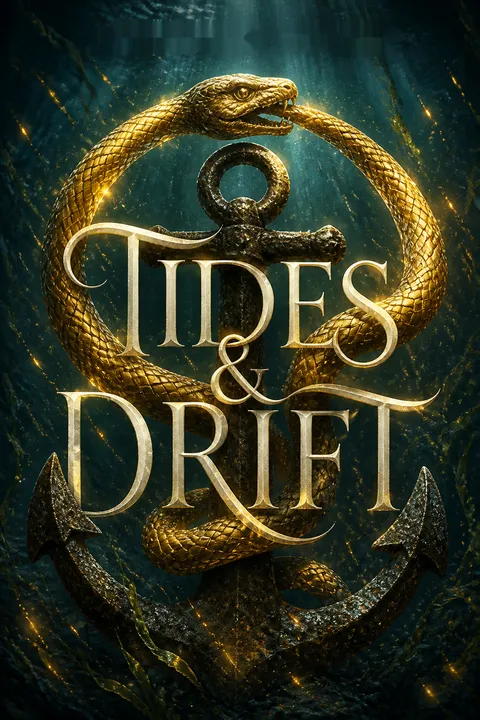


Plot Summary
Auster’s Failed Rye Heist
Auster Roth, raised inside Bastian’s criminal Roth family, plans to steal Sowan rye from the Scourge with his cousin Murrow and Ezra, a silversmith taken in by the family. Auster expects a drunken guard, but Paj, a young deckhand, catches him with a knife at his throat.
When Paj spots the ouroboros tattoo marking Auster as a Roth, he does not call the harbor watch. Instead, he shoves Auster into the sea and watches him drift away. Auster loses the cargo and returns to his uncle Henrik, who strikes him and makes him pay for the ruined clothes and rug. Henrik then assigns him the family’s dullest job, gathering gossip at a tavern.
The failed theft introduces the story’s central contradiction: Auster is trained to treat people as risks, yet Paj’s first consequential choice is to spare him. The family tattoo makes Auster’s identity visible before he can explain himself, while Paj’s silence leaves room for curiosity rather than the usual Roth response of fear or retaliation. Henrik’s punishment restores the family hierarchy, but the tavern assignment also places Auster where he can meet the wider world on terms other than criminal work. The encounter begins as a contest over cargo and quietly becomes a challenge to inherited loyalty.
The Trader at the Bar
At the tavern, Auster recognizes Paj and buys his drinks without knowing how to explain the gesture. Their wary conversation turns personal when they share where they grew up and Auster admits he has never sailed on a moving ship. Two weeks later, he waits at the harbor for the Scourge, then follows Paj to a modest North End food stall.
Auster’s tailored clothes mark him as an outsider there, and Paj gently blocks him from using money to claim a welcome that belongs to someone else. They spend the night walking through Bastian and watching the harbor. At dawn, Paj kisses him beside the ship, leaving Auster with a feeling he cannot fit inside his family’s rules.
The courtship develops through small tests of attention. Auster buys drinks, waits at the harbor, and follows Paj into a neighborhood where his wealth and family name do not grant him authority. Paj, meanwhile, offers time and eventually a kiss, but does not flatter Auster’s status or rescue him from the discomfort of being a Roth. Their intimacy begins in a space between ports and social classes, where neither can pretend the other’s life is simple. The kiss does not resolve Auster’s divided loyalties; it makes the division impossible to ignore.
Emeralds and Stitches
For six months, Auster and Paj meet during the Scourge’s brief stops in Bastian, keeping the relationship hidden from Henrik. When Henrik abruptly advances a plan to replace a rye merchant’s cat’s-eye emeralds with convincing fakes, Auster, Murrow, and Ezra attempt the switch in the crowded shop. The buyer catches Auster and stabs him; Ezra kills the buyer while helping carry Auster home.
Auster survives, but the wound makes the danger he has concealed from Paj visible. When Paj discovers the stitches, he demands to understand Auster’s work and offers love as a reason to become family to him. Auster cannot accept the offer or reject the Roths. He insists on keeping his family outside their relationship.
The emerald job converts Auster’s private conflict into bodily evidence. Until the stabbing, he can separate the tenderness of his meetings with Paj from the violence and coercion that sustain the Roth household. The wound collapses that partition. Ezra’s quick killing shows how normalized lethal protection is within the family, while Paj’s offer of belonging imagines kinship without the Roths’ system of control. Auster’s refusal is not proof that he loves his family more; it reveals how thoroughly he has learned to confuse survival with obedience. His scar becomes a record of the cost he cannot yet name.
Henrik Breaks the Bond
Henrik discovers the relationship and confronts Paj at the harbor, beating him and threatening Auster rather than asking permission to control the situation. When Paj next meets Auster, he hides his injuries and insists they must separate. Auster refuses to leave, so Paj calls the harbor watch and accuses him of stealing rye, identifying him as a Roth.
The officers drag Auster away while Paj weeps and avoids his eyes. Henrik arrives, bribes the watch, and takes Auster home. He frames the relationship as a family matter and expects Auster to choose the Roths. To protect Paj from further retaliation, Auster tells Henrik that the affair meant little and apologizes for hiding it. Henrik accepts the lie, and Auster grieves alone.
Paj’s apparent betrayal is an act of protection shaped by the same coercive structure that governs Auster. He uses the Roth name to make the arrest believable, turning Auster’s inherited mark into a shield against Henrik’s more dangerous reach. The tactic succeeds physically but fails emotionally: Auster experiences the staged separation as abandonment because he has no way to know its purpose. Henrik’s insistence that family comes first is not merely an argument about affection. It is a claim of ownership, enforced through violence and the threat of violence. Auster’s lie preserves Paj’s safety while deepening his own isolation.
Auster Leaves Bastian
Six weeks later, Paj finds Auster near the smith’s pier and proposes a way out: he will smuggle a passenger to Ceros, divide the payment with a trusted stryker, and leave the Scourge’s crew there. Auster warns him to secure the coin and protect the plan from betrayal, but does not promise to come.
Back at the Roth house, he thanks Ezra for saving him and watches Murrow sleep, taking in the routines he has always mistaken for the whole world. Before dawn, Auster leaves his pocket watch behind, takes hidden coin, and slips out through his window. Ezra sees him go but closes his own window without raising an alarm. Auster reaches the Scourge, where Paj waits, and boards for a life beyond Bastian.
Auster’s departure is not a clean rejection of his past. He leaves behind the watch Ezra made, but carries the habits, skills, and loyalties the Roth household planted in him. His practical advice to Paj shows that he is not simply being swept away by romance; he understands the risks and helps make the escape more survivable. Ezra’s silent permission matters because it offers a form of family care without demanding obedience in return. Auster’s choice is therefore less about becoming someone new than about refusing to let the Roth name dictate where his heart and labor must go.
Jeval’s New Harbor
After leaving the Marigold and her brother West, Willa has spent nearly a year helping Koy establish a working port on Jeval. She repairs ships, plans for a drydock, and trains Ailee, an eleven-year-old ship stray she persuaded a helmsman to leave behind in exchange for waived repair fees.
Yet the island’s dredgers still distrust Willa, and she fears that theft will keep larger traders away. When she sees Bruin pickpocket a stryker from the visiting Iris, Koy stops her from confronting him, arguing that the port cannot police every petty crime.
Their disagreement is interrupted by the arrival of the Wellworthy, an elegant ship from the Unnamed Sea. Its presence offers the kind of trade Willa wants, but also raises the stakes of Jeval’s reputation.
Willa’s port is both an economic project and a rehearsal for belonging. She has invested her own money and labor in Jeval, yet the islanders’ suspicion makes every commercial decision feel like a referendum on whether she can stay. Ailee’s apprenticeship repeats an older pattern of care: Willa recognizes a neglected child and creates a place for her, even as she insists she is trying to stand independently. Koy’s caution is not simple timidity; he understands the fragile local agreements that Willa’s ambition might rupture. The Wellworthy’s arrival makes their different instincts newly consequential.
Coen’s Burning Quarters
The Wellworthy’s helmsman, Dennon, hires Willa to repair fire damage in the quarters of Coen Fuerst, a wealthy merchant’s son traveling under his father’s authority. Coen’s disheveled charm and casual drinking contrast with Dennon’s discipline, and his attention to Willa unsettles Koy.
While Willa and Ailee rebuild the burned wall, Coen reveals that his voyage is meant to recover two people, including a scarred silversmith, though he gives few useful details. At the tavern, he invites Willa and Koy to drink and confirms that the Wellworthy will continue through the ports. Willa notices his interest in her, while Koy makes clear he does not want her involved with him. Their unspoken attachment becomes harder to dismiss.
Coen arrives as a bundle of mismatched signals: inherited wealth, apparent irresponsibility, and a mission he treats as both obligation and excuse for wandering. Willa reads the practical facts of his damaged quarters, but also senses that his ease conceals something sharper. Koy’s jealousy exposes a vulnerability beneath his steady harbor-master role, though neither he nor Willa has yet named what binds them. The repair work gives Willa a reason to stay close to Coen without inviting intimacy, while his vague search hints that the Wellworthy’s business may exceed ordinary trade. Hospitality becomes an uneasy form of investigation.
The Rumor in the Tavern
During an evening with Coen and Koy, Willa overhears an Iris deckhand claim that Emilia Marley, the rye guild’s powerful leader, is gravely ill. Because Emilia’s contracts support much of the Narrows’ trade, her death could unsettle ports far beyond Jeval. Willa suspects Coen heard the same warning, though he quickly conceals his reaction.
The next morning, she tells Koy what she heard and proposes alerting West, but Koy refuses to involve their port in traders’ affairs. Before Willa can decide whether to send her message anyway, a crowd finds the deckhand’s body in the harbor. The death makes the rumor look like a secret someone wanted buried, and Willa sees Coen leaving Jeval aboard the Wellworthy.
The rumor turns information into a form of power. Emilia’s possible illness matters not only because of her personal fate, but because contracts and supply chains concentrate influence in one person’s hands. Willa’s impulse to warn West comes from both practical foresight and an old attachment to the network she left behind. Koy’s refusal protects Jeval’s claim to neutrality, though it also risks mistaking procedural restraint for safety. The deckhand’s death changes the moral status of their silence: what seemed like an unverified report may now be evidence of deliberate suppression. Coen’s departure does not prove guilt, but it makes inaction feel dangerous.
Bruin Loses His Berth
The threat to Jeval’s trade becomes immediate when the Grouse’s helmsman discovers that someone has replaced three purses of payment with lead pellets. He gives Koy until sundown to make restitution or loses the port as a stop. Willa recognizes Bruin and his companions as the likely thieves and confronts them at the beach-bound skiff.
Bruin mocks her authority and belittles her in front of the gathered dredgers. Willa punches him, hurting her hand, but Koy takes control before the fight escalates. He announces that Bruin has lost his trading permit and orders him off the harbor. The public decision shocks the locals, who have watched Koy compromise with them before, and forces them to see that the new port has rules.
This confrontation turns Willa and Koy’s disagreement over tolerance into an institutional test. Willa acts from a clear understanding that one trader’s losses can damage the port’s credibility, but her punch also reveals how easily her defense of the project becomes personal. Koy’s decision to revoke Bruin’s permit is the first unmistakable use of the authority he has been reluctant to exercise. He does not merely protect Willa or appease a helmsman; he defines who may participate in Jeval’s emerging economy. The port’s rules acquire meaning only when enforcing them costs the founders something.
Chains Beneath Jeval
Bruin retaliates after dark, entering Willa’s post with an accomplice while Ailee sleeps nearby. Willa pushes Ailee through a small window and reaches for her dagger, but Bruin knocks her down, gags her, and drags her onto the dock. The men fasten an iron chain around her ankle and throw her into the water, intending to leave her tied to the reef.
Koy arrives as she sinks. When he cannot free her foot from the iron, he breaks the trapped ankle to release her. Willa rises to the surface and Koy hauls her onto the dock, where Ailee and watching crews wait. He carries Willa to safety, holding her as she sobs through the shock and pain.
The attack makes the costs of Willa’s authority brutally physical. Bruin’s use of chains and the reef turns a local dispute over permits into an attempt to erase her from the harbor, while her choice to get Ailee out first shows that care remains her reflex even under immediate threat. Koy’s rescue demands a terrible calculation: freeing Willa means inflicting an injury that will last beyond the crisis. His action is neither effortless heroism nor a return to control; it is trust expressed through a decision Willa must endure. Their partnership becomes intimate through mutual dependence, not through a declaration.
Westbound Before Dawn
Willa wakes in Koy’s post with a badly injured ankle. Koy has taken over harbor duties, while Ailee checks on the Wellworthy and reports that it slipped away before dawn, sailing west instead of following its stated route to Sowan. Willa and Koy suspect Coen is racing toward the Unnamed Sea with the information about Emilia Marley, though they have no proof of what he intends.
Since Willa needs a physician and a letter might not arrive in time, Koy arranges passage on the Featherback to Ceros, where West and the Marigold may be reached. Before she leaves, Willa and Koy finally kiss, and she entrusts him with the harbor and Ailee. The island recedes behind her, no longer a place she must flee.
The ending resolves Willa’s conflict between independence and attachment without pretending that either has vanished. She leaves Jeval because the wider crisis requires action, not because the port has failed or because Koy has become her new authority. Koy’s promise to keep the harbor running and care for Ailee allows Willa to travel without interpreting departure as abandonment. Their first kiss follows an act of mutual trust and practical responsibility, making it less a romantic escape than a recognition of what they have already built together. The Wellworthy’s unexplained westward course keeps the trade threat open, while Willa’s changed sense of home gives her journey a different emotional direction.
Analysis
Tides and Drift place two romances inside economies that are never neutral. Auster’s Roth household organizes care through hierarchy, shared work, and the threat of exclusion. Jeval’s new port organizes survival through repairs, permits, reputation, and the flow of ships. In both stories, love becomes meaningful when it alters a practical decision: Paj risks his standing to protect Auster, while Willa and Koy gradually learn that their partnership requires more than dividing duties.
The stories also distinguish chosen family from easy escape. Auster’s departure does not erase his history or make the Roths harmless; it lets him choose where his future will be formed. Willa, by contrast, has already left the Marigold to build something of her own, yet her attachment to West remains a source of knowledge and responsibility. Her journey back toward him is not a reversal of independence. It is a choice to act within a network of relationships she cannot simply discard.
Commerce provides the pressure that makes these emotional choices legible. A stolen crate, counterfeit gems, a forged reputation, a missing purse, or a rumor about a guild leader can shift who is safe and who has leverage. The sea connects ports, but it also carries danger, information, and debts beyond anyone’s control. Against that movement, the characters try to make forms of belonging that are neither inherited nor purely transactional. The books’ clearest insight is that freedom is not the absence of attachment. It is the ability to take part in relationships and obligations without surrendering the right to choose.
Review Summary
People Also Read







Characters
Auster Roth
Roth heir in conflictAuster is a sharp, polished young member of Bastian’s Roth family, trained to watch people, keep accounts, and carry out his uncle Henrik’s business. He has learned to survive through obedience and charm, but his private unease suggests he knows the family’s security comes at a price. His relationship with Paj draws him toward a life that is not organized around Roth authority, forcing him to question whether loyalty means staying or choosing for himself. Auster is not innocent of the family’s work, yet he is not defined by cruelty; he is attentive to the people he trusts and capable of practical courage when a choice finally becomes unavoidable.
Paj
Steady shipboard traderPaj is a deckhand on the Scourge, a Bastian-born man whose calm manner contrasts with Auster’s restless vigilance. He values honest work and directness, and he judges Auster less by the Roth name than by what Auster chooses to do. Paj’s life at sea has taught him to accept danger without romanticizing it. In relationships, he is patient but not passive: he makes room for Auster’s silences while also asking what kind of person Auster is becoming. His steadiness offers a different model of belonging, one based on chosen care rather than inherited obligation.
Willa
Builder of Jeval’s portWilla is a resourceful ship-repairer and aspiring port-builder who has invested her savings and labor in Jeval. She thinks in practical systems, from repair schedules to the reputation needed to attract ships, and she can be impatient when local caution slows progress. Beneath her competence is a strong need to protect people who remind her of her own vulnerable past, especially Ailee. Willa has left the Marigold and her brother West to make an independent life, but independence does not mean she has stopped loving or needing others. Her partnership with Koy tests whether shared responsibility can strengthen rather than limit her agency.
Koy
Jeval’s cautious harbor masterKoy is Willa’s business partner and the harbor master responsible for turning Jeval into a functioning port. He understands its residents, its risks, and the importance of agreements that outsiders might dismiss as small. His caution can frustrate Willa, who sees the larger economic future and wants to move faster, but it also reflects a survival-minded knowledge of the island. Koy is measured and difficult to provoke, often choosing compromise before force. His loyalty becomes visible through practical action: he takes responsibility for the people and work they share, even when doing so exposes feelings he has kept unspoken.
Henrik
Roth family patriarchHenrik leads the Roth family with discipline, calculation, and a belief that collective survival requires obedience. He values Auster’s skill and promotes him when he proves dependable, but he treats private attachments as potential liabilities. His paternal manner can coexist with violence, making his care difficult to separate from control. Henrik’s authority rests not only on wealth and criminal influence but on the family’s learned dependence on his decisions.
Murrow
Auster’s protective cousinMurrow is Auster’s cousin and frequent partner in Roth errands. Tall, conspicuous, and often irreverent, he can soften the pressure of the family household with humor. He is also loyal in concrete ways, covering for Auster and worrying when danger gets close. His instinct is to protect Auster without pretending he can make the Roth system harmless.
Ezra
Roth family silversmithEzra is a gifted silversmith whom Henrik brought into the Roth household as a child. Quiet and observant, he tends to show affection through work and decisive action rather than reassurance. His technical skill supports the family’s schemes, while his bond with Auster and Murrow gives him a place within the household that is more personal than transactional. Ezra’s reserve conceals a durable loyalty.
Ailee
Young shipwright apprenticeAilee is an eleven-year-old ship stray who becomes Willa’s apprentice on Jeval. Small and initially underfed, she learns repairs with concentration and grows stronger through work, food, and a stable place to sleep. She is observant enough to notice when Willa has not eaten and disciplined enough to follow instructions, though she longs to climb the masts. Ailee gives Willa someone to care for, but she is also developing skills and judgment of her own.
Coen Fuerst
Restless merchant’s sonCoen is the son of a prominent Bastian merchant and travels aboard the Wellworthy under the supervision of its helmsman, Dennon. He drinks freely, cultivates an easy charm, and appears to resist the disciplined life expected of him. Yet he is searching for two people on his father’s behalf, and his interest in Willa and Jeval suggests he is more attentive than his careless presentation implies. Coen’s motives remain difficult for those around him to read.
Bruin
Jeval’s disruptive dredgerBruin is a Jevali dredger whose contempt for Willa and disregard for the port’s rules make him a persistent source of friction. He uses mockery to challenge her standing and treats the harbor’s new trade as something to exploit rather than protect. His conflict with Willa reveals how economic change can threaten people who prefer the older, less regulated order.
Raef
Koy’s diver brotherRaef is Koy’s younger brother, a diver who has spent his life on Jeval. His easy manner and handsome, open face help him move among people who distrust outsiders. He often tries to mediate between Willa and Koy, though he does not always welcome being used as a go-between. His ties to the island give him a perspective different from Willa’s ambitions.
West
Willa’s brother at seaWest is Willa’s brother and a trader associated with the Marigold. His work at sea has shaped Willa’s understanding of shipboard life and the obligations that bind families together. Willa has chosen distance from him in order to build her own future, but he remains someone she trusts with urgent information. Their connection represents a past life she has left without ceasing to care for it.
Speck
Jeval’s tavern keeperSpeck runs Jeval’s rough tavern, which also serves as the island’s most practical inn. He watches the port’s trade closely and understands how much its success depends on keeping visiting crews comfortable. His willingness to support Willa and Koy helps turn the harbor into more than a row of docks.
Fret
Seashell seller and listenerFret sells shells and coral at a makeshift stall, using sea stories to make modest wares appealing. He also listens to the harbor’s gossip, making him a useful observer of Jeval’s shifting social weather. His cautious manner reflects the need to stay unobtrusive on an island where information travels quickly.
Emilia Marley
Rye guild powerbrokerEmilia Marley is the influential Sowan rye crofter who leads the rye guild and holds contracts that matter throughout the Narrows. She is not present in the events, but her commercial position makes her health consequential to traders, ports, and the balance between the Narrows and the Unnamed Sea.
Plot Devices
The Roth ouroboros
A mark of inherited allegianceThe entwined-snake tattoo marks members of the Roth family and makes Auster’s identity legible even when he tries to pass unnoticed. Paj sees the tattoo during the failed rye theft, and the mark shapes how Auster is treated by both outsiders and his family. It functions as more than a badge of criminal belonging: it represents a claim the family makes on Auster’s future. His struggle is not simply to hide the mark, but to decide whether the identity it signifies must govern his choices.
Counterfeit cat’s-eye emeralds
A risky family operationHenrik’s family plan depends on replacing genuine cat’s-eye emeralds with carefully weighted fakes. Auster carries out the switch in a merchant’s shop while Murrow and Ezra create a distraction outside. The operation demonstrates the Roths’ combination of craft, deception, and violence, while the fake stones give Auster a practical role that helps maintain his place in the family. The plan’s failure exposes how little control he has over its danger, even when he has been told the work is routine.
Jeval’s harbor venture
A fragile economic experimentWilla and Koy’s growing port is the material center of Drift. Its docks, merchant stalls, tavern, repairs, and proposed drydock depend on attracting ships while persuading Jeval’s residents to respect new trading rules. Every arriving crew brings possible income and new risk. The venture makes Willa’s ambition concrete and gives her conflict with Koy a shared object: she pushes for growth, while he prioritizes the agreements that keep the port from being rejected by locals or traders.
The Emilia Marley rumor
A secret with trade-wide stakesA drunken deckhand’s report that Emilia Marley may be dying gives Willa information that could affect the Narrows’ rye contracts and commercial balance. The rumor travels through tavern talk rather than official channels, forcing Willa and Koy to weigh its reliability against the danger of withholding it. The deckhand’s death soon afterward makes the information feel less like ordinary gossip and more like a possible target for suppression. Coen’s apparent reaction and the Wellworthy’s unexpected departure intensify suspicion without proving what he knows or intends.
The World of the Narrows Series



About the Author



Download PDF
Download EPUB
.epub digital book format is ideal for reading ebooks on phones, tablets, and e-readers.








