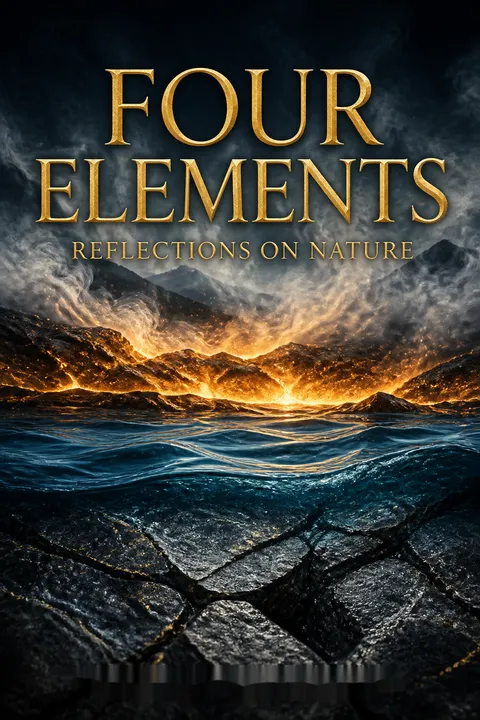


Key Takeaways
Treat the elements as participants in life, not scenery or raw material.
A different way of seeing. O’Donohue reads air, water, fire, and stone as more than physical substances. They become ways to notice how life breathes, changes, warms, remembers, and endures. His reflections move between theology, philosophy, poetry, and ordinary rural experience, asking readers to meet the natural world as a presence rather than a backdrop.
From use to relationship. In the foreword, his childhood work on an Irish farm is described as a conversation with the land. A task was not merely an order to complete; it had its own pace and conditions. This approach does not require believing that elements literally think or feel. Its invitation is to pay attention to how human life depends on forces and places that exceed human control.
The book’s central move resembles a shift in ecological ethics: from asking what nature provides to asking what kinds of relationships make human life possible. That shift can change practical judgments about land, water, and consumption without requiring agreement about spiritual claims. It also challenges the habit of treating usefulness as the measure of value. The caution is that poetic personification can blur distinctions between human experience and nonhuman life. Read as a discipline of attention, rather than a scientific account of nature’s consciousness, the approach remains both vivid and ethically useful.
Use breath to return attention from imagined pasts and futures to now.
Breath makes time tangible. O’Donohue links breathing with presence: each breath is an immediate bodily event, unlike memories already gone or futures not yet here. In his Christian vocabulary, the Hebrew word Ruach connects breath, wind, and spirit. Breathing therefore becomes both a physical rhythm and a spiritual image of life arriving moment by moment.
A practice of attention. He describes sitting quietly, noticing the breath, and imagining light moving through the body on the inhale, with heaviness leaving on the exhale. The point is not to solve a problem by visualization, but to gather attention instead of letting it scatter into worry or regret. He also recounts a meditator so absorbed by a bird’s song that he could not remember whether he heard it while breathing in or out.
This account joins contemplative practice to embodied cognition: attention is not only an idea in the head but something shaped by posture, breath, and sensation. Modern mindfulness exercises similarly use breathing as an anchor, although their benefits depend on the person and context. The bird episode sharpens the distinction between noticing an experience and being fully attentive to it. Breath can steady attention, but it is not a universal remedy for anxiety, pain, or illness. Its more modest promise is valuable: it offers a concrete way to return to present experience.
Let imagination uncover inner sources instead of forcing identity into a plan.
Follow what is emerging. For O’Donohue, water represents depth, change, and a capacity to take the shape of its surroundings without losing its nature. He contrasts imagination with sheer willpower. Rather than imposing a predetermined identity, imagination patiently notices what experience is already forming. He calls an original insight a new source: not merely a rearrangement of familiar ideas, but a fresh opening in thought.
Find the hidden well. A well connects concealed water beneath the ground with the visible world above it. O’Donohue uses this as an image of inner life, where unknown feelings and possibilities can rise into awareness. A childhood memory of oars cutting the water without dividing it illustrates water’s ability to separate briefly and then flow together again. The image suggests that change need not mean losing all continuity with oneself.
The emphasis on imagination offers a useful counterweight to self-improvement cultures that treat identity as a project to manage. In narrative psychology, people also make sense of themselves by interpreting experience, not simply by executing a fixed blueprint. Yet introspection can mislead: a compelling inner story is not automatically a reliable guide to action. The strength of this section lies in pairing inward listening with patience. Imagination can reveal possibilities, while reflection, relationships, and consequences help test which possibilities are worth following.
Allow tears to carry feelings that polished explanations cannot hold.
Emotion has its own language. O’Donohue presents tears as an expression that appears when ordinary speech reaches its limits. Grief and suffering may bring tears, but so can joy, love, and spiritual tenderness. The same bodily response can therefore hold very different experiences. His image of a person who has not cried for years and then weeps as if a barrier has broken conveys how much feeling can remain unexpressed.
Release is not erasure. The book suggests that crying can ease an emotional burden, while unacknowledged sorrow may continue to shape a person’s life. It also describes the mystical “Gift of Tears,” a term for tears associated with profound tenderness or spiritual connection. The claim is not that tears explain exactly what someone feels. Rather, they can give feeling expression when analysis alone cannot do the work.
Treating tears as meaningful rather than embarrassing can make room for emotional honesty and social support. Research on crying suggests that its effects vary: some people feel relief, while others feel worse, and the response of people nearby can influence the outcome. That nuance strengthens rather than weakens the book’s insight. Tears are not a dependable treatment or a transparent signal with one fixed meaning. They are a bodily event that may invite care, curiosity, and permission to feel before rushing to explain.
Aim fire’s intensity: it can cleanse, create, or consume without judgment.
Passion carries risk. Fire is O’Donohue’s image for creative force, desire, anger, and change. It can warm a home, shape tools, or help a person find courage; it can also spread beyond anyone’s control. The leap from a small spark to a destructive blaze captures how quickly energy can outrun intention. Fire does not distinguish between what deserves to survive and what does not.
Use heat with discernment. O’Donohue connects fire’s destructive history with the burning of people condemned as heretics or witches, and with religious threats of eternal punishment. He argues that fear can be used to control rather than renew. Anger, by contrast, may reveal an injustice that has been ignored. But anger alone does not guarantee justice: like fire, it needs direction, boundaries, and attention to what it might harm.
The image of fire is powerful because it refuses the easy assumption that intensity is inherently virtuous. Anger can alert people to violated boundaries and motivate collective change, while unchecked anger can injure those it aims to protect. This resembles the distinction in emotion research between a feeling’s informational value and the wisdom of acting on it immediately. The historical critique also matters: spiritual language can comfort, but institutions can weaponize it. The useful question is not whether passion should be suppressed, but what it serves and what safeguards keep it from becoming destructive.
Keep a hearth, literal or social, where memory becomes shared belonging.
A fire makes a center. In the rural household O’Donohue remembers, the hearth was a source of warmth and a place where people gathered. Neighbors visited at night, exchanged local news, and told stories. These conversations passed on customs and knowledge without turning every lesson into formal instruction. A fire could even be kept alive beneath ash overnight, ready to be stirred back into flame the next day.
Ritual links the days. The hearth joined work already done with plans for what came next. Its repeated tending gave daily life a rhythm and offered a focus for family and community. O’Donohue worries that screens and mechanized life can displace such gathering. His point is not that every home needs an actual fire, but that people need places and habits where attention, stories, and care can be shared.
The hearth works as both a physical setting and a social technology. Repeated gatherings create occasions for storytelling, informal teaching, and recognition across generations. Contemporary community research likewise finds that shared spaces can support trust, although a setting alone cannot guarantee inclusion or intimacy. The book’s rural memory should not be mistaken for a universal past: hearth-centered life also involved hard labor and social limits. Its lasting question is practical: what shared ritual can make conversation and mutual attention easier in a modern household or community?
Practice stillness outdoors; silence reveals what human-centered attention edits out.
Silence is not empty. O’Donohue describes several kinds of silence: the pause that makes speech possible, the quiet of love, the reserve of animals, and the absence left by death. Landscape, in his account, has its own scale and stillness. People often move through a place while mentally elsewhere, overlooking the presence of the ground beneath them and the life around them.
Notice before claiming. The foreword recalls sheep grazing while ravens move through a valley, a scene that suggests animals can seem more at home in a landscape than people do. O’Donohue also challenges the belief that only humans possess spiritual significance. His ecological argument is direct: a place should not be treated as inert simply because it cannot object to being altered. Quiet attention is one way to recognize that human plans are not the whole story.
This attention to silence has affinities with environmental humanities, which ask how human-centered language can obscure nonhuman lives and histories. A pause outdoors can reveal sounds, patterns, and relationships that hurried perception filters out. Still, silence is not proof that a landscape is untouched or that every development is wrong. People need homes, livelihoods, and access to places. O’Donohue’s contribution is less a policy formula than a moral starting point: decisions become more responsible when a place is encountered as more than a blank surface awaiting human use.
Read stone as earth’s slow archive, not merely an obstacle or building material.
Memory exceeds the human. O’Donohue uses memoria for the deep gathering and interweaving of experience that gives human identity continuity. He extends the idea metaphorically to the earth: places retain traces of lives and events even after people disappear. Stone becomes a “tabernacle” of memory, a concealed presence that rewards patient attention rather than quick inspection.
Time leaves material traces. The book points to tree rings, fossils, weathered rock, and ruins as records of different times. A ruin in the Burren, for example, is not only leftover stone; it also evokes the community and worship that once took place there. These traces do not preserve the past like a complete recording. They offer partial evidence, inviting interpretation while reminding the observer that human lifetimes are brief beside geological change.
The archive metaphor becomes especially compelling when paired with geology and archaeology: physical materials preserve traces that outlast individual memory, but those traces need interpretation. A fossil can establish that an organism existed, not what its experience felt like. This distinction keeps poetic attention from becoming a claim that rocks remember in a human sense. The larger insight remains strong. When buildings, stones, and land are treated as carriers of history, destruction looks less like clearing neutral space and more like erasing a record whose full meaning may not yet be known.
Honor the self as an embodied threshold, distinct yet made through relation.
A person is more than one role. O’Donohue begins from human uniqueness, then complicates the idea of a single, simple self. Each person contains a range of inner responses and memories, shaped by a different body and history. Reducing that complexity to one identity or role, he argues, can damage a person’s inner life. Individuality is real, but it does not make anyone self-sufficient.
Body opens onto space. The body gives each person a distinct place in the world, while air and space make movement and encounter possible. O’Donohue points to dance as a way bodies give shape to space. Samuel Beckett’s brief play Breath, which stages life from first cry to final breath, makes the human interval feel both embodied and short. The self is neither pure spirit nor mere matter, but an in-between life among others.
This account resists two common simplifications: the self as a sealed, autonomous unit, and the self as nothing but a social label. Embodied cognition and relational theories of identity similarly emphasize that perception and self-understanding develop through bodies, environments, and other people. O’Donohue’s spiritual vocabulary adds a sense of depth, though claims about a divine inner essence cannot be established in the same way as bodily dependence. The practical value is compatible with either view: identity deserves room to remain complex, and relationships shape that complexity without fully owning it.
Analysis
Four Elements is a sequence of lyrical meditations rather than a conventional argument or practical guide. Air, water, fire, and stone supply its organizing images, but the deeper subject is how people might recover intimacy with the world they inhabit. Breath becomes a model of presence, water of inner change, fire of creativity and danger, and stone of duration and memory. Rural Irish experience gives these abstractions a human scale: working the land, tending a hearth, visiting neighbors, and walking among ruins.
The book’s distinctive method is analogical. O’Donohue moves from a physical quality to a spiritual interpretation, then tests that interpretation against a story, poem, landscape, or ritual. The method makes abstract ideas felt. It also asks readers to reconsider the hierarchy that places human consciousness above supposedly inert nature. In this sense, the book anticipates concerns now prominent in ecological thought: human beings are dependent participants in systems they did not create, and material places have histories that exceed human ownership.
The method has limits worth keeping visible. Spiritual interpretation is not scientific explanation. Claims about angels, divine presence, and the inner life of landscape belong to a theological imagination, not to empirical proof. Some scientific statements in the book are dated or stated with more certainty than current knowledge warrants. The strongest reading therefore does not treat every metaphor as a factual claim. It recognizes the book’s invitation to attention, while distinguishing poetic truth from testable evidence.
Its lasting value lies in that change of attention. The elements are not presented as a checklist for self-improvement, but as teachers of scale and relation. A breath arrives without being manufactured; a river changes while following its terrain; fire gives warmth and can destroy; stone endures, then erodes into fertile ground. These images make human life seem less separate, less permanent, and more answerable to the conditions that sustain it.
Review Summary
Four Elements received mixed reviews, with ratings ranging from 2 to 5 stars. Many readers appreciated O'Donohue's poetic language and spiritual insights, finding the book thought-provoking and beautiful. However, some felt it lacked cohesion and depth compared to his other works. Readers enjoyed the exploration of air, water, fire, and stone, but some found the writing meandering and repetitive. Several reviewers suggested reading the book slowly or in parts to fully appreciate its content. Overall, the book was praised for its unique perspective on nature and spirituality.
People Also Read





Glossary
memoria
integrated living memoryO’Donohue uses memoria for the inward activity that gathers experience and gives a person continuity over time. It is not a literal storehouse or a complete record. Memories are selected and woven together as people are changed by what they live. He extends the idea poetically to the earth, whose materials preserve traces of earlier life.
Vunklein
the soul’s divine sparkVunklein is a term O’Donohue attributes to Meister Eckhart for a simple, sacred point within the soul. In this account, the deepest human essence and the divine share a single brightness there. It is not the ego’s achievement or a personality trait, but an image of an intimate spiritual ground within each person.
Ruach
breath, wind, or spiritRuach is a Hebrew word O’Donohue discusses as meaning breath and also carrying associations with wind and spirit. He uses the overlap to connect ordinary breathing with spiritual life and divine presence. The term is important to his meditation on air, but its meanings depend on linguistic and religious context rather than forming a single universal definition.
Shekinah
concealed sacred presenceShekinah is presented as a Hebrew term for sacred presence, associated in O’Donohue’s discussion with the tabernacle and the Ark of the Covenant. He draws on this image to describe a presence that is real but not immediately visible. He also applies it to the human body as a vessel of spiritual significance.
creatio-ex-nihilo
creation from nothingCreatio-ex-nihilo means creation out of nothing. O’Donohue treats the phrase as a contemplative image that restores a sense of wonder before matter and presence emerged. Rather than using it as a scientific account of cosmic origins, he uses it to unsettle familiar explanations and invite a fresh encounter with creation.
mother-liquid
water sealed within stoneMother-liquid is the name used in the book for water said to remain enclosed within stone since the stone formed. O’Donohue treats it as an image of hidden fluency preserved inside apparent hardness. The term supports his meditation on the conversation between water and stone; it should be read as the book’s specialized wording, not assumed to be standard geological terminology.
Gift of Tears
tears of spiritual tendernessThe Gift of Tears is a term from mystical tradition for tears arising from a profound experience of divine tenderness or spiritual connection. O’Donohue places it alongside tears of grief, joy, and love to show how intense feeling can exceed ordinary language. It names a spiritual interpretation of crying, not a claim that all tears have the same cause.
FAQ
What is "Four Elements: Reflections on Nature" by John O'Donohue about?
- Exploration of the Four Elements: The book is a poetic and philosophical meditation on the four classical elements—Air, Water, Fire, and Stone—and their significance in human life and the natural world.
- Celtic Spiritual Perspective: O'Donohue draws from Celtic spirituality, blending personal memories, myth, and philosophical insights to explore how these elements shape our inner and outer experiences.
- Interconnectedness of Nature and Self: The work emphasizes the deep connection between humans and the landscape, suggesting that understanding the elements can lead to a richer, more meaningful existence.
- Meditative and Reflective Essays: Each section is a lyrical essay that invites readers to reflect on their relationship with nature, memory, and the sacred.
Why should I read "Four Elements: Reflections on Nature" by John O'Donohue?
- Deepens Connection to Nature: The book encourages readers to see the natural world as alive, sacred, and intimately connected to their own lives.
- Inspires Mindfulness and Presence: O'Donohue’s meditations foster a sense of stillness, attention, and appreciation for the present moment.
- Offers Spiritual and Philosophical Insights: The text blends poetry, philosophy, and spirituality, providing a unique perspective on existence and belonging.
- Beautiful, Evocative Language: O'Donohue’s lyrical prose and poetic sensibility make the book a pleasure to read and re-read.
What are the key takeaways from "Four Elements: Reflections on Nature" by John O'Donohue?
- The Elements as Teachers: Air, Water, Fire, and Stone each offer unique lessons about life, presence, transformation, and memory.
- Importance of Imagination and Memory: The book highlights the role of imagination in perceiving the world and the significance of memory in shaping identity.
- Sacredness of Landscape: O'Donohue argues that landscape is not inert but alive, deserving respect and reverence.
- Healing Through Nature: Engaging with the elements and the natural world can be a source of healing, renewal, and spiritual insight.
How does John O'Donohue approach the concept of the four elements in "Four Elements: Reflections on Nature"?
- Elemental Meditations: Each element is explored in its own section, with essays and poems that delve into its physical, symbolic, and spiritual dimensions.
- Interplay of Elements: O'Donohue discusses how the elements interact and shape each other, reflecting the interconnectedness of all things.
- Personal and Cultural Reflections: The author weaves in personal stories, Celtic folklore, and philosophical ideas to illustrate the elements’ roles in human life.
- Invitation to Reflection: Readers are encouraged to contemplate their own experiences with the elements and what they reveal about existence.
What is the significance of Air in "Four Elements: Reflections on Nature" by John O'Donohue?
- Breath and Spirit: Air is associated with breath, inspiration, and the Holy Spirit, symbolizing the invisible forces that sustain life.
- Space and Possibility: Air provides the space for movement, dance, and individuality, representing freedom and the potential for growth.
- The Invisible World: O'Donohue explores the threshold between the visible and invisible, suggesting that air connects us to mystery, angels, and the spiritual realm.
- Sound and Silence: Air is the medium for sound and music, as well as the silence that underlies all creation.
How does John O'Donohue describe the role of Water in "Four Elements: Reflections on Nature"?
- Source and Flow: Water is seen as the origin of life, embodying fluency, adaptability, and the seamless unity of existence.
- Emotional Depths: Water is linked to emotion, tears, and the subconscious, serving as a metaphor for the inner life and the language of feeling.
- Transformation and Renewal: The element is associated with baptism, cleansing, and the cyclical nature of time and change.
- Connection to Folklore: O'Donohue shares stories and rituals related to wells, rain, and the ocean, highlighting water’s sacred and mysterious qualities.
What insights does "Four Elements: Reflections on Nature" by John O'Donohue offer about Fire?
- Origin and Creativity: Fire is connected to the origins of the universe, the sun, and the creative spark within each person.
- Transformation and Passion: Fire symbolizes transformation, passion, and the purifying force that burns away what is false or unnecessary.
- Hearth and Home: The hearth is depicted as the spiritual center of the home, a place of warmth, belonging, and storytelling.
- Ambiguity and Danger: O'Donohue acknowledges fire’s destructive power, its role in fear and religious imagery, and its capacity for both renewal and harm.
How is Stone portrayed in "Four Elements: Reflections on Nature" by John O'Donohue?
- Tabernacle of Memory: Stone is described as the keeper of memory, holding the history of the earth and the lives that have passed over it.
- Endurance and Silence: Stone represents endurance, stillness, and the silent presence that underlies all transience.
- Conversation with the Elements: O'Donohue explores how stone interacts with fire, earth, air, and water, shaping and being shaped by them.
- Symbolism and Sacredness: Stone is linked to ancient rituals, ruins, and the sacredness of place, inviting reverence and contemplation.
What is the relationship between landscape and self in "Four Elements: Reflections on Nature" by John O'Donohue?
- Mirror of the Soul: The landscape is seen as a reflection of the inner world, with each person carrying a unique relationship to place.
- Healing and Belonging: Engaging with the landscape can heal alienation and foster a sense of belonging and rootedness.
- Memory and Presence: The land holds the memories of those who have lived on it, just as individuals carry the memory of the land within themselves.
- Respect and Reciprocity: O'Donohue advocates for a respectful, reciprocal relationship with the landscape, recognizing its subjectivity and spirit.
How does "Four Elements: Reflections on Nature" by John O'Donohue connect spirituality and the natural world?
- Immanence of the Sacred: The book presents the elements and landscape as manifestations of the divine, accessible through attention and imagination.
- Integration of Body and Soul: O'Donohue challenges dualistic thinking, suggesting that the body is in the soul and that spirituality is grounded in the physical world.
- Ritual and Blessing: The text includes prayers, blessings, and rituals that honor the elements and invite spiritual presence into daily life.
- Mystical Tradition: Drawing on Christian mystics and Celtic spirituality, the book frames nature as a path to encountering God and the mystery of existence.
What practical advice or meditative practices does John O'Donohue offer in "Four Elements: Reflections on Nature"?
- Breathing and Presence: The author recommends simple breathing exercises to center oneself and connect with the present moment and the light within.
- Attentive Observation: Readers are encouraged to observe the elements in their environment, noticing their forms, rhythms, and effects on the senses.
- Memory and Reflection: O'Donohue suggests revisiting memories of warmth, belonging, and landscape as a source of strength and healing.
- Blessing and Ritual: The book offers blessings for the elements and the hearth, inviting readers to incorporate ritual and gratitude into daily life.
What are the best quotes from "Four Elements: Reflections on Nature" by John O'Donohue and what do they mean?
- “I would love to live / Like a river flows, / Carried by the surprise / Of its own unfolding.” — This quote expresses the ideal of living with openness, trust, and surrender to the flow of life.
- “Nothing in the universe resembles God more than silence.” — O'Donohue highlights the sacredness of silence as a space where the divine can be encountered.
- “Each thing is merely the limit of the flame to which it owes its existence.” — This line reflects the idea that all things are born from passion and fire, and that their boundaries are shaped by the energy that created them.
- “The earth is the great conclusion. All kinds of life-forms build and intensify themselves, ripen and then fall from the open clarity of air back into the smothering mesh of the earth.” — This passage contemplates the cycle of life, death, and return to the earth, emphasizing humility and interconnectedness.
- “Memoria is the place where our vanished lives secretly gather. For nothing that happens to us is ever finally lost or forgotten.” — O'Donohue affirms the enduring power of memory, both personal and collective, as a source of meaning and continuity.
About the Author
Download PDF
Download EPUB
.epub digital book format is ideal for reading ebooks on phones, tablets, and e-readers.








