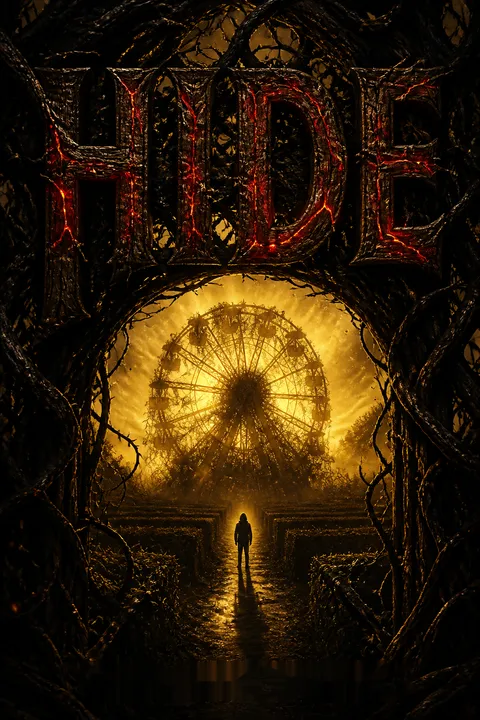


Plot Summary
Prologue
A shoe sized for a five-year-old hangs from a topiary inside the abandoned Amazement Park. The park once promised escape, but in 1974 a child vanished during its free week, and a migrant worker was blamed for her disappearance.
The scandal closed the gates. Years later, the trees have swallowed the rides and paths, while the small shoe remains caught above the weeds, an overlooked remnant of a much older crime.
The park is introduced as both entertainment and trap: its confusing paths were designed to absorb visitors, while its history teaches the reader to distrust the pleasant surface. The missing child and the shoe establish a human cost before the story’s contestants arrive, but withhold the explanation of how the park consumes people. That delay matters. The horror grows from a system that has learned to make disappearance look like an accident, a rumor, or somebody else’s fault. The shoe turns the park’s past into physical evidence that the place has been waiting longer than any game.
A Prize for Hiding
Mack, a young woman surviving in a homeless shelter, keeps quiet when its manager insists she must show ambition and accept help. The manager offers her a place in a hide-and-seek tournament run by Ox Extreme Sports, with a fifty-thousand-dollar prize. Mack distrusts the offer, but the shelter has already taken her backpack and left her with only the clothes she wears.
With no security to return to, she accepts. The game appeals to a skill she has honed for years: staying unnoticed. It also offers a way out of the shelter without requiring her to explain her past. For the first time, hiding might earn her something rather than merely keep her alive.
Mack’s decision grows from scarcity, not faith in the tournament. The shelter manager frames poverty as a personal failure that can be corrected through effort, while Mack recognizes that the immediate loss of her bag has made the offer materially difficult to refuse. Her silence protects her from scrutiny, but it also narrows her choices until the contest seems like agency. The game’s premise therefore exploits the exact survival habit Mack relies on. Hiding is not simply a talent; it is a practiced response to danger, shame, and the threat of being seen. The prize promises to turn that defense into a route toward independence.
Fourteen Strangers Arrive
After a punishing journey, Mack reaches the isolated town of Asterion and meets Ava, a blunt veteran with a damaged leg, and LeGrand, a frightened young man who avoids women. The other contestants arrive in waves, each carrying a different hope for the prize: Brandon wants an adventure, while Jaden treats the competition like a test of physical superiority.
Host Linda gathers them at a diner, where an abrasive cook mocks Rebecca’s severe allergies and Ava challenges him. The contestants learn the rules: seven days, a half-hour to hide each morning, and no leaving a hiding place between dawn and dusk. Their phones will not work. The park remains unnamed until they reach its gates.
The contestants arrive with sharply different forms of precarity, but the organizers flatten those differences into one contest and one prize. Their hopes are not equivalent: some need money, some want recognition, and others are trying to recover a sense of direction. The diner’s casual cruelty, especially toward Rebecca’s allergies and Ava’s identity, previews the larger social order surrounding the game. Linda’s polished hospitality masks how little control contestants have over the terms. By withholding the location and disabling phones, the organizers make the players dependent on the very people who claim to be offering an opportunity.
The Duck Stand
At the abandoned Amazement Park, Mack ignores the obvious hiding places near camp and follows its crooked paths to a games area. A booth hung with rubber ducks recalls an old childhood memory, and she climbs onto its sagging roof, lying in a hollow where searchers below cannot see her. She survives the long, dry day without moving.
Brandon later tells the others he hid near a roller coaster, while Mack keeps her method to herself. Two contestants, Logan and Isabella, fail to return; Linda simply declares them out, offering no goodbyes or explanation. Mack also hears a soft, wet breathing sound near the park’s decaying attractions. She cannot identify it, but the sound leaves the game feeling less like a sport.
Mack’s hiding place is practical, but its connection to childhood makes it psychologically charged. Memory briefly gives her a route through the park, then forces her close to a past she has worked hard not to examine. Her refusal to share tactics preserves her advantage and her anonymity. By contrast, Brandon treats the contest as a chance to connect, revealing how differently the same rules can feel to people with different histories. Logan and Isabella’s unexplained removal introduces the organizers’ power to define what has happened. The breathing sound, meanwhile, breaks the game’s apparent logic without yet giving Mack evidence she can trust.
Two More Vanish
On the next day, Mack lets Ava share her roof hideout, partly to repay the kindness Ava showed her and partly because Ava has not slept safely in years. Their careful alliance forms in silence.
Elsewhere, Jaden watches Sydney climb into a suspended ride, then makes enough noise to draw the searchers toward her before slipping away. Sydney follows him in anger and is taken. Rosiee, who has injured her arm while hiding inside the carousel, also disappears. Mack and Ava hear the strange breathing again, followed by a clatter that sends it away.
At camp, Jaden presents himself as a competitor who simply wants to win. Ava recognizes his willingness to sabotage others, but the group still treats the deaths and disappearances as part of an ordinary contest.
Ava and Mack create trust through small acts rather than disclosure. Sharing cramped shelter and protecting each other from disturbance offers a limited form of safety, but the game makes closeness strategically risky. Jaden’s action converts the rules into a weapon: he does not need to find Sydney himself, only direct danger toward her and benefit from the result. The contestants’ continued acceptance of the game’s official framing is not simple gullibility. They have been promised an organized event, a prize, and a clear schedule, and they have practical reasons to believe those assurances. The breathing sound keeps pressing against that explanation without yet dislodging it.
Mack's Name Revealed
At a campfire, Jaden tells a supposedly frightening story about a father who killed his family during a game of hide-and-seek. He identifies Mack as the surviving child, turning her private trauma into entertainment for the other contestants.
Mack leaves the fire rather than defend herself. Brandon quietly returns supplies to her bag and offers support without demanding an explanation. Meanwhile, Atrius marks the park with spray paint and realizes its paths form a deliberate maze.
He suspects the hidden leather book Linda mentioned may be at the center and sets out to find it. When he does not return, his arrows are the only trace he leaves behind. Mack’s past and the park’s design now point toward dangers the contestants have not been told to expect.
Jaden’s story is an act of control disguised as campfire entertainment. By naming Mack’s trauma, he turns her history into information the group can use to judge or fear her, without granting her the choice to tell it herself. Brandon’s quiet care offers a contrasting model of attention: he helps without making Mack perform gratitude. Atrius, meanwhile, tries to impose authorship on a place designed to confuse. His painted path is both a practical map and a declaration that he has been here. These actions begin to shift the story from competition toward investigation, though the contestants still lack a shared account of what the park is doing to them.
The Book Beneath the Maze
Rebecca finds Rosiee’s broken necklace, a boot, and signs of a struggle inside the carousel. She shouts for help, then disappears. Before dawn, the cynical writer Ian finds a leather-bound book hidden in a wall of the park’s central ride. Its translated pages describe families who summoned a creature in 1925 and promised it fourteen lives in exchange for prosperity.
Ian returns to camp with the book, but a guard shoots Christian as he approaches. The wounded man runs into camp, where an unseen predator reaches them. By nightfall, Ian, Christian, Rebecca, and Atrius are gone, and the supplies are scattered around a pool of blood. The survivors can no longer make the tournament’s rules explain what has happened.
The hidden book connects the park’s physical maze to a moral maze built from inherited excuses. The founders’ record does not describe a single desperate act that ended long ago; it documents a system repeatedly redesigned to keep its beneficiaries safe and its victims disposable. Ian’s skepticism has protected him from disappointment, but the evidence defeats that defense just as he tries to leave. Rebecca’s discovery is also important because she acts on what she sees, even when doing so may cost her a place in the game. The bloodied camp makes uncertainty itself dangerous: continuing to pretend this is entertainment now requires ignoring visible evidence.
A Hidden Room Shared
Mack returns to find Ava, LeGrand, and Brandon abandoning the bloodied camp for shelter in the Lovers’ Hideaway. Mack has spent the day alone, ashamed that she did not run toward Rebecca’s scream. In a narrow crawlspace above the ride entrance, she finally tells Ava that, during her father’s attack on their family, she took her younger sister Maddie’s safest hiding place.
Maddie was found instead. Ava does not absolve Mack; she tells her about losing her own friend Maria and the purpose she once had as a soldier. Their shared grief makes Mack feel present rather than sealed inside herself, and she kisses Ava. Brandon makes room for Mack in the cramped shelter and imagines the four of them building a life together after the tournament.
Mack has mistaken survival for moral guilt because the hiding place that saved her also left her sister exposed. Ava’s response matters because she offers neither easy absolution nor condemnation. Instead, she shares her own experience of loss and the collapse of identity that followed it. Their intimacy does not erase trauma; it creates a relationship in which the trauma can be spoken and witnessed. Brandon’s proposal of shared housing extends that fragile future beyond the park. For Mack, this possibility is frightening precisely because it gives her something to lose. The crawlspace becomes a refuge that holds both concealment and connection.
Jaden Leaves Ava Exposed
The next morning, Mack’s group stays hidden while Ava, the fitness model, follows Jaden to a hiding place. He climbs out of reach and leaves her exposed in the open. Bleeding and terrified, she runs past the Lovers’ Hideaway, where Mack and Brandon watch without knowing whether her appearance is a trap.
The veteran Ava follows with a metal pipe, but an invisible force attacks the model and takes her apart before Ava can reach her. The veteran swings at something she cannot see, then flees toward the park’s perimeter.
There she discovers the electrified fence and guard towers, evidence that the contestants are being contained, not merely protected from the outside. She gets beyond the fence, but instead of escaping, she searches for a way back to the others.
Jaden’s betrayal clarifies the difference between competitive aggression and lethal disregard. He treats Ava’s trust as equipment, useful until it threatens his own chances. The model Ava’s death forces the remaining contestants to confront a danger their different perceptions cannot reconcile: Mack and LeGrand can recognize the creature, while the veteran Ava cannot see it. Her military training does not make her invulnerable, but it gives her a way to act under uncertainty. The fence and towers then expose a second layer of coercion. The contestants are not simply being hunted inside a dangerous park; a human organization has designed the perimeter to prevent them from leaving.
Brandon Chooses the Fall
As the veteran Ava is outside the fence, Brandon climbs the swing ride to reach Jaden, who had chosen its high platform as a hiding place. Brandon throws Jaden down, then jumps himself, ensuring both will be found and giving Mack and LeGrand another day. Jaden survives the fall briefly, but the creature arrives and carries him away.
Mack and LeGrand see it clearly; Brandon’s body remains. The veteran Ava then returns with a rifle taken from a guard tower, having crossed back into the park rather than abandoning her friends. She explains that the creature is real, and the group heads for the perimeter. Brandon’s death turns his habitual kindness into a final, deliberate act that protects the others.
Brandon’s choice is not a sudden transformation into a different person. It is the most consequential expression of the care he has shown throughout the competition. He understands that the rules will keep claiming people, so he uses them to buy time for his friends. The act is both courageous and devastating because it gives the survivors a chance without promising their safety. Jaden’s brief survival after the fall prevents the story from treating death as clean or narratively convenient. The veteran Ava’s return completes the counterpoint: Brandon gives his life to protect the group, while Ava gives up a possible escape to rejoin them.
The Families’ Ledger
The veteran Ava, Mack, and LeGrand escape through the perimeter and take refuge in Linda’s immaculate house. Mack finds a hidden family journal that traces the sacrifice scheme from its beginning: seven founding families have fed fourteen people to the creature every seven years to preserve their wealth and influence.
The journal also explains the Amazement Park’s maze, the guards, and the organizers’ changing methods for attracting victims. The survivors discover their own ties to the families: Mack descends from the Nicelys, LeGrand from the Pulsiphers, and Brandon from the Callases.
When Linda returns, they restrain her. She offers to protect LeGrand’s disabled sister, Almera, if Mack and LeGrand return to the park as sacrifices. Mack accepts the bargain, and Ava refuses to leave them.
The journal turns a supernatural mystery into an account of social inheritance. The creature is real, but so is the human machinery that keeps it fed: family records, local authority, armed guards, and a contest tailored to people in need. The revelations about Mack, LeGrand, and Brandon’s ancestry complicate the idea that their presence is random, without making them responsible for the system that selected them. Linda’s offer repeats the founders’ logic by describing coerced death as duty and care. Mack’s acceptance is therefore a dangerous choice, made to protect Almera, but it also reflects her familiar belief that her own life is the price others must pay.
Mack Returns on Purpose
Mack, LeGrand, and Ava return to the park with Linda, a car, cash, and weapons taken from the house. Linda claims she will honor her promise to protect Almera, but the journal gives the survivors every reason to distrust her. At the perimeter, they separate their tasks. LeGrand uses a stolen radio to disrupt communication among the guards.
Ava takes a generator, Ian’s lighter, and Christian’s shirt toward the gate. Mack heads into the maze, carrying Rosiee’s sharp silver heart pendant. She no longer intends to disappear into a hiding place and wait for someone else to be taken. By cutting her arm, she gives the creature a scent to follow and draws it toward the park’s edge.
Mack’s return resembles her earlier self-sacrifice, but the resemblance is deliberately incomplete. As a child, she hid without understanding the full consequences; now she chooses to enter danger with knowledge, allies, and a plan. That does not make the choice uncomplicated or guarantee that it is wise. It does change the moral structure of her action: she is no longer treating survival as something she has stolen from another person. Ava and LeGrand also refuse passive roles. Their separate tasks distribute agency across the group, turning the survivors’ care for one another into practical coordination rather than an abstract promise.
The Gate Becomes a Weapon
The creature follows Mack through the maze as she races toward the gate, using the roller-coaster track to escape a dead end and reach the outer path. At the perimeter, Ava drags the fuel-filled generator into position and prepares to ignite Christian’s shirt as a fuse. Linda shoots at Ava, but LeGrand shoots Linda with her own handgun.
Ava lights the fuel-soaked cloth, and the generator explodes, tearing apart the ancient gate that has contained the creature. Mack reaches the others as it closes in. The gate’s destruction does not kill the creature; it removes the boundary that kept it inside the park. The three survivors have broken the system’s physical enclosure, but they cannot know what the creature will do once free.
The climax does not offer a neat victory over the creature. The survivors attack the architecture of the bargain instead: the gate that has kept the victims inside and the danger away from the town. Mack’s knowledge of the maze, Ava’s physical effort, and LeGrand’s interference with the guards make the escape collective rather than miraculous. Linda’s attempt to shoot Ava shows that the human system remains active until its last moments. Destroying the gate creates genuine freedom for the captives, but it also releases a force the founders had contained through murder. The ethical choice is therefore not between a safe and a dangerous ending, but between continuing an atrocity and refusing to preserve it.
The Shoe at the Gate
With the gate in ruins, Mack, Ava, and LeGrand climb out and reach Linda’s car. The creature emerges from the trees behind them, no longer confined to the maze. Linda lies wounded near the broken entrance and begs Mack to help preserve the arrangement. Mack places the old child’s shoe and a Nicely family handkerchief over Linda’s wound, then turns away rather than offer herself or another victim to restore the bargain.
She joins Ava and LeGrand in the car. Their escape leaves Asterion’s future uncertain, as does the creature’s fate, but the cycle of choosing other people to die for inherited prosperity has been broken. Mack leaves the park with companions, not alone in hiding.
The shoe from the opening returns as a concrete measure of what the town’s abstractions have concealed: a child was lost, and the families converted that loss into an acceptable cost. Mack’s gesture with the shoe and the handkerchief refuses Linda’s demand without pretending the damage can be repaired. Her final choice also answers the personal wound that has shaped her: she will not volunteer another person to preserve her own safety, and she will not surrender herself to make the old system feel orderly. The ending grants escape, not certainty. Its moral resolution is clear even as its supernatural consequences remain open.
Analysis
Hide makes its central horror legible through a collision between supernatural violence and familiar forms of social power. The creature is genuinely monstrous, yet the families’ conduct is more organized and culpable: they build a maze, create a contest, disable communication, staff guard towers, and describe their victims as people who owe society a sacrifice. The supernatural bargain does not absolve them. It gives their greed a ritual vocabulary.
The contestants are not interchangeable victims. Their different ambitions show how economic insecurity can make a dangerous offer look like the only available opening. Mack needs money and shelter; Isabella wants a foothold in work; Rosiee needs capital for her craft; Jaden wants recognition. The tournament recruits precisely by promising that effort and endurance can convert vulnerability into success. Its rules make structural coercion feel like personal choice.
Mack’s emotional movement is not a clean recovery from trauma. She begins by treating invisibility as the only form of safety and regards survival as something she may have stolen from her sister. Her bond with Ava and the care offered by Brandon and LeGrand do not erase that history, but they let her imagine responsibility differently. In the climax, she acts with knowledge and allies, refusing both the old pattern of abandoning others and Linda’s demand that she replace one victim with herself.
The ending does not restore a safe world. Breaking the gate may free the creature as well as the people inside, and the survivors cannot know what consequences follow. That uncertainty is ethically important. The novel rejects the comforting idea that every inherited benefit can be kept while its costs are transferred to someone less powerful. Mack’s final refusal does not repair Asterion. It ends her consent to its accounting, and makes the burden of what happens next belong to those who built and maintained the system.
Review Summary
Hide is a polarizing horror novel set in an abandoned amusement park. Fourteen contestants compete in a deadly hide-and-seek game for $50,000. Some readers praised the tense atmosphere, supernatural elements, and social commentary, while others criticized the large cast of underdeveloped characters and abrupt ending. The book's pacing and horror elements divided opinions, with some finding it thrilling and others boring. Despite mixed reviews, many readers found the premise intriguing and the abandoned park setting effectively creepy.
People Also Read




Characters
Mack
The practiced hiderMack is a young woman who has learned to survive by keeping quiet, staying small, and avoiding attention. Her skill at hiding makes her well suited to the contest, but it also reflects a deeper habit of withdrawing from relationships before they can hurt her. She is observant, resourceful, and wary of any offer that depends on someone else deciding what is best for her. Mack’s guardedness is not indifference; beneath it are fierce memories and a capacity for loyalty she has not yet learned to trust.
Ava (veteran)
The watchful soldierAva is a veteran with a damaged leg, sharp instincts, and a direct manner that unsettles people who expect her to soften herself for them. Her military experience gives her discipline, but it cannot shield her from grief or the loss of purpose that followed her injury. She is alert to danger and quick to protect others, even while she struggles to believe that anyone can remain close without eventually disappearing. Her bond with Mack grows through practical care and mutual recognition rather than easy reassurance.
LeGrand
The banished brotherLeGrand is a shy, soft-spoken young man raised inside an isolated religious community. He is unused to the outside world and uneasy around women, yet his fear does not prevent him from responding when someone is in danger. His deepest concern is his disabled sister, whose needs are dismissed by the people who control their community. LeGrand’s restrained manner can make him seem passive, but his moral instincts are strong. He is trying to understand whether the rules that shaped him deserve his obedience.
Brandon
The generous gas-station clerkBrandon is a kind gas-station attendant from Idaho who approaches the tournament as an adventure and assumes the other contestants might become friends. His optimism is not naivety so much as a deliberate habit of offering warmth, shaped by the grandmother who gave him a dependable home. He dislikes cruelty and tries to make room for people who feel excluded. Brandon’s longing for connection is sincere, sometimes so expansive that he imagines a future with people he has only just met. His friendliness gives the group a different model of strength from Jaden’s physical bravado.
Jaden
The competitive showmanJaden is a muscular CrossFit instructor who has shaped his body and manner around the hope that success will finally make him impossible to overlook. He performs confidence, enjoys being treated as the obvious favorite, and thinks of competition as a chance to prove his worth. His ambition is entangled with resentment: he expects rejection and tries to control how others judge him before they can. Jaden’s charm is strongest when it serves his image, making it difficult for the people around him to distinguish confidence from care.
Linda
The polished organizerLinda is the tournament’s bright, impeccably groomed host, skilled at managing schedules and smoothing over discomfort with practiced warmth. She treats logistics as a form of control and expects others to accept her version of events because she delivers it so confidently. Beneath her hospitality is a fierce investment in Asterion’s traditions and the role she has built for herself within them. Linda wants recognition for the work she performs, and she is especially sensitive to being displaced or treated as unimportant.
Ava (fitness model)
The camera-ready contenderThe second Ava is a fitness model whose polished appearance reflects the labor of trying to turn her body and personality into a reliable income. She thinks strategically about attention, alliances, and how a story might look if the tournament becomes a show. Beneath the performance is exhaustion with having to make every interest into an opportunity. Her ability to read the social atmosphere is real, though the pressure to secure success can draw her toward people who make her feel visible.
Rosiee
The silver-working dreamerRosiee is a jewelry designer who wears her own silver pieces as reminders of the decisions that have helped her claim her independence. She wants the resources to build a business and to prove that her mother’s dismissive judgment does not define her. Her history with an abusive partner has made safety and self-possession central concerns. Rosiee’s jewelry is not decoration alone; each piece carries a chosen memory and helps her maintain a sense of self.
Rebecca
The allergy-aware actressRebecca is an actress with severe food allergies who has learned to combine poise with constant vigilance. She knows that other people often mistake her necessary precautions for fussiness, so she works to present herself as composed and capable. She is socially confident enough to take charge of introductions, but she is also aware of how little representation and recognition she has in the room. Her wish to be seen as a leading presence coexists with the practical demands of managing a potentially fatal condition.
Ian
The stalled writerIan is an aspiring novelist with an MFA, a notebook, and a powerful fear that his creative life has stopped. He tells himself he needs the right conditions to write, using the missing pen or an unsuitable setting to explain his lack of progress. His literary ambitions are genuine, but his contempt for commercial work also protects him from risking work that might fail. Ian often reaches for cynicism when he feels overlooked, treating detachment as safer than hope.
Atrius
The graffiti cartographerAtrius is a graffiti artist who has rejected his birth name in favor of an identity he hopes will be harder to ignore. He marks his surroundings with spray paint, treating visibility as a form of authorship and a way to leave evidence that he existed. His jokes and posturing sometimes conceal a need for an audience, though he also sees the park more clearly than many contestants. For Atrius, art is both self-invention and an attempt to make a confusing place legible.
Sydney
The aspiring prank hostSydney is a would-be YouTube prank-show host who hopes a successful format might turn her online ambitions into a career. She borrows the language and mannerisms of younger creators, worried that she is already aging out of the audience she wants to reach. Her constant urge to make a joke or stage a moment covers a deeper discomfort with unplanned, ordinary conversation. She is imaginative and restless, but increasingly uncertain that the persona she performs is helping her become herself.
Logan
The app-building hopefulLogan is an aspiring app developer who hopes a connection to the technology company behind the tournament might launch his career. He quickly imagines a business partnership with Sydney and a future of success, even before either idea has been tested. His confidence rests partly on proximity to a famous name and partly on his ability to picture a better life.
Isabella
The endless internIsabella is an overeducated, underemployed intern who needs stable work and benefits more urgently than she needs a trophy. She approaches the tournament as a networking opportunity and tries to turn its disorder into a polished business proposal. Her professional composure is a defense against the debt and insecurity she cannot solve by sending out another résumé.
Christian
The solar salesmanChristian sells solar panels door to door and hopes the tournament will connect him to a more secure career. He treats networking as a route to respectability and imagines a conventional future built around a job, a house, and a family. His confidence in that future can make him inattentive to how other people experience him.
Almera
LeGrand’s vulnerable sisterAlmera is LeGrand’s disabled younger sister, a girl who cannot walk or speak and depends on others for care. She likes bubbles and the color yellow. LeGrand’s memories of her happiness and suffering shape his sense of responsibility, particularly because the community around them treats her spiritual status as more important than her needs in daily life.
Ray
The guarded diner ownerRay is a quiet member of the Callas family who runs Asterion’s famous diner alongside his cousin Gary. He avoids personal questions and appears more comfortable maintaining the town’s routines than explaining them. His work connects him to the public face of Asterion and to its private governing families.
Gary
The diner’s abrasive faceGary is Ray’s cousin and a co-owner of the diner chain. He uses jokes to belittle the contestants, especially anyone whose identity or needs challenge his assumptions. His easy aggression makes the town’s polished welcome feel less generous and more conditional.
Rulon Pulsipher
The prophet-fatherRulon is LeGrand’s father and the prophet who leads the isolated community where LeGrand was raised. His authority governs family life, religious belonging, and access to care. He represents a system in which a parent’s spiritual power can make ordinary compassion seem like disobedience.
Hobart Keck
The reluctant witnessHobart was asked by the founding families to witness their first ceremony and record what followed. A veteran who had endured war, he approached their supernatural claims with skepticism until the consequences became impossible to ignore. His account gives later generations evidence the families would rather control.
Plot Devices
The seven-day tournament
A lure disguised as sportThe tournament offers a substantial cash prize and a plausible reason for fourteen financially precarious people to enter an isolated park. Its daily structure gives contestants a thirty-minute hiding period and keeps the game active from dawn to dusk, while camp provides food and shelter at night. The contestants initially believe that being found means elimination, not death. The rules therefore do more than organize action: they encourage participants to stay inside the park and interpret the organizers’ control as ordinary event management. The tournament is the modern recruitment method for a much older system.
The Amazement Park maze
A landscape built to confineThe abandoned park’s winding paths, high walls, dense growth, and obstructed sightlines make navigation difficult for contestants and searchers alike. Its rides provide plausible hiding places, from a duck booth’s sunken roof to the carousel and a high swing platform. The same confusing design that once kept visitors wandering now helps contain the creature and draw its prey toward the center. Atrius’s spray-painted arrows reveal that the maze can be read, while Mack’s movement through its rides eventually turns that knowledge into an escape route.
The leather-bound records
A family history turned evidenceThe hidden book found by Ian contains an account of the founders’ first bargain and the creature they summoned. Linda’s larger family journal records later generations’ methods for maintaining the sacrifices, protecting the park, and recruiting new victims. Together, the books transform vague local wealth and ritual into an explicit system. Their records also explain the contestants’ family connections and show how each generation has revised the machinery without ending the bargain. The written history is dangerous because it gives the victims a way to understand what the organizers have concealed.
The blood covenant
Prosperity purchased with livesSeven founding families summon a creature and promise it fourteen people every seven years in exchange for protection and prosperity. Later generations inherit both the benefits and the duty to continue feeding it. The families adapt their methods over time, eventually using the Amazement Park and the tournament to make victims enter willingly and remain confused about their purpose. The covenant is supernatural, but it depends on ordinary human choices: secrecy, inherited privilege, armed enforcement, and the repeated decision to designate other people as expendable.
The silver heart pendant
A keepsake becomes a toolRosiee’s silver jewelry carries memories of self-definition, family conflict, and escape from an abusive relationship. After Rosiee disappears, Mack gathers the pieces rather than leaving them as trophies for the park. The pointed heart pendant later gives Mack a way to cut her skin and create a blood scent the creature can follow. A personal object that once helped its owner claim her identity becomes part of the survivors’ plan. Its use links the contestants’ individual histories to their shared attempt to break the system that treats them as disposable.
About the Author
Download PDF
Download EPUB
.epub digital book format is ideal for reading ebooks on phones, tablets, and e-readers.








