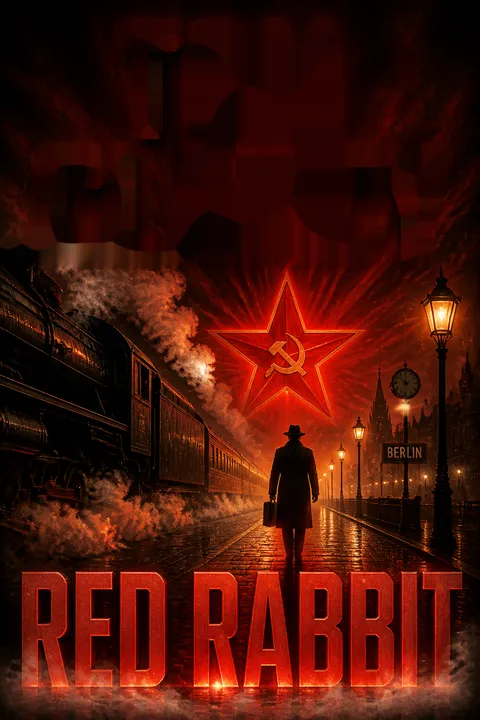


Plot Summary
Prologue
Jack Ryan arrives in England with his wife, Cathy, their children, and the uneasy knowledge that his new intelligence job will keep him far from ordinary life. Across Europe, KGB communications officer Oleg Zaitzev handles messages whose contents he is not supposed to consider.
One reaches Chairman Yuriy Andropov: Pope John Paul II has warned that he may return to Poland if its government crushes the labor movement. Andropov recognizes that the Pope's moral authority could unsettle Soviet control. The book opens with domestic adjustment, secret bureaucracy, and a political threat beginning to move through both.
The opening places private life beside the machinery of state. Ryan's new home is full of small, comic adjustments, while Zaitzev's office makes human lives into coded traffic and Andropov's office turns a letter into a problem of power. The contrast matters: the crisis begins not with a battle, but with an act of conscience that bureaucrats reinterpret as a threat. By showing ordinary routines in England and Moscow before the plot accelerates, the prologue makes the coming violence feel like something systems manufacture out of everyday decisions.
Ryan Enters the Old Game
At Century House, Britain's intelligence chief, Sir Basil Charleston, places Ryan in a joint Soviet-analysis group with Simon Harding. Ryan is still learning the work, but his background in economics and his habit of questioning official assumptions make him useful. Basil gives him a highly rated report from a Polish source: the Pope has warned Warsaw that repression of Solidarity could bring him back to Poland.
Ryan studies the Soviet leadership's likely response and argues that the threat is genuine because the Pope's loyalty to his people is not theatrical. He cannot yet say how the Kremlin will act, but his new post puts him close to the question, and his analysis becomes part of the warning shared with Washington.
Ryan's transition from teacher and investor to intelligence analyst is framed as a change in what counts as evidence. He can no longer rely on numbers alone: he must infer how frightened men interpret another person's courage. His resistance to treating the Pope's statement as bluff shows both his strength and his unfinished training. He can read motive, but he has not yet fully adopted his adversary's perspective. The posting therefore functions as an apprenticeship in moral imagination, not merely a transfer into a new office.
Andropov Chooses the Knife
Andropov discusses the Polish letter with ideological ally Mikhail Alexandrov, then asks experienced officer Aleksey Rozhdestvenskiy how an attack on the Pope might be arranged. Rozhdestvenskiy warns that killing a religious leader could bring severe political consequences, but Andropov presses for operational possibilities.
He orders the Rome station to assess access to the Pope and, after hearing the risks, turns to Bulgaria, whose security service has carried out deniable killings for Moscow. Colonel Ilya Bubovoy proposes a Turkish gunman and a Bulgarian officer to eliminate him afterward. Andropov takes the proposal to the Politburo, which approves the operation while trading political support for Alexandrov's advancement.
Andropov's decision is not presented as a single mad impulse. It grows from calculation, alliance-building, and a state ideology that treats dissent as contagion. His private ambition and public duty merge until he cannot distinguish preserving the Soviet system from preserving his own authority. The Politburo's unanimous vote reveals how collective procedure can conceal individual fear: nobody must own the choice alone, yet the decision becomes more dangerous precisely because responsibility has been dispersed.
The Clerk Sees the Crime
Oleg Zaitzev, a trusted KGB communications officer, handles the encrypted traffic linking Moscow to its foreign stations. When he processes the Rome request about approaching the Pope and the cautious reply warning against an attack, he understands what the messages imply. The operation number returns in further dispatches, now tied to Sofia and given the Chairman's approval.
Zaitzev has access to the machinery but no authority to change its course. A dream of Andropov shooting the Pope among children intensifies his private revulsion. On the Moscow Metro, he tests whether he can reach an American embassy official's coat pocket unnoticed, then slips in a first written signal.
Zaitzev's crisis begins in the gap between professional competence and moral permission. His position gives him unusually broad knowledge, but the institution trains him to route information without judging it. The dream makes his suppressed judgment visible to himself, while the pocket test turns thought into a bodily risk. His choice is not yet a fully formed defection; it is a small experiment in agency. The scene's tension comes from how little action is needed to cross the line from passive witness to participant.
A Note in Foley's Pocket
The American is Ed Foley, CIA's Moscow station chief, working under the cover of a minor embassy official. Zaitzev uses the Metro again to pass a note, then meets Foley's wife and case officer, Mary Pat, at a department store. He reveals that he works in KGB communications and demands safe passage for himself, his wife Irina, and their young daughter, Svetlana.
He will not disclose the target of the plot until he is in the West, but says an innocent man is in danger. He also warns that American communications may be compromised. Mary Pat agrees to help, and Foley sends an urgent request to Langley, which authorizes an extraction.
The bargain is built on asymmetry. Zaitzev asks the Americans to risk resources and lives before proving the value of his information; the Foleys must judge his character without seeing the full case. Mary Pat's attention to his family helps her read him as more than a possible source. His warning about communications security also changes the terms of trust: the people rescuing him may be leaking information themselves. Intimacy and tradecraft become inseparable, since every private detail is both human context and operational evidence.
Beatrix Takes Shape
With Budapest CIA station compromised, Foley asks British intelligence officer Nigel Haydock for help. Mary Pat proposes a way to hide the defection: move the family through Hungary, leave substitute bodies behind, and make the Soviets believe the Zaitzevs died in a fire.
British officer Alan Kingshot seeks suitable bodies through Scotland Yard and contacts in the United States, while Budapest chief Andy Hudson arranges a smuggler and a route into Yugoslavia. The plan requires exact matches for the family, forged travel identities, and a staged hotel blaze. Its purpose is not only to save the Zaitzevs, but to preserve the intelligence inside Oleg's head by concealing that he escaped.
Operation Beatrix turns deception into a form of protection. The plan's moral cost is immediate: people who died by accident are repurposed as substitutes, and their bodies must be altered so their deaths can serve the living. The agents do not pretend this is clean. Yet the concealment is designed to protect not only a source but the truth he carries. The operation makes intelligence work's central contradiction concrete: preserving future knowledge may require disturbing the dignity of the dead.
A Vacation Becomes an Exit
Zaitzev uses his KGB standing to secure vacation days, train compartments, and a hotel booking in Budapest. He tells Irina that the trip is for shopping and a concert by Hungarian conductor Jozsef Rozsa, keeping her outside the real plan until they leave Moscow. Meanwhile, Langley sends Ryan to Budapest as an observer, despite his lack of field experience.
British intelligence prepares the substitute bodies, and Haydock arranges a plausible visit to the Moscow railway station so his team can photograph the family. Zaitzev boards the train with Irina and Svetlana, carrying ordinary luggage and shopping lists. The innocent cover is convincing because it is, in fact, a real family holiday as well as an escape.
The departure exposes Zaitzev's most intimate gamble: he has chosen his family's future without first asking Irina to choose it with him. His confidence in her obedience is also an act of control, and the story leaves the emotional cost visible even as it makes the escape possible. Ryan's assignment brings him into the field through institutional improvisation. He is not promoted into a seasoned operative; he is simply placed where the crisis needs an extra pair of eyes.
A Family in Budapest
The Zaitzevs reach Budapest and settle into the Astoria Hotel, across from a Soviet cultural center that serves as a KGB base. Ryan arrives separately and meets Andy Hudson, who explains that a local smuggler can move them across the Yugoslav border. While Hudson and Ryan survey the city, they unexpectedly see Oleg, Irina, and Svetlana shopping on Váci Street.
The ordinary scene reassures them that the family has not been visibly followed, but it also exposes the wife's ignorance of the escape. Irina buys Western clothes and luxuries with their travel money, while Svetlana delights in the unfamiliar city. The operation remains intact, yet its human complications are now impossible to ignore.
The family's shopping trip gives the escape a fragile normality. Irina's pleasure is genuine, not merely a cover story, and that makes her later shock more consequential. Ryan sees the cost of planning around a person rather than with her: the operation's neat timetable depends on a wife who has not consented to its purpose. At the same time, the scene tests the intelligence officers' assumptions. The family appears exposed in a city full of surveillance, yet ordinary behavior provides camouflage more effectively than elaborate disguises.
Bach Before the Break
At a concert of Bach music, Hudson catches Zaitzev alone in the men's room and confirms that he still intends to leave. Zaitzev agrees, then returns to his seat beside Irina and Svetlana, who have no idea that the decision has just been renewed. The concert gives the family one last evening that resembles the life they expected in Budapest.
Ryan watches from a box with Hudson and British officers, carrying no certainty that the extraction will work. After the performance, the agents let the Zaitzevs return to their hotel and wait until the agreed hour. The music ends, the audience disperses, and the covert operation shifts from planning to movement.
The concert creates a counterpoint between shared beauty and private danger. Zaitzev hears music with the wife whose future he has decided for her, while the operative beside him turns a public ritual into a final confirmation of consent. The scene does not make art a cure for political violence; it makes it a temporary space in which both lives remain legible as human. Ryan's role is still observational, but the quiet approach is drawing him toward responsibility.
Three Bodies, One New Life
After midnight, Hudson enters the Zaitzevs' room and tells them they are leaving immediately. Irina wakes confused and frightened, but gathers Svetlana and follows her husband. The family rides out with Hudson and Ryan, transfers to smuggler Istvan Kovacs's truck, and passes the Hungarian border after Kovacs pays off guards with gifts and favors.
In Budapest, British agents place three substitute bodies in the hotel room, soak it with alcohol, and ignite a timed fire. The blaze destroys evidence and leads authorities to report the Zaitzevs dead. By the time the fire is discovered, the family is in Yugoslavia, then boards a delayed British flight to Manchester.
Escape succeeds through the joining of routine corruption and theatrical deception. The border guards accept familiar gifts, while the hotel fire supplies a story the KGB can believe because it fits ordinary misfortune. Irina's confusion is not a minor inconvenience; it is the human remainder of a plan that treats her as part of a package. Ryan's fear persists even after crossing the frontier, showing that a border can change jurisdiction faster than it changes the body's sense of danger.
The Rabbit Names the Enemy
At a British safe house, Zaitzev finally identifies the target: KGB plans to kill the Pope because his return to Poland could help destabilize Soviet control. He traces the operation through Andropov, the Rome station, and Bulgarian rezident Bubovoy.
The likely field killer is Boris Strokov, a Bulgarian officer associated with clandestine assassinations, who is expected to use a Turkish gunman. Zaitzev also names three valuable penetration agents: MINISTER in British political circles, NEPTUNE supplying American naval communications, and CASSIUS providing Washington intelligence.
His testimony confirms the communications warning and gives British and American services new leads. Ryan recognizes that the Rabbit is not merely a witness but a living map of Soviet operations.
The revelation expands the stakes from one threatened life to a whole architecture of compromised trust. Zaitzev's knowledge is valuable because his bureaucratic position made him an accidental witness to many separate operations. That same breadth explains why his escape had to remain hidden. The names he supplies also transform him from a frightened defector into a strategic resource, raising the danger that institutions will value the information more than the man who carries it. Ryan begins to see that intelligence can protect people and consume them at once.
A Gun at St Peter's
Ryan travels to Rome with a small British team and helps study the Pope's Wednesday route through St. Peter's Square. They have too few people to secure the whole plaza, so they divide positions and watch the crowd. Ryan spots Strokov near the barriers and reaches him just as the Pope approaches, pressing a pistol to his back and taking his own silenced weapon.
Before the agents can control the scene, a second gunman fires at the Pope. The crowd tackles the shooter, while the wounded Pope collapses and is rushed away for treatment. Ryan and the British team take Strokov into custody. They have prevented the Bulgarian from completing his part, but the assassination attempt has already succeeded in striking its target.
The climax turns Ryan's training into immediate moral action, but denies him the clean outcome that heroic stories promise. He identifies the professional threat and disarms Strokov, only to discover that the actual shooter is someone else. The failure is not caused by passivity; it arises from incomplete information and a plan designed around a single visible suspect. Ryan's courage can interrupt one mechanism, not control the whole event. The scene forces him to experience the limits of analysis when the world moves faster than its models.
The Cost of the Attempt
The Pope undergoes surgery and remains in critical condition, though Ryan's wife, Cathy, judges his chances better than even. Strokov is questioned by British officers and, confronted with evidence linking him to the earlier killing of Georgiy Markov, gives them information about the operation.
Later, a Bulgarian man is found dead in a car in Rome, apparently from a heart attack, leaving Strokov's ultimate fate unexplained in the public record. In Moscow, Andropov is told that Zaitzev and his family died in the Budapest fire, and accepts the report. Ryan returns to Langley with the rescued family and the knowledge that the Pope's life remains uncertain.
The aftermath refuses an easy moral accounting. The Pope's survival is possible, not yet secure, and the operation's apparent success is shadowed by the death of a Bulgarian whose identity and cause remain publicly ambiguous. Meanwhile, Andropov accepts the fabricated deaths, showing how a state can be deceived by the same habits of secrecy it imposes on others. The emotional resolution is therefore provisional: the family has escaped, but the threatened life is still unresolved, and the institutions that produced the crisis continue to function.
A New Kind of Pressure
Back at Langley, Ryan briefs the senior CIA leaders and argues that the Soviet assassination plot reflects deeper desperation. He connects what he has learned about unreliable Soviet economic reporting with the country's dependence on hard currency from oil exports.
Since Saudi Arabia can influence world oil prices, he sees a possible way to pressure the Soviet system without direct war. The idea recalls Bob Ritter's previously proposed project to examine Soviet vulnerabilities, now given a more concrete economic direction by Ryan.
The President is angry about the attack, and the Agency must decide what to do with the Rabbit's information while protecting him. Ryan's field experience has altered his work: he now treats analysis as a decision with human consequences.
The final movement returns the novel to its larger contest without pretending the crisis has ended. Ryan's proposal translates an immediate act of violence into a structural diagnosis: a state that cannot reliably measure its own economy may be vulnerable to pressure it does not anticipate. This is not a simple triumph of market logic over ideology. It is a question of whether intelligence can convert knowledge into policy without sacrificing the people who provided it. Ryan has moved from interpreting danger at a distance to understanding that every assessment carries an implicit choice about whose life matters.
Analysis
Red Rabbit is built around the difference between information and judgment. Ryan begins as an analyst who can criticize weak data, but the plot forces him to decide what to do when information concerns a life rather than an abstract estimate. Zaitzev's access to KGB traffic makes him valuable, yet his moral crisis begins when he refuses to treat the Pope's death as just another operation number. His defection is both an act of conscience and a bargain that places his wife and daughter at risk.
The novel also examines institutions that claim legitimacy while concealing their failures. Andropov can see that Soviet economic reports are distorted and that the state is unstable, but his answer is to defend it through coercion. The intelligence agencies mirror that contradiction: they protect sources through secrecy, yet secrecy can become an excuse for inaction. Operation Beatrix makes the conflict literal by using dead bodies to hide a living family. Its success depends on both careful planning and morally uncomfortable improvisation.
Ryan's intervention in Rome dramatizes the limits of individual competence. He identifies and disarms Strokov, but a second gunman still wounds the Pope. Training, courage, and intelligence can narrow danger without controlling every variable. The result deepens Ryan's understanding of his work: analysis is not detached observation when decisions affect actual bodies. His later proposal to exploit Soviet economic weakness extends that lesson from a single rescue to strategy. Knowledge matters only when someone is willing to accept responsibility for how it is used, and no institution can fully outsource that responsibility to procedure.
Review Summary
Red Rabbit received mixed reviews, with many criticizing its slow pace, repetitive content, and lack of action compared to Clancy's earlier works. Some readers appreciated the historical context and espionage details, while others found the political commentary heavy-handed. The character development and writing style were often deemed subpar. A few reviewers enjoyed the book as a prequel to the Jack Ryan series, but overall, it was considered one of Clancy's weaker efforts. The audiobook version was noted as more engaging due to better editing and narration.
People Also Read
Characters
Jack Ryan
The reluctant analystAn American intelligence analyst with a past in the Marine Corps, Ryan combines economic training, historical judgment, and an instinct to challenge comfortable assumptions. He is devoted to his wife, Cathy, and their children, and his dislike of flying and field danger makes his new work feel personally costly rather than glamorous. His strength is his willingness to connect evidence to human consequence; his weakness is that he sometimes trusts his own moral certainty before fully understanding the operational picture. As he moves from London analysis to a dangerous assignment, he learns that good judgment is not simply seeing what should happen, but accepting responsibility for acting with incomplete knowledge.
Oleg Zaitzev
The conscience in the wiresA mathematically trained KGB communications officer, Zaitzev has earned his position through discipline, memory, and a chess player's attention to sequence. His work gives him access to a broad stream of secret traffic, even though the agency expects him to act as a conduit rather than a thinker. He is a proud father and husband, and the modest privileges his job brings matter because they improve life for his family. His inward questioning arises from his own professional knowledge: he sees how power converts political convenience into permission. His mix of loyalty, fear, and moral seriousness makes him neither a born rebel nor a simple opportunist.
Cathy Ryan
Surgeon and moral anchorA gifted ophthalmic surgeon, Cathy values competent care, patient safety, and the practical truth visible in a human body. Her marriage to Jack is affectionate and candid, though his secrecy and travel frustrate her, especially when she cannot tell whether he is safe. Her medical training gives her a precise way of reading character and consequence, while her confidence can make her impatient with systems that excuse poor work. She is also a mother adjusting to life in England and to a different medical culture. Cathy embodies a form of public service built around direct contact with vulnerable people, sharply contrasting with Jack's hidden and indirect work.
Ed Foley
Moscow station chiefFoley is CIA's Moscow chief, a practiced field officer whose cover as a minor embassy official depends on appearing unremarkable. He is methodical, skeptical of easy explanations, and acutely conscious that agents bear the danger while handlers often remain protected by diplomatic status. His affection for his wife and son sits alongside a demanding professional conscience, which makes him cautious about exposing them to risk. Foley knows how to wait, build cover, and judge an approach without rushing to claim a source. His partnership with Mary Pat gives him a capable counterpart, though her appetite for bold solutions often pushes him beyond his natural caution.
Mary Pat Foley
The daring case officerA highly capable CIA officer, Mary Pat can pass as a shallow American housewife while quietly reading a room and taking operational risks. Her Russian is excellent, shaped by family history and training, and her grandmother's exile from Russia gives her opposition to Soviet rule a personal charge. Unlike Ed, she enjoys the improvisational edge of field work, but her boldness is disciplined by sharp judgment. She recognizes Zaitzev's concern for his daughter and helps turn that detail into trust. Her role shows how domestic presentation can become a professional instrument without erasing the person beneath the disguise.
Irina Zaitzev
The unwitting wifeIrina is an educated accountant who once hoped to become a pianist. She is attentive to her daughter and lives within the constraints of Soviet shortages, work routines, and limited access to the things she wants. Her marriage to Oleg includes affection and conventional expectations about who makes decisions. Music and the chance to shop for better clothing represent more than luxury; they offer access to a life that feels less narrowed by the state. Irina's quiet longing gives the family's escape emotional weight beyond Oleg's political crisis.
Svetlana Zaitzev
The little travelerOleg and Irina's young daughter is curious, affectionate, and delighted by simple novelties, from riding the Metro to seeing animals and bright clothes in Budapest. Her innocence makes the adults' decisions more consequential: she cannot understand the danger surrounding her or consent to the abrupt journey. Oleg's tenderness toward her is one of the clearest signs of his private life beyond the KGB. Through Svetlana, the story measures political conflict against the ordinary future a child should be allowed to expect.
Yuriy Andropov
The calculating chairmanAs chairman of the KGB and an emerging Soviet power broker, Andropov is disciplined, perceptive, and convinced that he understands the country's structural weaknesses better than his colleagues. He recognizes the stagnation and dishonesty inside the system, yet still sees coercive control as necessary to preserve it. His ambition is joined to a genuine belief that only forceful leadership can prevent collapse. This contradiction makes him dangerous: he can diagnose institutional failure while treating dissent as an infection to be eliminated. He prefers careful planning and deniability, but his fear of political change drives him toward actions with consequences he cannot fully control.
Pope John Paul II
Poland's spiritual standardThe Polish-born Pope is a religious leader whose connection to his homeland gives his public gestures unusual political weight. His willingness to stand with Polish workers reflects a parish priest's sense of responsibility rather than a conventional politician's calculation. He does not treat personal danger as a reason to abandon his people, which makes him difficult for Soviet leaders to intimidate. The story presents his faith as active rather than abstract: it shapes where he stands, whom he serves, and what risks he will accept.
Sir Basil Charleston
British intelligence chiefThe Director General of Britain's Secret Intelligence Service is a polished administrator with deep field experience and a talent for recognizing ability in others. He recruits Ryan into the Soviet working group, supports cooperation with CIA, and manages the political demands placed on intelligence without losing sight of operational limits. Basil trusts expertise but keeps sources compartmented, as a professional must. His manner is restrained, yet his decisions can commit people to dangerous work. He provides Ryan with both opportunity and pressure, treating the younger analyst as someone worth developing rather than merely assigning tasks.
Simon Harding
The Soviet specialistHarding is a British analyst with deep knowledge of Russian literature, history, and political culture. He teaches Ryan that Soviet leaders must be understood through their own assumptions, not simply through Western measures of rationality. His caution comes from years of interpreting incomplete intelligence, and he knows how easily analysts mistake a useful theory for certainty. Harding is neither cynical nor naïve; he values careful judgment and respects Ryan's ability to see patterns beyond bureaucratic conventions.
Andy Hudson
Budapest field chiefHudson is the British station chief in Budapest, a former paratrooper whose practical confidence comes from years of field work and language study. He knows the city's informal systems, including the smugglers and border officials who make an escape route possible. His manner is dry and self-assured, but he understands that plans depend on people, luck, and local knowledge. Hudson treats Ryan as inexperienced without dismissing him, and he is willing to explain the realities of field operations while maintaining the discipline that keeps them viable.
Alan Kingshot
The senior field operatorKingshot is a veteran SIS operative who coordinates the British side of Operation Beatrix. He understands surveillance, cover, and the difficult logistics of moving people across borders, and he can keep a plan moving without pretending its moral costs are small. His work with the substitute bodies shows the grim practical side of intelligence operations. He also handles the Zaitzevs' first debriefing, balancing the need for information against the family's need to feel secure.
Arthur Moore
The legal-minded directorThe CIA Director is a former Texas judge and experienced intelligence officer who values the rule of law as both a civic principle and a practical safeguard. He must answer to the President while managing an agency whose knowledge is always incomplete. Moore wants the Rabbit extracted but understands that every move could expose a source or trigger consequences beyond CIA's control. His humor and patience mask the burden of making decisions that others will judge with more certainty than he possesses.
James Greer
Ryan's exacting mentorGreer is Ryan's senior CIA mentor, a former naval officer and senior intelligence analyst who recognizes his unusual ability. He encourages Ryan to understand adversaries from within their own worldview, while protecting him from premature exposure to sensitive operations. Greer is loyal to people as well as institutions, and his confidence in Ryan helps make the young analyst's unconventional assignments possible. His guidance is demanding because he knows that analytical errors can endanger lives.
Bob Ritter
CIA operations directorRitter leads CIA's Operations Directorate and is an ambitious, abrasive field professional who believes the agency must actively exploit Soviet weaknesses. He is skeptical of Ryan's rapid rise and protective of his own operational domain, yet he recognizes valuable results when they appear. His strategic interest in pressuring the Soviet system develops alongside his impatience with institutional caution. Ritter's rivalry with Greer reflects the agency's internal divide between operational action and intelligence analysis.
Nigel Haydock
The trusted British handlerHaydock is an SIS officer working under diplomatic cover in Moscow, known to Foley and trusted by both services. He is experienced in Russian operations and understands how to use reporters, embassy routines, and official hospitality to create plausible cover. His father's history gives his work a personal connection to Soviet betrayal, though he remains controlled and professional. Haydock helps build the practical bridge between the Foleys' recruitment and Hudson's extraction operation.
Boris Strokov
Bulgarian state assassinStrokov is a senior Bulgarian security officer associated with clandestine killings and valued by the Soviet services for his experience. He is methodical and accustomed to treating assassination as a professional task rather than a moral decision. His history makes him a credible threat in Rome, where the British recognize him from an earlier killing in London. He represents the human specialist produced by a political system that outsources violence while preserving deniability.
Plot Devices
The Warsaw Letter
The inciting threatThe Pope's warning to Warsaw makes his possible return to Poland a political event with consequences across the Soviet bloc. It gives Andropov a concrete reason to fear that Solidarity could gain a powerful public ally, while giving Ryan and British intelligence a basis for assessing the Kremlin's reaction. The letter is a private communication that becomes dangerous precisely because it is passed through governments and interpreted as a challenge to state control. Its movement from Warsaw to Moscow turns moral solidarity into an intelligence crisis.
KGB Message Traffic
Secrets hidden in routineZaitzev's communications desk receives coded messages from foreign stations, routes them to the correct offices, and preserves an unusually broad picture of KGB activity. Operation numbers, one-time pads, and strict handling procedures make the messages difficult to read and easy to compartmentalize. The same routine that protects the agency exposes its plans to the one clerk who sees traffic from many regions. His memory and quiet attention convert a job designed to suppress judgment into the source of the novel's central moral knowledge.
Metro Pocket Signals
A covert first contactZaitzev uses crowded Moscow Metro trains to pass small written messages into Foley's coat pocket. The trains' regular schedules and the ordinary jostling of commuters provide cover, while a colored tie gives the two men a simple signal for confirming contact. The method is crude compared with formal cipher systems, but its physical simplicity makes it useful when Zaitzev distrusts electronic communications. The repeated transfers gradually turn an anonymous American into the contact through whom Zaitzev can ask for escape.
Operation Beatrix
The fabricated deathThe Foleys and their British partners arrange to substitute three unrelated fire victims for the Zaitzev family. The agents match the bodies to the family's approximate ages and appearances, alter them to obscure differences, and set a hotel fire after the Zaitzevs leave. The staged deaths are meant to convince KGB that its communications officer and family are gone, preserving the source's ability to provide information without immediately revealing the defection. The operation combines a real escape with a false account of what happened afterward.
Diplomatic Cover
A legal mask for movementThe Foleys, Haydock, Hudson, and Ryan use embassy jobs and diplomatic credentials to move through tightly controlled places without attracting the same scrutiny as ordinary travelers. Cover identities explain their presence, while diplomatic status limits searches and arrests. That protection is never absolute: it depends on keeping behavior plausible and on not provoking a government into ignoring convention. In Budapest, local bribery and smuggling complement the official cover, showing how formal privilege and informal networks can work together to move people across a border.
FAQ
0. Synopsis & Basic Details
What is Red Rabbit about?
- Cold War Espionage Thriller: Red Rabbit plunges into the tense geopolitical landscape of the early 1980s, focusing on a KGB communications officer, Oleg Zaitzev, who seeks to defect to the West with critical intelligence about a Soviet plot to assassinate Pope John Paul II. The narrative follows CIA operatives Ed and Mary Pat Foley in Moscow and Jack Ryan in London as they race against time to extract Zaitzev and prevent the unthinkable.
- Moral and Political Stakes: The story explores the profound moral and political implications of the Pope's defiance against Soviet control in Poland, which prompts the KGB to consider extreme measures. It highlights the personal courage of individuals like Zaitzev and the Pope, whose actions challenge the established order and force intelligence agencies to navigate complex ethical dilemmas.
- Intertwined Destinies: Through a meticulously crafted plot, the novel intertwines the fates of ordinary people caught in extraordinary circumstances with the machinations of global superpowers. It showcases the intricate dance of espionage, the human cost of ideological conflict, and the subtle ways in which individual choices can alter the course of history.
Why should I read Red Rabbit?
- Deep Dive into Cold War Intrigue: Readers seeking an authentic and detailed portrayal of Cold War espionage will find Red Rabbit compelling. Tom Clancy meticulously crafts a world where every detail, from communication protocols to bureaucratic infighting, feels real, offering a window into the high-stakes intelligence operations of the era.
- Moral and Ethical Exploration: Beyond the thrilling plot, the novel delves into profound moral questions. It forces readers to consider the ethical boundaries of state power, the personal cost of conscience, and the complex motivations behind betrayal and loyalty, making it more than just a spy thriller.
- Character-Driven Suspense: While known for technical detail, Clancy excels here in character development, particularly with Oleg Zaitzev's internal struggle and the Foleys' daring resourcefulness. Jack Ryan's early career experiences, grappling with the moral ambiguities of his new role, provide a relatable human element amidst the global tension.
What is the background of Red Rabbit?
- Early 1980s Geopolitical Context: Red Rabbit is set in the early 1980s, a period of heightened Cold War tension marked by the rise of the Solidarity movement in Poland and the election of a Polish Pope, John Paul II. This historical backdrop is crucial, as the Pope's influence directly challenges Soviet hegemony in Eastern Europe, driving the central conflict of the novel.
- Soviet Internal Dynamics: The story provides a detailed, albeit fictionalized, look into the inner workings of the KGB and the Politburo under Yuriy Andropov. It highlights the bureaucratic inertia, paranoia, and ideological rigidity within the Soviet system, contrasting it with the pragmatic, often ruthless, decision-making at the highest levels of power.
- Espionage Tradecraft and Technology: Clancy integrates realistic details of intelligence gathering, communication methods (like one-time pads), and counter-surveillance techniques of the era. The technological limitations and human elements of espionage are central, emphasizing the ingenuity and risks involved in covert operations before the digital age.
What are the most memorable quotes in Red Rabbit?
- "Heroes are often the most ordinary of men.": This epigraph, attributed to Henry David Thoreau, profoundly sets the tone for the novel, highlighting the unexpected courage found in characters like Oleg Zaitzev, an ordinary KGB clerk who risks everything for a moral cause. It underscores the theme that heroism isn't exclusive to the powerful or famous, but often emerges from quiet conviction.
- "The most momentous thing in human life is the art of winning the soul to good or to evil.": Pythagoras's quote, also an epigraph, directly addresses the core moral conflict of Red Rabbit. It frames the struggle between the Soviet regime's amoral political calculations and the Pope's unwavering moral stance, emphasizing the battle for human conscience that drives Zaitzev's defection.
- "It's a lot easier to get forgiveness than permission.": This pragmatic piece of advice, attributed to a Marine major, encapsulates the ethos of decisive action often required in high-stakes intelligence operations. It reflects Jack Ryan's own willingness to act on his instincts, even when operating outside strict protocols, and underscores the calculated risks taken by field operatives.
What writing style, narrative choices, and literary techniques does Tom Clancy use?
- Meticulous Detail and Technical Realism: Clancy's signature style is evident in Red Rabbit through his exhaustive attention to operational and technical detail. He immerses the reader in the minutiae of intelligence tradecraft, military hardware, and bureaucratic procedures, lending a strong sense of authenticity to the fictional narrative.
- Alternating Perspectives and Omniscient Narration: The novel employs an omniscient third-person narrator who frequently shifts perspective between key characters across different geographical locations (London, Moscow, Rome, Washington). This narrative choice provides a comprehensive, almost panoramic, view of the unfolding crisis, allowing readers to understand the motivations and actions of both protagonists and antagonists.
- Foreshadowing and Thematic Juxtaposition: Clancy subtly uses foreshadowing, such as early discussions about Soviet vulnerabilities or Jack Ryan's recurring nightmares, to build suspense. He also employs thematic juxtaposition, contrasting the mundane routines of daily life with the extraordinary moral and political stakes of espionage, and highlighting the clash between rigid ideology and human conscience.
1. Hidden Details & Subtle Connections
What are some minor details that add significant meaning?
- The "666" Operation Designator: The KGB's internal designation for the Pope's assassination plot is "15-8-82-666." While seemingly a routine alphanumeric code, the inclusion of "666" (the biblical "Mark of the Beast") subtly imbues the operation with a demonic, morally corrupt undertone, reinforcing Oleg Zaitzev's perception of its inherent evil and justifying his defection.
- The Milkman's Cigarette: Jack Ryan's early morning encounter with the milkman, who offers him a cigarette, is a small but telling detail. It highlights Ryan's lingering personal vices and the subtle ways he connects with ordinary people, contrasting with the rigid, often isolated world of intelligence. It also foreshadows his later reliance on small, human connections in high-stakes situations.
- Irina's Desire for a Piano: Oleg's wife, Irina, dreams of owning a piano, a symbol of cultural aspiration and personal fulfillment denied by the Soviet system. This seemingly minor detail underscores the pervasive impact of communism on individual lives and artistic expression, providing a poignant motivation for Oleg's defection beyond just saving the Pope.
What are some subtle foreshadowing and callbacks?
- Ryan's Helicopter Trauma: Jack Ryan's recurring nightmares about a helicopter crash on Crete, which broke his back and ended his Marine Corps career, subtly foreshadow his deep-seated aversion to flying. This personal detail becomes a source of internal conflict and humor during his unexpected field assignments, particularly his flights to Budapest and Rome.
- The "Canary Trap" Callback: Early in the novel, Sir Basil Charleston praises Jack Ryan's invention of the "Canary Trap" for catching security leaks. This callback to a previous success establishes Ryan's analytical prowess and unconventional thinking, justifying his rapid ascent within the intelligence community and setting the stage for his crucial role in Operation BEATRIX.
- Stalin's "How Many Divisions" Quote: The repeated reference to Stalin's dismissive question, "How many divisions does the Pope have?", serves as a powerful thematic callback. It highlights the Soviet leadership's reliance on military power and their initial underestimation of the Pope's moral and political influence, which ultimately drives their desperate assassination plot.
What are some unexpected character connections?
- Ryan and the Milkman's Shared Humanity: The brief, friendly interaction between Jack Ryan and his English milkman, where they share a cigarette and discuss mundane life, creates an unexpected connection. It highlights Ryan's grounded nature and ability to connect with ordinary people, a trait that contrasts with the detached world of espionage and subtly reinforces his moral compass.
- Mary Pat Foley's Romanov Ancestry: Mary Pat's deep-seated hatred for the Soviet regime is rooted in her grandfather's past as an equerry to the Romanov family, whose murder by the Bolsheviks instilled in her a lifelong mission. This personal history provides a powerful, almost aristocratic, motivation for her dedication to dismantling communism, making her a more complex character than a mere "daring operative."
- Andropov's Appreciation for Jazz: KGB Chairman Yuriy Andropov's private enjoyment of American jazz and Marlboro cigarettes is an unexpected detail. It reveals a hidden layer of cultural appreciation and a subtle contradiction to his rigid communist ideology, hinting at a more complex inner life than his public persona suggests, and making him a more nuanced antagonist.
Who are the most significant supporting characters?
- Simon Harding (British Analyst): Simon Harding, Jack Ryan's British counterpart, is crucial for providing cultural and historical context to Soviet actions. His academic background in Russian literature and psychology offers a nuanced perspective on the enemy, helping Ryan "think like a Russian" and understand the ideological underpinnings of their decisions.
- Nigel Haydock (British Commercial Attaché/SIS Officer): Haydock, initially appearing as a friendly neighbor to the Foleys, quickly reveals himself as a key SIS operative. His role in facilitating the Zaitzev family's defection and coordinating with the CIA underscores the vital Anglo-American intelligence partnership and his personal commitment to fighting communism.
- Colonel Boris Strokov (Bulgarian DS Assassin): Strokov, the ruthless Bulgarian assassin tasked with killing the Pope, serves as a tangible representation of the Soviet bloc's "wet work" capabilities. His professional detachment and history of successful eliminations highlight the cold, brutal reality of state-sponsored murder and provide a direct antagonist for Ryan in Rome.
2. Psychological, Emotional, & Relational Analysis
What are some unspoken motivations of the characters?
- Andropov's Quest for Legacy: Beyond merely maintaining Soviet power, Yuriy Andropov's drive to assassinate the Pope is subtly motivated by a desire to solidify his own legacy and prove his decisiveness to the Politburo. His internal monologues reveal a man acutely aware of Brezhnev's failing health and his own ambition to lead, seeing the Pope as an obstacle to be removed to clear his path to ultimate power.
- Oleg Zaitzev's Search for Meaning: Oleg's defection is explicitly driven by conscience, but beneath that lies an unspoken yearning for a life of authenticity and purpose beyond the Soviet system's pervasive lies. His internal reflections on the "grayness" and "boredom" of Soviet life, coupled with his appreciation for Western culture (jazz, quality goods), suggest a deeper, existential motivation for seeking freedom.
- Mary Pat Foley's Personal Vengeance: While a dedicated CIA operative, Mary Pat's fierce commitment to dismantling the Soviet Union is deeply personal, stemming from her grandfather's tragic history with the Romanovs. Her "visceral hatred for the Bolsheviks" is an unspoken, powerful undercurrent that fuels her daring and often reckless approach to espionage, making her mission a form of familial retribution.
What psychological complexities do the characters exhibit?
- Jack Ryan's Moral Conflict: Jack Ryan, an analyst thrust into field operations, grapples with the psychological toll of his work. His aversion to violence, his nightmares from past trauma, and his Catholic conscience create a complex internal struggle when confronted with the KGB's assassination plot. He is forced to reconcile his academic ideals with the brutal realities of espionage, questioning the ethical boundaries of his actions.
- Andropov's Ideological Blindness: Despite his intelligence and pragmatism, Andropov exhibits a profound psychological complexity rooted in his ideological commitment. He rationalizes the Pope's assassination as a political necessity, demonstrating how deeply ingrained Marxist-Leninist dogma can distort moral judgment and lead to ruthless decisions, even when he privately acknowledges the system's failures.
- Oleg Zaitzev's Conscience and Fear: Oleg's decision to betray his country is a testament to his conscience, but it is constantly battling profound fear. His internal monologues reveal the immense psychological pressure of his actions, the terror of discovery, and the moral isolation he experiences, highlighting the immense courage required to act on one's principles in an oppressive regime.
What are the major emotional turning points?
- Oleg's Dream of the Pope's Assassination: Oleg Zaitzev's vivid nightmare, where Politburo members including Andropov shoot children and the Pope in Red Square, is a critical emotional turning point. This dream crystallizes his moral outrage and transforms his abstract knowledge of the plot into a visceral, personal imperative to act, pushing him towards defection.
- Cathy Ryan's Disgust at British Surgeons: Cathy's emotional outburst over the British surgeons taking a beer break during an operation is a significant moment. It highlights her unwavering professional ethics and deep concern for patient welfare, contrasting sharply with the casual attitudes she encounters. This emotional reaction underscores her moral integrity and her role as Jack's ethical anchor.
- Ryan's Confrontation with Strokov: The moment Jack Ryan presses his pistol against Strokov's spine in St. Peter's Square is a major emotional turning point for him. It forces him to directly engage in the violence he usually analyzes from a distance, confronting his own capacity for lethal action and the stark reality of the mission, solidifying his commitment to protecting innocent lives.
How do relationship dynamics evolve?
- Ryan and Greer's Mentor-Protégé Bond: The relationship between Jack Ryan and Admiral James Greer evolves from a professional mentorship into a deeper, almost father-son bond. Greer consistently champions Ryan, trusts his instincts, and provides guidance, while Ryan, in turn, seeks Greer's counsel and strives to prove his worth, culminating in Greer's pride in Ryan's field performance.
- The Foleys' Partnership in Espionage: Ed and Mary Pat Foley's marriage is portrayed as a dynamic partnership, where their individual strengths complement each other in the field. Ed's caution and Mary Pat's daring create a balanced team, and their ability to communicate silently through hand signals and shared understanding deepens their bond, showcasing a unique marital synergy in a high-stress environment.
- Oleg and Irina's Unspoken Divide: The relationship between Oleg and Irina Zaitzev is marked by a profound, unspoken divide. Oleg's decision to defect is made without his wife's knowledge, reflecting the patriarchal norms of Soviet society and his desire to protect her from the burden of his secret. While Irina's initial excitement for the "vacation" highlights her innocence, it also underscores the emotional distance created by Oleg's perilous choices.
4. Interpretation & Debate
Which parts of the story remain ambiguous or open-ended?
- The Extent of Soviet Comms Compromise: While Oleg Zaitzev claims that some American communications systems are compromised (specifically naval comms via Agent NEPTUNE), the full extent and nature of this penetration remain somewhat ambiguous. The novel doesn't definitively confirm how deeply the Soviets have infiltrated US systems, leaving readers to ponder the ongoing vulnerability and the potential for future threats.
- The Fate of Boris Strokov: After his capture, Boris Strokov is interrogated by British intelligence, and the novel hints at his "singing like a canary." However, his ultimate fate—whether he is imprisoned, turned, or eliminated—is left open-ended. This ambiguity allows for reader speculation about the consequences for such a ruthless assassin and the ethical choices intelligence agencies make regarding high-value prisoners.
- The Long-Term Impact of Operation BEATRIX: While Operation BEATRIX successfully extracts the Zaitzev family and provides crucial intelligence, the long-term geopolitical impact of the Pope's survival and the exposed assassination plot is not fully detailed. The novel concludes with the immediate aftermath, leaving readers to consider how this event might reshape Cold War dynamics and the future of the Soviet Union.
What are some debatable, controversial scenes or moments in Red Rabbit?
- The British Surgeons' Lunch Break During Surgery: Cathy Ryan's shock and disgust at the British surgeons taking a beer break during an ongoing operation is a controversial moment. It highlights a stark cultural and professional difference in medical ethics, prompting debate about acceptable professional conduct and the potential impact of such practices on patient care, even if the patient is ultimately unharmed.
- The Use of Burned Bodies for Deception: Operation BEATRIX's use of three burned cadavers (including a child's) to fake the Zaitzev family's deaths is a morally controversial aspect of the plot. This grisly detail forces readers to confront the extreme, often unethical, measures intelligence agencies are willing to take to protect assets and achieve objectives, sparking debate about the "ends justifying the means."
- Ryan's Decision to Intervene in Rome: Jack Ryan's impulsive decision to physically intervene and disarm Boris Strokov, rather than simply observing or alerting local authorities, is debatable. While heroic, it deviates from his analytical role and risks compromising the entire operation. This moment raises questions about the boundaries of an intelligence officer's duty and the personal risks taken when moral imperatives clash with operational protocols.
Red Rabbit Ending Explained: How It Ends & What It Means
- The Pope Survives, Strokov Captured: The climax sees Jack Ryan, alongside British SIS operatives, thwarting the assassination attempt on Pope John Paul II in St. Peter's Square. While Ryan disarms the primary Bulgarian assassin, Boris Strokov, another, unidentified shooter manages to wound the Pope. The Pope survives, albeit critically, and Strokov is captured by British intelligence. This outcome signifies a partial victory, as the immediate threat is neutralized, but the broader conspiracy is revealed to be more complex.
- Zaitzev's Successful Defection and Revelation: Oleg Zaitzev and his family are successfully exfiltrated from Hungary to England via Operation BEATRIX, a complex deception involving faked deaths using cadavers. Zaitzev, the "Rabbit," reveals to Western intelligence that the KGB, under Andropov's direct order, orchestrated the assassination plot. He also exposes several high-level Soviet penetration agents within Western governments, including "MINISTER" in Whitehall and "NEPTUNE" and "CASSIUS" in the US. This intelligence is a massive coup, confirming the deep reach of Soviet espionage and the vulnerability of Western communications.
- The Dawn of a New Cold War Strategy: The novel concludes with Jack Ryan, now back in the US, briefing CIA Director Moore and Deputy Director Ritter. Ryan proposes a new strategy to exploit the Soviet Union's economic weaknesses, suggesting that the US can "take over" the USSR like a failing corporation by manipulating global oil prices. This marks a pivotal shift in US Cold War policy, moving beyond containment to active destabilization, and foreshadows the eventual collapse of the Soviet Union. The ending emphasizes the power of intelligence to shape geopolitical outcomes and the moral complexities inherent in such high-stakes decisions.
Jack Ryan Universe (Publication Order) Series










About the Author

Download PDF
Download EPUB
.epub digital book format is ideal for reading ebooks on phones, tablets, and e-readers.








