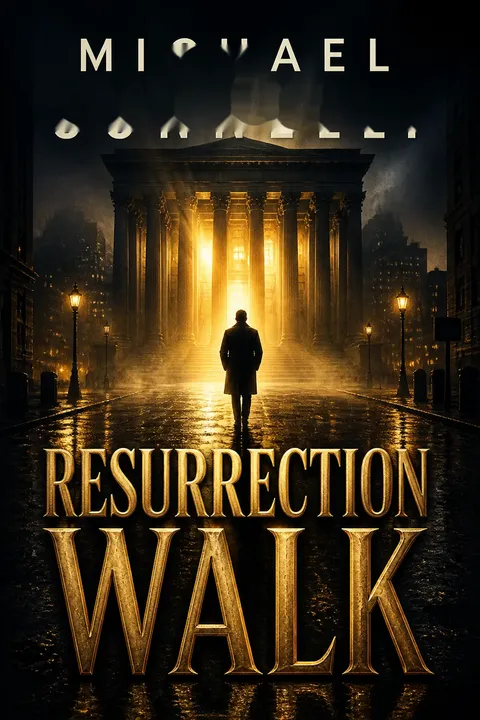


Plot Summary
Prologue
At Corcoran State Prison, Mickey Haller waits with Jorge Ochoa’s mother and brother as the gates open. Ochoa has spent fourteen years serving a life sentence for a murder he did not commit. Now a court has declared him innocent, and he runs into his family’s arms.
Haller came for the cameras, already thinking about a civil lawsuit, but the embrace changes the meaning of the day. He feels the satisfaction of returning a living man to the world, and the prison release becomes the measure against which his next case will be judged.
The opening gives the legal thriller its emotional destination before revealing the route. Haller’s attention begins in professional calculation, including how Ochoa’s appearance might influence a future jury, but the family reunion interrupts that habit of turning everything into strategy. The release is not simply a legal victory. It is a visible repair of time stolen from a person and his family. By placing this moment first, the story makes Haller’s later work more than a search for a successful petition. He is pursuing the rare experience of making justice tangible, while the flash-forward quietly asks whether that promise can survive a harder case.
The Innocence Letter
After Haller’s victory for Jorge Ochoa brings a flood of prison letters, he asks his half-brother, retired homicide detective Harry Bosch, to screen them for plausible claims. One letter comes from Lucinda Sanz, serving time for killing her sheriff’s deputy ex-husband.
Bosch also reviews a juvenile case for Haller’s associate Jennifer Aronson: sixteen-year-old Anthony Marcus is accused of shooting an LAPD officer. Bosch spots a possible accidental discharge and explains how gunshot residue might have reached Anthony.
The prosecutor drops the case rather than risk that theory in open court. Bosch dislikes helping an accused person, but Lucinda’s plea to be believed stays with him. His cancer treatment is already affecting his hearing and energy, while his daughter Maddie urges him to keep her informed.
The letter-screening project turns Bosch’s investigative instincts toward a task he initially considers morally different from police work. He is not being asked to identify a perpetrator but to decide whether the state may have imprisoned the wrong person. Anthony’s case makes that distinction immediate: a careful reading of procedure changes the prosecutor’s calculation and prevents a teenager from being tried as an adult. Bosch’s illness adds urgency without making him sentimental. He resists discussing it, yet his daughter’s insistence on being included reveals that professional usefulness is also one way he avoids vulnerability.
A Tattoo Beneath the Belt
Bosch asks LAPD cold-case detective Renée Ballard for leads, then follows her links to public newspaper reports rather than asking her to misuse police access. The coverage says Lucinda pleaded no contest to manslaughter after her ex-husband, Roberto Sanz, was shot twice in the back.
No murder weapon was found, despite searches, and the original account of a sudden domestic quarrel sits uneasily beside the apparent precision of the shooting. Bosch retrieves the thin court file from the archives.
The autopsy diagram confirms distinct bullet paths, and a photograph reveals a concealed tattoo on Roberto’s hip associated with the Cucos, a sheriff’s deputy clique. Haller studies the evidence with Bosch and agrees to investigate, though he warns that overturning a no-contest plea will be difficult.
The investigation begins by treating absence as evidence. A missing weapon is not proof of innocence, but it weakens the neat story that a furious former wife impulsively acted and then hid the gun. The tattoo changes the frame from private conflict to institutional context, while the autopsy makes the shooting’s physical details resist the prosecution’s simple narrative. Bosch’s choice to rely on public records also matters: his suspicion of official systems does not license him to compromise Ballard. Haller’s caution keeps hope from becoming certainty. The case is worth pursuing because the account has contradictions, not because Lucinda’s insistence alone settles the question.
Silver Takes His Cut
Haller visits Frank Silver, the lawyer who represented Lucinda, and asks for the old case file. Silver stuffs it with blank legal pads and demands a share of any eventual recovery. Haller agrees to give him a quarter of a possible fee after expenses, mainly to secure the records.
At Chino, Lucinda signs Haller’s engagement papers and repeats that she did not kill Roberto. She explains that Silver was not her chosen lawyer: he took over from her public defender and arranged credit cards she could not afford.
Her sentence is more than halfway served, but her son Eric is approaching adolescence in Boyle Heights, where gangs are recruiting children. Lucinda fears that her mother cannot keep him safe without her. She accepts the risk of a new legal challenge because returning to him matters more than a predictable release date.
Silver’s conduct introduces a second kind of pressure: the vulnerable client must depend on professionals who control access to her own case. His padded file and demand for money echo the imbalance that shaped Lucinda’s first representation. Haller’s willingness to bargain is pragmatic rather than approving; he needs the evidence more than he needs a clean confrontation. Lucinda’s urgency is not abstract longing for freedom. Eric’s age and neighborhood give her a specific fear about what may happen in her absence. Her rapid acceptance of the risks also establishes her steadiness, while the case tests whether Haller can offer honest hope without promising an outcome he cannot command.
Eric Remembers Chuck E. Cheese
At Lucinda’s mother Muriel’s home, Bosch questions thirteen-year-old Eric gently. Eric remembers that Roberto left him with his girlfriend, Matilda Landas, at Chuck E. Cheese after receiving a work call, then returned him to Lucinda two hours late.
He cannot explain the meeting, but the memory gives Bosch a lead. Muriel confirms that Matilda was Roberto’s girlfriend, while Lucinda’s brother Carlos and cousin Cesar make clear that gang influence surrounds the boy. Carlos threatens Haller if he fails to help.
After leaving the house, Haller visits the grave of his mentor, Legal Siegel, and recommits himself to finding a way to free Lucinda. The family’s anxiety is no longer only about the conviction. Eric is growing up between a mother in prison and relatives connected to the street world she fears.
Eric’s recollection is valuable because it is incomplete. He supplies a time, place, and companion, not a theory of the crime. That restraint keeps the investigation grounded in what a child can plausibly remember and directs Bosch toward a witness who may explain Roberto’s unexplained absence. The family visit also complicates the idea of rescue: Lucinda’s son is surrounded by people who may protect him and people who may draw him toward danger. Carlos’s threat reflects a code of coercion that resembles the institutional pressure emerging elsewhere. Haller’s visit to Siegel links the case to a personal inheritance, the belief that lawyering matters most when it returns agency to someone the system has reduced to a file.
The Girlfriend Changes Names
Haller’s investigator, Cisco Wojciechowski, traces Matilda Landas to South Pasadena, where she now lives as Madison Landon. Bosch approaches her at a bookstore and persuades her to speak privately. Landon says Roberto was late bringing Eric home because he had met an FBI agent named MacIsaac.
Roberto told her he was in serious trouble, but she knows little more and is frightened of the Cucos. Her revelation shifts the case beyond the sheriff’s department: Roberto met federal investigators on the day he was killed.
Haller warns Bosch not to contact the FBI agent yet, since federal officials may block a state subpoena. Soon afterward, Bosch finds his kitchen door open and signs that someone entered. The intrusion leaves him unsure whether he has been watched or whether his treatment is affecting his memory.
Landon’s name change is both a clue and a portrait of fear. She has made herself difficult to find, yet the reason is not simply privacy: she believes the deputies Roberto knew could reach her. Her account opens a federal dimension without resolving it, which forces Haller to think in terms of jurisdiction and strategic disclosure rather than a detective’s direct pursuit. The intrusion at Bosch’s home then attacks his confidence in his own perception. Because cancer treatment already produces physical side effects, intimidation can masquerade as illness. The case’s pressure operates through uncertainty as much as force, making reliable memory and careful corroboration central to the investigation.
A Lawyer’s Double Deal
Bosch visits Angel Acosta, a lifer who was involved in Roberto’s celebrated shoot-out at Flip’s hamburger stand. Acosta refuses to discuss the past, but reveals that Silver represented him.
Haller confronts Silver, who admits that anonymous deputies threatened him after Acosta described Roberto as a corrupt collector for the Cucos, not a hero defending himself from an ambush. A male caller pushed Acosta toward a favorable plea; a woman later pressured Silver to make Lucinda accept her deal and keep Roberto’s clique out of court. Silver never told Lucinda about the threats.
Haller names the unknown woman Lady X and visits prosecutor Andrea Fontaine, who refuses to reconsider either case. Meanwhile, Bosch and Haller discover their homes have been entered or ransacked, confirming that their inquiry has drawn attention from someone with reach.
Silver’s confession makes legal compromise part of the alleged machinery of the crime. He did not merely misjudge a client’s chances; he withheld information that might have changed her decision because he feared for himself. His self-protection helped transfer the cost of the threat onto Lucinda. Acosta’s story also recasts Roberto’s public heroism as a possible cover for extraction and corruption. Fontaine’s refusal does not prove her complicity, but it leaves the defense without an institutional ally. The break-ins translate that suspicion into present danger. Haller and Bosch now have to treat intimidation as both a threat and a possible attempt to control what evidence reaches court.
The Cellmate’s Convenient Confession
Cisco photographs members of Roberto’s former unit, and Bosch shows Lucinda six separate images at Chino. She identifies Stephanie Sanger, a deputy who had swabbed her for gunshot residue after Roberto’s death.
Haller’s federal habeas hearing begins with Lucinda testifying that she has always denied the killing and accepted a plea because Silver said trial could mean life in prison. The state then introduces her former cellmate, Isabella Moder, through a question designed to suggest Lucinda confessed. Haller learns Moder was moved months earlier and sends Bosch to investigate.
Bosch and Cisco find Moder’s brother, Max, who says Isabella asked him to retrieve old newspaper coverage and read it to her. The supposed confession now has a possible source in published facts, though Max is an unreliable witness and cannot by himself settle the issue.
The identification of Sanger turns a vague suspicion about the GSR test into a person the defense can question. Haller’s procedure matters because Lucinda’s certainty must survive scrutiny, not merely persuade Bosch in private. The surprise appearance of Moder shows the state using the prison’s social world as a counter-narrative: an alleged confession can overwhelm technical evidence if it sounds intimate and credible. Max’s account weakens that testimony’s foundation but does not magically make him dependable. The case therefore pivots on competing forms of knowledge, a prisoner’s alleged disclosure, a family member’s account, and an identification recorded under constrained conditions.
The Impossible Shooting Angle
Forensic expert Shami Arslanian uses a digital reconstruction to test the state’s account of Roberto being shot from Lucinda’s front stoop. The wound trajectories and the victim’s position suggest that the shots came from beside the house, and the model indicates Lucinda’s height and demonstrated shooting stance could not produce them.
Haller also gets Sanger and Keith Mitchell, another unit deputy, to describe the GSR collection and evidence handoff. But when the state points out that Arslanian’s model uses artificial intelligence, Judge Ellen Coelho excludes the presentation because the method has not yet been accepted in that federal district.
Haller loses the most vivid proof he has offered. The judge has seen the reconstruction, but she cannot rely on it in her ruling, leaving the defense to find evidence that fits existing rules.
Arslanian’s reconstruction translates forensic measurements into a scene the court can see, but its persuasive force exposes a conflict between truth-seeking and admissibility. The model may clarify the physical impossibility of the prosecution’s account; its technological novelty also gives the state a legitimate procedural opening. Haller’s frustration is therefore not simply that a judge rejects his preferred evidence. It is that a legal system can recognize a potentially clarifying method and still exclude it before its reliability has been tested in that venue. The ruling sharpens the novel’s central problem: evidence does not speak for itself. Institutions decide which forms of knowledge are permitted to speak.
Eighty-Four Minutes Offline
Bosch maps AT&T tower records from the day Roberto died. One phone follows Roberto’s movements and remains near Flip’s with him; another trails the same route, then stops transmitting at a gas station. The second device belongs to Sanger.
It stays offline for eighty-four minutes, spanning Roberto’s murder, and reappears after Lucinda’s emergency call. The timeline gives the defense a powerful reason to question Sanger’s account. The state brings in Mickey Haller’s former wife, Maggie McPherson, to attack Bosch’s qualifications and cancer treatment.
She uses a police report that wrongly suggests he was confused after a possible break-in. Bosch is shaken, but Haller points out that the prosecution has found no flaw in his analysis. The judge allows the cell evidence to remain under consideration and gives the state time to review it.
The cell map is powerful because it does not identify a shooter; it establishes a pattern that demands explanation. Sanger’s phone follows Roberto, goes silent during the critical interval, then returns after the 911 call. That gap cannot prove what she did, but it breaks the prosecution’s claim that the known evidence points only to Lucinda. McPherson’s attack shifts the contest from data to the credibility of the person who interpreted it. Bosch’s illness makes the insinuation psychologically effective, even though the report itself is weak. Haller’s defense of Bosch depends on distinguishing a vulnerable witness from an unreliable one, and on making the court judge the actual work rather than the investigator’s body.
The Evidence in Cold Storage
FBI agent Tom MacIsaac visits Haller in disguise and explains that Roberto had volunteered to wear a wire against the Cucos, who were working for the Sinaloa cartel. MacIsaac cannot testify because he is undercover on another case.
Haller then learns that Silver’s old evidence split left a GSR pad at a private lab. A DNA test finds no trace of Lucinda, but the pad also contains a laboratory worker’s DNA, allowing the judge to exclude the result as old, mishandled evidence.
Haller deliberately provokes a contempt ruling, buying time to compare the unidentified profile with a cigarette Sanger discarded. The comparison identifies Sanger’s DNA. Judge Coelho permits Haller to question Sanger about that finding, though the pad’s earlier test remains excluded from her formal consideration.
MacIsaac’s visit offers context without the courtroom proof Haller needs. Roberto’s decision to cooperate supports a motive for his murder, but the agent’s secrecy leaves the defense unable to make that account official. The abandoned GSR pad becomes the case’s most delicate object: it may expose a fabricated test, yet its age and contamination create legal vulnerabilities. Haller accepts a risk that is characteristic of his advocacy. He uses contempt not as a theatrical victory but as time purchased for a test that could make the difference. The distinction between the excluded pad result and the newly identified DNA profile matters. Haller is not granted the whole truth at once; he must find a narrow legal path toward it.
The Courthouse Execution
Before the final questioning, Sanger admits that she followed Roberto, claiming he asked her to watch his meeting with the FBI. She says she did not report the meeting because she wanted to protect his reputation. Her explanation leaves the phone’s eighty-four-minute gap unresolved.
When Haller begins to ask how her DNA reached the GSR evidence, Judge Coelho sends counsel to chambers, then allows the line of questioning. During the break, a man in black grabs Sanger outside the courthouse, shoots her with her own weapon, and escapes.
Bosch witnesses the murder and pursues him through downtown, Grand Central Market, and Angels Flight, but loses him on Bunker Hill. The killing makes the threat to the investigation undeniable and destroys the defense’s chance to question Sanger further, while Bosch becomes a crucial eyewitness to her death.
Sanger’s explanation attempts to transform suspicious surveillance into loyalty, but it cannot account for the full pattern or the DNA evidence Haller is about to raise. Her death abruptly removes the person best positioned to answer those questions. The violence is not a substitute for proof, yet its timing changes the court’s understanding of the case: a witness under scrutiny is silenced in public, just outside the courthouse. Bosch’s pursuit returns him to the physical urgency of police work, despite his age and illness, but he cannot catch the killer. The failure is important. He can preserve what he saw and report it, but he cannot force a confession from the man who escaped.
Lucinda Walks Free
After Sanger’s killing, Haller tells Judge Coelho that he is ready to rest his case, while the state threatens to rely on Moder’s alleged confession. Haller reveals that Moder’s brother supplied her with the newspaper stories from which she could have built the account, undermining the state’s surprise witness.
The judge rules that Sanger’s conduct damaged the investigation and that the state’s case carried manufactured evidence and permanent reasonable doubt. She vacates Lucinda’s conviction and restores her freedom. Lucinda leaves the courtroom to embrace Eric, Muriel, and the relatives who waited for her.
Haller calls the release a resurrection walk, the rare moment that has become his reason for taking innocence cases. Afterward, Coelho recognizes that he deliberately provoked his earlier contempt to buy time for the DNA test and orders him to spend another night in jail.
The ruling does not depend on a single perfect exhibit. It follows the accumulation of contradictions: the hidden deputy clique, the unreported FBI meeting, Sanger’s phone trail, the weak plea process, and the evidence that her GSR account cannot be trusted. The state’s informant loses force once her source is exposed, while Sanger’s murder makes the danger around the case impossible to dismiss. Lucinda’s reunion with Eric gives the legal decision its human scale. Haller’s renewed detention complicates the triumph: he has helped free a client by manipulating procedure, and the judge understands the tactic. Justice arrives, but not as a clean victory without cost.
Epilogue
Released the next morning, Haller steps from the federal jail into daylight and recognizes that the Lucinda Sanz case has changed his sense of his own work. He has spent years building a practice around clients and the machinery that keeps it running. Now he is unsure that this is where he should end his career.
The release of an innocent person has made another direction imaginable, even if he cannot yet name it. His own brief walk out of custody echoes the freedom he helped secure for Lucinda, but he leaves with a question rather than a verdict about what comes next.
Haller’s final release mirrors the book’s opening image of Ochoa leaving prison, but the resemblance is deliberately unequal. Haller has spent only one night in custody; his clients lose years. The parallel does not equate their suffering. Instead, it makes him feel, briefly, the threshold between confinement and ordinary life. His uncertainty about his practice marks a change in motivation: the work is no longer merely a means of maintaining a firm or pursuing the occasional headline. The two successful releases have altered what he considers worthwhile. The ending offers no new career plan, only a newly sharpened awareness that professional ambition can be redirected by a concrete encounter with injustice.
Analysis
Resurrection Walk examines the gap between factual innocence and legal innocence. Lucinda’s case is not difficult because there is no evidence to question; it is difficult because every route toward questioning it is constrained by a prior plea, institutional secrecy, evidentiary rules, or threats. The story makes those obstacles concrete. A hidden tattoo reframes a deputy’s public reputation. A phone’s silence becomes a measurable interval. A GSR pad survives because a lawyer failed to pay a laboratory bill. Each clue must be translated into a form a judge can accept, and each translation can be challenged.
The novel also treats professional identity as a moral habit. Bosch has spent his career building cases for the state, so investigating for a defense lawyer unsettles his sense of duty. Yet his work on Anthony Marcus shows that careful scrutiny can protect the innocent without requiring him to abandon the discipline of evidence. Haller, by contrast, understands performance and procedure as tools, but the case pushes him beyond the satisfactions of winning. His willingness to risk contempt is both strategic and ethically ambiguous: he bends the process to gain time for a test, then must live with the judge’s recognition of what he did.
Family gives the legal stakes their human measure. Lucinda’s son is not an abstract reason to seek release; he is a vulnerable adolescent whose home environment is changing while his mother is absent. Bosch’s relationship with Maddie likewise reveals the cost of treating work as a shelter from illness. The repeated prison-release images join these strands. Freedom is not a slogan or a verdict; it is a person crossing a threshold toward people who have waited. The book’s deepest claim is that justice becomes credible only when institutions are willing to examine their own mistakes, and when advocates remain answerable to the human lives hidden inside their records.
Review Summary
Resurrection Walk is widely praised as an engaging legal thriller featuring Mickey Haller and Harry Bosch working together. Readers appreciate the well-crafted plot, courtroom drama, and character development. The book's pacing and intrigue keep readers engrossed, with many finishing it quickly. Some note the unique dynamic between Haller and Bosch, while a few found the ending abrupt. Overall, fans of Connelly's work are satisfied with this addition to the series, highlighting its compelling narrative and the author's skilled storytelling.
People Also Read










Characters
Mickey Haller
The defense-side advocateA Los Angeles defense attorney who works from his Lincoln and relies on a small team rather than a conventional office. Haller is quick with courtroom strategy, commercially alert, and willing to stretch procedure without stepping outside his understanding of its boundaries. His half-brother Harry Bosch brings him the Sanz case, while his history with former wife Maggie McPherson and their daughter Hayley gives his professional life a family dimension. Haller is drawn to difficult cases partly by the challenge and partly by the rare possibility of reversing a wrongful conviction. He balances theatrical confidence with genuine personal investment, and his encounters with freed clients force him to reconsider what kind of lawyer he wants to be.
Harry Bosch
The relentless investigatorA retired LAPD homicide detective whose habits of patient observation remain intact even as cancer treatment brings fatigue, tinnitus, and hearing loss. Bosch works for Haller because the innocence project gives his investigative experience a new purpose, though he remains uneasy about helping people accused of crimes. His half-brother Mickey values his ability to find the detail that changes a case, while daughter Maddie presses him to treat his health and family as seriously as his work. Bosch is blunt, private, and suspicious of authority, but his skepticism is paired with a stubborn belief that evidence must be followed wherever it leads. He gradually learns the distinct discipline of defense investigation.
Lucinda Sanz
The imprisoned motherA Boyle Heights native and single mother serving a manslaughter sentence for the shooting of her former husband, sheriff’s deputy Roberto Sanz. Lucinda has maintained her innocence, but she once accepted a plea after her lawyer warned that trial could bring a life sentence. Her central concern is her son Eric, who is growing up in a neighborhood where gang recruitment reaches children. Lucinda is careful about what the case may do to him, even when investigators need to ask about his father. She is direct and composed under pressure, yet her confidence is grounded in a painful understanding of how little control she has over her own future.
Roberto Sanz
The deputy at the centerLucinda’s former husband and Eric’s father, Roberto served as a Los Angeles County sheriff’s deputy in an anti-gang unit. Public accounts emphasize his bravery during a gunfight, while his family remembers a complicated husband and father whose work often intruded on home life. His relationship with Lucinda deteriorated amid infidelity and conflict over their son. Roberto’s movements and associations become central to the effort to understand the case, even though much of his life remains inaccessible to the investigators. He functions in the story as both a family presence and a law-enforcement figure, joining private history to the institutions that shape the legal dispute.
Stephanie Sanger
The unit sergeantA sheriff’s sergeant assigned to the Antelope Valley gang-intervention unit, Sanger worked alongside Roberto and Keith Mitchell. She is disciplined in manner and protective of her department’s account of events. Her involvement in the early handling of Lucinda’s gunshot-residue test makes her a key witness for Haller, who must distinguish professional confidence from reliable procedure. Sanger understands how uniforms, commendations, and departmental standing shape a courtroom’s perception. She is guarded when questioned and aware that the case places her colleagues under scrutiny, making her presence a source of tension from the first hearing onward.
Eric Sanz
Lucinda’s growing sonLucinda and Roberto’s thirteen-year-old son, raised by his grandmother while his mother is imprisoned. Eric is physically slight and has been homeschooled after cruelty at school. He remembers fragments of the weekend before his father’s death, including a visit to Chuck E. Cheese with Roberto and Matilda Landas. His questions about whether his mother is guilty expose the emotional burden the case has placed on him. Eric is not a convenient source of answers; his recollections are limited, and his need for safety matters as much as their investigative value.
Maddie Bosch
Bosch’s cop daughterHarry Bosch’s daughter, a young police officer who checks on her father and wants a fuller account of his cancer treatment. Maddie is proud of their shared connection to the badge but does not want to be treated as an extension of his career. Her insistence that Bosch include her in medical decisions challenges his habit of withholding difficult information to spare other people worry. She provides a living connection beyond his cases and reminds him that continuing to work is not the same as allowing family to stand beside him.
Hayley Haller
Haller’s lawyer daughterMickey Haller’s daughter, newly out of law school and preparing for the bar. Hayley has encouraged her father to organize an innocence-review project, though she is interested in environmental law rather than criminal defense. Her choices complicate Haller’s assumption that family will follow his professional path. She remains connected to both parents and appears at a consequential moment in her father’s work, offering support without becoming part of his legal team.
Maggie McPherson
The prosecutor and ex-wifeA veteran prosecutor, former wife of Mickey Haller, and mother of Hayley. Maggie joins the state’s legal team because of her expertise in cellular data, bringing a formidable courtroom presence to the case. She and Haller share a history that is personal as well as professional, but their adult daughter and long-ended marriage do not make them allies. Maggie’s approach treats the witness and the evidence as legitimate targets of adversarial testing. Her presence forces Haller to work against someone who knows his habits and has shared many of the same legal arenas.
Judge Ellen Coelho
The federal decision-makerA long-serving federal judge who presides over Lucinda’s habeas hearing. Coelho insists on courtroom decorum and the limits imposed by evidence rules, even when those limits frustrate Haller’s effort to present new forensic methods. She listens closely to the competing claims and is alert to the difference between an advocate’s performance and a factual basis. Her authority is not merely procedural: every ruling determines which version of Lucinda’s case can be heard. She demands that Haller explain the evidentiary foundation for his increasingly ambitious strategy.
Tom MacIsaac
The guarded FBI agentAn FBI agent connected to Roberto’s final day and to a broader investigation of corruption. MacIsaac keeps his work compartmentalized and avoids public exposure, which limits his usefulness as a witness even when he has important context. He approaches Haller privately rather than entering the courtroom, revealing the tension between a federal investigation’s secrecy and a prisoner’s need for exculpatory evidence. MacIsaac is cautious, pragmatic, and convinced that his current assignment carries risks beyond the Sanz case.
Frank Silver
Lucinda’s former lawyerA solo defense attorney from a shared Chinatown office, Silver represented Lucinda and Angel Acosta in separate cases. He is proud of obtaining plea deals and defensive about criticism of his work. His legal practice is marked by financial insecurity and an appetite for recognition, which makes him susceptible to pressure from people with greater power. Silver’s decisions complicate the defense because he possesses information that he did not share with Lucinda. He remains useful to Haller as a source and potential witness, but his self-interest makes him difficult to trust.
Madison Landon
Roberto’s former girlfriendPreviously known as Matilda Landas, Landon changed her name and settled in South Pasadena. She was Roberto’s girlfriend and spent time with Eric during the weekend before his father’s death. Landon is wary of investigators and fears the deputies and gang connections around Roberto. Her account gives Bosch a lead toward the FBI, but she knows only part of what Roberto was doing. Her guardedness reflects a desire to protect herself rather than an eagerness to shape the case.
Angel Acosta
The imprisoned gang memberA prisoner at Corcoran whose past includes the shoot-out that made Roberto Sanz a public hero. Acosta is wary of Bosch, whom he recognizes as a former police officer, and refuses to become an easy source of information. His prior relationship with Frank Silver provides a connection between the old shoot-out and Lucinda’s later prosecution. Acosta’s loyalties and survival instincts are shaped by prison and gang life, making even his limited disclosures difficult to interpret.
Shami Arslanian
The forensic modelerA forensic expert with extensive courtroom experience and a specialty in reconstructing physical events. Haller hires Arslanian to test whether the shooting could have happened as investigators claimed. She works from measured details and explains her methods with confidence, while remaining aware that new technology can be challenged in court. Her reconstruction offers a vivid account of the bullet paths, but her role is not to declare Lucinda innocent. She provides a disciplined scientific reading whose legal usefulness depends on the judge’s standards.
Cisco Wojciechowski
Haller’s quiet investigatorHaller’s longtime investigator and Lorna Taylor’s husband, Cisco is skilled at locating people without relying on police access. He finds Madison Landon, identifies members of Roberto’s former unit, and helps track down Isabella Moder’s brother. Cisco is physically imposing, but his best work is often patient and unobtrusive. Haller values him as a counterweight to Bosch’s more direct investigative style, especially when a witness may be frightened or hostile.
Lorna Taylor
The firm’s operations centerHaller’s case manager and Cisco’s wife, Lorna coordinates the lawyer’s calendar, clients, and practical demands. She helps keep a mobile legal practice functioning while Haller and Bosch move between courtrooms, prisons, and witnesses. Lorna is organized and candid, balancing the firm’s ethical boundaries against the need for paying cases that support its pro bono work. Her role is largely behind the scenes, but without her coordination the investigation and courtroom preparation would lose their structure.
Andrea Fontaine
The original prosecutorA prosecutor who handled the Acosta and Sanz cases in the Antelope Valley before moving to Los Angeles County Major Crimes. Fontaine defends the old dispositions and refuses Haller’s request to revisit Lucinda’s conviction. Her professional confidence rests on the idea that the cases were properly closed, while Haller sees the timing and handling of the pleas as suspicious. She represents the institutional side of the original prosecution, though the available evidence does not establish how much she knew about the pressure on Silver.
Hayden Morris
The state’s habeas lawyerAn assistant attorney general tasked with defending Lucinda’s conviction. Morris relies on procedural objections, witness credibility, and the weight normally given to a no-contest plea. He is willing to challenge Haller’s tactics and tries to restrict evidence that could broaden the inquiry. His courtroom manner grows combative under pressure, but he is not portrayed as the source of the original investigation’s problems. He stands for the state’s obligation to defend a judgment, even when that obligation conflicts with Haller’s demand for a fuller search for truth.
Isabella Moder
The prison informantA former cellmate of Lucinda’s whose possible testimony becomes a surprise element in the habeas hearing. Moder has a serious criminal history and a brother who can be questioned about her access to old news reports. Her role tests how readily a dramatic claim of confession can be accepted when it appears to come from inside prison.
Max Moder
Isabella’s unreliable brotherIsabella Moder’s brother, a drug user whom Bosch and Cisco locate after the state raises her as a possible witness. Max says he retrieved newspaper accounts and read them to his sister. His account offers a possible source for her story, but his addiction and lack of records make him a fragile witness.
Muriel Lopez
Lucinda’s protective motherLucinda’s mother and Eric’s caregiver, Muriel lives in Boyle Heights and works to keep her grandson away from gang influence. She supports her daughter’s innocence and permits Bosch and Haller to speak with Eric, despite knowing that questions about Roberto may reopen painful memories. Muriel’s care is practical and determined, shaped by the burden of holding a family together while Lucinda is imprisoned.
Carlos Lopez
The threatening uncleLucinda’s younger brother and Eric’s uncle, Carlos moves within the gang-influenced world surrounding Muriel’s neighborhood. He confronts Haller and warns him to deliver results. His threat reflects a protective impulse expressed through intimidation, a method that mirrors the coercive forces surrounding the case.
Keith Mitchell
A deputy from Roberto’s unitA deputy who served in the same anti-gang unit as Roberto and Stephanie Sanger. Mitchell receives the GSR evidence from Sanger and says he passed it to homicide investigators. His testimony helps establish the chain of custody and exposes questions about the handling of the pads. He is physically imposing and controlled on the stand, offering few details beyond what he says he witnessed.
Plot Devices
The Prison Letter Pile
Finds needles in casesAfter Jorge Ochoa’s release draws attention, Haller receives letters from prisoners claiming innocence and assigns Bosch to screen them. The pile creates the story’s investigative method: Bosch must distinguish a plausible case from a general plea for help before Haller commits scarce time and resources. Lucinda’s letter prompts the central case, while the Anthony Marcus file shows that Bosch’s review can also affect an active prosecution. The device connects the book’s opening victory to its next legal challenge and makes the labor of reviewing forgotten claims part of the plot.
The No-Contest Plea
Locks open the convictionLucinda’s plea to manslaughter gives the state a powerful argument against reopening her case, even though she never admitted killing Roberto. Haller must pursue federal habeas relief by showing that the conviction rests on an unreasonable process and newly relevant evidence. The plea also exposes how fear and legal advice can narrow a client’s apparent choices. Because Lucinda accepted prison rather than risk a life sentence, Haller must demonstrate more than that she now maintains her innocence. This legal device governs the stakes, limits available remedies, and shapes the courtroom conflict.
Cell-Tower Mapping
Turns movement into evidenceBosch obtains AT&T records for the day Roberto died and charts the phones’ connections to local towers. By comparing the location data and time stamps, he reconstructs Roberto’s stop at Flip’s, a phone following him, and the follower’s long period offline around the shooting. The map does not identify the shooter by itself; it creates a timeline that contradicts the neat account of Lucinda as the only possible suspect. Its presentation also exposes the defense to challenges about Bosch’s expertise and health, turning technical interpretation into a credibility contest.
The GSR Evidence Split
Reopens the test’s chainFrank Silver once obtained one of the gunshot-residue pads for independent testing, then failed to retrieve it after Lucinda accepted her plea. The surviving evidence gives Haller a chance to test for touch DNA and ask whether the pad had actually been wiped over Lucinda. The test finds no match to her, but old handling and a laboratory worker’s DNA create admissibility problems. A comparison to DNA from Sanger’s discarded cigarette offers a further line of inquiry. This device ties physical evidence to questions of chain of custody, professional care, and the limits of habeas procedure.
Arslanian’s Reconstruction
Tests the shooting geometryShami Arslanian uses crime-scene measurements, wound trajectories, and digital modeling to test the original account of Roberto being shot from Lucinda’s stoop. Her reconstruction suggests the shots came from a different position and that Lucinda could not have fired them as described. The demonstration gives the judge a visual way to understand technical evidence, but its reliance on an artificial-intelligence platform allows the state to challenge it under evidentiary rules. It is a powerful example of a fact that may persuade a viewer while remaining unavailable to the court’s final decision.
FAQ
Synopsis & Basic Details
What is Resurrection Walk about?
- Wrongful Conviction Focus: The story centers on Mickey Haller, the Lincoln Lawyer, and Harry Bosch, a retired detective, as they investigate cases of wrongful conviction, seeking to free those unjustly imprisoned.
- Complex Legal Battles: The narrative follows their efforts to uncover corruption and conspiracy within the justice system, leading to intense courtroom battles and high-stakes investigations.
- Personal Stakes: The book explores the personal toll of wrongful convictions on individuals and families, highlighting the emotional and ethical complexities of the legal world.
Why should I read Resurrection Walk?
- Intricate Plot: The novel offers a complex and engaging plot with multiple layers of mystery, suspense, and legal intrigue, keeping readers guessing until the very end.
- Compelling Characters: The book features well-developed and relatable characters, including Mickey Haller and Harry Bosch, whose personal struggles and moral dilemmas add depth to the narrative.
- Exploration of Justice: It provides a thought-provoking exploration of the justice system's flaws and the challenges of seeking truth and redemption, making it a compelling read for those interested in legal thrillers.
What is the background of Resurrection Walk?
- Los Angeles Setting: The story is set in the complex and often corrupt world of Los Angeles, where the legal system is intertwined with law enforcement and gang activity.
- Sheriff's Department Corruption: The book delves into the history of deputy cliques and corruption within the Los Angeles County Sheriff's Department, highlighting the systemic issues that lead to wrongful convictions.
- Legal System Flaws: It explores the flaws and limitations of the legal system, including the challenges of proving innocence and the pressures faced by both defense attorneys and prosecutors.
What are the most memorable quotes in Resurrection Walk?
- "I had resurrected this man from the dead. And with that came a fulfillment I had never known in the practice of law or in life.": This quote captures Haller's profound sense of purpose and the emotional impact of freeing the wrongfully convicted.
- "It's never as easy as it looks.": This quote reflects the complexities and challenges of the legal world, highlighting the constant struggle for justice.
- "You're paying for all those billboards out there, right? The bus wraps, the benches, all of it.": This quote reveals the cynical view of some characters regarding Haller's motivations, suggesting that his pursuit of justice is driven by personal gain.
What writing style, narrative choices, and literary techniques does Michael Connelly use?
- Dual Narrative: Connelly employs a dual narrative, alternating between the perspectives of Mickey Haller and Harry Bosch, providing a comprehensive view of the investigation and legal proceedings.
- Detailed Procedural: The writing style is characterized by detailed procedural descriptions of legal processes, police investigations, and forensic analysis, adding realism and authenticity to the story.
- Foreshadowing and Suspense: Connelly uses subtle foreshadowing and suspenseful pacing to keep readers engaged, gradually revealing the complexities of the case and the characters' motivations.
Hidden Details & Subtle Connections
What are some minor details that add significant meaning?
- The Bogeyman Tattoo: Roberto Sanz's tattoo, "Que Viene el Cuco," foreshadows his involvement with a corrupt sheriff's clique and adds a layer of menace to his character.
- The Fake Law Library: Frank Silver's office with a fake law library wallpaper symbolizes his lack of genuine legal expertise and his attempts to project an image of success.
- The Condom Packet: Anthony Marcus's possession of a condom packet, along with breath mints, subtly supports his claim of a secret rendezvous, contrasting with the police narrative.
What are some subtle foreshadowing and callbacks?
- The Open Door: Bosch's discovery of his open kitchen door foreshadows the intrusion and intimidation tactics used by those trying to stop the investigation.
- The Missing Gun: The fact that the murder weapon in the Sanz case is never found foreshadows the possibility of a setup and the complexities of the case.
- The Vultures: Haller's observation of vultures circling City Hall foreshadows the predatory nature of those involved in the corruption and the challenges of seeking justice.
What are some unexpected character connections?
- Silver and Acosta: The revelation that Frank Silver represented both Lucinda Sanz and Angel Acosta, a gang member involved in the shooting that made Roberto Sanz a hero, highlights the interconnectedness of the cases and the potential for corruption.
- Sanger and Sanz: The connection between Stephanie Sanger and Roberto Sanz, as members of the same sheriff's unit, reveals a deeper layer of conspiracy and the potential for a setup.
- Haller and McPherson: The past relationship between Haller and Maggie McPherson adds a personal dimension to the legal battle, highlighting the emotional stakes and the complexities of their professional interactions.
Who are the most significant supporting characters?
- Lorna Taylor: Haller's case manager, Lorna, is a crucial supporting character who manages the logistics of his practice and provides a grounded perspective on the cases.
- Cisco Wojciechowski: Haller's investigator, Cisco, is a resourceful and intimidating figure who plays a key role in uncovering evidence and tracking down witnesses.
- Shami Arslanian: The forensics expert, Shami, provides crucial scientific analysis and insights, challenging the prosecution's narrative and offering a new perspective on the evidence.
Psychological, Emotional, & Relational Analysis
What are some unspoken motivations of the characters?
- Haller's Redemption: Haller's unspoken motivation is to redeem himself and his profession by seeking out and freeing the wrongfully convicted, driven by a desire to make amends for past mistakes.
- Bosch's Moral Code: Bosch's unspoken motivation is to uphold his moral code and seek justice, even when it means challenging the system he once served, driven by a deep-seated need to do what is right.
- Sanger's Ambition: Sanger's unspoken motivation is to protect her position and reputation within the sheriff's department, even if it means compromising her integrity and engaging in corrupt practices.
What psychological complexities do the characters exhibit?
- Haller's Internal Conflict: Haller exhibits a complex internal conflict between his desire for success and his need to do what is right, often struggling with the ethical implications of his profession.
- Bosch's Cynicism: Bosch displays a deep-seated cynicism toward the justice system, stemming from his years of experience with corruption and deceit, yet he remains committed to seeking the truth.
- Lucinda's Resilience: Lucinda exhibits remarkable resilience in the face of adversity, maintaining her hope and determination to reunite with her son despite the challenges of her imprisonment.
What are the major emotional turning points?
- Ochoa's Release: Jorge Ochoa's release from prison is a major emotional turning point, inspiring Haller to take on more cases of wrongful conviction and fueling his passion for justice.
- The Discovery of the Tattoo: The discovery of Roberto Sanz's tattoo, "Que Viene el Cuco," is an emotional turning point, revealing his involvement in a corrupt sheriff's clique and adding a layer of menace to his character.
- The Murder of Sanger: The murder of Stephanie Sanger is a major emotional turning point, highlighting the dangerous stakes involved in the case and the lengths to which those involved will go to protect their secrets.
How do relationship dynamics evolve?
- Haller and Bosch: The relationship between Haller and Bosch evolves from a professional partnership to a deep friendship, as they learn to trust and rely on each other in their pursuit of justice.
- Haller and Aronson: The relationship between Haller and Aronson is tested by the ethical complexities of their work, as they navigate the challenges of defending the accused while upholding their moral principles.
- Lucinda and Her Family: The relationship between Lucinda and her family is a driving force in the narrative, highlighting the emotional toll of wrongful convictions and the importance of family support in the face of adversity.
Interpretation & Debate
Which parts of the story remain ambiguous or open-ended?
- MacIsaac's True Motives: The true motives of FBI Agent MacIsaac remain ambiguous, leaving readers to question his role in the events and whether he was truly trying to help or hinder the investigation.
- The Identity of the Shooter: While the story strongly suggests that Sanger was involved in Sanz's murder, the identity of the actual shooter remains open to interpretation, leaving room for speculation about the extent of the conspiracy.
- The Future of the System: The book leaves open the question of whether the justice system can truly be reformed, highlighting the ongoing challenges of combating corruption and ensuring fairness.
What are some debatable, controversial scenes or moments in Resurrection Walk?
- Haller's Contempt of Court: Haller's decision to intentionally get held in contempt of court is a controversial moment, raising questions about the ethics of his actions and the lengths to which he is willing to go to win a case.
- Bosch's Pursuit of the Shooter: Bosch's decision to pursue the shooter after Sanger's murder, despite being unarmed and out of his jurisdiction, is a debatable moment, highlighting his relentless pursuit of justice and his willingness to put himself in danger.
- The Use of AI: The use of AI in Arslanian's crime re-creation is a controversial moment, raising questions about the admissibility of such technology in court and the ethical implications of relying on artificial intelligence in legal proceedings.
Resurrection Walk Ending Explained: How It Ends & What It Means
- Lucinda's Exoneration: The ending sees Lucinda Sanz exonerated, highlighting the power of truth and justice in the face of adversity, and the importance of advocacy in the legal system.
- Unresolved Questions: Despite Lucinda's release, the ending leaves some questions unanswered, such as the full extent of the corruption within the sheriff's department and the true motives of Agent MacIsaac.
- Hope for the Future: The ending offers a glimmer of hope for the future, suggesting that even in a flawed system, justice can prevail, and that the fight for truth and redemption is an ongoing process.
Harry Bosch Universe Series















About the Author
Other books by Michael Connelly


Download PDF
Download EPUB
.epub digital book format is ideal for reading ebooks on phones, tablets, and e-readers.








