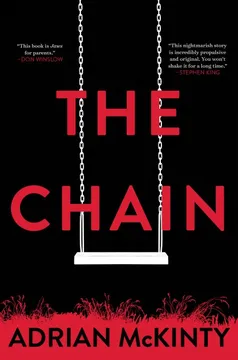


Plot Summary
A Gun at the Bus Stop
Rachel O'Neill1 is driving to a cancer follow-up when a disguised caller tells her that thirteen-year-old Kylie2 has been taken. At the bus stop, a masked man and woman11 had forced Kylie2 into their car; when a state trooper pulled them over for speeding, the woman11 shot him and they escaped.
The kidnappers send Rachel1 a photograph, then make their demand: she must pay a ransom and abduct someone else's loved one so the next family will continue the scheme. If Rachel1 contacts police or refuses, Kylie2 and the captors' son will die. Rachel's1 frightening appointment and her daughter's2 disappearance collide in a single morning. Her choice is no longer how to protect her life, but what she will do to get Kylie2 back.
The opening makes parental love the machinery of the crime. Rachel is not chosen for wealth or influence so much as for her capacity to act under pressure, and the captors make that presumed competence another form of coercion. The roadside shooting also destroys the comforting distinction between ordinary people and violent criminals: a mother under threat can become dangerous, while a person who appears helpless can be part of a lethal system. Rachel's cancer history sharpens the assault. She has already endured a body turned into a site of risk, and now the threat to Kylie gives that fear an external, immediate target.
Twenty-Five Thousand Dollars
Rachel1 pulls onto the highway shoulder and writes down the rules: no police, anonymous phones, Bitcoin, and a replacement kidnapping. A trooper stops to check on her, but she hides the real emergency by saying her cancer may have returned. The Chain's unseen operators already know she tried calling her ex-husband, Marty,6 and send a former participant to punch her outside the bank as proof of their reach.
Rachel1 secures an emergency loan, buys Bitcoin with the loan and her credit card, and transfers twenty-five thousand dollars. A new photograph confirms Kylie2 is alive, but the payment completes only the first task. Rachel1 now understands that the ransom is not a purchase. It is the entry fee for a crime she must commit herself.
The Chain turns practical acts into moral traps. Rachel's loan, her lie to the trooper, and the Bitcoin transfer are all concrete steps toward rescue, yet each narrows her options and deepens her exposure. The punch outside the bank is especially effective intimidation because it arrives through an ordinary stranger rather than a masked assailant. The system does not need to watch everyone constantly; it only needs its victims to believe that it can. Rachel's training in philosophy offers no refuge from the problem. Her abstract understanding of ethics is being forced into a choice where every available action harms someone.
A Mother's New Accomplice
Rachel1 buys disposable phones, a shotgun, ammunition, rope, handcuffs, and duct tape, then searches public social-media accounts for a family likely to obey The Chain. Her first choice, Denny Patterson, becomes unusable when she sees a police officer at his home. She turns to Toby Dunleavy, whose routine gives her a narrow chance to seize him alone.
Rachel's ex-brother-in-law, Pete,3 finally returns her call. A former Marine with combat experience, he urges police, but Rachel1 shows him evidence of the Chain's threats and convinces him that Kylie2 will be killed if they defect. Pete3 scans Rachel's1 devices and finds spyware on her computer. He agrees to help, while concealing his own struggle with heroin addiction.
Rachel's research converts the casual visibility of family life into a map for predation. The parents who post schedules, hobbies, and locations believe they are sharing harmless fragments; Rachel reads those fragments as openings. Her choice of Pete is equally consequential. His military skills make the plan possible, but his addiction compromises the steadiness she needs, a weakness neither of them can afford to acknowledge yet. Rachel is still resisting the identity of a kidnapper, telling herself that her actions are temporary and instrumental. That distinction will become harder to sustain once another child is in her custody.
The Wrong Child
Rachel1 and Pete3 scout the Dunleavy home, then prepare an empty beach house as a holding site. They plan to take twelve-year-old Toby after archery, when he walks home alone. The club unexpectedly ends early, however, and Toby goes elsewhere.
His eight-year-old sister, Amelia,8 walks home carrying his archery bag. Rachel1 and Pete3 seize her instead. Amelia8 protests and struggles, and Rachel1 must keep driving while Pete3 restrains her. The moment strips away the distance Rachel1 maintained while studying profiles online: Amelia8 is frightened, specific, and too young to understand the adults' invented story about an adventure.
The Chain then raises Rachel's1 payment by another twenty-five thousand dollars and demands the kidnapping be completed that night. Pete3 uses his credit cards to make the extra transfer.
The schedule's failure exposes the fantasy of control on which Rachel's plan depends. She and Pete have turned a family into a set of data points, but one early class and one brother's detour put a younger child in their hands. Rachel's decision to take Amelia rather than abandon the attempt is a crucial moral crossing. She acts from fear for Kylie, but the justification does not lessen what Amelia experiences. The sudden extra ransom reinforces that the Chain's rules are not stable contracts. Its operators can change the terms at will, ensuring that obedience produces no security, only another demand.
Basement Escape Plans
While Rachel1 holds Amelia,8 Kylie2 searches her basement for a way out. She drags a heavy stove across the floor to reach a forgotten wrench, then uses it to strike the male captor when he brings breakfast.
He wakes, reveals that his revolver is unloaded, and slaps Kylie2 hard enough to leave her bleeding and disoriented. At the same time, Pete3 gives Amelia8 cereal containing traces of nuts. Her severe allergic reaction forces Rachel1 to choose between calling an ambulance and risking the Chain's retaliation.
She refuses emergency help, holds Amelia8 through a collapse, and distracts a police officer who comes to the empty house. Pete3 finally returns with an EpiPen, which revives Amelia.8 Rachel1 realizes how close she came to letting a child die.
The two basements mirror one another without making the children interchangeable. Kylie converts observation into a risky plan; Amelia depends on adults who have already made her environment unsafe. Rachel's refusal to call for medical help is the sharpest proof that the Chain has altered her moral reflexes. She does not merely threaten Amelia to keep the system running. She weighs Amelia's life against Kylie's and accepts the possibility of death. Pete's mistake reveals that his technical competence cannot compensate for addiction. Their rescue effort is becoming another source of danger.
Kylie Comes Home
The Chain releases its captive boy, allowing the woman holding Kylie11 to tell Rachel1 that her daughter2 will soon be dropped near a New Hampshire rest stop. Kylie2 calls from a gas station near Exeter, and Rachel1 races there to bring her home. The reunion is ecstatic but not clean: Kylie2 says she believes the kidnappers shot the trooper, and Rachel1 forbids her from going to police because the threat still hangs over both families.
Amelia8 remains chained in the beach house. The Dunleavys9 have paid their ransom, but they must now abduct a new victim before Amelia8 can be freed. Rachel1 has recovered her daughter2 without escaping the Chain. She has only moved one step closer to the next family in its grip.
The reunion gives Rachel the relief she has been pursuing, then immediately refuses to let relief become resolution. Kylie is physically home, but she has learned that silence is part of her mother's rescue plan. Rachel's demand that she conceal a possible police killing protects the family in the short term while making the child carry the secret. The Chain's structure ensures that each recovered loved one becomes evidence for continuing, not stopping. Rachel's moral injury now has a family witness: Kylie can see that her mother's survival strategy has made another child a prisoner.
The Next Link
The Dunleavys9 choose Henry Hogg, a disabled boy, as their replacement victim. His father, Seamus,15 plans to tell his uncle, a retired U.S. marshal, about the kidnapping. The Chain warns Rachel1 that if Seamus15 defects, she must kill Amelia8 or face retaliation.
Rachel1 and Pete3 find the Dunleavys'9 home dark and their phones unanswered, then break in and discover that the parents have neglected even to keep a charged phone nearby. Rachel1 forces Mike10 to accompany them to Seamus's15 house.
They explain the danger and make the Dunleavys9 continue the process rather than abandon their hostage. Seamus15 instead takes a new target, football player Gary Bishop. Once the Chain approves the new abduction, Rachel1 and Pete3 release Amelia8 at a playground, where her parents9 arrive to reclaim her.
This episode makes the Chain's violence recursive: victims are expected to become managers of the next victim's suffering. Rachel's anger at the Dunleavys is not simply self-righteousness. Their carelessness threatens Amelia, Kylie, and themselves, while Rachel has become invested in enforcing the same rules that trapped her. Forcing Mike to go with her gives her temporary leverage, but it also demonstrates how quickly the roles of captive, rescuer, and perpetrator can overlap. Amelia's release is a real good, achieved through an ugly method. The novel refuses to let the result erase the means.
Children of the Commune
A late-1980s flashback reveals the violent beginning of Ginger4 and Olly's5 family history. Daniel Fitzpatrick, known as Red,12 and his son Tom13 enter a collapsing commune in search of Alicia,18 the twins'4 mother. They kill Alicia18 and several people around her, then take the toddlers, Moonbeam and Mushroom, away from the burning farm.
The children grow up as Oliver5 and Margaret,4 protected by a household that hides its violence beneath conventional respectability. Later moves, schoolyard cruelty, and their father's13 volatile behavior teach the twins4 that adults can be both protectors and threats.
Their grandfather Red12 gives them new names and a rough education in survival. The flashbacks show that the eventual criminal system is rooted not in an ancient tradition, but in a childhood shaped by violence, secrecy, and control.
The flashback challenges the Chain's claim to timeless authority by locating its founders inside an ordinary, damaged family history. Red and Tom's rescue of the twins is inseparable from the murders that make it possible, so care and violence are fused from the beginning. The children inherit not only trauma but a model of power: people with weapons decide which family survives and which story gets told afterward. Their later self-reliance is therefore not simple resilience. It is an adaptation to a world where dependence feels dangerous and control seems safer than trust.
The Chain's Architects
As the twins4 grow up, their mother Cheryl16 dies by suicide after years of drinking and receiving anonymous accusations. Their father Tom13 becomes abusive, and the siblings4 eventually stage his death as a suicide before their grandfather12 raises them.
Margaret4 becomes Ginger,4 joins the FBI, and gains access to the world of criminal investigation. Oliver5 becomes Olly,5 a gifted programmer. In 2013, Ginger4 adapts a Mexican exchange-kidnapping model, while Olly5 builds the technical infrastructure that conceals it. They recruit criminal enforcers, then make the victims themselves carry out the kidnappings.
Ginger's4 law-enforcement career gives her knowledge and cover; Olly's5 software hides their communications and money. What their victims experience as an ancient, unstoppable organization is a carefully constructed family enterprise, operated by two people4 who know its weak points.
The siblings turn their childhood lesson into an institution: if the world is governed by coercion, make coercion systematic and call it inevitable. Ginger's access to law enforcement and Olly's technical skill create a partnership between human manipulation and impersonal systems. Their use of victims as labor also gives the crime a disturbing efficiency. Each new link reduces the founders' direct exposure while recruiting another person to defend the organization. The scheme's authority depends less on actual omniscience than on the victims' fear that no one can safely test its limits.
Ariadne Finds Theseus
After Kylie2 returns, Rachel's1 cancer is confirmed to have recurred, and treatment begins while her daughter2 suffers nightmares, stomach cramps, and bed-wetting. Rachel1 discovers that Kylie2 has written down details of captivity and even searched for ways to die.
Unable to report the Chain without endangering them, Rachel1 creates an anonymous blog seeking information, then deletes it after a warning tells her to watch the Boston Globe's personal ads. The ad leads her to Erik Lonnrott,7 an MIT mathematician whose daughter Anna was also taken and left severely traumatized.
Erik7 has spent years investigating the organization. He believes the founders'4 communications may leave a trace, and Rachel's1 recent contact gives him something his own trail has lost: a live link to the people running the scheme.
Rachel's illness and Kylie's trauma make the household feel less like a refuge than a place where damage has settled in. Her decision to investigate is not a sudden return to confident heroism; it grows from watching her daughter bear the cost of silence. The anonymous blog fails as a public appeal but succeeds as a signal to someone who understands the same danger. Erik's history broadens the story beyond Rachel's family, while Anna's condition prevents the investigation from becoming an uncomplicated quest for revenge. Finding the Chain may stop further harm, but it cannot restore what it has already taken.
The Signal in the Marsh
Erik7 explains that a specially designed phone application may locate the cell tower nearest to a Chain call. Before Rachel1 and Pete3 can use his method, a woman4 breaks into Erik's7 home and kills him, leaving his message that he has been compromised and a link to the unfinished application.
Rachel1 and Pete3 hear the news, then use Erik's software to trace a later call from the Chain. A security code based on retired Yankees' numbers lets Rachel1 open the app.
Its first attempts through encrypted messages fail, but a phone call gives it enough time to narrow the signal to a cell tower near Choate Island. Rachel1 and Pete3 follow the location through cold marshland and find a large, isolated house aligned with the tower. Erik's7 research has brought them close to the people who can kill them.
Erik's murder gives the investigation a cost before it delivers a result. The application is not a magical solution: its limits force Rachel to keep a dangerous caller talking, and its success depends on a clue tailored to her identity as a Yankees fan. That small personal detail turns knowledge of Rachel into a tool for resistance rather than surveillance. The marsh search also reverses the Chain's usual power. Rachel and Pete are no longer merely waiting for the next message; they are moving toward its source, though they still do not know whether the location will reveal a headquarters or a trap.
The Girlfriend at the Door
The house belongs to Ginger's4 grandfather,12 where Marty6 has brought Kylie2 and her friend Stuart14 for a visit. Rachel1 and Pete3 mistake a figure on the balcony for Kylie,2 but the shoe tracker shows that Kylie2 is elsewhere in Boston. They continue toward the property and are intercepted by an armed guard.
Ginger4 appears with her twin brother, Olly,5 and their grandfather, Daniel.12 Rachel1 recognizes Ginger4 as the woman behind the Chain's calls; Ginger4 recognizes her too. Marty6 is inside, unaware that the woman he is dating leads the kidnapping enterprise.
When Ginger's family4 raises their weapons, Rachel1 understands that the discovery has ended any chance of a quiet police report. She and Pete3 are trapped at the center of the organization, with their children inside and the Chain's founders4 preparing to silence them.
The revelation turns domestic intimacy into the last layer of the disguise. Ginger has access to Rachel through Marty, while Rachel has been searching for a distant criminal organization; the person she needs to expose has already entered her family circle. The false sighting of Kylie matters because Rachel must separate panic from evidence, even as the correct location becomes more dangerous. Ginger's recognition confirms that surveillance has been reciprocal: both women have been reading the other, but only one has had institutional power and a hidden network. The confrontation shifts the story from investigation to immediate survival.
The Abattoir Showdown
Gunfire drives Rachel1 and Pete3 from the burning house into an abandoned slaughterhouse, where Ginger4 and Olly5 hold Kylie2 and Stuart14 at gunpoint and Marty6 lies injured. Kylie2 uses the handcuff escape technique she learned after captivity, frees herself, and takes Rachel's1 dropped pistol. She shoots Olly,5 giving Rachel1 a chance to escape Ginger's4 chokehold.
Rachel1 grabs a shard of glass and cuts Ginger's4 throat. Pete,3 wounded by Ginger,4 later shoots Daniel12 when he returns with a grenade launcher. Marty,6 Kylie,2 and Stuart14 keep Pete3 alive and call for police and paramedics. The founders4 are dead, the house burns, and the Chain's violence ends in the place where it began: children forced to act before adults can save them.
The climax makes the children's earlier experiences consequential rather than decorative. Kylie's captivity taught her to study locks and prepare an escape; Stuart's presence gives her someone else to protect. Rachel survives not through superior force but through a fragment of broken glass, an improvised tool gathered from the ruined setting. The slaughterhouse literalizes the system's treatment of people as replaceable bodies. Yet the final violence does not make the survivors innocent again. Kylie has killed, Rachel has killed, and Pete has been shot. They stop the Chain by taking actions that will remain part of their lives.
The Chain Breaks
Rachel1 and Pete3 are charged with kidnapping, false imprisonment, and child endangerment, but the Dunleavys9 tell investigators that Rachel1 took Amelia8 with their consent because she was trying to break the Chain. Federal agents uncover Ginger's4 records, and public sympathy makes prosecution increasingly unlikely.
Rachel1 avoids interviews and returns to teaching; Pete3 enters treatment and takes security work. Kylie2 slowly resumes school and ordinary routines, though her nightmares and bed-wetting show how much captivity remains in her body.
The family keeps its history secret, even as Rachel1 receives another warning that the Chain is watching. In the final scene, she buys a pregnancy test and accepts that either outcome will bring challenges. She has Kylie2 back, Pete3 beside her, and a future no longer governed by the kidnappers.
The ending distinguishes institutional justice from psychological recovery. The Chain's founders are gone and its victims are freed, but Rachel and Pete still face legal exposure, addiction, cancer treatment, and the consequences of involving children in violence. Public sympathy offers a practical shield, not absolution. Kylie’s gradual return to ordinary life is measured in small signs rather than a clean cure. The pregnancy test leaves the future open instead of presenting survival as a finished transformation. Rachel's hard-won freedom is the ability to face uncertainty without mistaking it for another command from the Chain.
Analysis
The Chain's central invention is not simply kidnapping but the conversion of love into labor. Its founders4 understand that a parent will accept almost any moral cost when told a child's life depends on it. By requiring each victim's family to abduct someone else, they make care itself serve the machinery of coercion. The sequence does not erase agency, though it distorts it. Rachel1 chooses to take Amelia,8 and that choice matters even when the Chain has engineered the conditions around it. The book's moral force comes from holding both facts at once: coercion explains behavior without making its consequences unreal.
The novel also treats modern visibility as a vulnerability. Parents publish routines to express affection and pride, but those details become usable intelligence. The Chain's apparent omniscience is partly technological and partly psychological. Its victims are monitored, threatened, and shown what happens to those who disobey, but they also enforce the system on one another because each believes another family's life depends on compliance. The organization survives by making isolated people imagine that they are alone.
Ginger4 and Olly's5 history complicates the temptation to treat evil as an alien force. Their family history contains genuine victimization, yet suffering does not predetermine their later crimes. Their invention is a deliberate structure that turns their private need for power into a profitable system. By contrast, Rachel1 and Pete3 are also changed by violence, but they remain capable of recognizing harm, accepting responsibility, and trying to stop its repetition. That difference is not purity. It is the willingness to see the people made invisible by one's own survival strategy.
The ending offers no clean return to innocence. Kylie2 carries captivity in her body and habits; Rachel1 and Pete3 carry criminal guilt, illness, and trauma. Still, the Chain can be broken because its supposedly eternal order is made by fallible people and sustained by fear. The novel's hard-won hope rests not on escaping every consequence, but on choosing to protect others after being forced to harm them.
Review Summary
The Chain receives mixed reviews, averaging 3.77/5. Many readers praise its gripping, original premise—a kidnapping scheme forcing victims to become perpetrators—and find the first half intensely thrilling and unputdownable. Rachel, the protagonist, is widely admired as a strong, compelling heroine. However, numerous reviewers feel the second half loses momentum, with cartoonish villains, implausible plot points, and a disappointing ending. The writing style also divides opinion, with some finding it engaging and others criticizing it as pretentious or poorly edited.
People Also Read




Characters
Rachel O'Neill
A mother under siegeRachel is a former waitress and Uber driver, a Harvard-educated philosophy student turned community-college teacher, and Kylie's2 devoted mother. After surviving breast cancer and divorce, she is rebuilding a life she fears she has squandered. Her captors exploit her love for Kylie2 and her capacity to organize under pressure, forcing her to make choices she once believed impossible. Rachel's analytical mind helps her read social media, plan a kidnapping, and eventually pursue the Chain's source. Yet her self-criticism often turns practical failure into a verdict on her worth. Her central struggle is not simply whether she can be brave, but whether survival can coexist with responsibility for the harm she causes.
Kylie O'Neill
The watchful daughterKylie is Rachel's1 thirteen-year-old daughter, bright, curious, and drawn to Egyptology, books, drawing, and online friendships. Her intelligence does not make her immune to fear; it gives her ways to observe, endure, and devise escape plans. During captivity she measures her surroundings and looks for tools, while afterward she struggles with the secrets her mother1 asks her to keep. Kylie is close to her uncle Pete3 and friend Stuart14, and she cares deeply about her mother1 even when Rachel's1 choices leave her feeling betrayed. Her resourcefulness is real, but the story also shows the cost of asking a child to become resilient before she is ready.
Pete
The troubled protectorPete is Rachel's1 former brother-in-law and Kylie's2 beloved uncle, a Marine veteran with engineering, reconnaissance, and weapons experience. He is loyal, inventive, and accustomed to carrying danger without discussing it. His military past includes guilt over a disastrous incident at Camp Bastion, and his return to civilian life is complicated by opioid addiction and unemployment. Pete's skills make Rachel's1 rescue effort possible, but his drug use undermines the very judgment she relies on. His affection for Kylie2 draws him into an illegal operation, while his bond with Rachel1 gives him a reason to confront the private damage he has long tried to manage alone.
Ginger
Marty's poised girlfriendGinger is a sharp, funny, ambitious woman who enters Rachel's1 life through Marty6. She has a polished social manner and the confidence of someone accustomed to being taken seriously. Her professional background connects her to federal law enforcement, and she has built close relationships with her twin brother5 and grandfather12. Ginger is practiced at reading people and shaping how they see her. Her charm is not merely decoration; it is a form of access, allowing her to move between social worlds without seeming out of place. She embodies the unsettling gap between a person's public identity and the private purposes that identity can conceal.
Olly Fitzpatrick
Ginger's guarded twinOlly is Ginger's4 twin brother, an introverted computer expert whose intelligence and emotional restraint contrast with her sociability. He prefers systems, models, and predictable rules to the messiness of close relationships. His history with Ginger4 and their grandfather12 binds him to a family shaped by abandonment and violence. Olly is often the more cautious sibling, interested in risk analysis and long-term security, though that does not make him emotionally detached from his sister4. His technical abilities give him influence over people he may never meet, while his difficulty understanding intimacy leaves him vulnerable to the human motives that can destabilize even a carefully designed system.
Marty O'Neill
Rachel's charming ex-husbandMarty is Rachel's1 ex-husband, Kylie's2 father, and a successful lawyer whose charm often softens the consequences of his unreliability. He has built a new life with a younger partner4 but remains affectionate toward Rachel1 and devoted to his daughter2. Marty is socially fluent and quick with a joke, traits that help him navigate awkward situations but can also make him seem inattentive to deeper distress. He is not part of Rachel's1 initial rescue effort, partly because she fears he would involve the police. His presence connects Rachel's1 old family life to the new relationships that become crucial to the story.
Erik Lonnrott
The grieving mathematicianErik is an MIT mathematician whose wife died in an accident and whose daughter was traumatized by the Chain. He has spent years studying the organization's communications and patterns, turning grief into a disciplined investigation. His training makes him attentive to statistical irregularities, but his determination to find the people responsible exposes him to grave danger. Erik is a careful thinker who understands that certainty is difficult when criminals hide behind proxies and encryption. He offers Rachel1 a technical path into the Chain's network, and his history reminds her that her family's experience is part of a larger pattern.
Amelia Dunleavy
The younger hostageAmelia is eight years old, Toby's younger sister, and the child Rachel1 and Pete3 take when their plan goes wrong. She is spirited, particular about her toys and food, and young enough to believe some of the captors' explanations while still recognizing that she wants to go home. Her peanut allergy makes her especially vulnerable in the makeshift basement. Amelia's ordinary needs, including her attachment to her bear Mr. Boo, keep Rachel1 from treating her as an abstract bargaining piece. Her presence turns Rachel's1 moral crisis into a daily responsibility for a child who has done nothing to deserve it.
Helen Dunleavy
A frightened motherHelen is Amelia8 and Toby's mother, a part-time teacher who shares much of her family's daily life online. The Chain's captors exploit those public details to study her routines and select her family. When Amelia8 is taken, Helen and her husband10 must weigh the danger of refusing orders against the harm of carrying them out. Helen's fear does not make her passive; she eventually helps identify another target and keeps her family within the Chain's rules. Her experience parallels Rachel's1 and shows how quickly an ordinary parent can be forced into complicity.
Mike Dunleavy
A father pressed into crimeMike is Helen's9 husband and father to Toby and Amelia8, a London-born management consultant who works long hours. Rachel1 studies his public profile as evidence that he can manage a crisis, but the abduction of Amelia8 strips away that reassuring image. Mike and Helen9 are made to repeat Rachel's1 ordeal by choosing a replacement victim. He resists the logic of the Chain and struggles to understand that returning Amelia8 alone will not end the threat. His frightened, imperfect responses reveal how coercion can turn a capable adult into a desperate participant.
Heather Porter
Kylie's first captorHeather is the woman who takes Kylie2 from the bus stop, acting under pressure because her own son is being held by someone higher in the Chain. She sounds frightened and volatile, yet she is willing to threaten a child to protect her family. Her situation does not excuse her actions, but it shows how the organization distributes responsibility among people who are each told that someone they love will die if they refuse. Heather is both a perpetrator and a hostage to the same machinery she helps operate.
Daniel Fitzpatrick, called Red
The hard-bitten grandfatherDaniel Fitzpatrick, known as Red, is a Vietnam veteran and retired Boston police officer who becomes the twins'4 grandfather and guardian. He prizes toughness, self-reliance, and practical survival skills, raising Ginger4 and Olly5 in an isolated house near the Inn River. His version of protection is forceful and shaped by his own violent past. Red offers the twins4 a home after a childhood of instability, but the values he teaches leave little room for vulnerability or trust. He remains a formidable presence whose loyalty to family is inseparable from his belief in armed power.
Tom Fitzpatrick
The volatile fatherTom is Ginger4 and Olly's5 father, an FBI agent whose career success masks a damaged private life. He first appears in the twins'4 history as a young man helping Red12 remove them from the commune, then raises them through repeated moves and growing family instability. After his wife Cheryl's16 death, Tom's drinking and violence deepen. He represents an authority figure whose public role as a lawman does not guarantee safety at home. The twins4 learn from his contradictions that the people charged with enforcing rules can also violate them.
Stuart
Kylie's loyal friendStuart is Kylie's2 close friend, a thoughtful, slightly awkward boy who notices when she disappears from school and messages. His concern forces Rachel1 to invent explanations for Kylie's2 silence. He is later caught up in the danger surrounding Rachel's1 search for the Chain. Stuart's friendship offers Kylie2 a connection to ordinary adolescence, though Rachel's1 secrecy prevents that bond from becoming a source of open support. His presence also gives Kylie2 someone besides herself to protect when the final confrontation begins.
Seamus Hogg
The endangered fatherSeamus is the father of Henry Hogg, the boy abducted by the Dunleavys9. He recognizes that the Chain's demands are intolerable and considers approaching his uncle, a retired U.S. marshal. His planned disclosure threatens to expose every family in the sequence, prompting Rachel1 and Pete3 to intervene. Seamus illustrates how the Chain's victims can become both a danger to the organization and a danger to one another.
Cheryl Fitzpatrick
The twins' troubled motherCheryl is Tom's13 wife and the mother of Ginger4, Olly5, and Anthony17. She once wanted a life built around baking, but domestic isolation, grief, and Tom's13 volatility leave her increasingly dependent on alcohol and medication. Anonymous letters intensify her shame after Anthony's17 death. Cheryl's story helps explain the emotional climate in which the twins4 grow up, without reducing their later choices to a single cause.
Anthony Fitzpatrick
The youngest siblingAnthony is Ginger4 and Olly's5 younger brother, a child who is caught between their guarded world and the ordinary social life they avoid. His relationships with the twins4 are shaped by their different responses to family life and childhood cruelty. Anthony's presence matters because it reveals the limits of sibling loyalty in a household where resentment and control have become routine.
Alicia
The commune's missing motherAlicia is the twins'4 biological mother, living in an unstable commune in upstate New York during their earliest years. The adults around her are absorbed in drugs and communal disorder, leaving the children without reliable supervision. Alicia's history becomes the first violent fracture in the twins'4 family story and helps establish how their lives were shaped by other people's claims of protection.
Plot Devices
The Chain
Turns rescue into recruitmentThe Chain is a replacement-kidnapping system in which each family must pay money and abduct another person's loved one to secure a hostage's release. Its operators present the process as ancient and invulnerable, while anonymous calls, threats, and reprisals enforce obedience. Each victim becomes the next link's captor, spreading the danger while keeping the founders distant from the crimes. The device gives the thriller its central moral pressure: Rachel1 can recover Kylie2 only by making another parent suffer. Its apparent self-perpetuation is also a concealment strategy, because every new participant helps protect the people who designed it.
Social Media Trails
Makes private routines visibleRachel1 studies the public posts of families she considers as targets, using photographs, school details, hobbies, and location updates to predict when children will be alone. The same habit that helps her choose Toby gives the Chain's operators a way to research Rachel1 and select her. Social media works as more than a modern background detail: it converts ordinary self-presentation into surveillance, often without the person posting realizing how much can be inferred. Rachel's1 search demonstrates both sides of that exposure. The information can help a parent find a pattern, but in the wrong hands it can become a map to a child.
Anonymous Payments
Hides money and callersBurner phones, the encrypted Wickr messaging app, and Bitcoin transfers allow the Chain to issue instructions and collect ransom while obscuring the identities of its operators. Rachel1 learns to use each tool because her captors insist on them, and Pete3 later discovers spyware on her computer that has exposed her activity. The technology makes the organization seem omniscient, though its security is imperfect. Erik's7 tracking research exploits the signal from a phone call rather than breaking the encryption itself. These devices sustain suspense by forcing Rachel1 to depend on tools that protect her communications and expose her to unseen surveillance at the same time.
Kylie's Escape Key
Turns captivity into preparationAfter Kylie2 fails to pick her handcuff lock with toothpaste packaging, she notices a wrench near the basement boiler and uses it to strike her captor. Later, her practice with a magic escape kit gives her a way to free herself from handcuffs during the final confrontation. The paired details make her escape a result of observation and preparation rather than sudden luck. The device also gives captivity an afterlife: Kylie2 keeps the escape key close because she can no longer assume that danger will announce itself. Her new skill helps save her family, but it is evidence of how thoroughly the kidnapping has altered her sense of safety.
Erik's Hunter-Killer App
Traces calls to their sourceErik's7 unfinished application analyzes a phone call's signal and narrows the location of the nearest cell tower. It cannot reliably trace encrypted messages, so Rachel1 has to keep the Chain's caller talking long enough for the software to work. The app's limits preserve risk: each extra question may reveal Rachel's1 intentions, and a failed trace could leave her more exposed. A Yankees-based password clue helps Rachel1 access it after Erik7 dies. The application transforms Rachel1 from a person waiting for instructions into an investigator who can follow the organization toward its hidden center.
About the Author
Other books by Adrian McKinty





Download PDF
Download EPUB
.epub digital book format is ideal for reading ebooks on phones, tablets, and e-readers.








