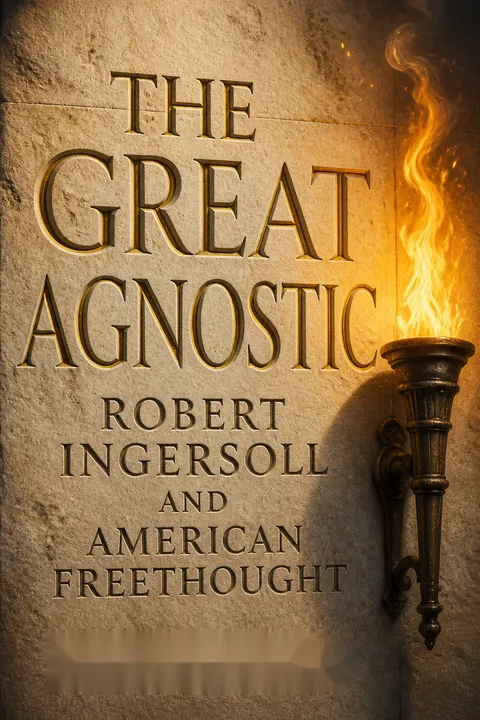


Key Takeaways
Restore Ingersoll to the story: secular American memory is politically contested
A forgotten public giant. Robert Ingersoll was among the most famous American speakers of the late nineteenth century. From 1875 until his death in 1899, he lectured across nearly every state, bringing arguments for reason, science, and religious liberty to audiences far beyond the universities. The son of a poor, frequently relocated minister, he educated himself through books and became a successful lawyer and Republican political speaker. His open disbelief in religion blocked his own path to high office, even as candidates sought his support.
Forgetting has consequences. Jacoby argues that Ingersoll did not simply fade because speeches are fleeting. His defense of secular government and his attacks on organized religion made him inconvenient to later accounts of American history. He had once revived Thomas Paine’s reputation; no comparable champion restored his own.
Ingersoll’s rise and disappearance reveal that public memory is not a neutral archive. The people preserved as national founders often reflect later political needs as much as their historical importance. Jacoby’s recovery of a popular speaker also expands what counts as intellectual influence: an idea can travel through a crowded theater as effectively as through a university. The caution is that restoring a neglected figure can encourage counter-mythmaking. Ingersoll deserves attention not because he was flawless or invariably right, but because his public arguments helped make secular citizenship imaginable to a mass audience.
Use wit to make unsettling science understandable beyond the lecture hall
The crowd was the classroom. Ingersoll made complicated disputes accessible to listeners with little formal education. He had grown up with religious texts, then discovered Shakespeare and Enlightenment writers on his own. As a speaker, he paired direct explanations with comic turns. When a theologian proposed that Eve’s tempter had been an ape who once spoke, Ingersoll turned the strained explanation into a joke about a polite, Hebrew-speaking orangutan. Humor made the argument memorable without requiring the audience to master biblical scholarship first.
Reach people outside your camp. His audiences included committed skeptics, religious believers, and people who came for the entertainment. Reports describe believers laughing at his jokes about their own traditions. That mix mattered: the speech could unsettle a belief without beginning by insulting the person who held it.
This is a powerful model of public explanation. Humor lowers the social cost of reconsidering an idea, while concrete imagery gives an abstract dispute something a listener can carry away. Ingersoll’s success also depended on performance, not just argument: a live speaker could respond to a room and make disagreement feel less like a private embarrassment. Yet humor has limits. A joke can expose a weak argument, but it cannot by itself establish a scientific alternative. Its best role is to open attention, then make space for evidence.
Treat agnosticism as uncertainty about knowledge, not proof of a deity
Two labels, one position. Ingersoll used atheist and agnostic as compatible descriptions. An agnostic, in his account, does not know whether a god exists but does not believe one does; an atheist likewise cannot claim certain knowledge that no god exists. The distinction matters because public debate often treats atheism as a claim of absolute certainty and agnosticism as a softer alternative. Ingersoll rejected that contrast. He did not consider lack of proof for a deity to be proof of a deity.
Keep belief claims honest. His skepticism grew partly from intense exposure to religious arguments as a child. He questioned, for example, why a complex universe supposedly required a creator while the creator itself required no explanation. Rather than present disbelief as omniscience, he argued that claims about the supernatural should face the same demand for evidence as other claims.
Ingersoll’s distinction anticipates a useful separation between what someone believes and what someone claims to know. That distinction can make disagreements clearer: a person may lack belief without claiming certainty, just as another may hold faith without possessing proof. It also prevents a common rhetorical shortcut, where uncertainty about an answer is treated as evidence for one preferred explanation. A limit remains: definitions of atheist and agnostic vary across communities and philosophical traditions. Ingersoll’s usage is valuable as his own position, not as a universal rule for how everyone must use the terms.
Keep government neutral so no faith can turn belief into law
No creed should govern. Ingersoll argued that the Constitution’s omission of God, its ban on religious tests for federal office, and its protection of religious liberty reflected a deliberate break with governments that joined church and state. He saw neutrality as protection for believers and nonbelievers alike: no church should wield the government’s power over citizens who reject its doctrines.
A dormant law can still threaten. In 1887, Ingersoll defended freethinker C. B. Reynolds, prosecuted in New Jersey for distributing a pamphlet attacking the Bible. The old blasphemy law had rarely been used, but it remained available to punish dissent. Reynolds was convicted and fined; Ingersoll paid the court costs. He also opposed public subsidies for religious schools and religious instruction in public schools, insisting that education should not privilege one faith.
The case for state neutrality is strongest when it is framed as a rule that protects pluralism, rather than as hostility toward religion. A government that endorses one creed makes minority beliefs vulnerable and gives political disputes a false aura of divine authority. The Reynolds prosecution shows why an unenforced law can matter: its existence can give local majorities a tool to intimidate dissent. At the same time, constitutional history is contested, and neutrality does not settle every question about religion in public life. It supplies a principle for debate, not an automatic answer to each policy dispute.
Defend evolution without treating science as a new priesthood
Make nature intelligible. Ingersoll helped explain Darwin’s theory of evolution to people who might otherwise have heard it only through religious attacks. He acknowledged that descent from other animals could initially unsettle human pride, then redirected attention toward what natural history made possible: a species that had developed the capacities for art, thought, and discovery. He also linked scientific knowledge to practical improvements, such as anesthesia and cleaner medical practice, which reduced suffering once blamed on supernatural causes.
Challenge certainty on both sides. Ingersoll rejected literal creation stories and arguments that complexity proved a divine designer. But he also warned that science should not become an unquestionable authority. His opposition to vivisection reflected a broader conviction that scientific claims and practices must be judged, not granted immunity, in the name of progress.
Ingersoll’s strongest move is to present evolution not as a humiliation but as a change in the scale of human wonder. Natural origins do not make human achievements less real; they make them part of a longer history. His insistence that science is a method of inquiry rather than a priesthood remains useful wherever expertise is treated as either infallible or inherently suspect. The tension is that his confidence in scientific progress could outrun what science alone can promise. Evidence can explain processes and guide interventions, but it cannot by itself decide which interventions are humane.
Pair reason with compassion, or secular progress can become social Darwinism
Science does not dictate justice. Ingersoll rejected social Darwinism, the use of evolutionary competition to argue that poverty and inequality were natural or deserved. Although he was a wealthy Republican lawyer with corporate clients, he supported an eight-hour workday, workers’ right to strike, better public education, and protection for people with little power. He argued that a society should not treat the poor as disposable simply because the market rewards some people more than others.
Human welfare is the measure. His secular outlook focused on improving life here, through food, shelter, education, health, leisure, and liberty. This separated him from freethinkers who shared his rejection of religion but accepted harsh economic hierarchy. Jacoby presents his mix of individual liberty and public responsibility as a central reason he cannot be neatly classified as either a conventional conservative or a socialist.
This distinction is essential because scientific description and moral prescription are different kinds of claims. Natural selection may describe how traits spread in populations; it does not establish that a society ought to abandon people who struggle. Ingersoll’s blend of liberty and social obligation resists the idea that skepticism about religion must entail skepticism about collective care. His own politics were not a complete program for economic justice, and his ties to business remain part of the picture. Still, his example shows that a secular worldview can support compassion without grounding it in divine command.
Apply equal rights consistently, including to races your allies exclude
Rights cannot stop at party lines. Ingersoll criticized his own Republican Party when it abandoned protections for Black Americans after Reconstruction. In 1883, after the Supreme Court struck down key protections against racial discrimination in public accommodations, he warned that the decision left Black citizens exposed to exclusion and violence. He also opposed laws that singled out Chinese residents, who were denied legal protections available to other immigrants.
Education, not exclusion. Some reformers of his era doubted that Black people and immigrants could participate equally in democracy. Ingersoll argued that lack of education was not evidence of permanent inferiority; public education could expand people’s ability to exercise their rights. His criticism of religious justifications for slavery and discrimination linked freethought to a wider defense of human equality.
The test of a rights principle is whether it protects people outside the speaker’s own group. Ingersoll’s criticism of his party and his opposition to anti-Chinese laws make his universalism more than a slogan. His argument also points toward a structural insight: denying education and then citing educational disadvantage as proof of incapacity turns exclusion into its own justification. The historical record of reform movements is often compromised by prejudice, including among people who championed other forms of equality. That makes scrutiny of allies necessary, not merely a way to discredit them.
Give women material control, not just formal political rights
Freedom needs an exit. Ingersoll believed women were intellectually equal to men but denied education, wages, and independence. He treated voting rights as important but insufficient: a woman trapped by poverty or an abusive marriage could not become free through formal citizenship alone. He spoke publicly about domestic violence and criticized laws that made it nearly impossible for women to divorce violent husbands.
Control over motherhood matters. Before reliable contraception was widely available, he argued that women needed the ability to decide whether to become mothers. Compulsory childbearing, he said, restricted women’s choices and reinforced dependence on men. He also called attention to women’s low wages and narrow employment options. These arguments placed economic security, bodily autonomy, and protection from violence alongside suffrage as conditions of women’s freedom.
Ingersoll’s account usefully distinguishes legal equality from the practical ability to act on it. A right has limited force if exercising it means losing housing, income, or personal safety. That insight connects political citizenship to material conditions, a connection often missing from debates that treat equal treatment in law as the whole task. His language of freedom also reflects the assumptions of his own era, including a tendency to frame women’s lives through marriage and motherhood. The enduring value lies in the principle that autonomy requires real options, not simply permission on paper.
Judge science by humane outcomes, not its claim to good intentions
Progress needs moral limits. Ingersoll condemned vivisection, the experimental cutting or injury of live animals, as cruelty disguised by scientific purpose. He doubted that such experiments produced useful knowledge and feared that indifference to animal suffering could weaken concern for human suffering too. His argument was not that science should stop investigating nature, but that the pursuit of knowledge did not excuse every method.
Reason requires empathy. The controversy exposed a risk within freethought itself: rejecting religious authority does not guarantee ethical judgment. Ingersoll challenged researchers who treated their intentions as sufficient justification, insisting that the effects on living beings mattered. His position included a strong empirical claim about the uselessness of vivisection, which Jacoby presents as part of his advocacy rather than as a settled conclusion about all animal research.
Ingersoll offers a useful challenge to the idea that technical expertise can settle moral questions. A practice may be methodologically sophisticated and still demand ethical scrutiny; the fact that an institution calls its work beneficial does not make that judgment self-validating. His concern for animals also pushes moral consideration beyond the boundaries of the human community. The caution is that a categorical condemnation of animal experimentation can understate the possible value of particular research. The stronger principle is not that every experiment is useless, but that potential benefits, harms, and alternatives require transparent evaluation.
Let mortality sharpen care for the living instead of inventing certainty
A finite life can matter. Ingersoll rejected claims that morality depends on heaven or fear of punishment. He argued that people could seek happiness, love, justice, and relief from suffering in this life, without pretending to know what follows death. Shakespeare and Walt Whitman helped him express this humanism: art could honor ordinary people, natural desire, and sympathy without invoking supernatural authority.
His ending matched his convictions. Ingersoll died at home in 1899 after breakfast with his family. Relatives publicly described his final hours because rumors claimed that he had recanted or called for a minister. He had done neither. His family cremated him, a choice then opposed by many religious communities. The scene does not prove his beliefs right; it shows the ordinary courage of facing death without surrendering them.
The emotional force of this position comes from refusing a false choice between religious consolation and a cold, meaningless universe. Grief can be acknowledged without turning uncertainty into a promise, and a finite life can acquire urgency precisely because it cannot be repeated. Ingersoll’s public attention to art, love, and mourning gives his humanism an emotional vocabulary, not just an argument against theology. Still, different people find meaning through religious belief, and his account cannot disprove their comfort. Its more modest contribution is to show that compassion need not depend on certainty about an afterlife.
Analysis
Jacoby’s biography is both a recovery project and an argument about American civic identity. Ingersoll matters not simply because he opposed religion, but because he connected skepticism to constitutional restraint, public education, scientific literacy, and the treatment of people denied power. That broad range prevents the book from shrinking into a portrait of a clever atheist. Its central historical claim is that popular freethought helped carry Enlightenment ideas into a mass public during a period of profound scientific and social change.
The book’s most persuasive contribution is its account of Ingersoll as a communicator. His humor and oratory allowed evolution and secular government to become subjects of public conversation rather than specialist disputes. The same biography also exposes a contradiction often hidden in histories of secularism: reason does not automatically produce egalitarian politics. Ingersoll’s resistance to social Darwinism, his defense of Black and Chinese rights, and his arguments for women’s autonomy distinguish his humanism from other secular currents that accepted hierarchy.
Jacoby’s admiration is explicit, and it gives the narrative energy. It also sometimes encourages a heroic framing in which Ingersoll appears unusually prescient and his opponents serve mainly as obstacles. The account is strongest when it preserves complications, including his Republican alliances, corporate legal work, and the limits of his own historical moment. His positions should be evaluated individually, not treated as a single package guaranteed by freethought.
The book’s lasting insight is therefore broader than a case for atheism. Democratic societies need public voices willing to challenge religious authority, but they also need standards by which secular authority can be challenged. Ingersoll’s legacy is most useful when reason remains open to evidence, constitutional liberty protects dissenters, and moral judgment considers those who bear the costs of progress.
Review Summary
The Great Agnostic receives mostly positive reviews, with readers praising Jacoby's portrayal of Robert Ingersoll as an important but forgotten figure in American freethought. Many appreciate learning about Ingersoll's progressive views on religion, women's rights, and social issues. Some reviewers note the book's brevity and wish for more depth, while others find it an excellent introduction to Ingersoll's life and ideas. Critics appreciate Jacoby's efforts to revive interest in Ingersoll's legacy and his contributions to secular thought in America.
People Also Read





Glossary
Freethought
Reasoned inquiry without religious authorityA way of examining the world through observation, evidence, and independent thought rather than accepting ancient religious writings or doctrines as final authority. In Jacoby’s account, freethought includes skepticism about supernatural claims and a political commitment to freedom of conscience. It is a historical movement as well as an approach to belief, especially prominent in the United States from the late nineteenth century into the early twentieth.
Secularism
Public life without religious ruleIngersoll used secularism to describe a way of organizing life around human effort, knowledge, justice, and well-being in this world rather than supernatural reward. Politically, it means government should not establish or favor a religion. His secularism was not simply disbelief: it included commitments to public education, liberty of conscience, and reducing poverty and suffering.
Agnostic
A nonbeliever without certaintyIngersoll used agnostic and atheist as compatible labels. An agnostic, in his account, does not claim to know whether a god exists and does not believe that one does. The term therefore marks a limit on claims of knowledge, not a reason to treat uncertainty as evidence for a deity. Jacoby emphasizes that Ingersoll did not use agnosticism to soften or conceal his disbelief.
Social Darwinism
Evolution used to defend hierarchyA political and social doctrine that applies ideas about competition and natural selection to human societies, often treating poverty and inequality as evidence that some people are naturally less fit. Jacoby distinguishes it from Darwin’s account of biological evolution. Ingersoll rejected its use to justify neglect of workers, the poor, immigrants, and other people with less social power.
Gospel of humanity
Ethics grounded in human welfareIngersoll’s description of a moral outlook centered on sympathy, justice, and improving life for people in the present world. It rejects the idea that goodness depends on divine command or expectation of an afterlife. Art, love, care for the vulnerable, and efforts to reduce suffering all belong to this human-centered ethic.
FAQ
1. What is "The Great Agnostic: Robert Ingersoll and American Freethought" by Susan Jacoby about?
- Biography and Intellectual History: The book is a biography of Robert Green Ingersoll, a 19th-century American orator, lawyer, and leading advocate for secularism, reason, and freethought.
- Freethought Movement: It explores the golden age of American freethought (roughly 1875–1914), highlighting Ingersoll’s role in challenging religious orthodoxy and promoting the separation of church and state.
- Cultural and Political Context: Jacoby situates Ingersoll’s life and work within the broader social, political, and scientific changes of his era, including debates over evolution, women’s rights, and civil liberties.
- Legacy and Relevance: The book also examines why Ingersoll’s influence faded in the 20th century and argues for his continued relevance in contemporary discussions about secularism and religion in America.
2. Why should I read "The Great Agnostic" by Susan Jacoby?
- Rediscovering a Forgotten Figure: The book revives the story of Robert Ingersoll, a once-famous but now largely forgotten champion of reason and secularism in American history.
- Insight into American Secularism: It provides a detailed account of the origins and development of secular thought in the United States, which remains highly relevant to current debates about religion and public life.
- Engaging Storytelling: Jacoby combines rigorous scholarship with accessible writing, making complex historical and philosophical issues understandable and compelling.
- Contemporary Relevance: The book draws parallels between 19th-century and modern culture wars, showing how Ingersoll’s battles over science, religion, and civil rights echo today.
3. Who was Robert Ingersoll, and why is he called "The Great Agnostic"?
- Prominent Orator and Lawyer: Ingersoll (1833–1899) was one of the most famous public speakers of his time, known for his wit, eloquence, and advocacy of secularism.
- Champion of Freethought: He was dubbed "The Great Agnostic" for his outspoken criticism of organized religion and his defense of reason, science, and humanism.
- Political and Social Influence: Ingersoll influenced a wide range of prominent Americans, from Mark Twain to Elizabeth Cady Stanton, and was a key figure in debates over evolution, civil rights, and women’s suffrage.
- Legacy of Secularism: Despite his fame, Ingersoll’s open agnosticism limited his political career, and his memory faded as America’s religious landscape shifted in the 20th century.
4. What are the key takeaways from "The Great Agnostic" by Susan Jacoby?
- Secular Roots of America: The book emphasizes that the U.S. Constitution was deliberately secular, and Ingersoll worked to remind Americans of this heritage.
- Role of Reason and Science: Ingersoll’s advocacy for science and reason helped popularize evolutionary theory and challenged religious literalism.
- Intersection of Social Issues: The book connects Ingersoll’s secularism to his stances on abolition, women’s rights, labor reform, and racial equality.
- Enduring Culture Wars: Jacoby shows that many of the issues Ingersoll confronted—such as church-state separation and the teaching of evolution—remain unresolved and contentious today.
5. How does Susan Jacoby define "freethought" in "The Great Agnostic"?
- Observation Over Revelation: Freethought is described as a worldview based on observation, evidence, and reason rather than adherence to ancient sacred texts.
- Intellectual Independence: It emphasizes the right and responsibility of individuals to form their own beliefs, free from religious or dogmatic authority.
- Historical Movement: Jacoby traces the term’s origins to 17th-century England and details its flourishing in 19th-century America, with Ingersoll as its leading advocate.
- Inclusivity and Progress: Freethought, as presented in the book, is linked to broader movements for social progress, including science, civil rights, and gender equality.
6. What was Robert Ingersoll’s stance on religion and the separation of church and state, according to "The Great Agnostic"?
- Secular Constitution Advocate: Ingersoll argued that the U.S. Constitution’s omission of God was intentional, ensuring government by and for people, not by divine authority.
- Religious Freedom for All: He believed in absolute freedom of conscience, supporting both the right to worship and the right not to worship.
- Opposition to Religious Privilege: Ingersoll opposed public funding for religious schools and any government endorsement of religious doctrine.
- Critique of Religious Orthodoxy: He was especially critical of attempts to impose religious beliefs through law or public policy, seeing them as threats to liberty and progress.
7. How did "The Great Agnostic" by Susan Jacoby address Ingersoll’s views on science and evolution?
- Popularizer of Evolution: Ingersoll played a key role in explaining and defending Darwin’s theory of evolution to American audiences, making complex ideas accessible.
- Science vs. Superstition: He argued that scientific knowledge, grounded in observation and evidence, was superior to faith-based explanations of the natural world.
- Critique of Intelligent Design: Ingersoll mocked arguments for intelligent design, such as William Paley’s "watchmaker" analogy, as illogical and unscientific.
- Optimism About Progress: He saw the acceptance of evolution and scientific thinking as essential to human progress and the alleviation of suffering.
8. What were Robert Ingersoll’s positions on social issues like women’s rights, race, and labor, as described in "The Great Agnostic"?
- Advocate for Women’s Rights: Ingersoll supported women’s suffrage, birth control, and legal reforms to protect women from violence and economic dependency.
- Racial Equality: He condemned slavery, opposed post-Reconstruction racial discrimination, and spoke out against laws and court decisions that undermined civil rights.
- Labor and Economic Justice: Ingersoll supported the eight-hour workday, the right to strike, and criticized social Darwinism’s justification of economic inequality.
- Universal Humanism: His secular humanism led him to champion the rights and dignity of all people, regardless of gender, race, or class.
9. Why did Robert Ingersoll’s influence decline in the 20th century, according to Susan Jacoby?
- Religious Backlash: Ingersoll’s open agnosticism and criticism of religion made him a controversial figure, leading to his exclusion from mainstream historical narratives.
- Changing Political Climate: The rise of fundamentalism and the persistence of religious influence in American politics marginalized secular voices like Ingersoll’s.
- Ephemeral Nature of Oratory: As a primarily oral communicator, Ingersoll’s impact faded with the decline of the public lecture circuit and the rise of new media.
- Misconceptions About Progress: Many intellectuals believed that science and secularism would inevitably triumph, underestimating the resilience of religious conservatism.
10. How does "The Great Agnostic" compare Ingersoll’s approach to religion with that of today’s "New Atheists"?
- No Distinction Between Atheist and Agnostic: Ingersoll saw little difference between atheism and agnosticism, emphasizing the limits of human knowledge about the divine.
- Engagement with Religious Liberals: Unlike some "New Atheists," Ingersoll was willing to find common ground with liberal religious figures who supported science and reform.
- Focus on Popular Education: Ingersoll prioritized making secular and scientific ideas accessible to the general public, not just intellectual elites.
- Legacy for Modern Secularism: Jacoby argues that Ingersoll’s blend of reason, humanism, and advocacy for liberty remains a model for contemporary secularists.
11. What are some of the most memorable quotes from "The Great Agnostic" and what do they mean?
- "The most formidable weapon against errors of every kind is reason." (Thomas Paine, quoted in the book) – Emphasizes the centrality of rational inquiry in combating falsehoods.
- "They knew that to put God in the Constitution was to put man out." (Ingersoll) – Argues that government should be based on human, not divine, authority.
- "Happiness is the only good. The time to be happy is now. The place to be happy is here. The way to be happy is to make others so." (Ingersoll’s creed) – Summarizes his humanistic philosophy focused on this-worldly well-being.
- "Blasphemy is the word that the majority hisses into the ear of the few." (Ingersoll) – Critiques the use of blasphemy laws to suppress dissent and minority viewpoints.
12. What is Susan Jacoby’s main argument about the relevance of Robert Ingersoll and freethought for today’s readers?
- Continuing Culture Wars: Jacoby contends that the debates Ingersoll engaged in—over science, religion, and civil rights—are still central to American society.
- Restoring Historical Memory: She argues that remembering figures like Ingersoll is crucial for understanding the secular roots of American democracy and the ongoing struggle for liberty of conscience.
- Model for Secular Advocacy: Ingersoll’s life demonstrates the importance of courage, clarity, and compassion in advocating for reason and human rights.
- Call to Action: Jacoby encourages modern secularists and "New Atheists" to reclaim Ingersoll’s legacy
Download PDF
Download EPUB
.epub digital book format is ideal for reading ebooks on phones, tablets, and e-readers.








