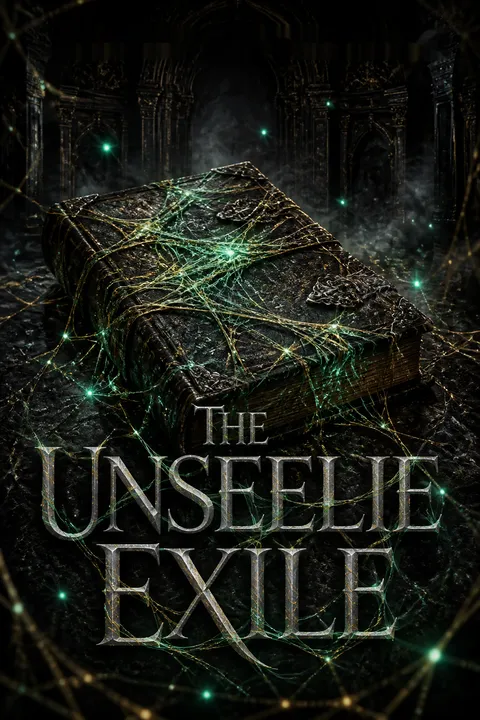


Plot Summary
The Rain Calls Ava In
Since her mother’s death, Ava Cole has been left with grief, an absent father, and no clear future. When her father evicts her to make room for his new family, she walks into a Massachusetts downpour with only a backpack and no working phone. She refuses to give up, but needs somewhere dry to sleep.
An impossible glow guides her into the woods, where an abandoned estate seems to offer shelter. The building’s welcoming interior collapses into ruin as she enters, and a swarm of many-legged creatures surges through its halls. Ava runs, bolts herself into a study, and finds herself trapped in a place that does not obey the rules of her world.
Ava’s entry into the Floof grows from a recognizable crisis rather than curiosity. Her father’s eviction repeats the abandonment she has already endured through her mother’s illness, leaving her dangerously close to believing she has no place in the world. Yet she chooses shelter and survival, even while despair presses on her. Serrik’s lure exploits that need, making the supernatural invitation feel like relief before it becomes a trap.
Gregor's Last Custody
In the study, Ava finds a vast locked grimoire clasped in the arms of a corpse-like man named Gregor. She feels the book belongs to her and takes it; Gregor crumbles into dust with a final breath of relief. A green-haired fae named Serrik appears as a ghostly presence and explains that Ava is inside the Floof, a prison between worlds.
The tome is now bound to her, keeping her from death but making escape impossible without Serrik’s help. He wants a partner who can act beyond the room where he is confined, and claims the book can guide them toward the means of release. Ava distrusts him and leaves to seek another way out.
The transfer of the grimoire makes Ava’s survival inseparable from a choice she did not knowingly make. Gregor’s quiet relief complicates the apparent prize: the book is not simply valuable, it is a burden whose previous keeper has been consumed by it. Serrik offers the first version of a bargain disguised as rescue. Ava’s refusal matters because it preserves her judgment, even though the prison has already narrowed her options.
A Witch's Supper
Seeking food and shelter, Ava accepts a bargain with Old Braega, a blind witch living inside a tree. Braega promises safety and an open right to leave in exchange for Ava’s phone, then serves stew containing a human eye and reaches for Ava’s face. The door will not open, exploiting the bargain’s exact wording, until two fae burst in and drive Braega back.
Ibin, a former human, and Nos, a stitched-together fae, take Ava to their rooms. They explain that the grimoire contains every spell but cannot be used by a powerless human. They also reveal Serrik’s stated plan: sever the fae realm from Earth, an act that would kill the fae and devastate worlds connected to them.
Braega’s hospitality turns familiar comforts into instruments of control: a meal, a warm room, and a promise all become dangerous when their terms are engineered. Ibin and Nos offer genuine help, but their warning about Serrik immediately makes Ava responsible for a conflict she never chose. The scene also establishes that kindness and threat can coexist in the Floof. Ava’s caution is not cynicism for its own sake; it is a survival skill learned through repeated betrayals.
The Bunny-Bound Pact
In dreams, Serrik tells Ava that the grimoire will attract wardens and predators, and that only his magic can let her use it. He frames cooperation as the sole alternative to a long, helpless death. Ava also learns that Serrik expects his plan to wipe out the fae, though he argues that their continued existence threatens humanity.
With no safe choice in sight, she agrees to help free him. Serrik seals their bond by forcing a tiny golden, many-legged creature into her mouth; she wakes with a green mark near her collarbone. Book then opens by itself, showing Ava chained beside a monstrous Serrik and, in another image, holding his heart. The images suggest that learning his power may also give her a way to stop him.
Ava’s agreement is neither free consent nor simple capitulation. Serrik uses the truth of her danger to make his preferred path appear inevitable, while withholding the full cost of what he intends. The grimoire’s images interrupt that manufactured binary with a possible act of resistance. Her emerging agency is therefore double-edged: the power she needs to escape may also bind her more closely to the person who trapped her.
A Locomotive for Rig
Ibin and Nos bring Ava to Rig, a satyr-like Unseelie exile, hoping he can protect her from the Floof’s dangers. Rig admits he can control other people’s thoughts and actions, then proposes making Ava his companion, insisting she has little reason to refuse. When he denies her time to consider, Ava asks for two minutes and retrieves the grimoire.
It opens to a spell, and she tears a massive iron steam locomotive out of its place in Earth’s past, dropping it onto Rig. The train kills him. Ava remains beside the wreckage, drinking wine and trying to absorb what she has done. Nos confronts her about concealing her bond with Serrik; Ava fires back that he and Ibin concealed their own plan to trade her protection for influence.
Rig’s offer exposes the violence hidden inside supposedly benevolent protection: his proposal depends on making Ava want what he has already decided for her. Her response is an act of self-defense, but the train’s sheer scale makes clear that her new power is not under control. The death leaves her with guilt rather than triumph. Meanwhile, Ava and Nos recognize their shared dishonesty, though neither can yet trust the other enough to turn that recognition into reconciliation.
Apples Through the Ceiling
Serrik begins teaching Ava to use the magic he has grafted onto her, first asking her to change an apple. Instead, she pulls several apple trees through space, shattering the floor and pelting them with fruit. Serrik protects her from the falling apples, then explains that her gift is powerful but dangerously imprecise.
He reveals that three seals hold his prison closed, each opened by a mirror shard earned through a trial. The first door is hidden somewhere in the changing Floof, and Ava must find it before either its residents or its wardens can claim her. Serrik gives her a drawing of the mirror door, while warning her that the journey will be dangerous. Ava leaves with a map, a magical book, and no reliable guide.
The apple trees turn a small lesson into a demonstration of scale: Ava’s magic does not merely fail at precision, it changes the physical world beyond her intention. Serrik responds by protecting her, but also by identifying how useful that excess power could be to his plans. Their connection begins to feel intimate through practical care, even as its terms remain strategic. The three-shard quest gives Ava a concrete task while keeping its ultimate consequences uncertain.
The Memory Price
Ibin and Nos guide Ava through an impossible passage where the entity called the Eyes recognizes her as something new and directs them to the first key. In a strange garden, three sisters offer a mirror shard in exchange for one of Ava’s memories. The crone reaches into her mind and selects the memories of her mother, from childhood birthdays to her final days.
Ava cannot pull away. Serrik enters the memory-dream and offers his own only memory of the Morrigan, his mother, in exchange. It is the moment she pushed him into the Floof and left him there. The crone accepts, preserving Ava’s memories and giving her the shard. Serrik’s sacrifice leaves him drained, and Ava begins to see a person beneath his cold performance.
The bargain forces Ava to confront memory as more than information. Her mother’s presence is part of how Ava knows who she is, so losing those memories would repeat the bereavement that brought her to the Floof. Serrik’s exchange is emotionally consequential precisely because it costs him something personal, not merely useful. It does not make him trustworthy, but it unsettles Ava’s certainty that he is incapable of acting from care.
The First Mirror Shard
Inside a chamber of fractured reflections, Ava resists visions of possible selves and uses Serrik’s architectural drawing to identify the real mirror among three similar doors. She fits the shard into its broken surface. The mirror pulls her into Serrik’s memory, where she witnesses the kings Dagda and Bres punish him on his first day of adulthood, cutting away one of his legs.
The memory also exposes the old wound beneath his hatred: the Floof was created as a prison for the Morrigan, then became Serrik’s own prison. The first seal breaks, drawing Ava deeper into Serrik’s dream before returning her to her body. She remains unconscious for eight days, and the tattoo on her arm has spread farther than before.
Ava’s architectural training becomes a means of survival: proportion and ornament help her distinguish the true door from deliberate imitations. But the key’s real consequence is intimate rather than merely mechanical. By opening the seal, she crosses into Serrik’s trauma and learns how violence shaped both his body and his design for the prison. The expanding tattoo makes that knowledge costly. Every step toward freedom also alters the boundary between Ava and the Floof.
The Floof Names the Cost
While Ava sleeps, the Floof reveals that Serrik’s prison is built on its ancient power and that each key is making Ava part of it. It warns that Serrik may turn her into a vessel for destruction, though the Floof itself cannot be separated from her without catastrophe. When Ava wakes after eight days, she confronts Ibin and Nos, recognizing that both have withheld information and that Ibin has a hidden allegiance.
She refuses to remain their instrument, leaves their rooms, and starts toward the Broken City alone. Bitty, a powerless fae who helped watch over her, catches up and offers to guide her. Ava accepts the company, but sets the terms herself. For the first time, she chooses a path without pretending she trusts its destination.
The Floof’s warning changes the central danger from external capture to internal transformation. Ava may survive the prison only to become a weapon whose power no longer belongs to her. Her break with Ibin and Nos is painful but psychologically coherent: she has learned that dependence can become another form of captivity. Bitty’s admission that she feels useless echoes Ava’s own earlier despair, yet her ordinary persistence gives Ava a model of life not organized around power.
A Kiss in the Broken City
As Ava and Bitty travel toward the Broken City, Serrik admits in a dream that the Floof may be changing them both; their argument turns into a kiss that Ava wants but cannot trust. In the city, they search through fragments of buildings and forgotten knowledge until Book and Ava’s tattoo draw them to a nameless library where knowledge goes to die.
The second shard is already in the hands of Valroy, the Unseelie king. He offers to take Ava to the fae realm, arguing that the war is not hers and claiming Serrik has concealed what the keys will do. Valroy opens a portal onto a moonlit forest and promises an escape. Ava does not yet know whether his offer is rescue or another bargain.
The kiss intensifies the conflict between Ava’s bodily desire and her judgment of Serrik’s aims. It does not resolve their distrust; it makes that distrust harder to separate from attraction. The Broken City then converts the abstract threat of forgotten knowledge into a physical search, while Valroy’s arrival introduces a new power with its own persuasive story. His offer matters because it presents an immediate exit before Ava can verify whether its safety is real.
The Moonlit Exit
Ava chooses the portal, and Bitty follows her into Cotn t’Aill. The moment they cross, Serrik loses the ability to see or hear Ava through their bond. Alone in his library, he smashes his harpsichord, sends books and furniture crashing through the room, and realizes she left willingly rather than being dragged away. Her absence breaks the certainty on which he has relied for centuries.
Serrik still tells himself that she remains part of his plan to destroy the fae, but his anger shifts toward the fear of losing her. The story ends with Ava beyond the prison and Serrik beginning to consider how to reach her, while the second shard remains with Valroy and the danger of her transformation is unresolved.
Ava’s departure is the first choice that directly removes Serrik’s access to her, not merely her first refusal of one of his proposals. His destruction of the library gives physical form to a loss he cannot master through calculation. The ending leaves no stable alliance in place: Ava has traded one uncertain refuge for another, while Serrik’s political purpose is now entangled with personal attachment. Escape changes the board, but does not make its players honest.
Analysis
The novel makes agency the scarce resource beneath its spectacle of magic. Ava is repeatedly presented with choices whose apparent alternatives have been engineered by someone else: Braega’s hospitality becomes a trap, Serrik makes a desperate pact sound necessary, and Rig treats her consent as an obstacle he can overcome. Her growing power does not immediately free her, because the book, the bond, and the Floof all make power inseparable from dependence. The most consequential change is not that Ava learns to summon impossible objects, but that she stops accepting other people’s accounts of what her choices mean.
Grief gives this conflict its emotional foundation. Ava’s caregiving years have taught her to place another person’s needs ahead of her own, while her father’s rejection makes belonging feel conditional. The crone’s attempt to take her memories threatens the last intimate evidence of her mother’s love. Serrik’s sacrifice complicates the simple category Ava has placed him in, but does not erase his coercion or his destructive purpose. Their attraction therefore functions as another pressure on judgment, not as proof that danger has become safety.
The Floof’s impossible architecture externalizes the instability of identity. Rooms change, mirrors display possible selves, and the Broken City collects what has been discarded. Ava’s architectural eye helps her navigate those spaces, but cannot determine which future is true. The novel ends before she can solve that problem: she leaves Serrik’s reach for Valroy’s court, carrying a power whose cost she only partly understands. Its central tension is not whether Ava can become powerful, but whether she can remain the author of what that power is used to do.
Review Summary
The Unseelie Exile receives mostly positive reviews (4.15/5), with readers praising Kathryn Ann Kingsley's villain romance style and worldbuilding. The story follows Ava, trapped in a web prison with half-fae Serrik who seeks escape after 1,800 years. Fans appreciate the connection to previous Unseelie books, the banter, and characters like Bitty. Common criticisms include a recycled plot similar to earlier works, rushed pacing, confusing narrative, and lack of chemistry between leads. Many note it's plot-heavy with minimal spice, serving as setup for the series. Readers eagerly anticipate book two.
People Also Read

Characters
Ava Cole
Unwilling mortal catalystAva is a young architecture student whose education and early ambitions have been interrupted by years of caregiving. Her humor is sharp, her language blunt, and her anger often arrives before her fear can make her freeze. Beneath the defiance is a deep need to belong, sharpened by her father’s departure and her mother’s illness. Ava notices structures, proportions, and practical details, so her professional habits become ways of reading an unfamiliar world. She is not naturally fearless or magically skilled; her strength lies in continuing to act while frightened and in questioning the choices powerful people present as inevitable.
Serrik
Imprisoned fae architectSerrik is a beautiful, inhuman fae with green hair, golden eyes, and the bearing of an old-world aristocrat. He designed the Floof and has spent centuries confined within it, leaving him both intimately knowledgeable about its workings and consumed by his own history. His calm, exacting manner disguises a formidable will and a talent for making coercion sound like the only rational option. Serrik treats people as pieces in a long strategy, yet his encounters with Ava expose tensions between his calculations and his capacity for attachment. His need for freedom is real, but so is the danger of what he hopes to do with it.
Ibin
Stork-shaped war veteranIbin is a warm, irreverent fae who remembers being human and brings a former pilot’s bluntness to the Floof. Her beauty and flowing clothes contrast with her earthy humor, appetite for conversation, and readiness to offer comfort. She recognizes Ava’s fear because she has lived through a similar rupture in her own sense of reality. Ibin’s kindness is genuine, but it does not make her free of agendas or divided loyalties. She wants to keep herself and her companions alive without abandoning her belief that the fae are more than the cruel exiles Ava encounters.
Nos
Stitched court survivorNos is a reserved fae whose face and body are assembled from mismatched parts. His stiff manners and cutting remarks make him seem hostile, but his suspicion comes from a history of betrayal and punishment. He prioritizes practical safety over the hope that Ava will trust him, and often mistakes bluntness for clarity. His loyalty to Ibin softens his severity without erasing it. Nos understands that Ava’s power could endanger everyone, yet he also recognizes the risks she faces. His central conflict is how to protect those he loves without treating another person as a problem to be managed.
Bitty
Powerless fae scoutBitty is a tiny fae with iridescent beetle wings and no magic. Her nervousness is plain, but so is her practical knowledge of the Floof, gathered over centuries of watching and studying what others overlook. She has learned to be useful without assuming that usefulness will earn her status. Bitty’s uncomplicated belief that life can remain worth living, even in a dangerous place, challenges Ava’s exhaustion without dismissing it. She offers companionship rather than authority, making her one of the first characters Ava can choose to trust on her own terms.
Valroy
Unseelie war kingValroy is the powerful Unseelie king, recognizable by his blue hair, silver crown, and vast batlike wings. He is charming in a way that does not conceal his capacity for cruelty; he can make a threat sound almost like a kindness. Valroy sees Ava’s predicament as an opportunity to intervene in a struggle already larger than she understands. His confidence and easy humor make him an effective persuader, but neither quality proves that his promises are safe. He embodies the political power waiting outside Serrik’s prison.
Old Braega
Treehouse witchOld Braega is a blind, elderly witch who lives in a house carved into a tree. She can sound hospitable and tender while treating another person’s body as something to bargain over. Her insistence on exact wording reflects the Floof’s brutal economy, where a promise may be technically honored while its meaning is twisted. Braega gives Ava an early lesson in the gap between reassurance and safety, teaching her to inspect every offer rather than trust its warmth.
Rig
Hypnotic satyr exileRig is an elegant satyr-like fae with the power to influence the thoughts and actions of those around him. He speaks of honesty and companionship, but his desire for an unforced relationship exists alongside his ability to force consent. That contradiction makes him difficult to read: he knows that manipulation has cost him trust, yet still assumes he can arrange the outcome he wants. Rig shows Ava how a polished offer can carry the same danger as an open threat.
Abigail
Seelie peacekeeping queenAbigail is the Seelie queen and Valroy’s wife. She is described as a former human who works to restrain her husband and preserve a fragile peace between the courts. Her role is largely indirect in this volume, but she represents a political alternative to Serrik’s insistence that the fae can only be stopped through destruction. Abigail’s efforts also complicate the image of a single, unified fae society by showing that even the rulers disagree about how to wield power.
The Three Sisters
Keepers of fair exchangeThe three sisters live in a cottage surrounded by a carefully tended garden. Their shared manner evokes the maiden, mother, and crone, and they observe old rules of hospitality and exchange. They are neither straightforward helpers nor simple predators: they explain the price of what they offer and expect that price to be honored. Their presence gives Ava a different encounter with fae power, one governed by ritual and balance rather than casual deception.
Ava's mother
Ava's emotional anchorAva’s mother is a loving, terminally ill woman whom Ava cared for through years of treatment and decline. Their relationship is expressed through ordinary rituals, including homemade birthday brownies, shared jokes, and the time Ava spends at her bedside. Her illness shapes Ava’s interrupted education and her sense of responsibility, while her memories remain central to Ava’s understanding of love and loss.
Ava's father
Absent family patriarchAva’s father leaves his wife during her cancer treatment, then returns after her death with a new partner and children. His decision to evict Ava turns an old family abandonment into the immediate crisis that leaves her homeless. He represents the human world’s capacity for harm, complicating any simple contrast between cruel fae and vulnerable mortals.
Gregor
Former grimoire keeperGregor is the human custodian who holds the locked grimoire before Ava finds it. His long confinement and apparent exhaustion make him a warning about what can happen to a person bound to the book without the means to use it.
The Eyes
Floof's ancient observerThe Eyes is a many-limbed being that moves through the deeper passages of the Floof. It views the place as its domain and recognizes Ava as an unusual presence. Its cryptic guidance offers a route forward without offering comfort or certainty.
The Morrigan
Fae power of fateThe Morrigan is an ancient figure associated with fae war and fate. Her choices have shaped Serrik’s understanding of abandonment and authority, and her influence reaches into the history of the Floof even when she is not present.
Athena
Proud craft goddessAthena appears in Serrik’s account of his origins as a powerful figure whose pride turns a contest of craft into a lasting curse. She helps establish the world’s uncertain boundary between gods, magic, and creatures with greater power.
Dagda and Bres
Rival fae kingsDagda and Bres are the Seelie and Unseelie kings of an earlier era. Their courtly authority is bound up with punishment and rivalry, and their treatment of Serrik helps explain why he came to despise the society that raised him.
Plot Devices
The Grimoire
Bound magical archiveThe locked grimoire contains access to every spell, but its pages reveal a spell only when its bearer knows what to seek. It binds itself to Ava after Gregor’s death, follows her through the Floof, and protects her from dying while leaving her vulnerable to pain and other forms of harm. As Ava gains access to Serrik’s magic, the book also offers images that suggest possible futures and choices. It functions as tool, compass, and warning, though its guidance is incomplete.
The Floof
Prison between worldsThe Floof is a shifting realm built over a deeper reality where worlds and possibilities meet. Its corridors rearrange, architecture grows through itself, and forgotten objects collect in places such as the Broken City. The prison holds fae and humans whom their societies could not kill or safely release. It is not just a backdrop: it responds to its inhabitants and gradually becomes entangled with Ava as she uses the mirror shards.
The Mirror Seals
Three trials to freedomThree mirror shards are needed to open the door that seals Serrik inside the Floof. Each shard must be earned through a trial, and the mirror’s reflections show possible selves and futures rather than reliable predictions. When Ava places the first shard, the seal breaks and her connection to Serrik and the Floof deepens. The key mechanism turns the quest into a test of choice, while raising the cost of every step forward.
Serrik's Patron Bond
Power with a binding costSerrik grafts his magic onto Ava so she can use the grimoire. The bond appears as a small green mark that spreads as she claims more power, and it lets them meet in dreams and sense one another across the Floof. It also intensifies their attraction and gives Serrik a way to influence Ava’s choices. The bond makes their alliance useful to both, but blurs the line between shared power and control.
Fae Bargains
Promises with loopholesFae bargains turn language into a mechanism of power. Braega honors the wording of her deal with Ava while preventing her from leaving; Rig presents coercion as a choice; and the sisters demand a memory in exchange for a mirror shard. The bargains are not all identical, but each requires Ava to consider what is offered, what is withheld, and whether the terms preserve her ability to refuse. They make trust a matter of consequences, not tone.
Web of Shadows/Floof of Shadows Series Series
About the Author
Other books by Kathryn Ann Kingsley


Download PDF
Download EPUB
.epub digital book format is ideal for reading ebooks on phones, tablets, and e-readers.








