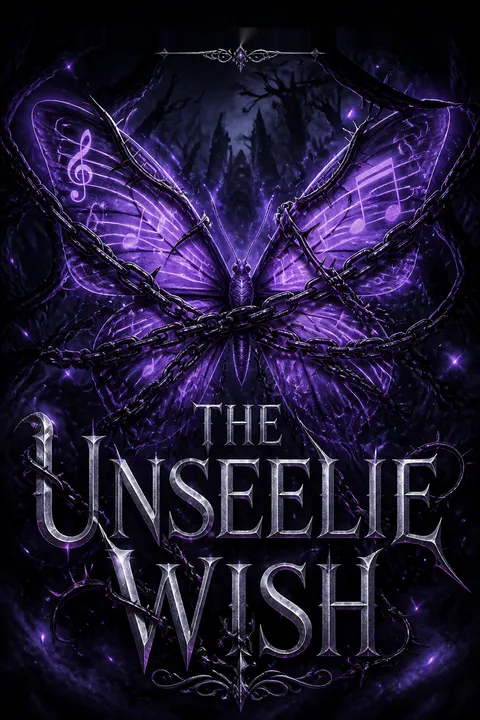


Plot Summary
Daylight Turns to Wildflowers
Alex has fled Izael, the Unseelie duke who wants her wish and soul, and hides in daylight wearing a glamor that makes her look like one of his kind. Seelie soldiers find her and move to execute her despite her attempts to explain. Cornered, she reaches for the strange music she can hear in living things and changes the soldiers' tune.
They burst into vines, flowers, and grass instead of corpses. Shaken by what she has done, Alex is approached by Abigail, the Seelie Queen, who removes her disguise and assures her the transformed soldiers are still alive. The rescue offers no simple safety: Abigail already knows Alex's wish could affect the fragile peace between the fae courts.
Alex's first uncontrolled use of power makes the central danger physical before anyone can explain its political meaning. She does not choose violence, but panic turns her gift into an instrument that alters other lives. Abigail's reassurance complicates Alex's guilt rather than erasing it: the soldiers survive, yet they have been changed without consent. The scene establishes that Alex's intentions cannot reliably limit the consequences of her magic. Her vulnerability and her capacity to reshape the world arrive together, which is why neither court can treat her as merely a frightened human.
Abigail Offers Seven Days
Abigail brings Alex to her modest home, where coffee and a frank account of her own history make the Queen feel less like a captor. She explains that Izael's bargain remains binding, while Valroy wants Alex to wish away the treaty that prevents the Seelie and Unseelie from making war openly. Alex refuses to surrender her wish or her soul without thought.
When Valroy arrives to enforce the contract, Abigail refuses to hand her over, but the law forces a compromise: Alex gets one week on Earth, guarded by Bayodan and Cruinn, while Izael must remain in Tir n'Aill. The respite gives her room to think, though it does not cancel the bargain or end the threat.
Abigail's protection is neither a rescue without conditions nor a simple act of political mercy. She recognizes Alex's predicament because she has herself been a human drawn into fae power, but her authority cannot nullify the contract. The week on Earth therefore becomes a narrow interval carved out of a larger coercive structure. Alex gains time, not freedom. This distinction matters: the book repeatedly makes delay feel like agency while showing that delay alone cannot dissolve the bargains governing her body, her wish, and the two worlds.
The Treaty Has Teeth
Bayodan and Cruinn settle into Alex's Boston home, where their strange company gives her a little ordinary companionship amid the crisis. Bayodan explains the treaty: neither fae court may attack the other except in defined circumstances, and only a mortal can end the pact. That makes Alex's human status, combined with her ability to alter living things, uniquely dangerous.
Puck warns that if Valroy learns how her gift works, he could turn her into a weapon and provoke war. Alex sees no safe option and tells Puck she will surrender her magic. She still hopes that losing the power might limit the damage, unaware that Izael is already making a different plan with Valroy.
The treaty turns Alex's identity into a legal loophole. She is dangerous not because she is stronger than the fae, but because the rules place her outside the restrictions that bind them. Her decision to surrender her gift is an attempt to reduce harm, yet it also reflects how little control she believes she has over her own future. Bayodan's gentle company and Puck's blunt warning offer competing forms of counsel, but both leave Alex making a choice under pressure rather than from genuine freedom.
An Iron Leash Returns
While Alex is on Earth, Izael seeks Valroy's favor by revealing that she can change the music of life. In exchange for keeping her in his custody, he proposes a second bargain: he will make Alex use her wish to love him, and if he fails, Valroy may claim Izael's soul. He also tells himself he can satisfy Abigail by containing Alex's power in iron.
When the respite ends, he returns Alex to Tir n'Aill and fastens an iron collar around her neck. It silences the music she hears and blocks her magic. Izael explains that she can remove the collar only by surrendering her power or choosing, through her wish, to love him.
Izael's affection remains entangled with possession. He sees himself as protecting Alex, yet he makes a secret bargain about her power and converts her body into the place where competing plans are enforced. The iron collar is effective precisely because it offers a practical solution to the danger while making her less able to defend herself. His wager with Valroy raises the stakes for Izael, but it does not make his treatment of Alex less coercive. The scene asks whether tenderness can be separated from control when one lover holds nearly all the power.
Anfar Names the Cost
During a tense dinner, Anfar, the drowned-looking Unseelie who serves Valroy, reveals that he is Izael's estranged father. Alex learns that Izael was brought to Anfar as a fully grown child after causing chaos in another realm. Their conversation unsettles Izael, who is unused to being treated as anyone's son.
Later, over takeout, Alex presses him about whether his love is real or simply another form of wanting to possess her. Izael admits he has never loved before. He also reveals that human bearers of fae magic can have their souls absorbed into the Hartsblood after death. Alex realizes that even winning the original wager may not free her from the fae or protect her from Valroy.
Anfar's arrival gives Izael a history beyond his appetite and title, but it does not absolve him of what he is doing to Alex. The father-son connection exposes a vulnerability Izael rarely acknowledges: he has been unwanted and displaced, and now mistakes possession for security. Alex's questions force intimacy into the open without resolving whether she can trust it. The Hartsblood revelation then strips away the apparent escape route of winning the wager. Knowledge deepens her agency, but it also shows how thoroughly the fae have shaped the choices available to her.
Three Futures, No Escape
Puck lays out three likely endings for Izael's scheme. If Alex wishes herself into loving him, Valroy can use her magic to destroy the Seelie and attack Earth, leaving Alex devastated. If she gives up her power, Valroy may kill her once she is no longer useful. If she wins the original wager, other fae may still seize her gift.
Izael finally sees that his plans offer no safe future and apologizes for treating Alex's fears as obstacles. She agrees that surrendering her magic might limit the damage, but Izael believes Valroy would still kill them both. Rather than let the King use her, they decide to attack him in the Maze of Shadows, despite knowing the attempt may cost their lives.
Puck's possible futures turn the lovers' private conflict into a problem of moral consequence. Each apparent solution protects one interest by sacrificing another, and Izael's apology begins with recognizing that Alex's fear is not a flaw to overcome. Their decision to confront Valroy is not a clean heroic turn: it is an attempt to choose who bears the cost when every available path is compromised. The partnership they form is meaningful because Alex is no longer merely the prize in Izael's game. She helps define the risk, even though the odds remain terrible.
One Last Boston Song
Before they leave Earth, Izael takes Alex to a Boston jazz club for one last night together. He removes her collar so she can hear the music again, and she sings with the band. As she follows the melody, she realizes she can guide the room's living music; the audience falls under her influence without knowing why.
Izael hears the scale of her power and is awed, while Alex is unsettled by how easily she could have made the crowd act. Afterward, they walk through the city and share how little either expects to be missed. Back in Tir n'Aill, their final intimacy brings Alex to the realization that she loves him, though she cannot yet tell him.
The jazz club gives Alex a moment of artistic pleasure that is also a demonstration of dangerous authority. Singing, once tied to the life she wanted before the fae, becomes a means of directing other people without their awareness. The scene links creative expression to power but refuses to make that power uncomplicated. On the walk afterward, Alex and Izael recognize their shared isolation, not as proof that they are destined for one another, but as the human fact beneath their different forms of loneliness. Her love arrives alongside fear, not as a cure for it.
Poison in the Engagement Ring
Before entering the Maze, Izael tells Alex she does not have to use her wish to bind herself to him. He fears that if he takes her soul and dies, she might be trapped in the Hartsblood rather than free to pass on. The admission costs him the control he has spent the story trying to secure.
He gives her a silver ring containing fast-acting poison, a last defense if Valroy captures her and she cannot use her magic. They set out through the Maze without restoring the iron collar, and Alex follows the music of its living growth toward the hidden center. The deeper they travel, the more the forest's sounds gather around a vast, ominous pipe-organ note.
Izael's decision not to demand Alex's wish is his clearest act of care because it accepts the possibility of losing her rather than securing her at any cost. The poison ring, however, makes that care inseparable from desperation. He prepares her to die rather than become Valroy's weapon, a grim recognition that protection can only go so far when the surrounding system is built on coercion. Alex's musical sense gives them a way forward, so the gift that once endangered both worlds becomes their guide through the danger.
The Maze Keeps Turning
The Maze tests Alex and Izael with a bone-built creature called a Nameless, which offers help in exchange for being given an identity. Izael warns that accepting would bind them to the monster, and they press onward. Alex tracks the distant organ through vines and moss, using their faint living music to choose between branching stone corridors.
Anfar appears repeatedly, urging them to abandon the attempt and warning that Izael cannot defeat Valroy. Alex refuses to be dismissed as a human who has no right to decide what happens to her. Anfar finally lets them pass. Following the music, they reach the blood-ringed tree at the Maze's heart, where Valroy's true form beats beneath the bark.
The Maze externalizes the way fae bargains work: every shortcut asks for a piece of identity, while every path forward demands that Alex choose what she is willing to risk. The Nameless makes that exchange literal, and Alex refuses to gain safety by surrendering her selfhood. Anfar's repeated interventions are not merely obstacles; his concern for Izael and his memories of earlier conflicts give the confrontation a familial and political weight. Yet Alex insists on being an agent in the decision. Her ability to read the Maze lets her act on that claim.
Valroy Takes Izael
Valroy arrives before Alex can destroy the heart-tree and offers to spare her and Izael if she ends the treaty. When he attacks, Alex changes his music and turns him briefly into moths, but he returns and captures her. Valroy defeats Izael, pins him with a sword, and finally kills him when Alex refuses to bargain.
Grief drives her to silence the Maze's music, bringing Valroy to his knees, but Abigail reaches him and Alex cannot kill the Queen's beloved husband. With no safe future left, Alex takes the poison from Izael's ring. As it works, she admits to herself that her wish is to be with him, tells Izael he has won their wager, and wishes they could remain together.
The climax makes Alex confront the difference between loving Izael and obeying Valroy. His offer promises private happiness at the cost of public catastrophe; Alex refuses to treat distant suffering as morally irrelevant. When Izael dies, her power becomes an expression of grief and vengeance, but Abigail's presence forces her to see that killing Valroy would also destroy someone she has come to care for. The final wish does not erase the violence or prove that every bargain is benign. It answers the story's opening wager with a choice Alex makes freely at the edge of death.
A Wish Rewrites Death
Alex wakes in Izael's tree-bed with him alive beside her. Abigail has ruled that Izael's original contract still counted: Alex lost the wager, so her soul belongs to him, and her dying wish has restored him. The wish also changes Alex into an Unseelie, giving her purple skin, horns, and a place within the fae world rather than leaving her a human whose magic could be used to break the treaty.
Izael welcomes her as his partner, but their survival does not make the earlier coercion disappear. Alex tells him she loves him at last. Their future is uncertain, yet the two are alive, together, and no longer facing Valroy's immediate attempt to weaponize her humanity.
The resolution fulfills the wish bargain while changing the terms that made Alex vulnerable. Her transformation is not simply a reward for love: it alters her legal and magical position, preventing Valroy from exploiting the human loophole that drove the conflict. The story preserves an uncomfortable remainder. Izael still holds her soul, and the relationship began under threats and manipulation, so the ending cannot be read as proof that those methods were harmless. Its emotional resolution instead rests on Alex's final choice and her ability to name her love after the danger has passed.
Epilogue
A week later, Alex and Izael visit Valroy, who enforces the bargain that gives Alex possession of Izael's soul. Back at Izael's home, Alex settles into her new life as an Unseelie duchess, while Pumpkin, Bayodan, Cruinn, Anfar, Perin, Puck, Abigail, and even Valroy gather for games and company.
Alex and Izael agree that she will keep his soul, though she postpones taking it until after dinner. They speak of a jazz club in Tir n'Aill and accept that the treaty may someday fail, but choose to enjoy the present peace. Later, Izael gives Alex his soul in a glass orb, completing the exchange that began with her wish.
The epilogue turns the story's most threatening objects into the furniture of an intimate life. A soul in a glass orb remains a serious imbalance of power, but Alex now holds Izael's as well, and their playful negotiation over when to exchange it suggests a relationship that can be argued with rather than merely endured. The crowded gathering also revises the isolation both described in Boston and Tir n'Aill: their community is eccentric, imperfect, and assembled across rival courts, yet it is real. Peace remains temporary, so their happiness is not certainty about the future. It is a deliberate attention to the life they have managed to claim.
Analysis
The Unseelie Wish makes love inseparable from questions of agency. Alex is repeatedly offered a bargain in which someone else defines the options: Izael wants her soul and affection, Valroy wants her power, and even the Seelie court must weigh her safety against political survival. The novel's central ethical pressure is not whether Alex loves Izael, but whether love can be meaningful when the beloved keeps trying to manage her choices. Izael's feelings are real, yet his certainty that devotion entitles him to possession reveals how easily sincerity can coexist with coercion.
Alex's music gives this conflict a physical language. She can change what living beings are, but the gift does not make her omnipotent. Each use demands interpretation, control, and moral judgment, as her transformation of the soldiers and her later influence over the jazz-club audience demonstrate. Her power offers a route to resistance while intensifying the danger she represents to both courts. The treaty sharpens that paradox by making a human the only person capable of breaking a political order designed by fae.
The story also contrasts several kinds of attachment. Abigail and Valroy remain bound across opposition; Bayodan and Cruinn embody care that acknowledges damage; Puck's loyalty arrives through irreverence rather than authority. These relationships show that intimacy is not automatically gentle, but it can make room for another person's perspective. Izael begins to approach that possibility when he stops insisting that Alex use her wish to secure him and considers what may happen to her soul after death.
The ending offers emotional resolution without pretending that power has vanished. Alex becomes Unseelie and gains a place within the world that once treated her as a loophole, while the bargain still leaves Izael's soul in her hands. Their survival is therefore not a return to innocence. It is a chance to negotiate a relationship on more reciprocal terms, with the larger political dangers still unresolved.
Review Summary
The Unseelie Wish receives a 4.1 rating across 783 reviews. Readers praise the witty banter between Alex and Izael, the spicy scenes, and the fun world-building in the fae realm of Tir n'Aill. Many enjoyed Izael's chaotic, possessive personality and Alex's growth. Common criticisms include rushed pacing, the duology feeling like it should've been one book, repetitive plotting, and an anticlimactic resolution. Some found the second book slower than the first, with too much contemplation and not enough action. Fans of the author's previous Maze of Shadows series appreciated seeing Valroy and Abigail return, though opinions on them remain divisive.
People Also Read

Characters
Alex
Human with dangerous musicAlex is a struggling singer and former barista whose dry humor helps her keep fear at a distance. She has grown used to feeling overlooked, which makes the attention and purpose offered by fae magic both intoxicating and frightening. Her ability to hear and alter the music of living things gives her enormous power without giving her matching knowledge or control. Alex is not naturally self-sacrificing in the abstract; she objects because she can imagine the people who would suffer from her decisions. Her central tension is between wanting to belong and refusing to let other people's desires define what she must become.
Izael
Covetous serpent dukeIzael is the Unseelie Duke of Bones, a charming, theatrical predator whose true form is part man and part enormous serpent. He enjoys games, elaborate clothes, food, and the fear he can provoke, but he is inexperienced with love and mistakes possession for security. His desire for Alex is sincere, yet he repeatedly pursues it through bargains and control, often imagining that his intentions make the coercion acceptable. His humor and vulnerability make him compelling company, while his appetite and entitlement make him dangerous. Izael's deepest conflict is not whether he feels love, but whether he can recognize that love does not give him ownership of another person.
Abigail
Seelie queen and former humanAbigail rules the Seelie court with a warmth that unsettles expectations of fae royalty. Once human herself, she understands what it means to be taken into a world whose laws and customs can overwhelm a newcomer. Her approachable manner does not make her powerless: she bargains firmly with Valroy and intervenes when Alex faces danger. Abigail's empathy is shaped by experience rather than innocence. She knows that love can bind people as strongly as law, but she also recognizes the damage that power can do when one person decides another's fate. Her marriage to Valroy makes her both political opponent and intimate partner to the King.
Valroy
Unseelie king of the MazeValroy is the Unseelie King, a formidable ruler whose true nature is bound to the Maze of Shadows. He sees the treaty as a constraint on his people's power and regards the mortal world as territory that should be subject to his rule. His confidence can make him seem almost reasonable when he offers bargains, but he measures outcomes by what he can command, not by the people who will bear the cost. His devotion to Abigail complicates his brutality without erasing it. Valroy is both a political force and a person capable of attachment, which makes his choices more disturbing rather than less.
Puck
Unruly fae messengerPuck is a silver-haired half-breed whose jokes, sudden appearances, and appetite for chaos make him difficult to manage. He is loyal to Abigail but also develops a genuine fondness for Alex, whom he tries to help without pretending the danger is small. His unusual movement through time gives him glimpses of possible outcomes, though he cannot see every path or guarantee which one will occur. Puck's irreverence conceals a sharper moral awareness than Izael often credits him with. He serves as a disruptive friend who can speak plainly to people who prefer to turn fear into a game.
Bayodan
One-armed Unseelie lordBayodan is an imposing Unseelie lord and Cruinn's partner, known for his reserved manner and blunt observations. While guarding Alex, he treats her less as a political object and more as a person trying to think through an impossible choice. His curiosity about human life gives him a patient, almost scholarly presence, though his own history reminds Alex that fae love can demand terrible sacrifices. Bayodan's advice is not a solution to her predicament; it is a way of helping her examine what she feels without pretending that feelings alone can remove the danger.
Cruinn
Shattered-glass shapeshifterCruinn is an Unseelie shapeshifter whose body is made of broken glass. Valroy's past violence has left Cruinn's mind fragmented, but their gentle manner and affection for animals remain vivid. During Alex's week on Earth, Cruinn offers quiet companionship and takes readily to television, games, and Pumpkin. Their relationship with Bayodan provides Alex with an example of care that is not expressed through ownership. Cruinn's fragility is physical and psychological, but the character is not defined only by damage; they retain humor, tenderness, and a strong capacity for attachment.
Anfar
Drowned Unseelie captainAnfar is a sea-haunted Unseelie who serves Valroy and appears in the guise of an old drowned captain. His black eyes, sharp teeth, and wet, decaying clothes make him an unsettling presence, while his guarded manner keeps his motives difficult to read. Anfar is connected to Izael's past and approaches Alex partly to assess what she may do with the duke's fate. He offers little comfort, but his interventions reveal that even among the Unseelie, family bonds and concern can survive beneath pride and distance.
Pumpkin
Opinionated orange catPumpkin is the orange cat Izael brings into Alex's life. He enjoys comfort, avoids unnecessary conversation, and treats the fae around him with feline indifference. His continued presence gives Alex a small, familiar responsibility amid the supernatural crisis.
Perin
Anfar's selkie partnerPerin is Anfar's selkie partner and appears among the small circle of fae who gather with Alex and Izael. Their presence helps show that the story's relationships extend beyond the central couple and the two courts.
Plot Devices
The wish bargain
Makes desire bindingIzael's wager gives Alex a limited time to discover a wish. If she makes one, he claims her soul; if she has no wish, she wins money and freedom from him. The bargain becomes the story's governing mechanism because every later choice must be weighed against its terms. Valroy tries to redirect Alex's wish toward ending the treaty, while Izael attempts to make her wish for love. The rules are not just magical procedure: they convert intimate desires into enforceable property and make each character's interpretation of what counts as a genuine wish consequential.
The Seelie-Unseelie treaty
Keeps two worlds containedThe treaty limits open conflict between the Seelie and Unseelie courts and prevents fae from freely entering Earth. Its terms make mortal action crucial: only a human can end the pact, leaving Alex's status as both vulnerability and political leverage. Valroy wants the treaty broken so he can pursue his ambitions, while Abigail works to preserve it. The treaty turns personal decisions into geopolitical events, and it explains why the courts do not simply seize Alex without regard to rules. Those rules are powerful, but they also create loopholes that the fae continually try to exploit.
Music of living things
Lets Alex alter lifeAlex hears living beings as music and can change their tunes, altering what they are or how they act. At first the gift appears only when she panics, as when the Seelie soldiers become plants. Later, her singing reveals that she can influence a whole room, and the music in the Maze helps her navigate toward Valroy's heart. The same ability can protect, guide, or devastate, depending on her intention and control. It gives Alex agency in a world where she is otherwise subject to contracts, but it also makes her a potential weapon whose power exceeds her experience.
The iron collar
Silences Alex's magicIzael's iron collar blocks Alex from hearing and changing the music of life while she wears it. He presents it as containment and protection, but it also makes her dependent on him and physically marks his control. The collar allows Izael to claim he is cooperating with Abigail's effort to keep Alex's power from Valroy, even as he pursues his own plan for her wish. When Alex returns to Earth, Izael removes it so she can hear music and sing. Its presence makes the difference between protection and possession difficult to ignore.
The poison ring
Keeps Alex's last choiceIzael gives Alex a ring containing fast-acting poison before they enter the Maze. If Valroy captures her and she cannot use her magic, the ring gives her a way to avoid becoming the King's weapon. The jewelry also echoes the rings involved in the original bargain, bringing the story's beginning and climax into the same object. Alex uses it only after Izael is killed and she has no way to protect him or prevent Valroy from controlling her. Her final wish follows as the poison takes effect, turning a planned escape from captivity into a choice for a shared future.
About the Author
Other books by Kathryn Ann Kingsley




Download PDF
Download EPUB
.epub digital book format is ideal for reading ebooks on phones, tablets, and e-readers.








