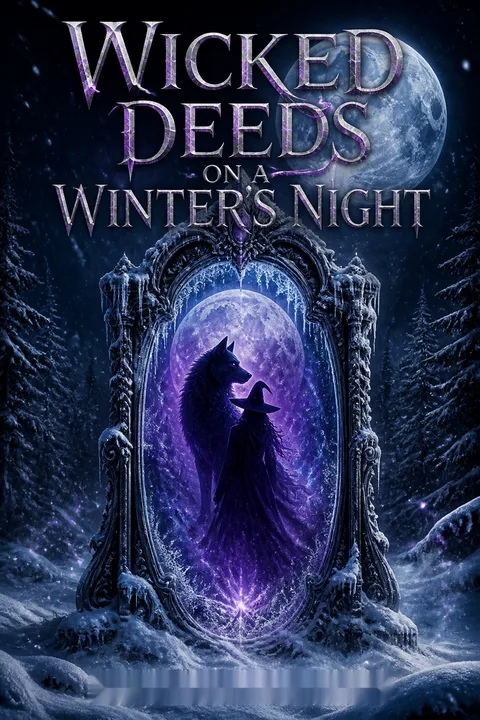


Plot Summary
Prologue
In 1827, Mariah flees the man she loves when the full moon turns Bowen MacRieve into a wolf-like beast. She falls in the forest and is fatally impaled on a felled tree.
Before Bowen can reach her, a strange presence ends her life; he arrives to find her dead and howls his grief beneath the moon. Ravens circle overhead, witnesses to a loss that will govern his choices for generations.
Mariah's death begins as an accident of fear and terrain, but the unexplained presence makes it feel arranged, a private tragedy touched by a larger design. Bowen's warning could not protect her because love cannot cancel danger when the people involved do not yet understand it. His grief becomes a fixed point in time: he measures later choices against the moment he failed to reach her. The ravens suggest that the forest is being watched, though their purpose remains uncertain.
The Tomb and the Key
At the Talisman's Hie, an immortal scavenger hunt, witch Mariketa the Awaited and Lykae warrior Bowen meet inside a Guatemalan tomb. Bowen seeks the grand prize, a key that can alter the past and might let him save Mariah. Mariketa wants to prove herself, despite being a mortal with unstable magic.
Their attraction overwhelms Bowen's long-held resolve to remain faithful to his dead beloved, and he kisses Mariketa, then accuses her of enchanting him. When she refuses to leave the contest, he takes a Mayan prize and seals the tomb's stone entrance, trapping her and four other competitors. In fury, Mariketa casts a curse that strips him of his power to heal. Bowen leaves them buried.
The contest makes each character's private desire visible under pressure. Bowen treats the key as a way to undo grief, while Mariketa sees the Hie as a chance to establish worth beyond her reputation as a future prodigy. Their kiss is both genuine attraction and a rupture in Bowen's self-image. His decision to seal the tomb converts his fear of enchantment into actual cruelty; Mariketa's curse is not a romantic gesture but a desperate weapon against a stronger opponent.
The Prisoners Below
Trapped beneath the jungle, Mariketa and the others learn from elven archer Tera that the tomb is a prison for six incubi, demons confined there for centuries. The creatures attack, targeting Mariketa, and drag her to a high ledge above the group.
For three weeks she endures darkness, illness, and their brutal attempts to keep her alive, while Tera, her brother Tierney, fellow archer Hild, and demon brothers Rydstrom and Cade search for a way to reach her. The incubi seem to recognize her power and want her to destroy them, though she cannot yet control her magic. Bowen, unaware of their continued captivity, has already abandoned them and is pursuing the Hie's final prize.
The tomb's horror grows from an inversion of Mariketa's public identity. Others expect the Awaited witch to command immense power, but captivity exposes the gap between potential and control. The incubi are not simply monsters to defeat: their attacks carry the desperation of beings who know what they have become and want release. Meanwhile, the surviving competitors form a fragile community across species lines, contrasting Bowen's choice to treat them as expendable obstacles.
The Key Lost in Fire
At the Hie's last trial, in a volcanic cavern in Hungary, Bowen reaches the prize after suffering a curse that prevents his injuries from healing. A mine blast has left him half-blind and badly wounded.
He frees vampire Sebastian Wroth from a boulder so the younger vampire can trace them across a lava pit, expecting a fair race for the blade. Sebastian takes it first. When Bowen tries to stop him with a whip, the blade cuts off Bowen's hand, and Sebastian escapes with the victory.
Bowen is trapped beside the deadly fire until his cousin Lachlain arrives with Sebastian and rescues him. He learns that Sebastian used the key twice to restore Valkyrie Kaderin's dead blood sisters, then hears the competitors he sealed in the tomb never returned.
Bowen's defeat is not a simple reversal of fortune. He chooses to help Sebastian, then loses the contest because his body has been weakened by the very curse he once dismissed as harmless. His willingness to rescue a rival offers a glimpse of honor beneath his ruthlessness, though it arrives too late to win him the past he wants. The news that the tomb's prisoners remain missing makes the cost of his earlier decision impossible to ignore.
The Tomb Opens Again
Despite his injuries, Bowen returns to Guatemala after learning the trapped group has not escaped. A battle is raging inside the tomb when he reaches it. He lifts the massive entrance stone with one hand and pulls Mariketa out, battered and nearly unconscious. Once awake, she recognizes him and blasts him against the ruins with newly unleashed magic.
Her next strike demolishes the entire prison, killing the incubi and opening a vast chasm beneath it. The survivors flee the collapsing ground. Bowen carries Mariketa up a vine while the others escape below, and she uses her power to remove the curse that had made him mortal. In the sudden danger, she discovers that healing him is within her reach.
Mariketa's eruption changes the balance between captor and captive, but it does not erase what Bowen did. Her destructive power is protective and lethal at once, finally matching the scale of the expectations placed on her. Bowen's return is consequential because it saves her, not because it earns forgiveness. The tomb's collapse also turns their conflict into physical dependence: he must carry her to safety, while she must restore the body he lost through her curse.
A Bargain in the Cave
After the survivors reach a cave, Mariketa wakes among Rydstrom, Cade, Tera, Hild, and Tierney. Bowen says a Valkyrie seer, Nïx, believes Mariketa placed a second spell on him, making him feel she is his destined mate. Mariketa cannot confirm or undo it, and Bowen insists she travel with him until she can contact her coven before the full moon.
The other survivors distrust him, but accept his food and protection as they prepare to leave the jungle. Bowen retrieves Mariketa's belongings and uses them to persuade her into a temporary arrangement. His practical care unsettles her more than his insults did: she has survived his betrayal, but does not know what to make of his sudden attention.
The bargain replaces force with an uneasy negotiation, though the power between them remains unequal. Bowen frames protection as a practical necessity, but his insistence that Mariketa travel with him also serves his need to keep her close. Mariketa accepts material help without conceding emotional trust. Her refusal to decide what his feelings mean preserves a small area of control in a journey where food, safety, and the route out of the jungle depend on others.
The Mirror Witch
At a mountain cave, Mariketa finds a letter from Nïx containing a cryptic rhyme. When she recites it over the still water, her reflection moves independently and identifies her as a rare captromancer, a witch who can use mirrors to focus magic and travel. A reflected hand offers her an apple, but Bowen interrupts before she takes it.
The next morning, Mariketa consults the mirror again and accepts the fruit, which leaves her stronger and helps her focus her power. Bowen distrusts the mirror and asks her not to use it near him. As the group begins the dangerous trek east, Mariketa keeps the new ability largely secret, while her reflected guide promises knowledge she cannot yet measure.
The mirror gives Mariketa a new route into power, but its guidance is not straightforwardly safe. Unlike the explosive magic she has known, reflection offers concentration and information, precisely the things she lacks. Bowen's alarm reflects his prejudice toward witchcraft, yet the book also gives him reason to fear an unknown force acting through her. The apple carries a double charge: knowledge and temptation, a useful gift whose price has not been explained.
The Cenote Kiss
As the group crosses the jungle, Bowen clears paths, carries Mariketa over obstacles, and watches her closely. She tests her new focus by playing small magical tricks on him, until a real snake sends her power wild and hurls him through the brush. Later, at a sunlit limestone pool, Cade's attention toward Mariketa provokes Bowen into a brutal fight with the demon.
Rydstrom breaks them apart before either can kill the other. Bowen carries Mariketa to a secluded cenote, furious that another male has been near her. Instead of resisting his kiss, Mariketa chooses it. They make love, and Bowen takes her willingness as proof that their bond may be real, though she still has not agreed to belong to him.
The cenote scene brings desire and possession into dangerous proximity. Bowen's jealousy makes his assumptions about Mariketa plain, while her choice to kiss him is a genuine act of agency, not proof that she accepts his claims. Their attraction is powerful enough to soften the hostility, but the fight with Cade shows how quickly Bowen converts fear of losing her into violence. Intimacy begins here, yet trust remains unfinished.
The Bridge Breaks
The group reaches a narrow wooden bridge spanning a deep gorge. Mariketa's fear of heights nearly stops her, but Bowen stays close and helps her begin crossing without making her surrender to being carried. An earthquake then tears the bridge apart. Bowen hooks one arm around her and catches the rope, keeping her from plunging into the ravine.
He climbs them back to solid ground, and Mariketa clings to him in relief. The ordeal shifts something between them: Bowen tells her he has decided not to use the key to return to Mariah, and that he wants a future with Mariketa. She does not promise him one, but accepts that his choice is beginning to matter to her.
The bridge turns trust into a bodily fact. Mariketa cannot debate Bowen's intentions while suspended over the gorge; she must rely on his strength, and he uses it to keep her alive rather than to control her. His declaration follows the rescue, but the rescue does not settle their future. The distinction matters: dependence can open the door to trust, yet it cannot substitute for Mariketa's eventual choice.
The Beast in the Bunker
Fearing that the full moon will make him dangerous, Bowen sends Mariketa away from him. Soldiers capture her and take her to a fortified bunker, where she realizes they mean to keep her as a captive. Bowen tracks her scent, finds the bunker, and tears through its armed guards in his transformed state.
When he kills the leader who struck her, Mariketa panics and flees in a stolen truck. The vehicle slides toward a ravine; Bowen catches it, cuts her free, and shields her as they fall into a river. Once they reach shore, she uses magic to bind him, then discovers she can heal his bullet wounds. For the first time, she sees his violence as protection rather than a threat to her.
The bunker forces Mariketa to confront the difference between Bowen's capacity for violence and his purpose in using it. His transformation is terrifying, and her flight is a reasonable response, not a failure of love. The rescue changes their interpretation of one another: Bowen risks himself to protect her, while Mariketa chooses to approach him once she can control the encounter. Her healing power makes care reciprocal instead of one-sided.
The Moon Claims Them
After restoring Bowen's injuries, Mariketa keeps him bound while she decides how close she can bear to come. She explores his transformed body, then chooses to take him as the full moon's influence intensifies. Bowen breaks free as the moon takes hold and claims her in a fierce encounter, leaving the permanent bite mark of a Lykae mate.
By morning, he has called her Mariah in his sleep. Mariketa leaves for a Belize resort, hurt that she may still be a substitute for his first beloved. Bowen finds her there and explains that his guilt over Mariah's death had shaped his response. He admits he now wants Mariketa. They reconcile, then spend two weeks together on his private island.
The intimacy is mutual, but it occurs amid a significant imbalance: Bowen's transformation gives him overwhelming physical power, so Mariketa's earlier decision to bind and study him matters. The morning name cuts through the romance because it confirms her fear of being second choice. Bowen does not erase the harm with an explanation; he names his guilt and admits that his attachment has changed. Their reconciliation rests on her willingness to return, not on the bite alone.
The Island Cannot Hold Them
On the island, Bowen and Mariketa build a happier life, but he asks her to stop consulting the mirror and to give up magic. Mariketa hides her continued visits, and Bowen discovers a pile of apples that reveals her deception. He explains that a witch once caused the deaths of five of his uncles and ruined his father, then insists that Mariketa's magic is a choice she should abandon.
She refuses to erase a central part of herself or her responsibility to the House of Witches. When Bowen will not accept that, Mariketa leaves by water taxi. He follows her onto a small plane, but their disagreement remains unresolved, leaving their bond vulnerable just as an unseen danger closes in.
The island's comfort exposes the limits of attraction as a solution to inherited prejudice. Bowen's fear has a history, but he turns that history into a demand that Mariketa amputate part of her identity. She is tempted by a life of ease with him, yet knows that accepting it would mean abandoning her calling. Her departure is not a rejection of love so much as a defense of the self she has struggled to become.
The Pilot Disappears
During the flight back toward the mainland, Bowen's unease prompts Mariketa to question her mirror. Its answer reveals that the demon pilot has vanished. The controls are wrecked and the plane is losing fuel, so Bowen holds Mariketa as they crash into the sea. He drags her from the water, but the impact has badly injured her.
Lachlain's rescue helicopter brings them to the Lykae compound, where Bowen refuses to leave her bedside. Mariketa's coven supplies magic to keep her alive, but her body remains broken until protective vines cover her and heal her. When she wakes, Bowen is still there. Before they can repair their relationship, Mariah appears at the house, apparently restored from death.
The crash makes the cost of their unresolved conflict immediate: they are physically together, but neither has repaired the rupture over Mariketa's magic. Bowen's vigil demonstrates care through persistence rather than command. Her recovery through the vines links her power to the natural world she has only begun to understand. Mariah's sudden return then threatens to reopen Bowen's grief at precisely the moment Mariketa is most vulnerable.
The Face in the Mirror
Mariah says a sorceress restored her and asks Bowen to honor their old bond. He cannot answer at once, and Mariketa, fearing she has been passed over again, enters her mirror rather than wait for his choice. In the witch's hidden dimension, her mentor Elianna reveals the deeper truth: Mariketa's parents, Jilian and Warren, were not willingly absent.
The sorceress Häxa trapped them in torment, and Mariketa is meant to oppose her. Elianna explains that Mariketa's captromancy can draw knowledge and power through mirrors. Mariketa trains in her own dimension and learns Häxa may be using Mariah's appearance to torment Bowen and feed on his grief. She decides to face the sorceress, while her friends watch from the other side.
Mariketa's entry into the mirror is both retreat and self-assertion. She cannot force Bowen to choose her, so she leaves the scene and seeks knowledge beyond the romantic triangle. The revelation about her parents reframes childhood abandonment as a false story that has shaped her self-worth. Her new purpose is not simply to win Bowen back: she must decide whether she can bear the power and responsibility her family concealed from her.
Häxa's Borrowed Face
Mariketa discovers that the apparent Mariah is Häxa, an ancient sorceress who feeds on misery. Häxa reveals that Mariah once wished to possess Bowen, and that the sorceress engineered the original union, Mariah's death, and Bowen's long grief to create suffering. She also admits that she arranged later dangers around Mariketa and Bowen.
Mariketa attacks with mirror-focused magic, while Bowen struggles against a binding that keeps him from intervening. Häxa overwhelms Mariketa and threatens to kill her, but Mariketa uses a mirror as a shield, reflecting Häxa's own destructive power back at her. Häxa is destroyed. The victory releases her captive souls, but the power she leaves behind overwhelms Mariketa and pulls her back into the mirror.
The revelation turns Bowen's two-century grief into the product of deliberate manipulation, without making his pain unreal. Mariketa's victory depends on using the very medium that tempts and endangers her: the mirror can teach, focus, and defend, but also consume her attention. She defeats Häxa through tactical understanding rather than superior force. Yet victory leaves her with a new danger, showing that taking power and mastering it are separate achievements.
The Familiar Finds Her
Mariketa becomes trapped before her mirror, unable to look away from the knowledge flowing through it. Bowen searches for a way to reach her and realizes that a witch's familiar can be a protector; as Mariketa's Lykae protector, he enters her family's dimension through her room at Andoain.
He persuades her to turn from the mirror by reminding her of their life together and the love he has chosen freely. Her parents and coven bind Häxa's power so Mariketa can use it without being consumed. She tells Bowen she loves him, and he promises to accept her magic as part of her. Six months later, they share a home between Scotland and New Orleans, and Bowen accompanies her on her work as a witch.
Bowen's arrival completes his change from wanting to possess Mariketa to learning how to accompany her. He reaches her not through strength or a claim, but by accepting the role of protector within her world. The binding acknowledges that power cannot be removed without cost; it must be approached with limits and care. Mariketa's choice of him is finally grounded in mutual recognition, while their divided home makes room for both his clan and her calling.
Epilogue
Six months later, Mariketa and Bowen celebrate the winter solstice in Scotland. She has become immortal, helps organize her coven, and takes freelance magical work; Bowen has arranged their life between his Scottish home and New Orleans, with a mirror to make the journey possible.
They play in the snow outside his lodge, where an orchard has been planted for her. Bowen still checks that she is safe, but Mariketa meets his protectiveness with affection and mischief. The future they once argued over now has room for both her work and his home.
The ending does not ask either lover to surrender a defining part of life. Mariketa remains active in her coven, while Bowen learns to support rather than replace that commitment. Their mirror and shared homes make the relationship practical across different worlds, not merely passionate within a secluded refuge. The orchard echoes the dangerous apples that first drew Mariketa toward knowledge, but here the trees are planted openly and shared. What once signaled temptation becomes part of a chosen domestic future.
Analysis
The novel treats destiny not as a clean answer but as a pressure that can be confused with coercion. Bowen's belief that Mariketa is his mate initially gives him grounds to claim, protect, and direct her; Mariketa's magic makes the question even less certain. Their attraction is real, but the story repeatedly tests whether desire can survive without turning into ownership. The decisive measure is not the intensity of their bond but whether Bowen can accept the parts of Mariketa that frighten him.
Mariketa's growth follows a parallel problem: she is praised for a power she cannot control, then judged for using it imperfectly. The mirror offers knowledge and technique, yet threatens to consume the attention it enables. Her confrontation with Häxa makes mastery a practice of limits, not simply a rise in strength. She wins by learning how to redirect power, and her recovery depends on accepting help from others rather than treating isolation as proof of competence.
The abandoned-child wound gives both romance and ambition their emotional charge. Mariketa fears being replaceable; Bowen clings to the past because guilt has become a substitute for a future. Häxa exploits those wounds by arranging situations that intensify grief and rejection. The eventual revelation does not erase responsibility: Bowen still made choices that hurt Mariketa, and she still must decide whether to trust him. Their resolution becomes meaningful because he chooses her without needing to reverse history, while she keeps her calling instead of making love the price of abandoning herself.
The novel's supernatural conflicts therefore echo its intimate ones. Curses, mirrors, and transformations externalize ordinary questions of consent, inheritance, and self-command. Magic can injure, protect, or open a route forward, but no power can make another person's choice ethically irrelevant. The ending's shared homes and work suggest that lasting intimacy is not fusion. It is a negotiated life in which distinct loyalties remain intact.
Review Summary
Wicked Deeds on a Winter's Night receives mostly positive reviews, with readers praising the chemistry between Bowen and Mariketa, the witty dialogue, and Cole's world-building. Many enjoy the enemies-to-lovers trope and the Scottish accent. Some criticize Bowen's behavior and the age gap between characters. The book is often cited as a favorite in the series, with readers appreciating the plot twists and steamy scenes. A few reviewers find the relationship dynamics problematic, but overall, the book is considered entertaining and addictive.
People Also Read


Characters
Mariketa
Untrained witch prodigyMariketa is a young witch raised among the New Orleans coven, where people expect her to become the most powerful witch of her generation. Her magic is broad but unreliable, and she copes with that gap through humor, bravado, and a refusal to be treated as fragile. Having been left by both parents, she is especially alert to signs that someone might choose another life over her. Her curiosity and loyalty draw her toward friends and new experiences, while her ambition pushes her into the dangerous Talisman's Hie. She wants more than recognition: she wants control over her abilities and the right to decide what her future will contain.
Bowen MacRieve
Grieving Lykae warriorBowen is a Scottish Lykae warrior, a formidable fighter whose life has been shaped by the death of a woman he loved. He is blunt, proud, and quick to answer fear with force. His distrust of witches is rooted in a family tragedy, yet it also protects him from confronting how little control he has over grief and desire. Bowen prizes loyalty and physical care, but often mistakes protection for the right to decide for someone else. His persistence, fierce sense of responsibility, and capacity for tenderness complicate his intimidating manner. He must learn whether love can mean making room for another person's power rather than containing it.
Mariah
Fey princess from Bowen's pastMariah is a fey princess who loved Bowen before the events of the main story. Her history is central to his grief and his determination to change the past. She is associated with the expectations of courtly life and with the ideal Bowen has carried through centuries of loss. Her story also reflects how desire can be shaped by forces that those involved do not understand.
Häxa
Witch of false facesHäxa is an ancient sorceress feared in witch lore for her ability to assume other forms and exploit suffering. Stories about her make her a measure of the danger Mariketa may one day face. She represents a threat that works through deception and emotional pressure as much as through direct magical force.
Rydstrom
Displaced demon kingRydstrom is a powerful rage demon and the rightful king of his people, though he has lost his throne. He remains measured under pressure and acts as a stabilizing presence among the trapped competitors. His history with Bowen makes him willing to see more than the Lykae's worst decisions, while his concern for Mariketa keeps that loyalty from becoming blind.
Cade
Ruthless demon mercenaryCade is Rydstrom's younger brother, a mercenary whose blunt pragmatism contrasts with Rydstrom's royal bearing. He is alert to opportunity and suspicious of claims that others make about themselves. His interest in Mariketa and his rivalry with Bowen sharpen tensions inside the group, while his actions show that self-interest can coexist with moments of protection.
Tera
Elven archer and translatorTera is an elven archer who can understand languages others cannot. She reads the tomb's inscriptions, helps the group interpret its danger, and treats Mariketa as kin through their shared fey ancestry. Her competence is practical and quiet, making her a source of clarity when the others are trapped in unfamiliar territory.
Tierney
Hotheaded elven archerTierney is Tera's brother and one of the elven competitors in the Hie. He brings quick temper, fighting skill, and a protective bond with his sister to the group. His readiness to challenge Bowen reflects the distrust the Lykae's choices have earned.
Hild
Quiet elven scoutHild is an elven archer whose quiet observations make him a useful scout. He notices dangers and carries information beyond the immediate group. His restrained manner contrasts with the more openly combative competitors.
Nïx
Eccentric Valkyrie seerNïx is an ancient Valkyrie whose scattered manner disguises an uncanny command of foresight. Her cryptic guidance nudges other characters toward discoveries they are not ready to understand. She is connected to both Mariketa and Bowen, but rarely explains the full purpose of her interventions.
Elianna
Mariketa's witch mentorElianna is an older witch who has helped raise and train Mariketa. Kind and sometimes bewildered, she offers practical lessons about magic while withholding truths she believes Mariketa is not ready to bear. Her role combines surrogate parent, teacher, and keeper of the coven's history.
Carrow
Rebellious witch friendCarrow is Mariketa's bold, irreverent friend and a talented witch in her own right. She treats witchcraft as a source of pride rather than embarrassment and stands ready to defend Mariketa. Her humor gives Mariketa a familiar point of connection when danger and responsibility threaten to overwhelm her.
Lachlain
Bowen's Lykae cousinLachlain is Bowen's cousin and the Lykae king. He is protective of Bowen but willing to challenge his self-destructive choices. His relationship with a woman outside his own kind gives him perspective on the conflicts Bowen faces, though he does not simply excuse his cousin's behavior.
Sebastian Wroth
Vampire Hie competitorSebastian Wroth is a vampire competing in the Hie for reasons tied to Valkyrie Kaderin. His rivalry with Bowen is fierce, but he is not governed by the same factional loyalties as the Horde. His actions in the final contest shape Bowen's fate.
Emma
Lachlain's Valkyrie mateEmma is Lachlain's mate, a half-vampire and half-Valkyrie woman with close ties to the Valkyries. She helps coordinate support for Bowen and Mariketa and brings warmth to Lachlain's otherwise imposing household.
Jilian
Mariketa's fey motherJilian is Mariketa's fey mother, a druid whose absence has shaped her daughter's understanding of family. Her choices are bound to forces Mariketa does not initially know, and her relationship with her daughter carries both love and the pain of withheld truth.
Warren
Mariketa's warlock fatherWarren is Mariketa's warlock father, remembered through a childhood marked by affection and later absence. His magical abilities and responsibilities belong to a larger struggle than Mariketa has been told about.
Plot Devices
The Talisman's Hie
Contest that tests desireThe Hie is an immortal scavenger hunt held once every 250 years. Competitors seek magical prizes through dangerous tasks, with trickery allowed and killing permitted in the final round. Its grand prize, Thrane's Key, can send its holder back in time twice. The contest gives Bowen a chance to alter his past and gives Mariketa a rare opportunity to prove herself, while forcing the two into direct competition.
The paired spells
Desire clouded by uncertaintyMariketa curses Bowen so he cannot regenerate, then Bowen believes she has also made him feel she is his mate. The second spell becomes a source of conflict because neither can initially establish whether it is real, accidental, or tied to their deeper bond. The uncertainty magnifies their attraction while giving Bowen an excuse to demand closeness and Mariketa reason to distrust it.
The captromancer's mirror
A doorway to powerA mirror helps Mariketa focus her magic and communicate with a reflection that offers knowledge through riddles and apples. It later serves as a shield and a passage between worlds. The mirror makes her abilities more usable, but its access to knowledge can become compulsive, so each gift carries the risk of losing control.
The full moon
Lykae instinct made visibleThe full moon intensifies Bowen's transformation, strengthening the animal side of his Lykae nature and making his protective and possessive impulses harder to control. Its arrival creates a deadline for Mariketa's journey and a danger neither can solve by ordinary negotiation. The moon also makes Bowen's vulnerability visible: he fears harming the person he wants to protect.
The Accession
Destiny under pressureThe Accession is a recurring conflict among immortal factions, a mystical cycle that can bring upheaval and shape encounters. It frames the novel's coincidences and escalating dangers, while making the return of old forces possible. Characters understand only fragments of its workings, so it functions less like a predictable rulebook than pressure gathering behind their personal choices.
Immortals After Dark Series







About the Author
Download PDF
Download EPUB
.epub digital book format is ideal for reading ebooks on phones, tablets, and e-readers.








