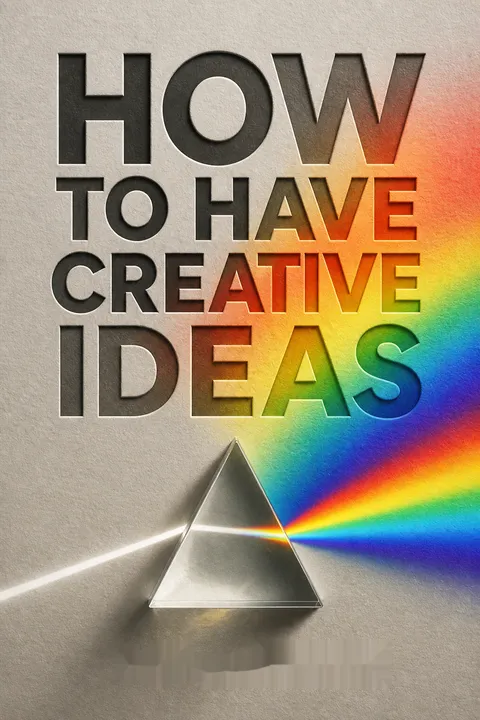


Key Takeaways
Treat idea-making as a trainable skill, not a rare artistic gift
Practice beats mystique. De Bono separates the ability to invent useful ideas from artistic creativity, which also depends on aesthetic judgment. A person need not become a musical genius to learn how to generate fresh approaches to a problem. The book treats creativity as a mental skill, much like cooking or sport: people start at different levels, but practice can improve everyone’s ability.
Use the skill deliberately. The 62 exercises are designed to build habits of mind, not to supply a collection of clever answers. De Bono argues that removing inhibition can help, but it is not enough. A person freed from a rope still cannot play the violin without learning how. Likewise, confidence or an open atmosphere cannot replace tools and practice.
The distinction between generating ideas and producing art is valuable because the two abilities are often blurred together. It makes creativity teachable without pretending that technique alone can manufacture artistic excellence. The comparison to sport also carries an important implication: competence grows through repeated attempts, not by waiting for inspiration. Still, the exercises are better understood as training in idea generation than as a complete account of creativity. Expertise, judgment, and the ability to revise an idea remain essential when a promising possibility has to work in the world.
Use an arbitrary word to escape the routes your problem already suggests
Start from the edge. Lateral thinking means deliberately changing the concepts and perceptions used to approach a question, rather than simply reasoning harder within familiar assumptions. De Bono’s Random Input method gives the mind an unexpected starting point. A Random Word is a noun selected without choosing it for its relevance to the task. The thinker then uses it to generate ideas for a clearly defined focus.
Follow the first prompt. For a new restaurant, the word cloak might suggest disguise, hidden food, or a themed dining experience. The point is not to find a tidy link between cloak and restaurant, but to let the word provoke several directions. De Bono reports that this method helped a workshop generate 21,000 ideas for a steel company in one afternoon. He advises using the first word rather than fishing for an easier one.
An unrelated prompt can interrupt mental fixation: once a person settles into one interpretation, familiar associations tend to reinforce it. The method creates a structured detour, which resembles how design teams use analogies to discover features beyond a product’s obvious function. Its strongest safeguard is the insistence on a clear focus. Without one, free association can become entertaining but aimless. And a high count of ideas is not proof of quality; selection, testing, and knowledge of the problem are still needed to turn generated possibilities into useful choices.
Make room for plausible possibilities before demanding certainty
Facts do not interpret themselves. De Bono argues that progress needs more than collecting and analyzing information. People also need hypotheses, speculative explanations, and alternative ways to combine facts. He calls attention to possibility because institutions often reward certainty and established evidence while neglecting what might be true.
A medical reversal illustrates the stakes. Barry Marshall proposed that peptic ulcers could be caused by infection, despite the common objection that stomach acid would kill bacteria. The idea was dismissed for years. The book recounts that infection was eventually recognized as the cause, making antibiotic treatment possible instead of long-term antacids or major stomach surgery. The lesson is not that every unusual hypothesis is right. It is that an initially awkward possibility can be worth investigating rather than rejecting on the basis of current assumptions.
This is a useful correction to data-driven decision-making: evidence needs questions and models to become knowledge. In science, a hypothesis is not a rival to facts but a way to organize observations and invite a test. The ulcer story shows how a plausible mechanism can be obscured by an entrenched assumption. At the same time, possibility must not become a license for unsupported belief. The productive sequence is to generate alternatives, identify what each predicts, and check those predictions. Open-mindedness without standards is credulity; standards without imagination can preserve a mistake.
Practice seeing the same object through different concepts and values
Perception can be trained. De Bono calls this perceptual creativity: the ability to find different relationships, functions, meanings, or values in familiar things. Many exercises use random words to make this ability concrete. A player might group unrelated words by a shared quality, identify several ways two items connect, or decide which item has the greatest value under a chosen criterion.
Change the question, change the answer. In one exercise, a set including cap, graduate, critic, concrete, and algae can be assessed as most useful, most dangerous, cheapest, or most durable. Different criteria lead to different choices. Another exercise asks players to find a second response to a word, beyond the first obvious association. Answers must still be defensible: creativity means expanding the range of reasonable interpretations, not declaring that anything can mean anything.
These exercises train a form of cognitive flexibility: shifting the frame used to classify or evaluate an object. That capacity matters in negotiation and design, where two people may disagree because they are judging different values rather than disputing the same fact. The explicit criterion is especially helpful because it makes a judgment inspectable. The limitation is that some connections can be stretched until they become merely possible. De Bono’s insistence on explaining the basis for a link is therefore more than a game rule; it is a check against mistaking verbal cleverness for insight.
Turn surprising combinations into designs that deliver real value
Novelty is not the finish line. De Bono calls the work of putting ideas together to produce value constructive creativity. Exercises ask players to combine two random words into a business, improve one item with another, or use several words to design a service. In one example, dock and cabin prompt the idea of places where travelers can conveniently connect or store items such as cameras and computers.
Make the idea earn its place. A combination counts only if its purpose is clear and it can plausibly work. In the business exercise, players must explain how the venture would operate and why it might make money. Other variations allow a public or environmental benefit instead of profit. This shifts the test from “Is it different?” to “What value does it create, for whom, and how could it be delivered?”
The insistence on value distinguishes useful creativity from novelty for its own sake. It also connects ideation to design: a concept becomes stronger when its users, operation, and benefits can be described. The business test is intentionally concrete, although profitability is only one possible measure of success. A public service may create value through access or safety, while an artistic experiment may matter for reasons that are difficult to price. The broader lesson is to name the intended benefit and judge feasibility against that purpose, rather than treating commercial success as the only valid outcome.
Use creativity to improve what works, not only to repair what fails
Problems are only one target. The book distinguishes problem-solving, where the aim is to remove a difficulty, from task-achieving, where the aim is to create something valuable. Creative thinking can also improve a process that is not obviously broken, simplify an operation, or open a new direction. Exercises invite players to apply random words to tasks such as designing a restaurant, creating a sport, or automating a function.
Look for consequences, not just cleverness. One exercise tests a policy proposal by using successive random words to explore its effects. A proposal to raise the pension age, for example, is considered through questions about people unable to work, possible employment, and whether a universal rule fits individual circumstances. The word prompts are starting points for analysis, not proof that a policy is sound.
This broad view resembles continuous improvement in engineering, where a functioning system can still be redesigned for speed, access, or resilience. It also guards against a common bias: attention is drawn to visible failures, while opportunities to create new value remain unnoticed. The policy exercise adds a useful discipline by asking how a proposal affects different circumstances. However, imaginative consequences should be separated from evidence about actual outcomes. A prompt can reveal questions worth asking, but decisions still require data, stakeholder input, and practical evaluation.
Constrain stories with random inputs to make imagination do useful work
Limits can generate momentum. Several exercises use random words as ingredients in a story. Players may see all the words at once, or receive them one by one and continue the narrative without knowing what comes next. One example begins with a patrol, a wasp, a lasso, and a drug, then turns their collision into a comic escape and a point about ineffective pursuit.
Different constraints train different muscles. Other games assign each word a role, such as setting, characters, plot, or ending. Still others ask for a children’s tale, an advertising concept, or a newspaper headline that includes specified words. The words are not decorations to list; they must contribute to a coherent result. This makes the exercise both playful and purposeful, with the constraint forcing the writer to connect ideas that would not ordinarily meet.
The storytelling exercises show how constraints can reduce the burden of beginning. Instead of facing an unlimited blank page, the writer has a small set of ingredients and a clear task. This principle appears across creative fields, from formal poetry to product briefs: boundaries can focus attention and make invention more tractable. The exercise is especially effective for fluency and recombination, though it does not by itself teach every craft skill required for a compelling story or advertisement. The constraint starts the work; revision determines whether the result holds together.
Train creativity with short, repeated exercises, then judge ideas by fit
Treat the book as a gym. De Bono’s 62 games are meant to be used, repeated, and adapted, not simply read for information. He recommends doing at least one exercise regularly, setting a time limit of about four or five minutes at first, and shortening it to two or three minutes as skill grows. Readers can begin with the supplied problems before bringing in their own, which prevents them from choosing only easy challenges.
No single answer does not mean no standards. A valid response must satisfy the exercise’s requirements. Some ideas will be more practical, more unusual, or more valuable than others. Keeping a record can help a player notice progress and preserve ideas for later development. The goal is not to solve each game once, but to build a repeatable habit of producing and assessing alternatives.
The book’s most credible promise is behavioral: regular practice makes creative moves more available when a real problem appears. Short sessions lower the barrier to starting, while time limits encourage quick exploration rather than endless polishing. The scoring principle also matters. Treating every answer as equally good would confuse permission to experiment with an absence of judgment. A strong routine therefore alternates expansion and evaluation: generate several possibilities, then select according to the task’s actual constraints. The exercises offer a starting structure, but transfer depends on deliberately applying the habit to work and daily decisions.
Analysis
This book is best understood as a workbook with a theory attached. Its central contribution is not a single master recipe for originality, but a large repertoire of prompts that make people practice moving between concepts, associations, values, and practical designs. The Random Word method is the clearest example: an arbitrary noun interrupts the path of least resistance, while a defined focus keeps the detour connected to a purpose. The 62 exercises broaden that practice beyond business problems into evaluation, storytelling, advertising, and design.
The distinction between perceptual and constructive creativity gives the collection useful shape. First, people learn to notice more possible interpretations and relationships. Then they learn to combine elements into something intended to work. This is a strong corrective to education and workplaces that often reward analysis while treating invention as mysterious. The exercises also make a persuasive case that creativity and discipline are compatible. A prompt, a time limit, and a requirement to explain the connection can produce more purposeful exploration than an unstructured demand to be imaginative.
The book’s account of the brain as a self-organizing pattern system is an explanatory model, not a demonstrated proof of every claim made about creativity. Its more dependable value lies in the practical method. Random prompts can generate quantity and variety, but they cannot guarantee accuracy, usefulness, or ethical soundness. Those depend on domain knowledge, evidence, and judgment. The steel-company tally demonstrates productivity, not the quality or implementation of every idea.
The most productive use is therefore cyclical: establish a meaningful focus, generate alternatives through a deliberate prompt, assess them against the intended value, and test the strongest candidates. Used this way, the exercises are not a substitute for expertise. They are a way to stop expertise from becoming a rut, and to give possibility a disciplined place beside analysis.
Review Summary
How to Have Creative Ideas receives mixed reviews. Readers appreciate the concept of using random words to generate creative ideas, finding it fun and potentially useful for overcoming writer's block. Some praise the exercises for improving thinking skills and lateral thinking. However, critics note repetitiveness in the games and concepts, with some feeling the book offers little new material compared to de Bono's previous works. Overall, readers find it a simple yet effective tool for developing creativity, though opinions vary on its long-term value and applicability.
People Also Read
Glossary
Lateral thinking
Changing the idea routeA deliberate way of generating ideas by changing concepts, perceptions, or assumptions instead of continuing to work within the same familiar approach. In this book, lateral thinking is practiced through structured exercises, especially Random Input, to open alternative directions and possibilities.
Random Input
An unrelated prompt for ideasA lateral thinking technique in which a randomly selected word is used to stimulate ideas for a clearly defined focus. The word is not chosen because it naturally fits the problem. The thinker explores concepts, values, functions, or possibilities it suggests, then applies promising directions to the focus.
Random Word
A randomly selected nounA noun selected without regard to the problem or task under consideration. The book provides tables and several ways to select one, including dice and number maps. The first word should normally be used rather than replaced with a more convenient choice, since its unfamiliarity is meant to prompt new directions.
Perceptual creativity
Seeing things in new waysThe ability to discover different meanings, relationships, functions, concepts, and values in things that may already be familiar. Exercises in perceptual creativity ask players to make connections, find alternative interpretations, compare values, or organize words according to a defensible principle.
Constructive creativity
Combining ideas to create valueThe process of putting concepts, objects, or possibilities together to produce something useful or worthwhile. The book applies it to business ideas, stories, designs, and solutions. Novelty alone is insufficient: the result should have a defined value and, where relevant, a plausible way of working.
Operating concept
The action driving a processA core idea about how something functions or produces results, rather than a description of its appearance. In the book’s exercise, players look across several random words for a shared underlying operation, such as organizing a system, supporting activity, or applying force.
Provocation
A prompt before its rationaleA deliberate statement or input that may not have an obvious reason for being introduced. Its purpose is to create a new starting point; a useful direction may become apparent only after exploration. De Bono presents Random Input as one example of this approach to generating possibilities.
FAQ
What's "How to Have Creative Ideas" about?
- Purpose of the book: "How to Have Creative Ideas" by Edward de Bono is designed to help readers develop their creative thinking skills through a series of 62 games and exercises.
- Focus on creativity: The book emphasizes that creativity is not just a talent but a skill that can be learned, practiced, and applied in various aspects of life.
- Use of Random Words: A central technique in the book is the use of Random Words to stimulate new ideas and perspectives, which is a fundamental part of de Bono's lateral thinking approach.
- Practical application: The exercises are intended to be practical and enjoyable, allowing readers to engage in creative thinking regularly.
Why should I read "How to Have Creative Ideas"?
- Develop creative skills: The book provides tools and exercises to enhance your ability to think creatively, which is valuable in both personal and professional contexts.
- Structured approach: Edward de Bono offers a systematic method to creativity, making it accessible to everyone, regardless of their natural creative abilities.
- Versatile applications: The skills learned can be applied to problem-solving, innovation, and generating new ideas in various fields, from business to education.
- Enjoyable learning: The exercises are designed to be fun and engaging, making the process of developing creative skills enjoyable.
What are the key takeaways of "How to Have Creative Ideas"?
- Creativity as a skill: Creativity is not an innate talent but a skill that can be developed through practice and the use of specific techniques.
- Random Word technique: Using Random Words to stimulate new ideas is a powerful tool for lateral thinking and can lead to innovative solutions and perspectives.
- Importance of practice: Regular practice of the exercises in the book can help develop creative habits of mind and improve overall thinking skills.
- Value of possibility: Emphasizing the importance of exploring possibilities and alternatives, which is crucial for innovation and progress.
How does Edward de Bono define creativity in "How to Have Creative Ideas"?
- Skill, not talent: De Bono argues that creativity is a skill that can be learned and developed, rather than a talent that only some people possess.
- Logical behavior: Creativity is seen as the logical behavior of a self-organizing information system, where new ideas and patterns emerge.
- Value creation: Creativity involves bringing into existence something that has value, distinguishing it from mere novelty or repetition.
- Lateral thinking: Creativity is closely linked to lateral thinking, which involves changing perceptions and concepts to generate new ideas.
What is the Random Word technique in "How to Have Creative Ideas"?
- Definition: The Random Word technique involves using a randomly chosen word to stimulate new ideas and perspectives related to a specific focus or problem.
- Process: A Random Word is selected using various methods, and the challenge is to use this word to generate creative ideas for the defined focus.
- Logic behind it: The technique works by placing the thinker at the periphery of their usual thought patterns, allowing new pathways and ideas to emerge.
- Applications: This method can be used for problem-solving, idea generation, and exploring new directions in both personal and professional contexts.
How can "How to Have Creative Ideas" help in problem-solving?
- Structured exercises: The book provides structured exercises that encourage looking at problems from different angles and generating multiple solutions.
- Lateral thinking tools: By using lateral thinking tools like the Random Word technique, readers can break free from conventional thinking patterns.
- Creative solutions: The exercises help in developing the ability to come up with creative and innovative solutions to problems that may seem unsolvable.
- Practical application: The skills learned can be applied to real-world problems, making the book a valuable resource for anyone looking to enhance their problem-solving abilities.
What are some examples of games in "How to Have Creative Ideas"?
- Game 1 - Random Word: This game involves using a Random Word to generate new ideas for a defined focus, such as improving a business or solving a problem.
- Game 3 - Odd Man Out: Players obtain four Random Words and determine which one is the odd man out based on a chosen basis, encouraging creative thinking.
- Game 7 - Business Combination: This game involves combining two Random Words to create a new business idea, focusing on the potential for profit and value.
- Game 15 - Problem Solving: Players use Random Words to find creative solutions to predefined problems, such as reducing traffic congestion or improving customer service.
What are the best quotes from "How to Have Creative Ideas" and what do they mean?
- "Creativity is a skill that everyone can learn, practise and use." This quote emphasizes that creativity is accessible to everyone and can be developed through practice.
- "Without creativity there is only repetition and routine." De Bono highlights the importance of creativity for innovation and progress, as opposed to sticking to the status quo.
- "The brain is designed to be ‘non-creative’." This statement explains that the brain naturally forms stable patterns, and creativity requires deliberate effort to break these patterns.
- "Creativity is bringing into existence something that has value." This quote defines creativity as the creation of valuable new ideas, distinguishing it from mere novelty.
How does "How to Have Creative Ideas" relate to Edward de Bono's other works?
- Lateral thinking: The book builds on de Bono's concept of lateral thinking, providing practical exercises to apply this approach to creativity.
- Consistent themes: Themes such as the importance of possibility, the skill of creativity, and the use of structured techniques are consistent with de Bono's other works.
- Complementary tools: The Random Word technique is one of several tools de Bono has developed, alongside others like the Six Thinking Hats and the CoRT thinking program.
- Foundation for creativity: This book serves as a practical guide to developing creative skills, complementing the theoretical foundations laid out in de Bono's other writings.
What is the significance of the introduction in "How to Have Creative Ideas"?
- Importance of creativity: The introduction sets the stage by explaining why creativity is essential for personal and professional success.
- Misconceptions addressed: De Bono addresses common misconceptions about creativity, such as the belief that it is an innate talent rather than a skill.
- Role of creativity in business: The introduction highlights the growing importance of creativity in business, where innovation is key to staying competitive.
- Foundation for the book: It provides a foundation for the exercises that follow, emphasizing the need for a disciplined approach to developing creative skills.
How does "How to Have Creative Ideas" suggest using the book?
- Regular practice: Readers are encouraged to practice the exercises regularly, similar to physical exercise, to develop creative thinking skills.
- Flexible use: The book can be used individually or in groups, allowing for flexibility in how the exercises are approached.
- Log of progress: Keeping a log of ideas and progress is suggested to track development and improvement in creative thinking.
- Enjoyable process: The exercises are designed to be enjoyable, making the process of developing creativity both fun and rewarding.
What are the benefits of using Random Words in "How to Have Creative Ideas"?
- Breaks routine thinking: Random Words help break routine thinking patterns, allowing for new ideas and perspectives to emerge.
- Stimulates creativity: The technique stimulates creativity by forcing the mind to make connections it wouldn't normally make.
- Versatile application: Random Words can be used in various contexts, from problem-solving to idea generation and innovation.
- Enhances lateral thinking: This method enhances lateral thinking skills, which are crucial for creative problem-solving and innovation.
About the Author
Other books by Edward de Bono

Download PDF
Download EPUB
.epub digital book format is ideal for reading ebooks on phones, tablets, and e-readers.








