

Key Takeaways
A safety claim is only as strong as its weakest evidence link
The book's central charge. The anonymous authors argue that vaccine safety assurances rest on a chain of weak links: clinical trials they consider inadequate, limited investigation of possible injury mechanisms, passive reporting systems, contested epidemiological studies, and missing research on the full schedule. They also challenge familiar accounts of vaccines, herd immunity, and polio's history. Their recurring instruction is to inspect original sources rather than rely on institutional confidence alone.
A polemic, not a guide. The book says it does not answer which vaccines to choose or when to give them. Instead, it argues that the public has been misled and that criticism is suppressed. Those are major allegations. Showing that a method has limitations is not, by itself, proof that officials deliberately concealed harm.
The book's most useful habit is its demand for traceable evidence: Who conducted a study, what did its control group receive, and what question did it actually answer? That discipline travels well beyond vaccines. But the book often moves from defects in evidence to certainty about motive. Institutional incentives can distort research without proving coordinated fraud. Readers gain the most by separating the testable methodological questions from the authors' broader verdict.
A vaccine comparator cannot reveal a new product's absolute risk
The control group matters. A randomized controlled trial compares outcomes in a group receiving a test product with outcomes in a control group. The book argues that many childhood vaccine trials used another vaccine or a vaccine-like compound as the control, rather than an inert placebo. That can show whether one product differs from another, but it cannot directly measure the new product's risk compared with receiving no active substance. The authors propose a three-group design: new vaccine, existing vaccine, and placebo.
A contested interpretation. Their review concludes that no US routine childhood vaccine had been tested against a true placebo before approval. They also describe rotavirus trial controls containing the vaccine without its antigen, which they argue were not safety-neutral. The book interprets these choices as concealment. A trial design's limitations warrant scrutiny, but do not establish that a vaccine is unsafe or that its designers intended deception.
This is the book's clearest methodological question: relative safety and absolute safety are different estimates. Yet the choice of control is also an ethical decision. When an effective intervention already exists, withholding it can be problematic, and regulators may favor an active comparison. The best evaluation asks what each trial could establish, what it could not, and how other evidence fills the gap. One missing comparison is a reason to seek better evidence, not a verdict on the product.
Missing biological explanations justify research, not automatic causal claims
The missing mechanism. The book says medicine has not adequately investigated how many reported post-vaccination conditions might arise, who could be susceptible, or how such conditions should be diagnosed and treated. It points to the Institute of Medicine's 2011 review of 158 vaccine and adverse-event pairings: the committee found evidence supporting a causal link for 14, favoring a link for 4, rejecting one for 5, and insufficient to decide for the remaining 135.
Isaac and David. A chapter contrasts Isaac, a child whose family reports serious problems after vaccination and whose doctors struggle to identify a cause, with David, a fictional child who receives extensive screening and a tailored plan. The contrast illustrates the authors' claim that clinicians lack tools. But an unexplained illness following vaccination does not alone show that vaccination caused it; the book's own example also exposes how little can be concluded without patient-specific evidence.
The call for better diagnosis and treatment is compelling even where the book's causal conclusions are not. Clinical medicine needs ways to distinguish coincidence, known reactions, and plausible individual susceptibility. At the same time, mechanisms are not the only route to causal understanding: carefully designed population studies can contribute evidence too. A responsible research agenda would combine clinical investigation, biological work, and epidemiology rather than treating one kind of evidence as sufficient on its own.
Treat VAERS as an alarm system, not a vaccine-risk calculator
A passive reporting system. The US Vaccine Adverse Event Reporting System, or VAERS, collects reports from manufacturers, health professionals, and the public. The book emphasizes that reporting is incomplete, many reports are not verified, and the number of doses distributed is not the same as the number administered. It cites estimates that only 1 to 10 percent of adverse events may be reported, while stressing that the true underreporting rate is unknown.
The authors' criticism. They analyze a 2009 CDC and FDA study of Gardasil reports, arguing that missing information and uncertain reporting rates make its safety conclusions unreliable. They also describe a proposed electronic reporting system developed by Ross Lazarus and colleagues, which they say the CDC did not advance to a full trial. The authors view that episode as evidence of institutional reluctance; the episode alone cannot establish why the project stalled.
A database built to detect unusual patterns should not be mistaken for a population survey. That distinction is central here, and the book is right to ask what VAERS can support. But limited reporting does not make the system useless: reports can raise questions that require follow-up through other methods. The stronger lesson is to make the system's purpose explicit, improve the quality of its data, and avoid turning raw report counts into either proof of harm or proof of safety.
Audit epidemiology, but do not mistake conflicts for proof of fraud
How studies can mislead. Epidemiological studies examine patterns across groups, but their results can be distorted by poor data, selection choices, confounding, or unsuitable calculations. The book applies this critique to five studies. It argues that Madsen 2002's statistical adjustments reversed the direction suggested by raw data, that DeStefano 2013 examined antigen counts rather than the total number of vaccines, and that Grimaldi 2014 used a questionable control group. It also faults McKeever 2004 and Fombonne 2006 for dismissing or mishandling findings.
Follow the funding. The authors emphasize government and industry funding, researchers' ties, and journals' peer review limitations. They treat these features as part of a system that favors reassuring conclusions. The specific allegations about misconduct belong to the authors' interpretation of the studies, not to an uncontested finding established by this summary.
Conflicts of interest matter because they can shape the questions researchers ask and the choices they make. They are a reason for disclosure and independent scrutiny, not automatic proof that a result is false. Likewise, a study can be flawed without being fraudulent. A reader can test the book's strongest accusations by checking the original methods, data, and subsequent critiques. That standard is demanding, but it is fairer than treating either a journal's prestige or an author's suspicion as conclusive.
Demand whole-schedule studies, but do not guess their missing results
The absent comparison. The book stresses that the full childhood schedule has not been tested as a single intervention against a completely unvaccinated comparison group. It cites the Institute of Medicine's 2013 report, which said that key features of the schedule, including timing, order, frequency, and cumulative effects, had not been systematically examined. The authors argue that retrospective studies using health records could compare vaccinated and unvaccinated children.
A leap beyond the evidence. They also discuss reports about Amish communities, a homebirth medical practice, and immigrant populations as possible starting points for research. They then suggest that unpublished comparisons must show better health among unvaccinated children. That conclusion is not supported by the absence of published studies. The report's methodological and ethical concerns, and the difficulty of separating vaccination from other differences between families, make study design important, but do not make such research impossible.
The absence of a whole-schedule comparison is a legitimate research gap, especially when policy concerns cumulative exposure. Yet vaccinated and unvaccinated groups may differ in income, healthcare use, family choices, and other factors. Those differences can be measured and addressed imperfectly, but they cannot be wished away. The sound conclusion is neither that the schedule has been proven harmless nor that unvaccinated children are healthier. It is that the question deserves transparent, well-designed investigation.
Test scheduling rules instead of relying on reassuring slogans
Specific practices, specific evidence. The book questions giving several vaccines at one visit, spacing doses out, and vaccinating mildly ill children. It argues that some routine combinations have not received direct safety testing. A 2009 Israeli study by Shneyer and colleagues followed 102 children given two vaccines together and 74 given them separately; the authors report a 50 percent higher adverse-event rate in the simultaneous group. The book notes that health authorities did not pursue the finding with follow-up studies.
The 10,000 claim. The authors also challenge claims that an infant can handle thousands of vaccines at once, arguing that theoretical estimates about immune responses to antigens are not equivalent to evidence about whole vaccine products. These concerns identify questions worth studying. They do not, by themselves, show that simultaneous administration or vaccination during mild illness is harmful.
A practical guideline should be judged by the evidence behind that particular practice, not defended with a general statement about immune capacity. The Shneyer result, as presented, is a signal for replication rather than a basis for a universal rule: small studies can be affected by chance and group differences. The useful response is targeted research that measures concrete outcomes and compares realistic schedules, rather than reassurance that bypasses the question.
Separate vaccine-era timing from proof that vaccines caused the decline
Mortality fell early. Drawing on historical work by Thomas McKeown and others, the book argues that much of the decline in infectious-disease mortality in Britain and the United States occurred before vaccines and effective drugs were widely used. It points to improvements in sanitation, clean water, housing, nutrition, and hygiene. It also acknowledges that vaccines helped reduce the incidence of some diseases, including measles, pertussis, and diphtheria.
A second trend. The authors describe rising chronic illness among children, including estimates that about 8 percent had activity-limiting chronic conditions in the United States in 2010 and roughly one in four regularly used medication. They juxtapose this rise with increasing vaccine use, but the book does not establish that vaccines caused the increase. Its historical account challenges an overly simple story of vaccines alone defeating infectious disease; the timing of two trends is not evidence that one caused the other.
Public health history is rarely a single-hero story. Clean water, safer housing, nutrition, medical treatment, and vaccination can all affect disease burden, with different contributions by disease and period. The book is useful when it asks readers to distinguish mortality from incidence and to look at timing. Its argument becomes less reliable when it treats rising chronic illness alongside vaccine use as an explanation. That causal question requires evidence that can separate vaccination from other changes in society.
Herd protection requires blocking transmission, not only preventing illness
Two kinds of protection. The book distinguishes protection from getting sick from protection against infection and passing a pathogen to someone else. Herd immunity means enough people resist infection that transmission becomes difficult, indirectly protecting others. A vaccine that prevents severe illness but does not stop infection may not provide the same community effect.
Not one-size-fits-all. The authors classify only five of the 14 vaccines on the US childhood schedule as providing relevant herd protection for children. They discuss pertussis in particular: a 2014 study by Warfel and colleagues found that vaccinated baboons could carry and transmit the bacterium despite protection from disease symptoms. The book uses this to question claims about the vaccine's effect on transmission. The animal study is important to the argument, but alone cannot settle every question about human transmission or policy.
Herd protection is a pathogen-specific claim, not a property that can be assumed for every vaccine. Separating infection, symptoms, and onward transmission makes public-health reasoning more precise. Still, community policy also depends on disease severity, vaccine performance, vulnerable groups, and the quality of available evidence. The book's count of five is its own assessment, not a universal classification. Its strongest contribution is to insist that indirect protection be demonstrated rather than invoked as a slogan.
Keep the pesticide theory of polio in the hypothesis column
A disputed history. The book reviews unresolved questions about polio's emergence, seasonal outbreaks, and changing patterns. It notes that US polio incidence began falling before the Salk vaccine was introduced, that diagnostic practices changed, and that some patients with polio-like paralysis did not test positive for poliovirus. It also recounts the 1955 Cutter vaccine incident, when contaminated vaccine caused cases of paralysis.
An alternative explanation. The authors propose that exposure to arsenic- and lead-based pesticides, and later DDT, could explain some paralysis outbreaks. They point to the timing of pesticide use, seasonal patterns, and reports of animal paralysis. This is presented as a competing theory, not established history. The book's evidence raises questions about diagnosis and timing, but does not demonstrate that pesticides caused polio epidemics or that vaccines played no role in their decline.
The chapter is strongest as a reminder that historical disease categories, diagnostic tests, and reporting rules can change over time. Those changes complicate simple before-and-after comparisons. But an alternative theory must explain the evidence more convincingly than the existing account, not merely fit selected details. Temporal overlap, animal cases, and resemblance between symptoms can generate a research hypothesis; they cannot identify a cause on their own. The book leaves that distinction less secure than its rhetoric suggests.
Analysis
This book is best read as an adversarial audit of vaccine institutions, not as a balanced clinical reference. Its structure builds a cumulative case: trial controls may limit absolute-risk estimates; post-marketing reporting is incomplete; mechanistic research is scarce; epidemiological studies may be biased; and whole-schedule comparisons are missing. It then extends that critique into public-health history, herd immunity, and polio. The narrative is effective because it turns technical procedures into questions a lay reader can recognize: What was the control group given? What outcome was counted? Who funded the study?
The central analytical weakness is a repeated jump from uncertainty to accusation. A lack of evidence for a causal link does not establish safety, but it also does not establish that a vaccine caused the condition. A study's conflict of interest is a reason for scrutiny, not proof of falsification. Likewise, a missing vaccinated-versus-unvaccinated comparison is a research gap, not evidence that the unpublished result would favor one group. The book's pesticide account of polio is an alternative hypothesis, not a demonstrated replacement for the prevailing account.
Its strongest contribution is therefore methodological rather than medical: demand clear definitions, appropriate comparison groups, accurate denominators, transparent funding, and independent replication. Its most important caution is that evidence must be judged symmetrically. A claim that institutions overstate certainty should not be answered with equal certainty based on suggestive patterns or unanswered questions. Safety, effectiveness, rare harms, and community protection are distinct questions requiring different evidence. The book raises legitimate questions about how institutions earn trust, but its most sweeping conclusions exceed what its cited examples establish. It does not provide an individual vaccination decision guide, and readers should not treat its polemical claims as personalized medical advice.
Review Summary
Turtles All The Way Down receives overwhelmingly positive reviews, praised for its thorough examination of vaccine science, safety, and policy. Readers appreciate its well-researched approach, citing numerous studies and historical data. Many find it eye-opening, challenging conventional beliefs about vaccine efficacy and safety testing. The book's anonymity is seen as a strength, forcing focus on the content rather than the author. Critics, however, view it as biased and potentially harmful to public health by promoting vaccine skepticism.
People Also Read




Glossary
Randomized Controlled Trial (RCT)
Randomized comparison studyA study in which participants are assigned by chance to a group receiving an intervention and a control group. Blinding can reduce the influence of expectations on reporting or assessment. The book emphasizes that conclusions about safety depend partly on what the control group receives, since an active comparator and an inert placebo answer different questions.
Vaccine Adverse Event Reporting System (VAERS)
Vaccine event reportsThe US reporting system jointly managed by the CDC and FDA that collects reports of health events occurring after vaccination. Reports may come from manufacturers, healthcare professionals, or the public. A report records an event after vaccination, not proof that the vaccine caused it. The book focuses on underreporting, incomplete records, and the limits of using these data to calculate risk.
Vaccinated vs. unvaccinated (VU) studies
Health comparison by vaccinationStudies comparing health outcomes in people who received vaccines with outcomes in people who did not. The book argues that whole-schedule comparisons are needed to examine cumulative effects and overall health. Such studies can be prospective or retrospective, but differences between groups, including factors beyond vaccination, must be considered when interpreting results.
The Pure Science Myth
Idealized view of scienceThe book's term for the belief that scientific research is inherently objective, disinterested, and protected from financial or institutional pressures. The authors argue that funding, career incentives, and conflicts of interest can shape research questions and conclusions. The term frames their criticism of vaccine studies, though the existence of incentives does not by itself establish misconduct.
Improved Hygiene theory
Hygiene explanation of polioThe explanation, as presented in the book, that improved sanitation and hygiene delayed exposure to poliovirus until children were older and no longer had maternal antibodies, increasing the chance of paralytic disease. The authors argue that this account conflicts with parts of the historical record. They propose pesticide exposure as an alternative, while acknowledging unresolved questions about polio.
acute flaccid paralysis (AFP)
Rapid-onset muscle weaknessA clinical category describing quickly developing weakness or paralysis in which affected muscles are relaxed rather than rigid. The book explains that AFP includes polio and other conditions that can resemble it. Because symptoms may overlap, diagnosis may require laboratory testing and clear case definitions, especially when disease surveillance methods change.
vaccine-sans-antigen
Vaccine without antigenThe book's label for a compound used in some vaccine trials that contains vaccine ingredients but lacks the antigen intended to trigger a disease-specific immune response. The authors argue that such a compound may be useful for testing efficacy but cannot automatically be treated as safety-neutral. They question the ethics and interpretation of trials using it as a control.
IOM 2011 report
Review of vaccine-event evidenceA report by the US Institute of Medicine reviewing evidence about possible causal links between vaccines and adverse health events. As summarized in the book, the committee assessed 158 vaccine and event pairings, finding evidence supporting or favoring a link in some, rejecting a link in a few, and insufficient evidence for most. The authors emphasize the large unresolved category.
IOM 2013 report
Review of schedule research gapsA report commissioned to examine the evidence concerning the childhood vaccination schedule and concerns about its safety. The book highlights its acknowledgment that the schedule as a whole, including its timing, order, frequency, and cumulative effects, had not been systematically studied. The authors criticize the report's reasons for not recommending whole-schedule comparisons.
Shneyer 2009
Study of simultaneous vaccinationAn Israeli prospective study comparing children who received MMR and a pentavalent vaccine at the same time with children who received them separately. The book reports 102 children in the simultaneous group and 74 in the separate group, with a higher adverse-event rate in the former. It presents the result as a reason for follow-up research, not definitive proof about all vaccine combinations.
Warfel 2014
Baboon pertussis studyAn animal study comparing pertussis infection and transmission in baboons vaccinated with whole-cell or acellular vaccines, previously infected, or neither vaccinated nor infected. As described in the book, vaccinated animals could be protected from disease symptoms while still carrying and transmitting the bacterium. The authors use it to question assumptions about vaccine-induced herd protection.
FAQ
What is Turtles All The Way Down: Vaccine Science and Myth by Anonymous about?
- Comprehensive vaccine critique: The book critically examines vaccine science, focusing on the safety, efficacy, and approval processes of vaccines, and challenges the mainstream narrative that vaccines are unequivocally safe and effective.
- Analysis of scientific methods: It scrutinizes the design and execution of clinical trials, adverse event reporting systems, and epidemiological studies, revealing systemic flaws and biases.
- Broader context: The book explores the political, financial, and institutional influences shaping vaccine research, policy, and public discourse, aiming to empower readers to critically assess vaccine information.
Why should I read Turtles All The Way Down: Vaccine Science and Myth by Anonymous?
- Unveils hidden research flaws: The book exposes how vaccine safety has been systematically misrepresented through flawed clinical trials and deficient adverse event reporting systems.
- Empowers informed decisions: It provides detailed scientific references and critical analysis, equipping parents, medical professionals, and policymakers to make better-informed vaccination choices.
- Challenges mainstream dogma: By presenting meticulously documented evidence from mainstream sources, the book encourages readers to question official claims and engage in rational, skeptical discussion about vaccines.
What are the key takeaways from Turtles All The Way Down: Vaccine Science and Myth?
- Systemic flaws in vaccine science: The book reveals that vaccine safety research is plagued by methodological flaws, data manipulation, and conflicts of interest.
- Lack of true placebo trials: No routine childhood vaccine in the US has been tested in Phase 3 trials with a true placebo, undermining claims of safety.
- Suppression of dissent: The book highlights the suppression of vaccine-critical voices and the lack of open scientific debate, calling for transparency and honest discourse.
How does Turtles All The Way Down by Anonymous critique vaccine clinical trial methods?
- Flawed control groups: Vaccines are often tested against other vaccines or vaccine-like compounds, not true placebos, which obscures the real rate of adverse events.
- “Fake placebo” practice: Using another vaccine as a control inflates the background rate of adverse events, making the tested vaccine appear as safe as the control.
- Ethical violations: Some trials have used untested, potentially harmful compounds in control groups, violating medical ethics and the Declaration of Helsinki.
What does Turtles All The Way Down reveal about vaccine adverse event reporting systems like VAERS?
- Severe underreporting: Systems like VAERS rely on passive, voluntary reporting, leading to significant underreporting of vaccine-related adverse events.
- Data limitations: Due to underreporting and lack of verification, these systems cannot provide reliable incidence rates or valid comparisons to population background rates.
- Systemic design flaws: The book argues that these systems are intentionally deficient, serving more as “window dressing” than effective safety monitoring tools.
How does Turtles All The Way Down by Anonymous evaluate epidemiology’s role in vaccine safety research?
- Population-level focus: Epidemiology studies disease patterns and correlations at the population level but cannot establish causal mechanisms or predict individual outcomes.
- Prone to bias: Epidemiological studies can be manipulated through selective data interpretation and statistical adjustments to support predetermined conclusions.
- Need for biomedical evidence: The book stresses that epidemiological findings must be complemented by physiological studies to establish causation.
What are the main criticisms of vaccine safety studies in Turtles All The Way Down?
- Manipulation and bias: The book analyzes specific studies (e.g., Madsen 2002, DeStefano 2013) and exposes data manipulation, conflicts of interest, and methodological errors.
- Peer review limitations: It highlights that peer review often fails to detect errors or fraud, allowing flawed studies to be published and remain unchallenged.
- Missing crucial studies: Essential vaccinated vs. unvaccinated (VU) studies have never been properly conducted or published, leaving a major gap in vaccine safety evidence.
How does Turtles All The Way Down by Anonymous address the safety of multiple vaccines administered simultaneously?
- Lack of safety testing: Many vaccine combinations given at a single visit have never been tested for safety in clinical trials.
- Contradictory evidence: The book cites studies (e.g., Shneyer 2009) showing that spacing out vaccines reduces adverse events, challenging official claims of safety.
- Critique of “10,000 vaccines” claim: The assertion that infants can handle 10,000 vaccines at once is debunked as a misleading extrapolation.
What does Turtles All The Way Down by Anonymous say about vaccinating infants with mild illnesses?
- No solid scientific evidence: The recommendation to vaccinate mildly ill infants is not supported by robust studies; only one small, low-quality study exists for MMR vaccine safety in this context.
- Parental concerns dismissed: Health authorities insist on vaccinating mildly ill infants to maintain schedules, despite lack of evidence and common sense concerns.
- Call for transparency: The book argues that parents should be informed about the lack of evidence behind this guideline.
How does Turtles All The Way Down by Anonymous challenge common vaccine myths, such as herd immunity and disease eradication?
- Decline before vaccines: The book shows that most infectious disease mortality declines occurred before vaccines, due to improved sanitation and living conditions.
- Herd immunity limitations: Only about one-third of routine vaccines provide herd immunity relevant to children; others do not prevent infection or transmission.
- Rise of chronic disease: It highlights the increase in chronic diseases among children, contradicting claims of ever-improving public health due to vaccines.
What unresolved mysteries about polio are discussed in Turtles All The Way Down by Anonymous?
- Epidemiological puzzles: The book questions why polio epidemics emerged in industrialized countries, peaked in summer, and declined before widespread vaccination.
- Infectious nature questioned: Early researchers found little evidence of direct contagion, and the classification of polio as infectious is based on speculative theories.
- Alternative pesticide theory: The book presents evidence that polio-like paralysis may have been caused by exposure to toxic pesticides, not just a virus.
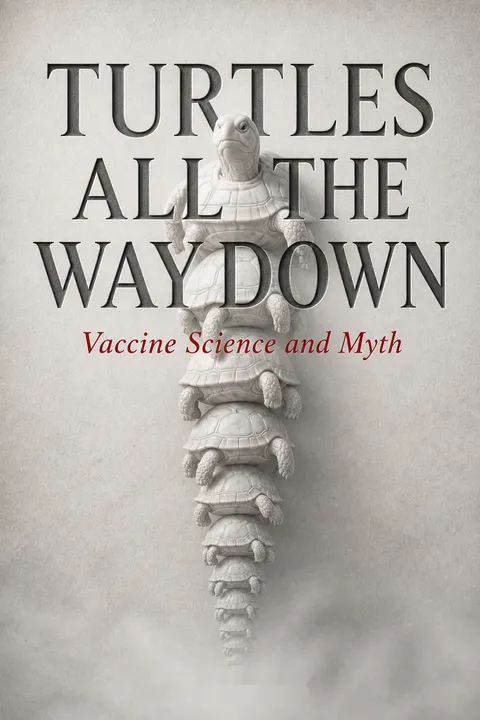
What is the significance of the title Turtles All The Way Down in the context of vaccine science?
- Metaphor for flawed foundations: The title refers to the story of infinite regress, symbolizing how vaccine safety claims rest on a series of flawed studies, each supported by another equally flawed study.
- Clinical trial “turtles”: Each vaccine’s safety is “proven” by comparison to a predecessor vaccine or compound, none of which were tested against a true placebo.
- Call for critical examination: The title invites readers to look beyond surface assurances and question the underlying assumptions and evidence supporting vaccine safety.
About the Author
Other books by Anonymous







Download PDF
Download EPUB
.epub digital book format is ideal for reading ebooks on phones, tablets, and e-readers.








