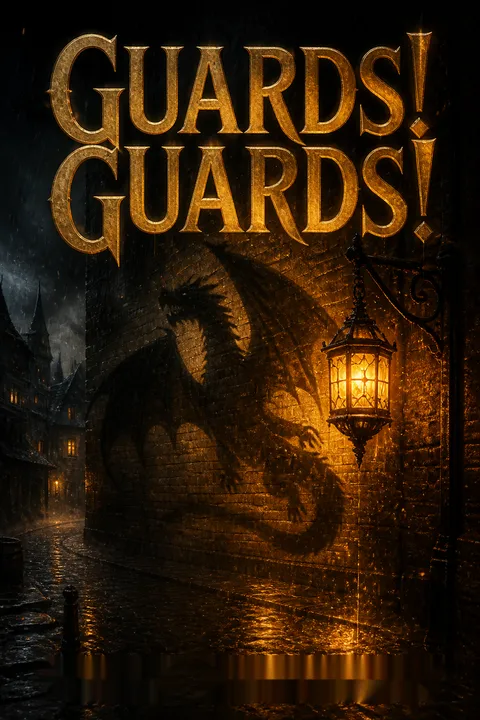


Plot Summary
A Dragon From Elsewhere
In Ankh-Morpork, a secret society’s Supreme Grand Master finds a book describing how to summon dragons from a realm beyond the ordinary world. He gathers resentful tradesmen and tells them that restoring a king will cure the city’s injustices, carefully steering their self-interest toward his own ambitions.
Their first ritual briefly brings a dragon into the city. It kills a thief in an alley, then vanishes when the spell’s borrowed magic runs out. The ritual leaves the society’s collected magical objects exhausted, but proves the book works. The Grand Master now needs more power, and his followers have tasted magic without understanding the danger they have invited.
The Grand Master’s pitch works because it translates political grievance into a fantasy of personal compensation. His followers do not want justice in any consistent sense; they want the people who frustrate them punished and their own appetites recognized as rights. The dragon spell gives this resentment material force. Its brief appearance also establishes the novel’s central danger: a creature summoned by human desire is not a tool merely because its summoners believe they can control it.
Carrot Enters the Watch
Carrot arrives in the city carrying a sword and a thick book of ordinances. Raised by dwarfs after being found near a bandit attack, he has only recently learned that he is human. His adoptive father sends him to join the Watch, expecting the city’s guards to uphold the law. Instead, Captain Vimes is drunk in a tavern and barely remembers accepting him.
Carrot nevertheless reports for duty, learns that the Night Watch consists of Sergeant Colon and Corporal Nobby Nobbs, and starts patrolling with Nobby. When Carrot arrests the president of the Thieves’ Guild for being a thief, the Guild complains to the Patrician. The arrest forces the city’s rulers to notice a recruit who takes his job literally.
Carrot’s innocence is not ignorance so much as an untested commitment to shared rules. He has been raised in a community where duty is legible, so the city’s casual abandonment of law seems to him like a correctable mistake. The contrast makes his literalism comic, but it also reveals how much of Ankh-Morpork’s order depends on citizens agreeing not to see what is happening. By arresting the Guild’s leader, Carrot turns that tacit arrangement into a public question.
The Law Gets Loud
Nobby tries to teach Carrot the Watch’s real routine: ring the bell, keep moving, and avoid trouble. Carrot instead steps into a violent dwarf bar, speaks to the drinkers in their language, and shames them into stopping their fight by reminding them of their families. At the Mended Drum, he reads out a long list of licensing and safety violations.
The crowd answers with a brawl that wrecks the tavern and leaves Carrot unconscious among dozens of battered patrons. Vimes and Colon arrive late, expecting to rescue him, then find Carrot has survived the fight and formally recorded its offences. For Vimes, the recruit’s impossible earnestness briefly recalls the purpose the Watch has lost.
Carrot’s authority comes neither from rank nor threat. In the dwarf bar, he invokes kinship; in the tavern, he invokes written law. Both interventions work because he treats other people as answerable to standards they already recognize, even when they have stopped acting on them. The Watch’s delayed response exposes its learned helplessness, while Vimes’s reaction suggests that cynicism has not erased his buried desire for the institution to matter.
Ash on the Alley Wall
A second summoning places the dragon in the Shades, where it incinerates a group of criminals and leaves their outlines fused into a wall. Vimes and his drunken patrol find the remains and enormous claw marks. The Patrician dismisses the evidence as gang warfare and orders the tracks covered, but Vimes secretly casts a print before obeying.
At the same time, the Librarian discovers that a book has been stolen from Unseen University’s magical library. Carrot helps him identify its subject: summoning dragons. The missing volume connects the impossible deaths to magic, while the Patrician’s refusal to investigate convinces Vimes that the danger is not simply a creature in the streets.
Vimes’s investigation begins when official language tries to make physical evidence disappear. The Patrician is less interested in whether the dragon exists than in preventing the city from behaving as if it does. Vimes’s hidden plaster cast marks a quiet break with obedience: he preserves the evidence before he fully understands it. The Librarian’s missing-book clue supplies a causal explanation, but the fact that the thief had access to the University narrows the mystery toward someone inside the city’s respectable structures.
Sybil Names the Impossible
Vimes takes his cast to Lady Sybil Ramkin, an aristocratic breeder of small swamp dragons. Sybil identifies the print as belonging to a noble dragon, far larger than the fragile creatures in her kennels, and explains why its size, fire, and flight defy ordinary biology. While Vimes is with her, the creature sweeps over Ankh-Morpork and sets selected buildings alight.
Sybil watches with scientific wonder; Vimes sees a threat that has chosen targets with unnerving precision. The city erupts into panic, dragon hunters arrive for the Patrician’s reward, and treasure-seekers begin searching for a lair. Their excitement and greed make the crisis harder to manage, not easier.
Sybil and Vimes respond to the same spectacle through different forms of attention. She sees a once-in-centuries biological mystery; he sees homes burning and a city’s institutions failing to protect people. Neither perspective is foolish, but the difference matters: knowledge without urgency can become fascination, while urgency without knowledge risks misreading the threat. The dragon’s selective fires also complicate the image of indiscriminate destruction, hinting that a human purpose may be shaping where it strikes.
The Watch Loses Its Home
The dragon attacks the Night Watch’s old headquarters, and Carrot drags Vimes and the others clear just before the building melts into a heap of stone. Sybil offers the Watch a vacant property in Pseudopolis Yard as a replacement base. When frightened citizens later storm her kennels, intending to kill her swamp dragons in retaliation, Vimes uses one of the small creatures to make the mob retreat.
Sybil gives him the unusually intelligent but awkward Goodboy Bindle Featherstone, soon nicknamed Errol. The Librarian joins the Watch as a temporary special constable, bringing his knowledge of the stolen book. A makeshift team begins to form around the duties the city’s formal authorities have abandoned.
The Watch’s destruction strips away even the shabby shelter that had contained its marginal existence. Sybil’s offer is practical, but it also makes room for a different kind of institution, one built through cooperation rather than official prestige. The mob’s attack shows how fear turns the vulnerable into convenient scapegoats; Vimes’s defense of the swamp dragons gives his courage a more personal direction. Errol and the Librarian join not as polished tools, but as unruly companions whose particular abilities will matter later.
A King on Cue
Vimes’s squad tries using Errol to track the noble dragon, but the little creature cannot find its trail. Soon a horn draws the great dragon toward a public plaza, where a young man with a glittering sword presents himself as Ankh-Morpork’s rightful king. The dragon appears to meet the expected challenge, then vanishes in a burst of magic when the sword touches it.
The crowd accepts the young man as a hero, and the Patrician is imprisoned as the monarchy returns. Vimes notices that no dragon remains have been left behind. The tidy disappearance, timed to crown a convenient claimant, feels less like victory than a performance arranged for the city.
The scene satisfies a familiar story pattern so neatly that the crowd mistakes narrative shape for proof. A shining sword, a challenger, a vanished monster, and a restored crown create the sensation of inevitability. Vimes’s suspicion arises from the missing physical residue, a policeman’s refusal to let symbolism substitute for evidence. The episode also shows how political longing can be manufactured: the city’s inhabitants are ready to embrace a king before they know anything about the man or the machinery behind his triumph.
Vimes Loses His Badge
At the coronation, Vimes mistakes a raven in the fog for the dragon and disrupts the ceremony. Lupine Wonse, the Patrician’s ambitious secretary, strips Vimes of his badge and sends him away. The mistake seems to settle the Watch’s fate, until the noble dragon returns and destroys the ceremony, killing the newly crowned king.
Wonse survives and takes charge under the creature’s rule. Vimes is left outside the institution he has served, while Ankh-Morpork’s people shift from cheering their king to fearing their new ruler. The false victory has not defeated the dragon; it has given the city a throne on which to place its terror.
Vimes’s dismissal turns a perceptual error into an institutional verdict. He is punished not because his warning was foolish in itself, but because authority prefers a convenient explanation to a difficult one. The dragon’s return exposes the coronation as political theatre, yet the city’s response remains shaped by spectacle: it transfers obedience from one symbol to another. Vimes’s exclusion is therefore both personal humiliation and a test of whether duty can survive without a badge or public approval.
The City Learns to Yield
The dragon claims treasure from the city and demands a monthly human offering, while Wonse describes both as voluntary contributions to public safety. Vimes confronts the secretary at the palace, recognizing him as the man whose ambition has guided the plot. Wonse has the former captain arrested and locked in the palace dungeon.
There Vimes finds the imprisoned Patrician, who has made a functioning society of the rats and other creatures sharing the cell. Vetinari’s composure reveals that confinement has not made him powerless, but the city above has accepted a bargain that trades strangers’ lives for the hope of being spared.
Wonse’s political skill lies in converting coercion into a story of consent. The language of contribution and protection lets citizens participate in cruelty while imagining that they have chosen prudence. Vetinari’s miniature society in the dungeon offers a counter-image to this public surrender: even among rats, he builds reciprocal arrangements rather than relying on grand claims. Vimes, caught between them, must reckon with how little physical authority is required to make injustice feel administratively normal.
The Badge Finds Vimes
The Librarian travels through the strange connected spaces of L-space to recover the stolen spellbook, then returns to break the dungeon bars and free Vimes. The book and a proclamation reveal that Sybil has been selected as the dragon’s next offering. Across the city, Colon and Nobby join Carrot on a rooftop and prepare an unlikely shot at the creature’s vulnerable point.
Sybil is chained in the plaza, while Errol grows feverish after eating fuel, polish, and other unlikely ingredients. His body begins converting its chaotic digestion into an unfamiliar source of power. Vimes races toward the sacrifice, and the scattered Watch members prepare to act without waiting for orders.
This convergence shifts the Watch from a collection of reluctant individuals into a moral community. The Librarian risks a dangerous journey because a stolen book matters; the guards risk action because Sybil is a person they know, not an abstract offering. Errol’s illness is alarming precisely because his body has always been treated as defective. The section turns overlooked forms of loyalty and difference into sources of possibility, while showing that responsibility begins before anyone is certain a plan will work.
Errol Takes the Sky
Vimes reaches the plaza and cuts Sybil free as Colon fires from a rooftop. His arrow misses the dragon but strikes a whisky distillery, whose explosion knocks the creature from the sky. Errol, now burning with a strange internal heat, rises from Sybil’s ruined kennels and pursues it.
He uses his flame to propel himself at impossible speed, striking the larger dragon with a force that shatters buildings and leaves it stunned. Carrot climbs onto the rubble and arrests the creature before the mob can kill it. Sybil argues for restraint, and Vimes backs the Watch’s decision to treat even this dangerous animal as a prisoner rather than a trophy.
The decisive force comes from a chain of errors, care, and improvised courage rather than a heroic weapon. Colon’s missed arrow becomes the blast that wounds the dragon; Errol’s apparent weakness becomes the basis of a new physical capacity. But the battle’s ethical test follows the victory: the crowd wants revenge, while Carrot and Vimes insist on procedure. Their choice does not deny the dragon’s harm. It rejects the idea that fear grants the city permission to become a mob.
The Watch Takes Back
With the dragon contained, Vimes and the Watch enter the ruined palace, where Wonse tries to summon another creature. Carrot throws the law book at him; the secretary falls from the broken upper floor and dies. The Patrician leaves the dungeon and resumes control of the city. At a public ceremony, the Watch asks not for grand honours but for better wages, a replacement kettle, and a dartboard.
Vimes accepts the chance to build a life with Sybil, while Carrot continues serving the Watch. Errol and the wounded noble dragon leave the city together, their destination beyond the Disc’s familiar skies. The city is not remade, but the Watch has made its duty visible again.
The resolution refuses the conventional reward of a new monarch or a spotless city. Instead, it restores a fallible political order and leaves the Watch with modest material demands that make its work sustainable. The law book becomes both weapon and emblem: its authority matters only when people risk using it. Vimes’s renewed personal life does not erase his cynicism, but gives it a human counterweight. The dragons’ departure preserves uncertainty, suggesting that power shaped by imagination cannot be permanently sealed away.
Analysis
Guards! Guards! treats the fantasy of a rightful ruler as a political technology. The Brethren do not discover a king and then organize society around him; they manufacture the conditions that make a king seem necessary. A dragon creates danger, a staged victory supplies a hero, and the public supplies its own appetite for pageantry. The sequence reveals how quickly people can mistake a familiar story for evidence, especially when it promises relief from ordinary frustrations.
The Watch offers a counter-model, though not a clean one. Vimes is compromised by drink and despair, Colon and Nobby have adapted to cowardice, and the institution has dwindled into irrelevance. Carrot’s literal faith in law disrupts that settled failure because he refuses to treat rules as decoration. His example does not make the others innocent or fearless; it makes evasion harder to justify. The climax’s insistence on arresting the dragon extends this ethic beyond human convenience. Restraint becomes meaningful precisely because the creature is frightening and the crowd wants a simpler answer.
The novel also tests the difference between weakness and worth. Sybil protects swamp dragons that respectable society considers defective, while Errol’s apparent uselessness conceals an unforeseen capacity. Vimes, too, is not remade into a shining hero. He remains a flawed, observant man who acts because another person is in danger and because the law, however battered, still matters. The story’s optimism is deliberately modest: no perfect government arrives, and human beings remain susceptible to fear and spectacle. What changes is that a few people refuse to let those forces have the final word.
Review Summary
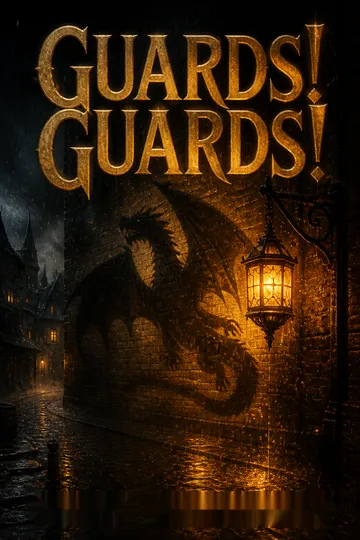
Guards! Guards! is a beloved entry in the Discworld series, praised for its humor, clever satire, and memorable characters. Readers appreciate Pratchett's wit, social commentary, and ability to subvert fantasy tropes. The book introduces fan-favorite characters like Sam Vimes and the Night Watch, while exploring themes of leadership, justice, and civic duty. Many consider it an excellent starting point for the series, highlighting Pratchett's skill in blending comedy with deeper insights. The novel's portrayal of Ankh-Morpork as a living, breathing city is particularly celebrated.
People Also Read

Characters
Sam Vimes
The battered lawmanVimes is the alcoholic captain of Ankh-Morpork’s neglected Night Watch. Years of compromise have left him cynical, poor, and convinced that the city no longer wants justice, though his anger at cruelty never quite disappears. He distrusts power because he has seen how easily it protects itself, and he is more comfortable with a hard fact than a grand promise. Carrot’s uncompromising example and Sybil Ramkin’s steadiness draw him back toward active responsibility. Vimes’s struggle is not to become an idealist, but to keep acting when he expects institutions and people to disappoint him.
Carrot Ironfoundersson
The literal idealistCarrot is a human man raised in a dwarf family and sent to Ankh-Morpork to join the Watch. Huge, courteous, and earnest, he takes the law book given to him as a real guide rather than a ceremonial object. His literal-mindedness produces comic misunderstandings, but it also makes him unusually attentive to the obligations other people ignore. Carrot approaches strangers without the city’s usual suspicion and treats criminals, colleagues, and citizens as people who can still be called to account. His steadiness changes the emotional climate of the Watch without requiring him to imitate its old cynicism.
Sybil Ramkin
The dragon-breeding aristocratSybil Ramkin is a wealthy noblewoman who devotes her attention, money, and practical skill to breeding and caring for swamp dragons. Her blunt manner and imposing presence conceal a generous patience, especially toward creatures others consider useless or dangerous. She is intellectually curious about dragons, but her concern is not limited to scientific fascination: she resists the casual cruelty directed at them. Sybil meets Vimes as both a source of expertise and an independent force. Her confidence comes from knowing what she values, not from needing society’s approval.
Lord Vetinari
The calculating PatricianVetinari rules Ankh-Morpork through observation, careful pressure, and a clear-eyed understanding of competing interests. He is austere and difficult to read, preferring arrangements that make people reveal their motives to displays of personal virtue. His political intelligence is matched by a practical respect for systems that work, even when they are neither fair nor beautiful. Vetinari regards Vimes as a useful counterweight to his own control, because the captain notices consequences that a ruler might prefer to ignore. Their relationship is defined by mutual distrust and a grudging recognition of each other’s utility.
Lupine Wonse
The ambitious secretaryWonse is the Patrician’s neat, capable secretary, a man whose intelligence developed in the precarious gang life of the Shades. He learned to survive by proposing plans rather than leading through force, and he carries that habit into adult politics. His desire to rise is joined to a conviction that he understands people better than they understand themselves. Wonse is drawn to schemes that promise order and advancement, especially when he can position himself as the indispensable mind behind them. His controlled exterior makes it easy to mistake calculation for wisdom.
Sergeant Colon
The cautious old sergeantColon is a long-serving Watch sergeant who prefers routine, safety, and clear instructions. He has learned to survive by avoiding situations that might demand more courage than his position seems to require. Beneath his bluster, however, he feels responsibility for his colleagues and remembers a more honorable idea of the Watch. Carrot’s example unsettles his habits, while Vimes’s leadership gives him a model to follow when events become frightening.
Corporal Nobby Nobbs
The streetwise corporalNobby is a small, wily corporal whose cynicism has become a survival skill. He knows which doors are safer left unopened and how quickly ideals can get a guard hurt. His talent for improvisation and social adaptability often hides a more loyal nature than he wants to advertise. Nobby’s street knowledge gives the Watch a view of the city that official reports cannot provide.
The Librarian
The stubborn bookkeeperThe Librarian is an orangutan transformed by magic and retained by Unseen University to care for its dangerous collection. He communicates through expressive noises and gestures, and he is fiercely protective of books and library order. His long experience with magical texts gives him a patience and expertise the human characters lack. He treats the Watch as a practical means of recovering stolen knowledge, and his quiet loyalty grows from a shared respect for the work itself.
Errol
The unlikely swamp dragonErrol is a small, oddly formed swamp dragon in Sybil’s care. His unusual build makes him an outsider even among the creatures that people routinely underestimate. He is gentle, curious, and perpetually hungry, with a digestive system that seems to turn nearly anything into fuel. His presence invites others to see value in a creature that does not fit the expected image of strength.
The Supreme Grand Master
The grievance salesmanThe Supreme Grand Master leads the Elucidated Brethren, a secret society whose members are more resentful than capable. He understands how to flatter wounded pride and channel petty complaints into collective action. He presents himself as a guide to a better city, while privately imagining a future in which he holds power over those he despises. His talent is less magical than psychological: he knows how to make other people’s envy serve his ambition.
Brother Watchtower
The credulous brotherA talkative member of the Brethren, Watchtower supplies confident explanations of kingship and destiny despite understanding little of either. His eagerness to belong makes him easy to steer, but his occasional practical doubts expose the gaps in the Grand Master’s plans.
Cut-me-own-Throat Dibbler
The opportunistic vendorDibbler is a street seller who can turn nearly any public danger into a product. His quick instincts let him profit from panic without needing to believe in the stories he sells. He represents Ankh-Morpork’s ability to keep commerce moving even when common sense has stopped.
Plot Devices
The Summoning of Dragons
Desire made physicalThe stolen book explains how to summon dragons from a realm shaped by imagination and will. Its instructions give the Brethren a means to turn their resentment into a real creature, though their first ritual shows that magical objects are consumed in the process. The book also gives Vimes and the Librarian a concrete investigative lead. Its surviving warning suggests that a summoned dragon reflects the mind that calls it, making the spell not merely a technique but a revelation of its user.
Carrot’s law book
Rules against expedienceCarrot’s old volume of city ordinances seems absurdly out of date in a city that has arranged to tolerate organized crime. He nevertheless uses it to define his duties, record offences, and insist on prisoners’ rights. The book becomes a practical counterweight to the vague appeals to destiny and public safety used by the conspirators. Its literal force is both comic and serious: the written law cannot protect anyone unless someone is willing to apply it.
Errol’s digestion
Weakness becomes propulsionSwamp dragons survive through a precarious system of internal chemistry, and Errol’s appetite leads him to consume substances far beyond an ordinary diet. As his body changes, the same digestive instability that makes him seem defective becomes a source of intense heat and power. This device pays off the early portrait of swamp dragons as fragile, awkward creatures. It also turns Sybil’s care for an overlooked animal into a crucial part of the Watch’s resistance.
Million-to-one chances
Courage under absurd oddsThe Watch repeatedly relies on the idea that a nearly impossible chance may succeed when a situation has become desperate. This belief is comic because the characters debate the odds with misplaced precision, yet it also helps them act when sensible alternatives have disappeared. The device does not promise that bravery will be rewarded; Colon’s arrow initially misses. Instead, action creates consequences no one planned, and the Watch must take responsibility for what those consequences make possible.
FAQ
Synopsis & Basic Details
What is Guards! Guards! about?
- City Under Threat: Ankh-Morpork, a city rife with organized crime and apathetic law enforcement, faces a new threat: a dragon.
- Disillusioned Watch: The story follows the Night Watch, a group of mostly incompetent and disillusioned guards, as they are forced to confront this threat.
- Unlikely Heroes: The narrative explores how ordinary individuals, like the naive Carrot and the cynical Vimes, rise to the occasion and challenge the status quo.
Why should I read Guards! Guards!?
- Humorous Fantasy: Pratchett's signature wit and satire are on full display, making for a laugh-out-loud reading experience.
- Subverted Tropes: The novel cleverly subverts classic fantasy tropes, offering a fresh and unique take on the genre.
- Compelling Characters: The story features a cast of memorable and relatable characters, each with their own flaws and strengths.
What is the background of Guards! Guards!?
- Dysfunctional City: Ankh-Morpork is a city with a long history of corruption, where crime is organized and the law is often ignored.
- Apathetic Governance: The city is ruled by the Patrician, who maintains order through a delicate balance of power and a hands-off approach.
- Magical Elements: Magic exists in the Discworld, but it is often unpredictable and unreliable, adding to the chaotic nature of the setting.
What are the most memorable quotes in Guards! Guards!?
- Vimes's Cynicism: "The city was a, was a, was a wossname. Thing. Woman. Thass what it was. Woman. Roaring, ancient, centuries old. Strung you along, let you fall in thingy, love, with her, then kicked you inna, inna, thingy." This quote encapsulates Vimes's complex relationship with Ankh-Morpork.
- Carrot's Idealism: "Stealing is Wrong." This simple statement highlights Carrot's unwavering moral compass and his naivety about the city's ways.
- The Patrician's Pragmatism: "The thing about legends, of course, is that they are legendary." This quote reveals the Patrician's cynical view of the world and his understanding of how stories shape reality.
What writing style, narrative choices, and literary techniques does Terry Pratchett use?
- Satirical Tone: Pratchett employs a satirical tone to critique societal norms and power structures, often using humor to highlight absurdities.
- Third-Person Omniscient: The narrative is presented from a third-person omniscient perspective, allowing the reader to access the thoughts and feelings of multiple characters.
- Frequent Footnotes: Pratchett uses footnotes to provide additional context, humorous asides, and commentary on the story, enhancing the reading experience.
Hidden Details & Subtle Connections
What are some minor details that add significant meaning?
- The Librarian's Actions: The Librarian's seemingly random actions, like his fondness for peanuts and his presence at the Mended Drum, hint at a deeper understanding of the city's events.
- The Illuminated Sign: The malfunctioning illuminated sign outside the Watch House, with its flickering "E," symbolizes the erratic and unreliable nature of the city.
- The Protective: The codpiece given to Carrot by Varneshi, initially a source of embarrassment, becomes a symbol of his literal-mindedness and his unique approach to the world.
What are some subtle foreshadowing and callbacks?
- Gaskin's Death: The mention of Gaskin's death early in the story foreshadows the dangers faced by the Watch and the potential for tragedy.
- The Figgin: The Supreme Grand Master's repeated use of the word "figgin" in the Brethren's oaths foreshadows the absurdity and incompetence of the group.
- The Caged Whale: The password used by the Elucidated Brethren, "The caged whale knows nothing of the mighty deeps," subtly hints at the dragons' true nature and their connection to a different realm.
What are some unexpected character connections?
- Vimes and Wonse: The shared history between Vimes and Wonse, growing up in the Shades, adds a layer of complexity to their interactions and highlights the different paths they have taken.
- Lady Ramkin and Nobby: The unlikely friendship between Lady Ramkin and Nobby, based on their shared appreciation for the absurd, reveals the hidden depths of both characters.
- Carrot and Minty: The recurring mention of Minty, Carrot's love interest back home, emphasizes his longing for a simpler life and his struggle to adapt to the city.
Who are the most significant supporting characters?
- Sergeant Colon: Colon's bumbling nature and his genuine concern for his fellow guards make him a relatable and endearing character.
- Nobby Nobbs: Nobby's street smarts and his cynical outlook provide a counterpoint to Carrot's idealism, adding depth to the Watch's dynamic.
- Lupine Wonse: Wonse's ambition and his manipulative nature make him a compelling antagonist, highlighting the dangers of unchecked power.
Psychological, Emotional, & Relational Analysis
What are some unspoken motivations of the characters?
- Vimes's Self-Loathing: Vimes's heavy drinking and cynicism stem from a deep-seated self-loathing and a belief that he is unworthy of respect or happiness.
- The Supreme Grand Master's Insecurity: The Supreme Grand Master's need for control and his constant manipulation of the Brethren reveal his own deep-seated insecurities and his desire for validation.
- Lady Ramkin's Loneliness: Lady Ramkin's passion for dragons and her eccentric behavior mask a deep loneliness and a longing for connection.
What psychological complexities do the characters exhibit?
- Vimes's Internal Conflict: Vimes struggles with his desire to do good and his cynicism about the world, creating a complex and compelling character.
- The Brethren's Paranoia: The Brethren's constant suspicion and resentment of others reveal their deep-seated paranoia and their inability to trust one another.
- Carrot's Literal-Mindedness: Carrot's inability to understand metaphors and his unwavering adherence to the law highlight his struggle to adapt to the complexities of Ankh-Morpork.
What are the major emotional turning points?
- Vimes's Sobriety: Vimes's brief moments of sobriety force him to confront his own demons and the reality of his situation, leading to a shift in his perspective.
- Carrot's Disillusionment: Carrot's growing awareness of the city's corruption and the limitations of the law challenge his naive idealism.
- Lady Ramkin's Vulnerability: Lady Ramkin's moments of vulnerability, such as her fear for the dragons and her genuine concern for Vimes, reveal her hidden emotional depths.
How do relationship dynamics evolve?
- Vimes and Carrot: The relationship between Vimes and Carrot evolves from one of initial skepticism to one of mutual respect and understanding, highlighting the power of mentorship.
- The Watch's Camaraderie: The shared experiences of the Watch, particularly their encounters with the dragon, strengthen their bond and create a sense of camaraderie.
- Vimes and Lady Ramkin: The relationship between Vimes and Lady Ramkin evolves from one of initial awkwardness to one of mutual attraction and respect, offering a glimpse of hope for the future.
Interpretation & Debate
Which parts of the story remain ambiguous or open-ended?
- The Nature of Magic: The exact nature of magic in the Discworld remains ambiguous, with its unpredictable and often chaotic effects.
- The Dragons' Origin: The origin of the dragons and their connection to a different realm are left open to interpretation, adding to the story's mystique.
- The Patrician's Motives: The Patrician's true motives and his long-term plans for Ankh-Morpork remain ambiguous, leaving the reader to question his ultimate goals.
What are some debatable, controversial scenes or moments in Guards! Guards!?
- The Dragon's Destruction: The dragon's destruction, while seemingly necessary, raises questions about the nature of heroism and the morality of violence.
- The Patrician's Methods: The Patrician's manipulative tactics and his willingness to sacrifice individuals for the greater good raise ethical questions about the nature of leadership.
- The City's Acceptance of Chaos: The city's acceptance of chaos and its willingness to embrace a dragon as its ruler highlight the complexities of human nature and the limits of reason.
Guards! Guards! Ending Explained: How It Ends & What It Means
- The Dragon's Departure: The dragon's departure, while seemingly a victory, leaves the city with a sense of unease and uncertainty about the future.
- Vimes's Resignation: Vimes's resignation from the Watch, while initially a sign of defeat, ultimately leads to a new beginning and a renewed sense of purpose.
- The Cycle of Chaos: The ending suggests that the cycle of chaos and change in Ankh-Morpork is likely to continue, highlighting the city's enduring nature and its ability to adapt to any challenge.
Discworld Series Series

About the Author
Other books by Terry Pratchett

Download PDF
Download EPUB
.epub digital book format is ideal for reading ebooks on phones, tablets, and e-readers.








