

Plot Summary
Prologue
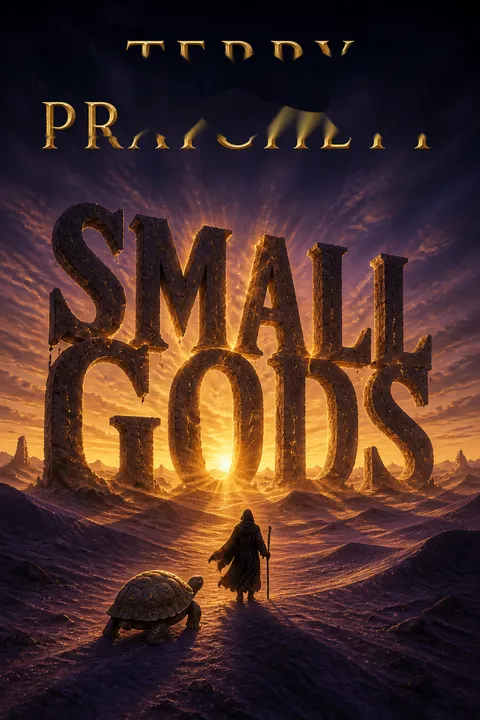
An eagle lifts a tortoise high above the ground, then drops it, leaving the creature to learn the distance between danger and survival. The story begins with this unequal contest, then widens to the monks who watch over history and try to keep events from slipping off course.
Lu-Tze, an ancient monk who travels with a broom and a miniature landscape of mountains, is sent to Omnia as the Church awaits its next prophet. There, a novice and a god are about to discover that belief can raise a god, but it can also keep one trapped.
The opening image compresses the novel's central power imbalance into a physical ordeal: the eagle controls the height, while the tortoise must endure the fall. Yet survival is not the same as safety, and the tortoise's stubborn persistence hints that the apparently powerless can alter the terms of a contest. The history monks complicate the image by treating events as both real and vulnerable to manipulation. Their presence makes Omnia's religious crisis part of a larger question about who gets to shape what people remember, and whether history belongs to those who act or those who control its account.
The Voice in the Garden
Raised by a fiercely devout grandmother, Brutha has memorized Omnia's scriptures but cannot read or write. He works in the Citadel garden, where a voice calls to him and a battered tortoise identifies itself as Om, the Great God. Brutha doubts the claim: the Church depicts Om as a mighty bull, not a creature that can barely cross a melon patch.
Brother Nhumrod, the novice master, hears nothing and carries the tortoise toward the kitchens to make soup. Brutha rescues it, and Om proves his identity by recalling a private childhood memory and producing a feeble spark of lightning. Brutha's belief has brought the god back within reach, but Om's tiny body reveals how little power remains.
The first encounter overturns the expected direction of religious authority. Brutha's certainty has been trained by scripture and punishment, yet his direct experience of Om contradicts the Church's grand images. His response is not instant enlightenment: he tests the claim with the limited reasoning available to him. Om, meanwhile, discovers that divine status cannot compensate for physical helplessness. Their awkward alliance begins with a basic asymmetry: Brutha can give Om belief, while Om can only offer knowledge that unsettles the world Brutha has been taught to accept.
Vorbis Plans a Holy War
Deacon Vorbis, the cold strategist who heads Omnia's Quisition, prepares a delegation to Ephebe while privately arranging an invasion. He treats Ephebe's philosophers and their account of the world's shape as a threat because their ideas might loosen the Church's grip. A dying secretary reveals the name of a forbidden book, and members of the underground Turtle Movement plan to recover its author, Didactylos.
General Fri'it, who knows how war looks after the victory speeches end, recognizes the danger but cannot safely oppose Vorbis. Vorbis notices Brutha's extraordinary ability to remember everything he sees and orders him onto the mission. Soon afterward, Fri'it dies in Vorbis's custody, and the delegation leaves without him.
Vorbis makes coercion appear administrative. He does not need to shout when the institution around him has taught everyone to anticipate punishment. His political project begins before the public dispute, so the language of religious defense conceals a campaign already in motion. Fri'it's fear is not simple cowardice: experience has taught him that surviving an unjust system can require silence, until silence itself becomes complicity. Brutha is selected for a different reason. His memory is useful to power, but his innocence makes him harder to predict than Vorbis understands.
A God Under Sail
Brutha carries Om aboard the delegation's ship, hidden in a box among scraps of food, while Vorbis travels with soldiers and clerics. The novice grows seasick and loses the familiar landmarks by which he usually knows where he is. When Vorbis orders a porpoise harpooned, Om recognizes the captain as the same man who once turned him over in the sun to watch him struggle.
The killing brings a violent storm. Om summons the Sea Queen and uses his one believer as leverage to demand the ship's safety; the storm parts around them, but the goddess claims a future payment. The ship reaches Ephebe in calmer weather. Brutha has seen a god intervene, yet the rescue has made him question what divine power costs other people.
The sea strips Brutha of his usual orientation, both literally and morally. His dependence on remembered paths cannot help him on a moving deck, while Om's power proves real but transactional. The storm does not arrive as an uncomplicated miracle: Om saves the passengers by promising a price whose consequences he cannot control. His reaction to the porpoise also exposes a changing moral perspective. He objects not from abstract principle, but because he remembers helplessness in his own body. Experience begins to make the god more human, though not yet reliably compassionate.
Ephebe Opens the Books
Ephebe receives the Omnians with armed guards, open courtyards, statues of many gods, and a bewildering population that does not resemble the demons Brutha was taught to expect. The Tyrant has already prepared a peace treaty, while Vorbis insists that Omnia comes from a position of strength. Brutha meets Didactylos, a blind philosopher who lives beside the Library with his nephew Urn.
Didactylos shows him books about animals, plants, maps, and the world's possible shape. Brutha has never seen such open inquiry. He still cannot read, but his memory stores every image he sees. A treatise on religion suggests that people may come to trust temples and priests more than the gods those institutions claim to serve.
Ephebe challenges Brutha not through a single persuasive argument, but through ordinary life that contradicts Omnian caricature. People here worship differently, debate openly, and still behave like people. Didactylos offers a form of knowledge that does not pretend to certainty; for Brutha, this is more unsettling than an obvious heresy because his education has equated doubt with moral failure. The Library also gives material form to an alternative social order. Its many books do not settle every question, but they allow questions to survive without being treated as crimes.
Peace Becomes an Ambush
At the palace, Ephebe's Tyrant explains that Brother Murduck was mocked and pelted with food after preaching Omnian supremacy, not murdered as Vorbis claimed. Vorbis treats the account as irrelevant and uses the diplomatic visit to study the city's defenses. That night he orders Brutha to guide him through Ephebe's deadly labyrinth.
Brutha obeys, and Vorbis kills a guide who might have exposed their passage. Omnian troops already crossed the desert by relays of water caches, so they are waiting to take the palace as soon as Vorbis opens a route. In less than an hour, Ephebe falls. Vorbis announces that the city is now Omnian territory and demands the name of the philosopher who wrote the forbidden book.
The labyrinth turns Brutha's obedience into an instrument of conquest. His perfect memory, previously a private oddity, becomes the route by which Vorbis bypasses Ephebe's defenses. The false story about Murduck shows how political violence manufactures its own justification: Vorbis does not merely lie about the past, he uses the lie to make future aggression seem inevitable. Brutha's failure to resist is psychologically credible because his entire life has taught him that refusing an order is itself a sin. The horror begins when he realizes that obedience can make him participate in what he believes is wrong.
The Library in Brutha
Vorbis identifies Didactylos as the author and orders the Library burned. Before the soldiers arrive, Didactylos and Urn scramble to save the most useful scrolls. Brutha steps between the philosopher and the guards, then offers a different escape: he can preserve the books by memorizing what he sees.
One scroll after another passes before his eyes, and their maps, diagrams, and writing settle into his astonishing memory. Simony, a soldier secretly aligned with the Turtle Movement, helps the group escape through hidden passages.
Urn brings along a steam-driven boat built from Didactylos's ideas. The Library burns behind them, but its contents now survive in Brutha, who is beginning to understand that knowledge can be carried even when its buildings are destroyed.
Brutha's memory changes from a tool that makes him valuable to Vorbis into a means of protecting knowledge from Vorbis. The reversal is significant because Brutha does not need to become a conventional scholar to act decisively. He can preserve what others have written before he understands it, making the act of attention itself a form of resistance. Didactylos's library is not saved as an institution, and its destruction remains real; nevertheless, the books have escaped the conqueror's control. The scene binds intellectual survival to physical risk and turns Brutha's unusual mind into shared cultural inheritance.
The Sea Collects Its Price
The escaping party's steam boat struggles across the sea while the Omnian warship Fin of God closes in. The Sea Queen returns to collect the payment Om promised: everyone aboard the smaller boat, with Brutha as the exception. As lightning gathers around Urn's copper engine, Om urges Brutha to jump. Brutha goes overboard just as the mechanism flares and the boat vanishes into the storm.
He and Om wash up on a barren shore, alive but separated from Simony, Didactylos, and Urn, whose fate is uncertain. The Fin of God is also destroyed, and its crew enter the afterlife without the religious certainty they expected. Brutha's survival leaves him alone with Om and the responsibility to decide what happens next.
The bargain exposes the moral cost of treating people as counters in a divine negotiation. Om has secured Brutha's survival, but the Queen's demand makes clear how casually gods can endanger everyone else. Brutha's leap is not a calculated act of heroism; he follows a warning because trust has begun to replace obedience. The wreck also strips the group of its machinery, political plans, and community. On the shore, Brutha and Om have only their relationship and the choices they make toward a vulnerable stranger, Vorbis, whom they find alive nearby.
The Desert Demands Mercy
Brutha finds Vorbis badly injured and chooses to carry him inland rather than leave him on the coast. When thirst threatens them, Om digs through the sand and reaches water held beneath the desert, though he insists the discovery is natural rather than miraculous. Brutha learns from a hermit, St. Ungulant, that the fleshy leaves of desert plants hold drinkable water.
Along the way he kills a snake for food, tends a wounded lion, and studies the remains of an abandoned temple where no one remembers the god once worshiped there. Brutha's memory fills with knowledge, but it cannot decide what is right for him. He keeps helping Vorbis, even as Om argues that the deacon deserves to be abandoned.
The desert removes the institutional supports that once told Brutha what goodness meant. Survival requires practical knowledge, but his most consequential choices cannot be reduced to technique. He feeds himself, finds water, and tends the lion while refusing to make a helpless enemy into a convenient sacrifice. The ruined temple gives Om a glimpse of divine mortality: worship can vanish until even a powerful god becomes unrecognizable. Brutha's insistence on caring for Vorbis is not forgiveness or approval. It is a decision that responsibility belongs to the person acting, not solely to the rules or gods that might authorize him.
A Prophet Made of Lies
Near Omnia, Vorbis knocks Brutha unconscious and carries him back to the Citadel, leaving Om behind. An eagle seizes the tortoise, carrying the god toward the city. Brutha wakes under Brother Nhumrod's care to learn that Vorbis has been declared the eighth Prophet and has used their desert journey to build his authority.
Vorbis promotes Brutha, calls him a bishop, and presents the novice as proof of his own holiness. He also shows Brutha an iron torture device shaped like a turtle, designed to punish anyone who questions the Church's account of the world. Brutha cannot hear Om and does not know whether the god is alive. Lu-Tze finds him grieving in the garden and urges him to keep walking the path he must take.
Vorbis converts Brutha's real suffering into political evidence, claiming the spiritual credit for a journey he did not lead. The promotion is another form of capture: Brutha receives status, but only within a system designed to turn his silence into endorsement. The iron turtle makes that system tangible, transforming a symbol of alternative knowledge into a torture instrument. With Om absent, Brutha must confront a question he had deferred: whether ethical action depends on divine instruction. Lu-Tze does not provide a doctrine. His counsel instead directs Brutha toward self-reliance at the moment when institutional authority has become most persuasive.
The Eagle Breaks the Ceremony
During Vorbis's inauguration, Brutha stands before the temple doors and asks Om for a sign, but hears nothing. He is chained to the iron turtle and left in the heat. Above the Citadel, the eagle carries Om toward the crowd; the tortoise grips the bird until it flies over the temple and drops him onto Vorbis, killing the deacon.
The gathered people see the impossible act and their belief restores Om to immense strength. Om breaks Brutha's chains, but Brutha refuses to let him answer fear with punishment. He insists that a god must be accountable to the people as well as the people to their god. Om accepts a temporary compact, including the principle that people should not be killed for religious power.
The rescue is spectacular, but Brutha's moral decision afterward matters more than the miracle. Once Om has enough believers to wield overwhelming force, Brutha could trade Vorbis's regime for divine rule by terror. Instead, he makes power answer to a relationship rather than demand submission. The eagle's capture of Om completes the opening image in reverse: the tortoise reaches the height controlled by the predator and uses that moment to alter the outcome. Yet Brutha does not mistake a dramatic sign for a sufficient political settlement. He insists that belief must create obligations for the god, not merely obedience from humans.
Omnia Faces the Fleet
With Vorbis dead, Brutha goes to meet the fleet gathering against Omnia and offers peace, religious freedom, and an end to the country's threat to its neighbors. The commanders distrust him, and the Omnian resistance prepares Urn's armored steam machine for battle.
Simony still wants to fight, while Brutha refuses to let Om smite the invading soldiers. The machine fails when its lever breaks, and combat threatens to begin anyway. Om enters the gods' gaming hall and confronts the deities treating human lives as counters.
He forces their attention onto the people below. A supernatural storm batters both sides, but its purpose changes the battle: soldiers from opposing armies stop to pull the wounded from wreckage. The violence ends when they recognize one another as lives to save, not pieces to spend.
The final crisis tests whether Brutha's insistence on ethical action can survive contact with an actual invasion. His offer of peace cannot erase years of aggression, and the broken machine shows that engineering and courage do not guarantee control. Om's intervention shifts the frame from human politics to divine indifference: the gods have treated war as entertainment because they do not bear its consequences. Their storm initially resembles another exercise of power, but the people below interrupt its logic by rescuing enemies. The turning point is not victory over a rival army; it is the moment combatants refuse to continue behaving as disposable instruments.
Faith Learns to Bargain
After the fighting, Brutha becomes Omnia's Cenobiarch and starts changing the institution that made Vorbis powerful. He appoints Simony to dismantle the Quisition from within, limiting punishment rather than replacing one purge with another.
Didactylos is invited into religious leadership, and Urn is encouraged to use his mechanical skill for practical work such as irrigation and construction. Brutha refuses to destroy the old scriptures; instead, he plans to preserve the Ephebian books and let people examine them.
Om agrees that other beliefs may exist in Omnia, though the agreement is a time-limited bargain rather than a final solution. Brutha returns to ordinary work and treats reform as a daily responsibility, not a single proclamation.
The resolution rejects the fantasy that replacing a bad ruler automatically produces a just society. Brutha inherits authority but uses it to reduce the institution's capacity for violence, including by changing the Quisition rather than simply killing its members. His refusal to burn the Septateuch matters alongside his defense of the foreign library: he does not answer censorship with counter-censorship. Om's agreement remains provisional, which keeps the ending politically honest. The novel's hope rests less on a perfected doctrine than on repeated accountability, the difficult habit of making powerful people answer for what they do.
Epilogue
A century later, Brutha has become an old leader who still rises early and attends to the work before him. When Death arrives, Brutha discovers that the desert afterlife is real and that Vorbis has remained there, alone with himself, unable to face judgment.
Brutha reaches out to him, despite knowing what Vorbis did and what he made others do. He walks with the former deacon into the desert. The final gesture does not absolve Vorbis or erase his crimes. It shows Brutha continuing to act from his own sense of responsibility, even where law and punishment cannot reach.
The afterlife turns the novel's dispute about justice into a final test of character. Vorbis's punishment is not a spectacular torture imposed from outside; it is the isolation produced by the mind he built, a self sealed against other people and even against his own memories. Brutha's response refuses two easy conclusions: that compassion means innocence, or that guilt makes compassion impossible. He does not declare Vorbis harmless, but neither does he let the deacon's cruelty dictate his own conduct. The ending completes Brutha's movement from obedience to ethical agency, while leaving judgment larger than any institution he has rebuilt.
Analysis
Small Gods examines what happens when a religious institution grows so powerful that people begin to serve its machinery instead of the god at its center. Omnia's Church has commandments, hierarchy, prisons, and a Quisition capable of turning suspicion into proof. Its elaborate structure appears to protect belief, yet it has left Om so weak that he can barely speak to anyone. The irony is not that religion is merely false, but that forms meant to preserve faith can displace the relationship they were built to express.
Brutha's development gives this institutional critique its human measure. He starts as an obedient novice whose knowledge is mostly memorized and whose moral vocabulary comes from authority. Contact with Om, Ephebe, and Didactylos does not make him instantly learned; instead, it makes his inherited certainty harder to maintain. His memory preserves facts, but his ethical growth comes from choosing what those facts require of him. He refuses to abandon Vorbis, refuses to let Om answer injury with mass punishment, and refuses to make the truth another excuse for killing. The book treats moral agency as practice, not revelation.
The novel also distinguishes power from responsibility. Vorbis knows how to make institutions act, but he uses their obedience to hide his own choices. Om has divine strength when belief returns, but Brutha insists that strength does not grant unlimited permission. Even knowledge and invention carry no guaranteed virtue: Brutha's memory can save books, while Urn's machine can become a weapon. The most hopeful change occurs when enemies stop treating one another as expendable during the storm and begin rescuing the people beside them.
The ending does not promise a perfect settlement. Om's agreement lasts for a set term, and Brutha's reforms require daily work. That provisional quality is the point. A just society cannot rely on the flawless goodness of a god, a ruler, or a doctrine. It must remain answerable to the people whose lives its authorities shape.
Review Summary
Small Gods is a highly acclaimed Discworld novel that satirizes organized religion. Readers praise Pratchett's wit, humor, and thought-provoking commentary on faith and belief. The story follows the god Om, trapped as a tortoise with only one true believer, Brutha. Many consider it one of Pratchett's best works, appreciating its blend of comedy and philosophical depth. While some found it darker than other Discworld books, most reviewers were thoroughly entertained and found the characters engaging. The novel is often recommended as a standalone entry point to the Discworld series.
People Also Read



Characters
Brutha
The novice who remembersBrutha is an unusually old novice in Omnia's Church, raised by a devout grandmother and known for obedience, plainness, and an almost total inability to read. He has memorized scripture by listening, and his memory preserves far more than he understands. Brutha begins with faith shaped by fear and fixed rules, so direct experience unsettles him rather than immediately freeing him. His careful, literal thinking can look like stupidity to people who prize speed or status, but it also keeps him attentive to details others overlook. What drives him is a stubborn commitment to do what seems right, even when authority, doctrine, and personal safety pull in another direction.
Om
The diminished Great GodOm is the god of Omnia, accustomed to worship, grand manifestations, and the obedience of believers. When Brutha encounters him, Om is trapped in the small body of a one-eyed tortoise and must depend on a single human's faith. His pride and appetite for power make him impatient with Brutha, while his vulnerability forces him to experience the world from near ground level. Om initially treats people as sources of belief and influence, not as partners with independent needs. His relationship with Brutha confronts him with the limits of divine authority and the possibility that worship without care may preserve a god's name while hollowing out the god himself.
Vorbis
The Quisition's strategistVorbis is a senior Omnian cleric who leads the Quisition, the institution responsible for rooting out heresy and enforcing the Church's authority. Tall, controlled, and difficult to read, he rarely needs open anger to make others comply. He sees religion as a structure to shape and political power as a tool for imposing his own vision of order. Vorbis is especially skilled at converting fear into obedience and presenting personal ambition as sacred necessity. His interest in Brutha's memory reflects the way he values people for their usefulness. He embodies an authority that claims to serve truth while reserving the right to define what truth means.
Simony
The rebel sergeantSimony is a professional soldier in the Omnian guard and a committed member of the underground Turtle Movement. His hatred of the Church is rooted in Omnia's conquest of his homeland and in the repression he sees around him. He wants resistance to become organized and effective, and his military discipline makes him a natural leader. Simony is capable of courage and strategic patience, but his desire for justice can slide toward revenge and the use of people as symbols. Brutha's example forces him to consider whether opposing Vorbis's methods is enough if he adopts the same logic of sacrifice.
Didactylos
The blind philosopherDidactylos is an elderly, blind Ephebian philosopher whose blunt curiosity and irreverence make him an awkward fit among scholars who prefer respectable abstractions. He lives with his nephew Urn and earns what he can by offering practical philosophy. His writing questions the Church's account of the world, but he does not claim that uncertainty can be eliminated. Didactylos listens closely and uses humor to make intellectual pretension visible. He values inquiry for its own sake, yet the threat to his Library reveals how fragile an open culture can be when power decides that inconvenient ideas are dangerous.
Urn
The inventive apprenticeUrn is Didactylos's nephew and assistant, a capable mechanic who understands how ideas become working devices. He is more interested in useful engineering than in winning philosophical arguments, though his inventions can be turned toward purposes he did not intend. Urn's practical intelligence makes him essential to the group's escape and resistance. His discomfort with violence shows that technical skill does not automatically supply a moral framework for using it.
Lu-Tze
The unnoticed history monkLu-Tze is an ancient monk from the order that watches over history, though most people mistake him for an ordinary gardener or sweeper. He travels lightly, carries a broom, and survives by being easy to overlook. His quiet presence allows him to observe people without drawing their attention. Lu-Tze offers Brutha companionship and a plain lesson in facing hardship without expecting a complete map of the future. His work links the local crisis in Omnia to the larger movement of history.
General Fri'it
The weary generalFri'it is a senior Omnian military commander whose experience of battle has stripped away the romance of holy war. He recognizes that Vorbis's plans will bring needless deaths, but decades of surviving the Church's politics have taught him caution. His memories of other cultures and beliefs give him a wider perspective than many of his peers. Fri'it's conflict is between the instinct to stay alive and the knowledge that silence helps dangerous people act.
Brother Nhumrod
The anxious novice masterBrother Nhumrod oversees Brutha and the other novices in the Citadel. He is nervous, pious, and prone to treating unfamiliar experiences as spiritual dangers, yet he is not simply cruel. His habits reflect a Church that has made fear seem ordinary and caution seem holy. Nhumrod's concern for Brutha occasionally breaks through the institution's rigid assumptions, even though he cannot understand the novice's encounter with Om.
Brutha's grandmother
The stern first teacherBrutha's grandmother raises him in a poor village and teaches him the prayers, laws, and habits of Omnian devotion. Her powerful piety gives Brutha his extraordinary store of memorized scripture, but also introduces him to a world where fear and punishment are treated as guides to goodness.
The Tyrant of Ephebe
Ephebe's elected rulerThe Tyrant leads Ephebe under a political system that elects a ruler for a fixed term, despite the unsettling title. He is practical, sharp-tongued, and aware that Omnia's diplomatic language conceals a history of conquest. He offers peace from a position of caution, not trust, and represents a society where authority is limited and publicly questioned.
St. Ungulant
The desert anchoriteSt. Ungulant is a hermit living atop a wheel in the desert, accompanied by an imaginary friend and an elaborate private understanding of hardship. His isolation has given him an unusual way to survive the small gods and mirages that gather in the wilderness. He is comic and clearly unreliable, but his practical knowledge of desert plants helps Brutha endure.
Cut-Me-Own-Hand-Off Dhblah
The opportunistic merchantDhblah is a persistent vendor in the Place of Lamentation, selling dubious treats and religious trinkets to pilgrims. He watches for opportunity in every crowd and treats sacred occasions as potential business. His appetite for profit is matched by a lively instinct for how ordinary people respond to power.
The Sea Queen
The storm's divine creditorThe Sea Queen is a powerful water deity with the authority to answer Om's plea for help and the right to demand payment in return. Her sense of justice differs sharply from Brutha's, treating human lives as part of an old divine bargain.
Death
The desert's final guideDeath appears to the dying and escorts them toward judgment. He is patient, unsentimental, and unwilling to pretend that he controls the moral meaning of a person's life.
Brother Murduck
The disputed missionaryBrother Murduck is an Omnian missionary whose treatment in Ephebe becomes a political pretext for Vorbis's campaign. The gap between what happened to him and what the Church claims happened exposes the power of official stories.
Brother Sasho
Vorbis's dying secretarySasho serves as Vorbis's secretary until the Quisition interrogates him over forbidden correspondence. His final disclosure gives the secret opposition a name and points toward the ideas Vorbis wants suppressed.
Fasta Benj
The accidental fishermanFasta Benj is a fisherman from a remote community whose small boat is swept into the conflict between larger nations. His unfamiliarity with their wars gives him a practical, uninvested perspective on the strangers around him.
Plot Devices
Belief and divine strength
Faith fuels the godsIn this world, gods depend on human belief for their strength and continued existence. A god may be surrounded by temples, rituals, and official doctrine while receiving little genuine belief from the people who follow those forms. Om's diminished body makes that distinction visible, while Brutha's sincere faith gives him a connection that institutional worship cannot provide. The device turns theology into a concrete relationship of dependence: people shape the gods they worship, and gods can use or neglect the people who sustain them. It also raises the novel's central ethical problem, since belief can empower a god without ensuring that the god deserves that power.
Brutha's total memory
Memory preserves forbidden knowledgeBrutha remembers nearly everything he has seen or heard, despite being unable to read or write. Vorbis first treats this ability as a tool for political service, but it becomes crucial when the Ephebian Library is threatened. Brutha can retain books by looking at their scrolls, preserving their contents even when he cannot yet interpret them. His memory also makes lies difficult to erase from the record of his own experience. The device links personal cognition with cultural survival, while distinguishing the act of retaining information from the harder task of deciding what it means.
The Turtle book
A heresy opens the worldDidactylos's book presents a model of the world that conflicts with Omnian doctrine. The book matters not only because of its cosmology, but because it demonstrates that people can observe, argue, and revise their understanding without accepting the Church's authority. Vorbis treats the text as a political threat and tries to silence its author and destroy the Library. The Turtle Movement turns the book into a symbol of resistance, while Brutha discovers that its most important challenge is not simply a different picture of the universe. It is the permission to ask how anyone knows what they claim to know.
The history monks
History needs careful tendingThe monks who maintain the books of history observe events and try to keep the timeline from being distorted by accident or manipulation. Lu-Tze is dispatched to Omnia because the coming religious succession and conflict threaten to become a hinge in history. His quiet interventions rarely resemble grand heroism; he watches, nudges, and then lets people make their own choices. This device gives the novel a perspective beyond the immediate political struggle, while resisting the idea that history is wholly controlled by rulers. The monks can preserve a record, but individuals still make the consequential decisions.
Urn's steam machine
Ideas acquire dangerous enginesUrn turns philosophical and mechanical principles into a steam-powered vehicle, then armors it as a moving shield and weapon. The invention helps the resistance challenge the Citadel's defenses, but it also unsettles Urn when its intended use shifts toward killing. Its imperfect construction is part of its meaning: innovation does not arrive as a clean solution, and a device's purpose can change faster than its maker's intentions. The machine connects knowledge to material power and forces the characters to ask whether a useful invention remains innocent once people use it for war.
FAQ
Synopsis & Basic Details
What is Small Gods about?
- A god's loss of power: The story centers on the Great God Om, who is reduced to a tortoise and must rely on a simple novice, Brutha, to regain his power through belief.
- Clash of cultures: It explores the conflict between the rigid, dogmatic religion of Omnia and the free-thinking, philosophical society of Ephebe.
- A journey of faith: The narrative follows Brutha's journey as he grapples with his faith, the nature of his god, and the corrupting influence of power.
Why should I read Small Gods?
- Unique perspective on religion: It offers a satirical and thought-provoking look at the nature of gods, belief, and organized religion, challenging conventional ideas.
- Compelling characters: The story features a diverse cast of memorable characters, from the devout Brutha to the ruthless Vorbis, each with their own complex motivations.
- Exploration of philosophical themes: It delves into profound themes such as free will, predestination, the nature of truth, and the power of belief, making it a rewarding read for those who enjoy intellectual stimulation.
What is the background of Small Gods?
- Discworld setting: The story is set in Terry Pratchett's Discworld, a flat world balanced on the backs of four elephants standing on a giant turtle, providing a fantastical backdrop.
- Religious and political satire: It satirizes organized religion, particularly its tendency towards dogma, intolerance, and the abuse of power, drawing parallels to real-world historical and political events.
- Cultural contrast: The story contrasts the desert-based, theocratic society of Omnia with the coastal, philosophical society of Ephebe, highlighting different approaches to knowledge, power, and belief.
What are the most memorable quotes in Small Gods?
- "The Turtle Moves": This phrase, a symbol of Ephebian philosophy, represents the idea that the world is not static but constantly changing, challenging the rigid beliefs of Omnia.
- "What people believe is what's real": This quote encapsulates the central theme of the book, highlighting the power of belief in shaping reality and the nature of gods.
- "There is no justice, there's just me": This quote, spoken by Death, underscores the indifference of the universe to human concepts of fairness and morality, a recurring theme in Pratchett's work.
What writing style, narrative choices, and literary techniques does Terry Pratchett use?
- Satirical and humorous tone: Pratchett employs a witty and satirical style, using humor to explore serious themes and critique societal norms, making the story both entertaining and thought-provoking.
- Third-person omniscient narration: The narrative is presented from a third-person omniscient perspective, allowing Pratchett to delve into the thoughts and motivations of multiple characters, providing a comprehensive view of the story's events.
- Foreshadowing and irony: Pratchett uses foreshadowing and irony to create dramatic tension and highlight the absurdity of certain situations, adding layers of meaning to the narrative.
Hidden Details & Subtle Connections
What are some minor details that add significant meaning?
- The chipped tortoise shell: Om's chipped shell is a constant reminder of his vulnerability and diminished state, contrasting with his former divine power and highlighting his dependence on Brutha.
- The postcards in the Quisition: The seemingly mundane postcards in the Quisition's cellar reveal the banality of evil, showing how ordinary people can commit horrific acts when they believe they are doing their job.
- Lu-Tze's broom: Lu-Tze's constant sweeping symbolizes his role as a caretaker of history, ensuring that events unfold as they should, and his quiet observation of the world.
What are some subtle foreshadowing and callbacks?
- The eagle's behavior: The eagle's repeated dropping of the tortoise foreshadows Om's own fall from grace and his dependence on Brutha, while also hinting at the cyclical nature of power and vulnerability.
- The mention of the Brown Islands: Fri'it's story about the Brown Islands, where people ride waves, foreshadows his own decision to "ride the wave" of change and challenge Vorbis's authority.
- The description of the library: The description of the Ephebian library as a place where "books interact in strange and unforeseeable ways" foreshadows the transformative power of knowledge and the unexpected consequences of ideas.
What are some unexpected character connections?
- Brutha and Vorbis: Despite their opposing ideologies, Brutha and Vorbis share a connection through their shared experience in the desert, highlighting the complex nature of good and evil.
- Lu-Tze and Om: Lu-Tze's quiet compassion towards Om, despite not being able to hear him, reveals a deeper understanding of the god's plight and the nature of belief.
- Simony and Didactylos: The unlikely alliance between the soldier and the philosopher demonstrates the power of shared ideals and the potential for change when people from different backgrounds come together.
Who are the most significant supporting characters?
- Didactylos: As a blind philosopher, he challenges Brutha's beliefs and introduces him to new ways of thinking, acting as a catalyst for Brutha's transformation.
- Lu-Tze: As a history monk, he represents the importance of observation and the delicate balance of time, subtly influencing events and guiding Brutha's path.
- Simony: As a soldier and atheist, he embodies the struggle against oppression and the search for meaning beyond religious dogma, providing a counterpoint to Brutha's devout faith.
Psychological, Emotional, & Relational Analysis
What are some unspoken motivations of the characters?
- Vorbis's fear of uncertainty: Beneath his ruthless exterior, Vorbis is driven by a deep-seated fear of uncertainty and a need to control the world around him, which fuels his desire for power and his suppression of dissent.
- Brutha's desire for belonging: Brutha's unwavering devotion to Om stems from a deep-seated desire for belonging and acceptance, which is challenged by his experiences in Ephebe and his growing awareness of the world.
- Om's longing for recognition: Om's actions are driven by a longing for recognition and validation, as he struggles to regain his former glory and prove his worth as a god.
What psychological complexities do the characters exhibit?
- Vorbis's fanaticism: Vorbis's fanaticism is rooted in a deep-seated insecurity and a need for control, leading him to commit horrific acts in the name of his faith, highlighting the dangers of religious extremism.
- Brutha's internal conflict: Brutha's internal conflict between his devout faith and his growing awareness of the world creates a complex character, as he grapples with the limitations of his beliefs and the need for independent thought.
- Om's identity crisis: Om's identity crisis as a tortoise forces him to confront his own limitations and the nature of his divinity, leading to a transformation from arrogance to humility.
What are the major emotional turning points?
- Brutha's encounter with the Ephebian philosophers: This encounter challenges his worldview and forces him to question his faith, marking a turning point in his journey of self-discovery.
- Om's realization of his dependence on Brutha: This realization forces Om to confront his own vulnerability and the limitations of his power, leading to a transformation in his character.
- Brutha's decision to confront Vorbis: This decision marks a shift in Brutha's character, as he moves from passive obedience to active resistance, driven by his growing sense of justice and compassion.
How do relationship dynamics evolve?
- Brutha and Om's relationship: Their relationship evolves from one of master and servant to one of mutual respect and understanding, as they learn from each other and grow together.
- Vorbis and Brutha's relationship: Their relationship is characterized by manipulation and control, as Vorbis seeks to exploit Brutha's faith for his own gain, highlighting the dangers of unchecked power.
- Brutha and Didactylos's relationship: Their relationship is based on mutual respect and intellectual curiosity, as they challenge each other's beliefs and explore new ways of thinking, demonstrating the power of open-minded dialogue.
Interpretation & Debate
Which parts of the story remain ambiguous or open-ended?
- The nature of the small gods: The story leaves the nature of the small gods somewhat ambiguous, suggesting that they are both products of human belief and independent entities with their own agendas.
- The true nature of Om: The true nature of Om's power and his transformation remains open to interpretation, leaving readers to ponder the relationship between gods and their followers.
- The long-term impact of Brutha's reforms: The long-term impact of Brutha's reforms on Omnia is left open-ended, suggesting that the struggle for justice and understanding is an ongoing process.
What are some debatable, controversial scenes or moments in Small Gods?
- Vorbis's actions in the Quisition: The graphic depiction of Vorbis's cruelty and the torture methods of the Quisition raises questions about the nature of evil and the abuse of power in the name of religion.
- Brutha's decision to spare Vorbis: Brutha's decision to spare Vorbis, despite his horrific actions, raises questions about the nature of justice and the limits of forgiveness.
- The ending's ambiguity: The ending, with its focus on the cyclical nature of history and the ongoing struggle for truth, leaves readers to ponder the ultimate meaning of the story and the possibility of lasting change.
Small Gods Ending Explained: How It Ends & What It Means
- Brutha's transformation: Brutha's journey culminates in his transformation from a simple novice to a leader who challenges the established order, demonstrating the power of individual agency and the potential for change.
- Om's acceptance of human agency: Om's transformation from a power-hungry deity to a more humble and understanding figure highlights the importance of human agency and the limitations of divine intervention.
- The cyclical nature of history: The ending suggests that the struggle for truth and justice is an ongoing process, with the potential for both progress and regression, leaving readers to ponder the complexities of human nature and the enduring power of belief.
Discworld Series Series


About the Author
Other books by Terry Pratchett

Download PDF
Download EPUB
.epub digital book format is ideal for reading ebooks on phones, tablets, and e-readers.








