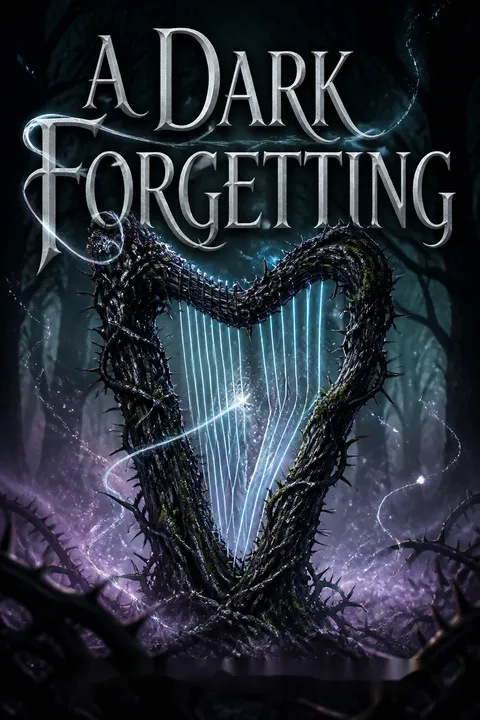


Plot Summary
A Voice Calls Home
Nineteen-year-old Emeline Lark is building a music career in Montreal when the woods seem to invade her final set at La Rêverie. Moss spreads beneath her boots and beetles crawl over her legs, though the audience sees nothing. When she stops singing, the forest vanishes.
Then Maisie Decker, her grandfather’s neighbor, calls with worse news: Ewan Lark has disappeared from his locked care home, without appearing on its cameras. Emeline cancels her gigs and drives back to Edgewood, leaving a tour with her musical heroes and a possible record deal hanging in the balance. She has spent months avoiding Pa’s decline. Now she fears he is lost, frightened, and beyond her reach.
The opening binds Emeline’s public ambition to a private dread. Singing is both her chosen livelihood and the trigger for the woods’ appearances, so the career she has built cannot fully shield her from the place she left. Pa’s disappearance forces a decision she has postponed: whether distance is a practical response to dementia or a way to avoid grief. The supernatural disturbance initially resembles a symptom of her fear, making her uncertainty about her own mind part of the story’s central pressure.
The Marker on Pa’s Bed
At Pa’s empty farmhouse, Emeline finds hawthorn branches above his bedroom door and a copper bowl used for the town’s old seasonal offerings. A small, pearl-colored orb lies on his pillow. Tomás Pérez, the neighbor known as Poor Mad Tom, insists the police found no trace of Ewan and hints that the Wood King may have taken him.
Emeline has dismissed such beliefs as Edgewood superstition, but the orb matches the marker people say appears when a tithe has been paid. The trees have been following her through her songs, and the evidence makes denial feel less like reason than evasion. With no other place to search, she crosses the hedge into the forest.
The orb converts local folklore into a physical problem Emeline cannot explain away. Her turn toward the woods is not a sudden conversion so much as a bargain with uncertainty: believing the stories offers a chance to find Pa and a reason not to fear that she is losing her mind. The farmhouse objects also make the town’s customs legible as forms of care. The bowl, branches, and marker are ways people have tried to negotiate danger and helplessness long before Emeline was willing to take them seriously.
The Stain and the Stranger
Inside the forest, Emeline loses the green woodland and enters the Stain, where trees are bleached and rotting. A shadow skin finds her and paralyzes her by forcing her to relive the day she placed Pa in care. It turns her guilt into a weapon, making her imagine him dying alone.
A blade kills the creature before it can reach her, wielded by a stern young man who calls himself no one important. He brings her away on Lament, a huge black horse whose mane burns without harming Emeline. They race with a herd of ember mares, but when they emerge from the forest, he has returned her to Pa’s farm instead of taking her to the Wood King. He leaves without giving his name.
The shadow skin makes Emeline’s guilt materially dangerous, but the scene also distinguishes remorse from useful responsibility. She cannot undo Pa’s placement in care by punishing herself, and the creature exploits exactly that confusion. Hawthorne’s rescue offers safety without trust: he protects her body, then deceives her about where he is taking her. The ember mares briefly give her exhilaration and connection, which makes the return home feel like a betrayal of more than her plan. The forest has become a world with its own rules, not simply the projection she feared.
Rooke’s Price of Passage
Emeline refuses to abandon her search and returns to Pa’s garage for an ax. There she meets Rooke, a shiftling whose shadow takes the form of a winged creature, and accepts his offer to lead her to the King’s City. His raven companion guides them west to a swamp entrance guarded by Bog, a huge earth spirit that tries to drag Emeline into the mire.
Rooke pays for their passage with his blood, but Bog drains him until Emeline cuts her own palm and offers blood too. The raven attacks Bog, forcing the spirit to release them. Emeline helps the weakened Rooke along a hidden boardwalk, and together they pass through a curtain of vines into the city.
The passage establishes the story’s economy of exchange before Emeline is asked to make its largest sacrifice. Entry costs blood, and Rooke’s willingness to pay first complicates Emeline’s suspicion of him. Her intervention is not a calculated bargain but a refusal to let someone else be consumed for her benefit. That impulse will recur in more consequential forms. Bog’s threshold also makes the King’s City feel less like a destination than a boundary that admits only those willing to pay something real.
The Minstrel’s Bargain
At the palace, Emeline presents the tithe marker and demands her grandfather back. The Wood King refuses her proposed payment of a guitar or car. Rooke instead offers Emeline as a replacement court minstrel, and the king accepts only after guards bring Ewan into the grove. Terrified and confused, Pa does not recognize his granddaughter.
Emeline agrees to sing for the king, hoping to escape once Pa is released, but the king keeps Ewan prisoner until she proves herself. He gives her one week to succeed. Rooke then identifies Hawthorne as the king’s tithe collector, the same man who took Pa and misled Emeline in the woods. Her rescue mission has become a forced audition with her grandfather’s life as the price of failure.
The bargain exposes the gap between Emeline’s understanding of sacrifice and the court’s. She offers expensive possessions, but the king measures value through what someone is willing to lose, not what can be replaced. Pa’s terror makes her decision immediate while his failure to recognize her makes it emotionally cruel. Rooke’s proposal saves her from an instant refusal, yet creates a new form of captivity. Hawthorne’s title confirms that the man who protected her is also an agent of the system threatening her family.
The Dragon’s Lost Music
Hawthorne tells Emeline that the king’s former minstrel, the Song Mage, left music guarded by Claw, a blind dragon on a cliffside aerie. The king has killed previous singers for minor mistakes, so the score may be her best chance to survive. Emeline and Hawthorne descend toward the aerie, where Claw wakes and blocks their search.
While Hawthorne looks inside the cavern, Emeline keeps the dragon occupied by singing a lullaby associated with Pa. Claw falls asleep, and Hawthorne finds the music, but the dragon wakes and pins him beneath a paw. Emeline burns Claw with a torch, freeing Hawthorne, and they escape with the score. Claw warns her that Hawthorne will betray her.
Music becomes more than an occupation here: Emeline uses a personal memory to affect a creature stronger than herself. The lullaby works because it carries emotional history, not because she has mastered formal magic. Yet the victory is compromised by the dragon’s warning, which leaves her unsure whether Hawthorne’s assistance is genuine. Claw’s prophecy is particularly destabilizing because he cannot distinguish past from future. The scene gives Emeline evidence of her power while denying her a reliable way to interpret what that power might cost.
A Court Built on Skulls
At dinner, Emeline recognizes Grace Abel, her childhood friend, now living in the King’s City with Sable Thorne, a guarded shiftling. Grace takes Emeline to a crypt lined with the skulls of former minstrels and explains that a curse is rotting the forest, spawning shadow skins, and forcing shiftlings permanently into their other forms.
The next night, the Wood King demands a performance. Emeline’s attempt to bargain for a message home angers him, and he chokes her until Sable intervenes.
Rooke persuades the king to offer another chance: Emeline must learn all eleven of the Song Mage’s songs within three days. Sable arranges for Hawthorne to deliver a letter to Montreal, while Calliope, an instructor from another court, begins teaching Emeline.
The crypt gives Emeline a concrete measure of the cost of failure, while Grace’s account widens the threat beyond one family. The curse is ecological and social: it destroys habitat, creates predators, and strips people of the forms through which they know themselves. The king’s attack shows that performance cannot reliably humanize power; he treats Emeline’s voice as a resource and her request as insolence. Sable’s intervention and letter offer small, practical solidarities inside a court where formal authority is dangerous.
A Song Opens Hawthorne
When Calliope’s arrival is delayed by a shadow skin attack, Hawthorne teaches Emeline the Song Mage’s music and invites her to his home to continue lessons. During their argument there, he reveals that Pa chose to tithe himself because he wanted to leave Heath Manor and return to the people who loved him. Emeline’s guilt shifts: Hawthorne took Ewan, but not against his will.
Later, Emeline’s voice breaks through Hawthorne’s emotional defenses during a lesson, and she senses a deep longing in him before he stops her. At a court gathering, Nettle enchants Emeline with a drink, prompting her to kiss Hawthorne. He recognizes the spell and ends it. The missing pages from the final song then threaten Emeline’s deadline.
Hawthorne’s revelation complicates Emeline’s anger without absolving his deception. Pa’s choice was an attempt to recover dignity and place, while Emeline had understood her own decision as abandonment. Her voice’s intrusion into Hawthorne’s mind parallels the shadow skin’s violation of hers, making her new ability ethically unsettled rather than automatically heroic. Nettle’s enchantment further clarifies that desire without informed choice is not intimacy. The missing score then converts these emotional questions back into urgent plot: Emeline still has to perform, but now knows she may be capable of crossing boundaries herself.
The Vile’s Cellar
With the final pages missing and only two days left, Emeline meets Grace at the Song Mage’s ruined estate. They find signs of recent use and a hidden cellar containing a moldy mattress, a bucket, and iron shackles fixed to the wall. The Vile, a monstrous witch associated with the Song Mage’s death, descends and hunts them.
Emeline sings to draw the creature away from Grace, but the Vile seizes her and threatens to kill her. Grace strikes the Vile with the chamber pot, giving them time to escape the house and ride back to the city. They find no music, only a bent copper hairpin that feels familiar to Emeline. The cellar’s restraints and the pin leave them with questions they cannot yet answer.
The estate shifts the search from a missing artifact toward the history of a person harmed there. The shackles make the Song Mage’s romantic legend harder to accept at face value, while the hairpin gives Emeline an intimate clue without yet supplying its meaning. Her instinct to distract the Vile with a song repeats the protective use of music, but the attempt does not make her invulnerable. Grace’s intervention matters as much as Emeline’s voice, preventing the story from treating magical talent as a substitute for friendship and practical courage.
Rose’s Waltz Found
Back in Edgewood, Emeline asks Tom whether he knew the Song Mage. Tom admits that he once brought Rose Lark, Emeline’s absent mother, to the King’s City, where she fell in love with someone at court. A photograph reveals a crescent-moon tattoo matching the muse described in the minstrel’s songs.
Emeline finds a matching butterfly hairpin among Rose’s belongings, then discovers the missing pages of the Song Mage’s final waltz in the same box. As a shadow skin attacks Maisie at the farmhouse, Emeline uses Sable’s enchanted knife to kill it. She races back through Bog’s passage and returns the score to the Wood King before sunset. The king releases Pa, and Hawthorne is still alive.
Tom’s confession transforms scattered details into a family history, but the evidence remains incomplete: the tattoo and pin suggest a connection without resolving Rose’s fate. The recovered score is therefore both practical salvation and a key to a more painful past. Emeline’s defense of Maisie demonstrates that she has begun acting on what she once dismissed as folklore. The deadline forces her to move between worlds at speed, and the result is tangible: Pa comes home. Yet saving him does not settle what the Song Mage did or what Emeline inherited.
The Curse Breaches the City
At Hawthorne’s house, Emeline shares the evidence linking Rose to the Song Mage and learns that the minstrel may have been her father. Hawthorne stays with her while she heals her cut foot, and their growing attraction surfaces before he admits that he once betrayed someone he loved. Sable and Rooke interrupt with news that shadow skins have breached the King’s City.
Hawthorne joins the fight, but the monsters ambush him and drag him into the woods, leaving Sable wounded and alive to report what happened. Emeline refuses to wait behind palace walls. She climbs over the city wall with help from a sycamore and follows the river into the Stain, where the shadow skins use Hawthorne’s voice to lure her toward a trap.
The breach converts the curse from a distant forecast into immediate political collapse. Hawthorne’s capture also tests Emeline’s agency: she has repeatedly been told to stay safe, but safety now means waiting while someone she cares about is taken. The false voice demonstrates how the shadow skins weaponize attachment just as they once weaponized guilt. Emeline’s climb over the wall marks a shift from entering the magical world as a desperate outsider to navigating it through her own decisions, even when those decisions expose her to danger.
The Vile Is Rose
Sable stops Emeline from following the false Hawthorne and leads her to a cage of living elms, where the real Hawthorne lies unconscious. The Vile appears and attacks Sable. Emeline sings her own unfinished waltz, waking the dying trees enough to open the cage and free Hawthorne. The Vile then turns on Emeline and reveals that the Song Mage imprisoned her and used his voice to control her.
Emeline recognizes the Vile as Rose, her mother, and escapes when the roots restrain Rose. Shadow skins pursue her, but Sable, Rooke, and the court’s fighters help drive them back. Hawthorne survives. Emeline, horrified by her father’s coercive magic and her own power, tells Hawthorne to keep away and takes his enchanted ring to leave.
The revelation of Rose as the Vile dismantles the simple division between monster and victim. Rose has committed violence, but the story traces it to coercion, imprisonment, and a curse that erased her former self. Emeline’s song briefly revives the trees, showing that her power can answer life rather than simply dominate minds. Her retreat from Hawthorne is an attempt to prevent inherited harm, yet it also repeats the story’s pattern of making choices for other people without asking what they want. Fear of becoming her father drives her toward isolation.
The Sketchbooks Remember
Emeline returns to Hawthorne after initially trying to leave, and they share a night together. The next morning, she finds his sketchbooks filled with drawings of her from years before they met again, including intimate images from her adolescence. Hawthorne explains that they had been in love before she left Edgewood.
When Emeline returned from Montreal intending to give up her career and stay with him, he asked the Wood King to erase her memories of him and the woods, hoping to protect her dream. The spell also removed her memories of Sable and their shared childhood. Emeline feels violated by the choice he made on her behalf. She takes his book of poetry, uses his ring to return home, and leaves him behind.
Hawthorne’s motive is protective, but the method reproduces the paternalism he fears: he decides what Emeline’s life should be and removes her ability to choose. The sketches make the violation visible, turning private art into evidence of a relationship she cannot remember. Her departure is not a simple rejection of love; it is a demand that love include accountability and consent. The episode also reframes her earlier loneliness. Some of what she experienced as personal failure was the emotional residue of a past she had been made unable to access.
The Tour’s Last Song
On the eve of her tour, Emeline opens Hawthorne’s poetry book and finds a line that reveals the password to her locked folder of old songs. Listening to the recordings restores memories of Hawthorne, Sable, and the life she chose to leave. At her Montreal concert, she abandons the commercial set list and performs her own song, recognizing that success built on other people’s work has become a distorted version of her dream.
The woods erupt through the stage, their roots and diseased leaves warning that the curse has reached them. Emeline walks away from the tour. Back in Edgewood, she sees the Stain at the tree line and finds the King’s City empty. She meets Grace, then follows her to the Heartwood.
The password is not merely a clue but an act of self-recognition: a poem about forgetting unlocks the songs that contain Emeline’s own past. Her choice at the concert rejects neither music nor ambition; it rejects a version of success that has required her to silence her authorship. The woods’ appearance makes that inward decision answerable to an external crisis. She returns not because her old dream was false, but because she has discovered a more honest relation to it and to the people whose lives are endangered.
A Voice for the Heartwood
At the Heartwood, the Vile captures Emeline and Grace, intending to kill Emeline before her voice can harm her. Emeline understands that her father’s curse created the Stain and that her mother has forgotten the life before it. She offers the Heartwood her voice and her future beyond the forest in exchange for the power to become its new Song Mage.
Her songs heal the woods and restore Rose to human form. Five months later, Emeline is mute, the King’s City is recovering, and Hawthorne remains a hawthorn tree because he will not choose to change. After Emeline sings farewell at its roots, he returns to human form without his memories. She finds him injured in a storm and brings him home, where he recognizes neither her nor the house.
Emeline’s sacrifice is not a repetition of her father’s misuse of power. She gives up the career she has fought for, but directs the resulting magic toward repair rather than possession. The distinction is ethical as well as magical: she names the cost and chooses it herself. Rose’s restoration cannot erase the harm done, and Hawthorne’s return does not instantly restore their relationship. The ending allows love to persist without making memory a prerequisite for care, while leaving Emeline to live with both the loss of her voice and the consequences of her choice.
Epilogue
Three months later, Hawthorne still has no waking memories of Emeline, though his dreams keep returning to her. At a palace ball, Nettle’s enchanted drink makes him kiss Emeline, but she stops him when she realizes he has been spelled. Later, a visit to the Song Mage’s ruined estate and the sound of one of Emeline’s old songs stir fragments of memory.
Sable and Rooke urge him to stop avoiding the woman he once loved. Hawthorne finds Emeline at the Heartwood and chooses to approach her, even without knowing what they were. Their kiss is not a recovered past but a new beginning, made possible by his willingness to let her decide what comes next.
The epilogue refuses the easy repair of restored memory. Hawthorne’s dreams and bodily responses suggest continuity, but they do not give him ownership of Emeline’s past or guarantee forgiveness. Nettle’s spell repeats the problem of desire without consent, and Emeline’s recognition of it establishes a boundary that the earlier romance sometimes blurred. Hawthorne’s eventual approach matters because he does not claim that longing entitles him to her. The reunion remains tentative: he can offer attention and choice, while Emeline must decide whether those are enough to begin again.
Analysis
A Dark Forgetting makes memory an active force rather than a storehouse of facts. Ewan’s dementia removes recognition without erasing the love that shaped his life; Hawthorne’s spell removes Emeline’s history while leaving an ache that neither career nor casual intimacy can explain. In both cases, the people around the forgetful person face a temptation to substitute their own judgment for the missing person’s agency. Hawthorne’s protection becomes a violation precisely because he decides that Emeline’s future is worth more than her right to remember and choose it.
The book’s musical magic offers a countermodel. Songs preserve experience, but they do not guarantee that the past can be recovered without pain. Emeline’s own recordings return her memories because she created them, and her final sacrifice becomes meaningful because she names its cost herself. Her father’s power, by contrast, turns song into coercion. The difference between them is not simply talent or strength; it is whether another person’s will remains intact.
The forest’s curse extends these questions into ecology. The Stain is not scenery behind the romance but a living consequence that spreads through trees, animals, and political institutions. Healing it requires more than defeating a monster. Emeline must understand the history concealed by the court’s legends, protect the people still in danger, and accept a loss she cannot reverse. The novel therefore treats repair as neither clean victory nor restoration to an untouched past. Rose can return to herself, the court can recover, and Hawthorne can come back, but Emeline’s voice is gone and trust must be rebuilt.
Its emotional center is the tension between escape and belonging. Emeline’s ambition is genuine, yet the version of success she has pursued asks her to silence her authorship. Returning to the woods does not mean surrendering ambition to romance. It means reclaiming the right to decide what a meaningful life requires, even when that decision carries a lasting cost.
Review Summary
Edgewood received mixed reviews, with an average rating of 3.78 out of 5. Readers praised the atmospheric setting, magical elements, and exploration of family relationships. Many enjoyed the romance and character development. However, some felt the world-building lacked depth and found the protagonist frustrating at times. The pacing was inconsistent for some readers. Several reviewers noted that the content seemed more appropriate for new adult than young adult audiences. Overall, opinions were divided, with some loving the whimsical story and others finding it predictable or underdeveloped.
People Also Read





Characters
Emeline Lark
The song-making runawayA nineteen-year-old musician from Edgewood, Emeline has built a fragile career in Montreal through persistence, adaptability, and a willingness to take practical advice. She is quick-witted and brave, but her habit of fleeing pain can look like independence even to herself. Her grandfather’s decline leaves her torn between ambition and care, while the forest’s strange responses to her songs make her doubt her own perceptions. Music is both craft and memory for her: she stores experience in melodies, even when she has stopped writing songs of her own. Her central struggle is not choosing between love and ambition, but learning to make those choices without surrendering her own voice or someone else’s consent.
Hawthorne Fell
The guarded tithe collectorHawthorne is a human serving the Wood King as tithe collector, a role that places him between the borderlands and the court. He is disciplined, observant, and more tender than his severe manner first suggests. Books, drawing, cooking, and music reveal a reflective life beneath his duty-bound exterior. His protectiveness can become controlling when fear convinces him that he knows what is best for someone else. His connection with Emeline is shaped by attraction, old affection, and unresolved guilt. He wants to protect her freedom, but his challenge is to respect it even when her choices frighten him.
Ewan Lark
Emeline’s steadfast grandfatherKnown to Emeline as Pa, Ewan raised her after her mother disappeared and became her family, teacher, and first audience. He worked his farm and vineyards with pride, encouraged Emeline’s musical ambitions, and shared a life built from routines, songs, and practical affection. Dementia increasingly disrupts his ability to recognize people and place events in order, but it does not erase the emotional history between them. His vulnerability forces Emeline to confront the limits of caregiving and the painful difference between loving someone and being recognized by them.
Sable Thorne
The court’s fierce bladesmithSable is a shiftling with a wolfish other form and a reputation for formidable skill with enchanted blades. She is guarded, direct, and difficult to read, keeping her emotions behind a still surface until someone she cares about is threatened. Her craft makes her useful in a court beset by monsters, but her loyalty is more than professional. She understands the cost of the curse and is willing to risk herself for the people who matter to her. Sable’s relationship with Emeline carries the ease and intimacy of a friendship whose history is not immediately visible.
Grace Abel
The scholar who stayedGrace is Emeline’s childhood friend, an Oxford student who has made a life in the King’s City. Thoughtful and resourceful, she reads danger quickly and is willing to act before fear has time to become paralysis. Her knowledge of the court’s history helps Emeline understand the curse, the Song Mage, and the lethal rules governing the king’s singers. Grace has also made profound commitments of her own, and her loyalty is as much a source of courage as it is a vulnerability. She helps Emeline while holding to a life and love that she chose for herself.
Rooke
The raven-shaped guideRooke is a mischievous shiftling whose shadow reveals a raven-like form. He knows the hidden routes into the King’s City and is adept at reading the court’s moods, though he rarely explains his plans in advance. His teasing manner masks a willingness to take real risks, as when he pays for passage through Bog. Rooke can be manipulative, but he is not indifferent to the people caught in his schemes. He often acts as the catalyst who pushes others toward choices they might otherwise avoid.
The Wood King
The forest’s unstable rulerAn ancient ruler bound to the forest, the Wood King presides over a court of shiftlings and demands seasonal tithes from nearby human communities. His power is entangled with the health of the woods, leaving him increasingly vulnerable to the curse spreading through his realm. He treats people as sources of service and sacrifice, yet his court’s survival depends on the bargains he makes with them. The Wood King embodies authority under pressure: a ruler whose fear of losing control can turn unstable magic into immediate cruelty.
Tomás Pérez
The brokenhearted neighborCalled Poor Mad Tom by the people of Edgewood, Tom is a retired photographer and Ewan’s neighbor. He helped care for the farm as Ewan weakened and entertained Emeline as a child with stories of the Wood King’s court. His affection for Emeline is paternal, though his own history with her mother leaves him carrying old grief. Tom is practical and gentle, but he has kept painful truths to himself in the name of loyalty.
Rose Lark
Emeline’s absent motherRose left Edgewood when Emeline was an infant, leaving her daughter to be raised by Ewan. The surviving photographs show a young woman once capable of radiant joy, followed by images in which her expression has grown distant and hollow. Her absence has shaped Emeline’s understanding of family and abandonment, even before Emeline knows the full story behind it. Rose remains a person with a past of her own, not merely the blank space Emeline has inherited.
Joel White
The familiar city refugeJoel is a guitarist in a successful indie band and the son of Emeline’s manager. He offers her companionship, physical comfort, and an ordinary life away from the woods. Their relationship is affectionate but poorly defined, partly because Emeline sometimes uses romance to quiet loneliness rather than to pursue a lasting bond. Joel is persistent and caring, but he can also assume he knows what she needs, making their closeness less secure than it first appears.
Maisie Decker
The neighbor who steps inMaisie is Ewan’s neighbor and trusted friend, known for her warmth and baking. She searches for him when he disappears, informs Emeline of the crisis, and helps maintain his care when Emeline must leave. Her practical kindness gives the Lark family a wider support system, reminding Emeline that she is not the only person who loves or can care for Pa.
The Vile
The cursed witchThe Vile is a feared creature associated with the shadow skins and the Song Mage’s ruined estate. She is dangerous, physically altered, and driven by a history of injury that the court’s legends reduce to a monster story. Her presence makes the estate’s hidden cellar and its restraints impossible to dismiss as harmless remnants. She represents the violence that survives when a victim’s history is buried beneath a public myth.
Claw
The blind music guardianClaw is a huge, blind dragon who guards the Song Mage’s music in a cliffside aerie. He can perceive events across time, though he cannot reliably tell whether what he sees belongs to the past, present, or future. His appetite and distrust make him a lethal obstacle, but his warnings carry enough truth to unsettle those who hear them. Claw is both guardian and unreliable witness.
Nettle
The court’s spell-playing gossipNettle is an owl-eyed shiftling who enjoys gossip and magical pranks. Her enchanted drinks can alter the feelings of those who consume them, turning courtship and rivalry into games she can watch from a safe distance. Nettle’s cheerfulness is unsettling because she treats other people’s emotions as entertainment. Her conduct makes the court’s social danger feel as real as its monsters.
Calliope
The patient singing tutorCalliope is a singer from another court who agrees to teach Emeline the Song Mage’s music despite the danger. Her calm, encouraging style contrasts with Hawthorne’s demanding instruction. She helps Emeline learn the songs without trying to control the way Emeline interprets them.
Aspen
Hawthorne’s court companionAspen is a graceful courtier and friend of Hawthorne’s who moves comfortably through the King’s City’s social world. Her connection with him makes Emeline question what she means to him, though Aspen’s presence also reflects the friendship and community Hawthorne has built apart from his duties.
Chloe Demarche
Emeline’s songwriterChloe writes the polished, commercially minded songs Emeline performs during her rise in Montreal. She is warm toward Emeline and proud of her own career, even as the music industry’s judgments create pressure between authorship and opportunity. Chloe’s work represents the practical compromise Emeline has made to keep her career moving.
Cornelius Henrik
Ewan’s boisterous friendKnown as Corny, he owns a winery with his wife, Anya, and is one of Ewan’s longtime friends. His energy fills the family gathering, but he treats Ewan’s confusion without embarrassment and helps him return to playing music among the neighbors.
Anya Henrik
A neighbor and farm friendAnya is Corny’s wife and part of the circle of Edgewood neighbors who helped raise Emeline. She joins the search for Ewan and contributes to the communal care that surrounds the Lark family.
Eshe Abel
Grace’s watchful motherEshe is Grace’s mother and a member of the close-knit Edgewood community. Her memories of a shadow skin’s approach show how the supernatural danger has touched ordinary households, even when people cannot explain what they have seen.
Abel
Grace’s fatherAbel is Grace’s father and one of Edgewood’s farmers. His account of encountering a strange, fire-eyed horse in his orchard adds another eyewitness detail to the lore Emeline once dismissed.
The Song Mage
The court’s lost minstrelThe Song Mage was a human singer whose music became central to the Wood King’s court. His eleven songs are treasured, and the king searches for someone who can perform them. The surviving stories present him as a celebrated figure, while the damage left in his estate suggests that his history is more complicated than the court’s idealized memory.
Plot Devices
Seasonal Tithes
A price for protectionThe Wood King demands offerings from communities along the forest border at each season’s turn. A paid tithe leaves a small, cold marker, while an unpaid obligation may be collected later in a far more painful form. The custom links human misfortune to the forest’s political order and gives the king leverage over people who may not understand the rules they are obeying. Tithes also establish the story’s moral economy: what matters is not simply wealth, but what someone gives up and whether the choice is freely made.
Songs as Memory
Melody keeps the pastEmeline instinctively stores memories inside songs, so a melody can return her to the person, place, and feeling associated with its creation. This ability makes singing a form of emotional record keeping, even while she has stopped writing her own music. It also gives her voice unusual influence over creatures, trees, and people. The device links musical authorship to identity: when Emeline’s memories are taken, her old songs become a route back to the self she cannot consciously recall.
The Stain
The curse eats the forestThe Stain is the visible spread of a curse that drains color and life from the woods. Its advance brings shadow skins, threatens the King’s City, and eventually alters shiftlings so they cannot return to their familiar forms. The curse makes ecological decay an immediate danger to bodies and communities. It also complicates blame: the court initially fears the Vile as the source, while the history of the Song Mage reveals a deeper cause rooted in human coercion and the misuse of magic.
Hawthorne’s White Ring
A passage between worldsHawthorne’s enchanted ring can carry its wearer to a place they consciously picture. It gives Emeline a way out of the King’s City when she no longer trusts Hawthorne or wants to remain in his home. The ring makes escape physically possible, but it cannot settle the emotional choices that sent her away. Its power underscores the difference between being transported and being free: Emeline still has to decide where she belongs and what she is willing to leave behind.
Shadow Skins
Fear made predatoryShadow skins are lethal creatures that enter their victims’ minds and force them to relive their deepest fears. Their attacks turn guilt, grief, and attachment into traps, immobilizing people before the creatures strike physically. They can also mimic familiar voices to lure someone toward danger. The monsters make emotional vulnerability a tactical risk, but the story repeatedly shows that fear can be interrupted by memory, another person’s intervention, or a prepared weapon. Their presence marks the curse’s spread from remote woods into homes and the city.
About the Author
Other books by Kristen Ciccarelli




Download PDF
Download EPUB
.epub digital book format is ideal for reading ebooks on phones, tablets, and e-readers.








