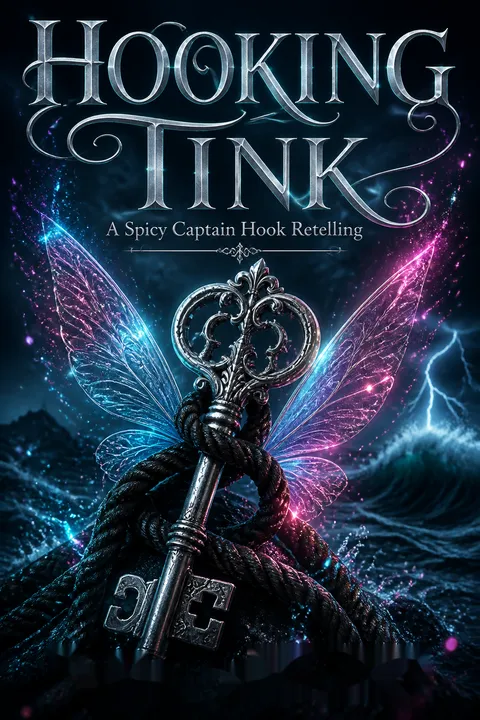


Plot Summary
A Pixie in the Storm
A Boston storm drives Captain James T. Hook into Inked by Tink, where the small, winged tattooist is finishing a magical tree design for Libby, a gravely ill child. Tink's ink and pixie dust leave Libby visibly stronger, and she refuses payment, revealing that her work serves more than a business. Hook has endured fifteen years of mermaid curses and needs Tink's rare ability to make magical tattoos.
She knows his reputation for exploiting fae and rejects him. Hook challenges her professional pride, claiming another artist could do better. Tired of being underestimated for her size and fae blood, Tink accepts at triple pay. He reveals a skeleton key and the Three of Hearts marking on his chest, and she begins.
The story opens by placing Tink's magic in an act of care rather than spectacle: her tattoo gives Libby strength, and refusing payment makes the healing inseparable from Tink's values. Hook enters the same space as a predator who needs something, so the contrast is immediate. Yet he cannot simply take her skill. Tink's pride, shaped by repeated dismissal, becomes the leverage that brings her into his plan. Their bargain therefore begins with a moral imbalance and a personal one: Hook has power and reputation, but Tink controls the only craft he needs.
The Key Burns Through
As Tink traces the key over Hook's chest, her instinct finds where its likeness belongs. The tattoo causes searing pain, and Hook reveals that the curse ensures a crew member betrays him on every voyage. His former first mate Erik turned against him, and good sailors died when the betrayal led them into a trap.
Tink finishes the design; a burst of magic erases the Three of Hearts and exposes older tattoos beneath it. The curse's release unleashes an overwhelming sexual hunger in both of them. They give in for hours, with the magic drowning out the hatred and caution that brought them together. At dawn, Hook thanks Tink, leaves the shop, and promises to return for his other curses.
The curse makes betrayal more than a pirate's occupational hazard. It turns Hook's suspicion into an imposed certainty, damaging the trust a captain needs to keep a crew alive. The key's painful tattooing also gives Tink power over a man accustomed to forcing outcomes. Their sudden desire is magical, but its effect is not emotionally neutral: the encounter exposes attraction while making consent and judgment difficult to separate. Hook leaves freed from one supernatural constraint, yet neither character can treat what happened as a simple transaction.
The Key From Marcus Kane
After leaving Tink, Hook secretly visits Libby at the hospital and gives her the Waves of Poseidon, a charm that protects its wearer from illness and serious harm. He later returns for it after Libby recovers, but the charm's absence leaves him vulnerable; a boy cuts his throat during a mission, and healers barely save him.
A year after Tink's first tattoo, Hook secures another key from Marcus Kane, a trafficker who refuses to surrender it. Hook kills Kane and takes the object that can undo another curse. The betrayal curse is already gone, allowing Hook's crew to sail without expecting a traitor on every voyage. Still, Hook's remaining curses make the sea dangerous, and his thoughts turn back to Tink.
Hook's visit to Libby complicates the villainous identity he uses as armor. He gives away his strongest protection without asking Tink to witness it, suggesting that his capacity for mercy exists independently of praise or romantic reward. The later injury shows the real cost of that choice. His killing of Kane, meanwhile, preserves the brutality of his world rather than cleansing it; Hook can be protective and violent without those traits canceling each other out. The key brings him back toward Tink, but his hidden generosity will matter only when she learns it.
The Tree He Names
When Hook returns, Tink refuses to help until his plea and a promise to resist the previous encounter change her mind. She charges more and insists there will be no sex. His back bears a storm-filled compass, its marks tied to weather that wrecks voyages and stars that lead him astray. As Tink tattoos the key, Hook presses her about why she lives in Boston instead of a fairy sanctuary.
She breaks down and explains that Peter Pan, the boy she loved, drained the magic from her home tree to revive a dying human girl. Hook's careless question has reopened her grief. Tink then accuses him of killing a mermaid for the Waves of Poseidon. He admits he lured her toward its treasure, and the curse breaks as Tink kisses him.
The tattoo session joins two wounds that initially seem unrelated: Hook's dependence on the sea and Tink's exile from her enchanted home. Tink's account of Peter reveals how an idealized love left her with loss, while Hook's attempt to question her place in Boston shows how easily he mistakes belonging for geography. Her accusation forces him to face the same pattern of exploiting trust. The curse's release does not resolve their distrust; instead, Tink's kiss follows an admission of wrongdoing, holding desire and judgment together rather than allowing either to erase the other.
Mercy Beneath the Hook
The second curse's release again drives Hook and Tink into hours of intense, magic-amplified sex. When his metal hook cuts Tink's thigh, Hook removes the prosthesis, tends the wound, and shows fear at having hurt her. The gentleness unsettles Tink more than his usual cruelty. Afterward, she meets Libby and her mother, Diana, at a cafe.
Diana explains that Hook visited the hospital, gave Libby his protective charm, and returned after the girl recovered. Tink learns that he risked his own safety to help a child he barely knew. The revelation does not erase his exploitation of fae, but it makes his self-description as irredeemably bad harder to accept. Tink leaves unable to reconcile the man she desires with the man she condemns.
The cut and Hook's response make vulnerability bodily and immediate. Removing the hook reveals both his physical difference and his fear of causing harm, but Tink resists turning that tenderness into proof that he is harmless. Diana's account widens the evidence: Hook's care was not performed for Tink's approval. This matters because it gives Tink a more complex basis for reassessing him than sexual attraction alone. The scene asks whether moral judgment can acknowledge particular acts of mercy without excusing a larger history of violence.
Five Months at the Poison Apple
Five months pass without Hook returning, and Tink's friends at the Poison Apple hear how the curse-breaking encounters have unsettled her. Ariel explains that mermaid magic intensified their desire but could not invent the attraction beneath it. Tink has been drinking when Hook arrives and overhears enough to know she still thinks about him.
He pays her tab and walks her home through an approaching storm. Tink refuses to let him into her apartment, her private refuge after losing her fairy home. Hook accepts the boundary, unlocks the shop door for her, and leaves her there alone. The restraint surprises her: the pirate who once took what he wanted now lets her decide how close he can come.
The five-month absence turns desire into an unresolved question rather than a continuous affair. Ariel's explanation gives Tink a way to distinguish supernatural pressure from genuine feeling, but it does not make the attraction safer. The walk home tests Hook in a quieter register than the curses do. Tink's apartment represents a boundary built after betrayal, and Hook honors it without demanding credit. His restraint cannot undo his past, yet it offers Tink new evidence about how he might behave when she has the power to refuse.
Tea, Keys, and Old Roots
The next morning, Hook brings Tink hangover medicine and the lavender tea she likes, then learns that the living tree at the Poison Apple once belonged to her. Tink explains that her friend Rapunzel preserved it, though it can no longer be her home. Hook leaves with the knowledge of what she has lost. Later, he returns with the final key, obtained from a Sphinx by trading away a phoenix feather.
As Tink prepares to tattoo it, she tells him she knows about Libby and doubts his insistence that he is only a villain. Hook denies that his kindness means anything, but Tink keeps working. The final tattoo begins with both of them aware that the coming magic may again test the boundary they failed to hold before.
The tea is a small, practical gesture that changes the scale of Hook's attention. He remembers Tink's preference and listens when she explains the tree, taking in a loss that cannot be solved by charm or money. The Sphinx's exchange also places his quest inside a world where magic demands a cost. Tink's challenge to his villain identity is not a claim that he is innocent; it is an insistence that he cannot reduce himself to his worst acts. Their final working arrangement is therefore charged by recognition, not merely need.
The First Clear Sky
As Tink inks the last key, she reminds Hook that giving up his protection to help Libby was a choice, not an accident. He resists her judgment, insisting that a single good act cannot change the pirate he has become. The final curse breaks before either can settle the argument. Its magic overwhelms them with the same fierce desire, and they surrender to it together.
When the force finally ebbs, Hook looks through the shop window and sees the sky clearing for the first time in years. He realizes the storm that shadowed his voyages has lifted. Tink stays beside him as dawn colors the horizon, while the restored sky gives Hook a glimpse of the sea without its supernatural punishment.
Hook's insistence that one merciful act cannot define him protects him from the harder question of whether he might choose differently in the future. Tink refuses both easy absolution and easy condemnation. The curse's last eruption repeats their earlier pattern, but their history has changed what the desire means: they have accumulated trust, injury, and knowledge of each other's limits. The clear sky is not a moral pardon. It is a literal release from imposed suffering, leaving Hook free to decide what kind of life he wants beyond the curse.
Seraphina's Last Swim
In Tink's shower, Hook finally recounts how he met Seraphina, a mermaid, and cultivated her trust to reach the Waves of Poseidon. He wanted the charm's strength and longevity, but he also cared for her. When the cavern's guardian attacked, Hook lost his hand fighting it; his grenade drove the creature away but killed Seraphina.
He tried to return the charm, too late to save her. Her kin cursed him to suffer at sea, where he could never escape the thing he loved. Tink recognizes the guilt beneath his reputation and admits she wants his company. They also acknowledge that Hook belongs to the ocean and Tink to Boston. They make love, then part without pretending their homes have changed.
Seraphina's story exposes the difference between intending harm and accepting responsibility for the risks one creates. Hook did not mean to kill her, but he pursued the treasure while knowing the cavern was dangerous and allowed her trust to carry the danger too. His grief is real, yet it does not rewrite the choice that brought them there. Tink understands this because Peter's betrayal also damaged a home she had trusted him to enter. Their intimacy becomes recognition between survivors, not a cure for the incompatible lives they have built.
A Sapling for Home
Two months after leaving Boston, Hook returns to the Poison Apple with a sapling grown from a seed of Tink's original tree. He traded the Waves of Poseidon, which had given him protection and immortality, to obtain it, then nurtured the seed aboard his ship until it could survive.
Hook offers Tink a place on the Jolly Roger and explains that he has made his cabin green with plants so she can feel at home. Tink recognizes that he has not simply brought her a reminder of what she lost; he has made room for her in the life he loves. She tells him that he feels like home. Hook draws her close, and they begin imagining a life that can hold both land and sea.
The sapling answers the opening loss without pretending to restore the past intact. Hook cannot return Tink to the home Peter destroyed, so he gives up a source of his own power and cultivates a new beginning. The trade matters because it reverses his old habit of treating magical treasures as possessions to acquire. This time, he accepts vulnerability in order to make room for someone else. Tink's choice does not require her to abandon the roots she has put down in Boston; the ending imagines home as something they might build across the distance.
Analysis
Hooking Tink makes home, trust, and moral identity physical. Hook's curses turn the sea into both his beloved territory and the instrument of his punishment. Tink's dead tree likewise makes betrayal more than a memory: it is the loss of a place that once sustained her magic. Their attraction begins under supernatural pressure, but the story repeatedly tests whether it can survive outside that pressure. Hook's tenderness toward Libby and his fear of hurting Tink complicate his self-image without erasing his history of exploitation. Tink does not mistake vulnerability for innocence; instead, she insists that a person can be responsible for harm and still choose acts of care. Their connection grows through specific changes in behavior: Hook honors her boundary at home, gives up protection for a child, and eventually trades a source of immortality for a living piece of her past. Tink, in turn, risks letting him see the grief beneath her pride. The ending does not require either character to abandon a defining attachment. Hook remains drawn to the sea, and Tink remains rooted in Boston and her work. The sapling offers a third possibility, a shared life shaped around movement rather than possession. The novella's central claim is not that love redeems a villain by itself, but that intimacy becomes meaningful when it alters what someone is willing to risk, relinquish, and make room for.
Review Summary
Hooking Tink is a spicy, fast-paced retelling of Peter Pan, focusing on Tinkerbell and Captain Hook. Readers praise the unique take on familiar characters, with Tink as a sassy tattoo artist and Hook as a complex anti-hero. The novella is lauded for its intense chemistry, emotional depth, and clever subversion of the original story. While some wish for a longer narrative, most reviewers appreciate the well-paced plot and steamy scenes. The book is part of the Lost Girls series and is recommended for adult readers who enjoy dark, spicy fairytale retellings.
People Also Read
Characters
Tinkerbell
The defiant magic tattooistTink is a winged fairy who runs a magical tattoo shop in Boston. Her designs help clients face needs they may not yet understand, and she treats that work as a responsibility rather than a novelty. Years of being underestimated have sharpened her pride and made independence essential to her sense of safety. She is quick-witted, ambitious, and compassionate, but her history of betrayal makes it difficult to trust tenderness. Her ruined fairy home remains a private grief, even as she builds a life through her business and friendships. Tink is drawn to people who admit their flaws, partly because perfection and innocence have already failed her.
James T. Hook
The cursed pirate captainHook is a feared pirate captain whose missing hand is replaced by a metal hook. He is resourceful, commanding, and proud of his ability to survive, but he has turned self-interest into a creed that protects him from dependence. His pursuit of freedom from mermaid curses brings him to Tink, whose bluntness unsettles his authority. Hook's rough humor and appetite for danger sit beside a capacity for care that he rarely admits, even to himself. He understands the sea as more than a profession: it is the place where he feels most alive. His central struggle is whether attachment must mean surrendering the freedom he has fought to keep.
Peter Pan
Tink's lost first lovePeter is the charismatic boy Tink loved when they were young in Neverland. His presence belongs to the part of her past shaped by faith in adventure, magic, and the possibility of being chosen. For Tink, remembering him means confronting how first love can turn a sacred confidence into lasting grief.
Seraphina
The mermaid in Hook's pastSeraphina is a curious mermaid connected to a protected cavern and the traditions of her people. Her interest in the human world makes her receptive to stories and to the person telling them. She is important to Hook's understanding of trust, ambition, and the consequences of treating another person's faith as a path toward a prize.
Libby
Tink's young clientLibby is a child facing serious illness when she comes to Tink's tattoo shop with her mother. She is brave without being fearless, and the tree design gives her a tangible reminder of strength. Her recovery and her connection to Tink reveal the compassionate work happening beneath the shop's edgy surface.
Diana
Libby's devoted motherDiana accompanies Libby through illness and treatment, carrying the worry of a parent who cannot control what happens next. Her encounter with Hook challenges her first impressions, and her willingness to share what she has witnessed helps Tink see a more complicated side of the pirate.
Rapunzel
The Poison Apple ownerRapunzel owns the Poison Apple, a gathering place for Tink and her circle of friends. She is sharp, self-possessed, and comfortable negotiating with Hook on familiar terms. Her care for the bar's living tree also connects Tink to a fragment of the home she lost.
Belle
The romance booksellerBelle owns a romance bookstore and belongs to Tink's circle of independent women. Her curiosity and practical warmth make her a willing listener when Tink struggles to understand her attraction to Hook.
Snow
The Poison Apple bartenderSnow tends bar at the Poison Apple and watches over its regulars with dry humor and steady attention. She gives Tink a friendly place to admit confusion without turning that vulnerability into judgment.
Ariel
The mermaid magic expertAriel works at the Poison Apple and knows how mermaid magic affects people. Her explanation helps Tink distinguish supernatural amplification from feelings that were already present. She is observant and measured, offering perspective without making Tink's decisions for her.
Marcus Kane
A brutal criminal targetKane is a ruthless trafficker whose dealings make him an enemy of Hook. His possession of a key draws the pirate into a dangerous confrontation during the long gap between visits to Tink.
Erik
Hook's former first mateErik once served as Hook's first mate and benefited from the captain's trust and training. His place in Hook's crew history illustrates how deeply the pirate's curse has damaged his ability to rely on others.
The Sphinx
The costly magical brokerThe Sphinx is a powerful magical being who grants favors only in exchange for a meaningful sacrifice. Its bargain supplies Hook with the final key and reinforces the story's rule that magic never comes without a cost.
Plot Devices
The Curse Keys
Unlocking the cursed marksHook carries magical curse markings that Tink can alter only by tattooing the likeness of a corresponding key into them. Each design must be found through a separate quest or bargain, turning the removal of the curses into a sequence of concrete costs. Tink's intuition guides the placement, while the needle makes each attempt physically painful. When a marking breaks, the magic releases in a surge that affects both the person being tattooed and the tattooist. The keys therefore connect Hook's search for freedom to Tink's specialized craft, while making every step a test of trust and self-control.
The Mermaid Curses
Punishing Hook at seaMermaid magic binds Hook to the ocean he loves while making life there treacherous. One curse guarantees betrayal from someone on each voyage; others turn weather and navigation against him, with storms and unreliable stars threatening his crew. Breaking a curse does not simply erase a mark. The released magic intensifies desire in Hook and Tink, creating a supernatural pressure that neither can easily separate from their genuine attraction. The curses externalize Hook's fear of dependence and give Tink a reason to return to him, but their eventual removal forces both characters to choose what remains when magic no longer compels them.
Magical Tattooing
Making hidden needs visibleTink's tattoos are magical acts, not decorative designs alone. Her intuition helps her discover what image a client needs, and pixie dust gives the work power beyond ink. Libby's tree tattoo becomes a source of courage during illness, while the key designs alter Hook's cursed markings. The craft gives Tink financial independence and a way to help people, but it also places her in intimate contact with clients who must trust her judgment. In Hook's case, the work turns her shop into the setting where the pirate's defenses, pain, and desire become impossible to keep separate.
The Waves of Poseidon
Protection bought at a priceThe Waves of Poseidon is a powerful charm that grants its wearer protection from illness and serious harm, along with enhanced strength and longevity. Hook pursues it because he wants the power to become a stronger pirate, and its magic remains bound to the choices he made in obtaining it. Giving it to Libby exposes a more generous impulse beneath his self-protective image. Later, the charm becomes the price Hook is willing to pay for a seed connected to Tink's lost home. Its changing purpose tracks a shift from taking magical power for himself toward surrendering power to create something for another person.
The Lost Tree
A home that can regrowTink's fairy tree was once her sanctuary and a source of her magic. Its destruction marks the loss of her first home and the betrayal that drove her to make a life in Boston. A remnant of the tree survives at the Poison Apple, close enough to comfort Tink but not enough to restore what she had. The later sapling changes that symbol from a preserved memorial into a living possibility. Because Hook gives up a prized source of power to obtain its seed, the tree also becomes a measure of whether he can offer care without demanding ownership in return.
About the Author
Other books by Holly Roberds

Download PDF
Download EPUB
.epub digital book format is ideal for reading ebooks on phones, tablets, and e-readers.








