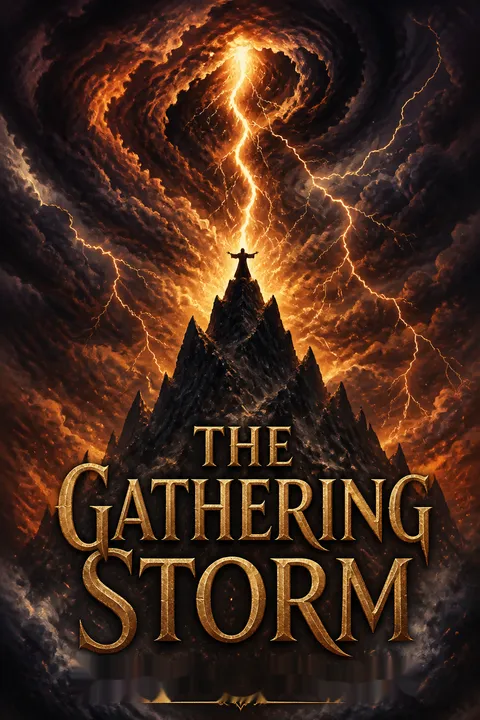


Plot Summary
Prologue
In the Borderlands, farmer Renald watches crops fail beneath an unnatural storm until smith Thulin abandons his home and urges him north, carrying food and turning tools into weapons. Elsewhere, Rand releases Seanchan prisoners with a message of peace, while the captive sul'dam Falendre learns that the woman who manipulated her leaders was a Forsaken.
Lieutenant-General Tylee leads her army through a world where food spoils and men vanish, then faces an attack by creatures that should exist only in legend. Graendal is ordered to frustrate Rand's efforts in Arad Doman. Meanwhile, Rodel Ituralde prepares to face a vast Seanchan army, and Faile kills Masema before he can escape, ending the Prophet's reign of terror.
The opening makes catastrophe visible before its causes are understood. Failed crops and impossible weather reach ordinary people first, while soldiers, rulers, and captives encounter the same unraveling from different directions. Renald's decision to leave his farm translates prophecy into practical fear: gather food, make weapons, move north. The other scenes complicate any simple division between heroes and villains. Rand offers peace to former enemies, Tylee must lead through unfamiliar horrors, and Faile kills a man whose followers once claimed to serve the Dragon. The world is coming apart, but everyone still has to choose what to do next.
The Dragon's Missing Hand
The attack by Semirhage has left Rand al'Thor without his left hand, with blurred vision and two wounds that refuse to heal. He keeps the Forsaken imprisoned, but forbids Cadsuane and the other Aes Sedai from torturing her, even as he demands information about Graendal and the other Chosen. Min watches him grow colder.
Rand hears Lews Therin Telamon, the voice of his previous life, and can no longer confidently separate the dead man's memories from his own. Still, he has a political task: unite the lands and make peace with the Seanchan before the Last Battle. He regards every army, advisor, and nation as a tool he must use, then feels guilty for doing so.
Rand's physical injury gives visible form to a deeper loss of agency. He is powerful enough to command nations but feels less free than the soldiers he orders into danger. His refusal to torture Semirhage preserves one moral boundary, yet it also exposes how little control he feels elsewhere. The voice of Lews Therin makes that uncertainty literal: memory, identity, and madness occupy the same mind. His peace-making is therefore not a calm diplomatic project. It is an attempt to reduce the number of enemies before the final battle, undertaken by a man who increasingly believes that tenderness is a liability.
Egwene Refuses to Bow
Captured by Elaida, Egwene endures repeated beatings, forkroot, and novice chores while refusing to curtsy or accept that she has been demoted. At dinner, Elaida proposes adding an oath of obedience to the Three Oaths, threatening the institution she claims to lead. Egwene deliberately spills soup rather than risk answering in rage, then realizes that her real duty is not simply to bring Elaida down.
She must preserve the White Tower through its fractures. During punishment, she laughs at the absurdity of trying to beat that conviction out of her. Her visits to the imprisoned Leane and her careful conversations with sisters become small acts of repair, even while Elaida restricts her freedom.
Egwene's resistance is not simple stubbornness. She learns to distinguish personal pride from institutional responsibility, and that distinction changes how she uses endurance. The beatings matter less than the Tower's collapse around her, so she chooses when silence serves the larger task and when visible defiance is necessary. Her refusal to curtsy protects the credibility she will need to reunite the Ajahs. This is leadership practiced under coercion: she cannot command the Tower, but she can shape what its members believe a leader ought to endure.
Aviendha's Empty Lessons
Aviendha travels with Rhuarc and the Wise Ones through Arad Doman, no longer a Maiden but not yet accepted as a Wise One. She sees refugees fleeing the violence and struggles to understand Rand's orders to restore order without conquering the country. Her own uncertainty grows sharper: the Wise Ones assign humiliating tasks, including separating seeds and carrying stones, but refuse to explain what she has done wrong.
She worries that time with Elayne has softened her, and that she cannot approach Rand as an equal until she understands her new place. Her devotion to him remains firm, but she will not accept his marriage offer as an inferior. She must first discover what honor means beyond the spear.
Aviendha's crisis is a problem of identity rather than ability. She is powerful, brave, and accustomed to clear standards of honor, yet the Wise Ones deliberately withhold the rules she needs to interpret their judgment. Their method forces her to confront a hidden assumption: obedience to authority is not the same as readiness to lead. Her discomfort with wetlander customs also exposes a broader transition. She can no longer define herself solely by the Aiel past, because the future of her people and her place beside Rand require new forms of understanding.
Ituralde's Empty City
Rodel Ituralde lures the Seanchan army toward Darluna, a walled city whose apparent lack of defenders has been carefully arranged. His supposed farmers rise from the fields with bows, while hidden troops emerge from the city itself. The Seanchan's aerial scouts have counted what they can see, not what Ituralde has concealed.
The trap wins a remarkable victory, but half of Ituralde's hundred thousand soldiers die, and General Turan is left mortally wounded. Ituralde grants his enemy the death he requests, then understands that even this success cannot defeat the Empire. Seanchan forces learn quickly, the Taraboners hesitate to help, and Ituralde must decide whether to keep fighting for a homeland he cannot save alone.
Ituralde's victory depends on exploiting the very confidence that makes Seanchan scouting effective. Their aerial advantage encourages them to trust visible evidence, so he turns empty fields and an undefended city into instruments of deception. The cost prevents the battle from becoming a simple triumph: his tactical brilliance buys time, not victory. His decision to keep resisting is not optimism. It is an argument about memory and political possibility, that future generations may need proof their people did not simply surrender their homeland.
The Council Is Taken
Rand summons Rhuarc and Bael to Arad Doman, demanding results before recognizing that the country is too fractured for ordinary rule. He orders the Aiel to seize members of the Council of Merchants and protect the cities they govern, a plan that offends their sense of honor.
After he meets Ituralde in the general's beleaguered camp, Rand proves his identity by channeling and offers him a different command: take a hundred Asha'man to defend the Borderlands. Ituralde accepts, trusting Rand's promise to remove the Seanchan from Arad Doman. The plan gives Rand a capable commander and the Aiel a task, but it also reveals his growing habit of treating allies as pieces to position.
Rand's strategy is effective because it recognizes that Arad Doman cannot be repaired through a single military victory. Food, safety, and a functioning council matter as much as battlefield success. Yet his methods strain the people he needs: the Aiel hear a command to kidnap, while Ituralde hears a demand to abandon his homeland. Rand's apology to the clan chiefs shows that he can still correct himself, but his default language is increasingly coercive. His political competence is growing alongside a dangerous belief that urgency excuses the erosion of consent.
Faile Returns to Perrin
After the battle that frees Faile from the Shaido, Perrin inspects wagons and organizes a hundred thousand refugees for a march away from Malden. He refuses to leave them behind, even as his captains press him to move faster and the exhausted Asha'man struggle to open gateways.
Faile is home, but Perrin cannot return to the man he was before her capture. He worries over the men who died while he pursued her and over Aram, his friend, who fell after Masema sent him against Perrin. Faile and her companions quietly burn keepsakes of the Brotherless who protected them, honoring the men they killed during the rescue.
The rescue does not restore the old order because the act of saving one beloved person has redistributed danger onto many others. Perrin's devotion was morally understandable, but his single-minded pursuit made him neglect the people who followed him. Faile's private memorial recognizes the same cost from another angle: survival depended on killing men who had treated her with honor. Their grief is not resolved by reunion. Instead, it makes leadership and love more demanding, because both now require remembering consequences rather than escaping them.
Tuon Claims the Throne
After Mat sends her back to Ebou Dar, Tuon returns to an Empire shaken by civil conflict and Suroth's betrayal. She confronts Beslan, who had plotted rebellion, and offers him a choice between execution and a place in the Seanchan order; he pledges loyalty and is raised among the High Blood. Then Tylee arrives with grotesque animal-headed bodies from a Trolloc attack, warning that a greater threat is approaching.
Tuon hears Tylee's argument that the Dragon Reborn may be a better ally than enemy. Rather than immediately authorizing a strike on the White Tower, Tuon orders her forces to avoid Rand and agrees to meet him. She must secure her new authority while deciding what kind of war the Empire can survive.
Tuon's political strength lies in converting submission into a bargain. She does not treat Beslan as an equal, but she offers him tangible authority and protection rather than relying on punishment alone. Tylee's evidence disrupts the Seanchan assumption that conquest is the only urgent task. Tuon responds with caution, not sentiment: an alliance may be strategically necessary even if she does not trust Rand. Her coronation is therefore less a ceremonial arrival than a test of whether imperial order can adapt when old threats are no longer the most dangerous ones.
Hinderstap After Sunset
Traveling toward Caemlyn with the Band, Mat stops at Hinderstap, where the mayor orders outsiders to leave before nightfall. Mat stays to gamble, deliberately losing gold so villagers will bet their food, ale, and wagon against him. The mayor finally makes the decisive throw himself, and Mat wins.
Then the town erupts into a slaughter: neighbors attack one another with animal fury, forcing Mat, Talmanes, and their soldiers to fight for escape. They return at dawn to find the dead alive again and the town restored. The mayor explains that residents lose their memories overnight, wake in their own beds, and cannot escape the curse. A drawing of Mat reveals someone is hunting him.
Mat's gamble begins as a practical expression of his luck, but Hinderstap turns it into an ethical trap. He wins supplies from people who seem carefree, then discovers they have been living under a nightly horror they cannot prevent or remember. Their rules about sunset were not arbitrary; they were a fragile technology of survival. The repeated restoration of the town denies ordinary consequences without removing suffering. Mat leaves with food and a new pursuer's clue, but also with the knowledge that his luck can place him inside disasters rather than safely above them.
Gawyn Leaves Elaida
Gawyn's doubts deepen as he leads the Younglings against Bryne's rebel army, a force commanded by the very general who trained him. When he learns that Egwene is the rebels' Amyrlin and has been captured by Elaida, he abandons the Younglings and rides to seek Bryne's help. Bryne refuses an immediate rescue because Egwene has ordered her followers not to risk one, and he remains bound by his own oath.
Gawyn also learns that Elayne holds Andor's throne, weakening his reason for staying away. During the search for help, he and Bryne find Shemerin, a former Aes Sedai whom Elaida stripped of her shawl. Gawyn's loyalty has changed, but he still does not know what it should become.
Gawyn's martial skill offers him certainty that political judgment cannot. On a training floor, action has clear consequences; in the White Tower's divided conflict, every available choice feels compromised. His departure from the Younglings is the first decision that aligns his conduct with his concern for Egwene, but it does not resolve his deeper confusion about Andor, the Tower, and Rand. Bryne's refusal matters because it models a different kind of loyalty: keeping an oath even when the person one loves might be harmed by it.
Egwene Uncovers the Black
Inside the White Tower, Egwene uses novice lessons and private conversations to bring rival Ajahs into contact. She discovers that Meidani, a Gray sister spying on Elaida, has been bound by a secret oath to a group of Sitters investigating the Black Ajah. Egwene confronts the Sitters, then argues that the Black vote used in Siuan's deposition may have made Elaida's original elevation unlawful.
Rather than expose the investigators, Egwene urges them to work toward unity. At a public dinner, she refuses Elaida's demand to kneel and names the dangers of the proposed obedience oath. Elaida beats and imprisons her, but the Sitters have seen which woman defends Tower law.
Egwene's central political skill is not overpowering her opponents but changing the terms on which they judge her. She turns the debate from whether she is a legitimate Amyrlin to whether any leader can claim legitimacy while breaking the Tower's own laws. Her argument links institutional procedure to moral credibility: if a Black Sitter helped depose Siuan, then the rebellion began with a corrupted vote. The danger is real, but Egwene refuses to protect the Tower through another secret abuse of power. She makes unity a public obligation rather than a private bargain.
Aviendha Claims Her Place
After enduring punishments she cannot understand, Aviendha finally confronts Amys, Bair, and Melaine. She insists that she has learned what they asked and refuses to continue accepting tasks that make her a da'tsang. The Wise Ones reveal that the punishments were a test: they had judged her ready weeks earlier, but she had not claimed equality with them.
They welcome her as a sister and send her toward Rhuidean for the final rite of passage. Aviendha leaves the camp with supplies and a new understanding of her standing. She has not abandoned her Aiel identity; she has learned that a Wise One must defend her own judgment rather than wait for permission to speak.
The test succeeds because it targets a blind spot rather than a weakness. Aviendha's courage was never in question; her deference to the Wise Ones was. She interpreted every punishment as evidence that she remained unworthy, when the elders were asking her to decide for herself that she was ready. The scene turns Aiel honor inward: accepting pain can restore standing, but unquestioning obedience can also prolong shame. Her new authority is not handed down by praise. She claims it, then accepts the responsibilities that follow.
Perrin Enters the Wolf Dream
Perrin returns to the wolf dream seeking instruction from Hopper, hoping to master the wolf instincts that frighten him. Hopper urges him to run and hunt rather than analyze every danger. When Perrin insists on learning control, Hopper casts him out of the dream, warning that his forceful probing could kill him.
Awake, Perrin considers how his pursuit of Faile became a way to avoid leadership and the violence inside himself. He decides to face the wolf dream again and to stop treating responsibility as an obstacle he can postpone. He will march toward the Last Battle and must choose whether to accept the people who follow him, even if that means letting Faile share the danger.
Perrin's conflict is not simply man against wolf. It is a struggle between control and participation: he wants to understand the danger before entering it, while Hopper's instinct is to live through the encounter. His earlier rescue mission allowed him to focus on one urgent love and ignore broader obligations. Now that Faile is beside him, the excuse is gone. The wolf dream becomes a test of whether he can accept uncertainty without surrendering to rage, while his waking choices ask the same question about leadership.
Verin Finds Mat
After Hinderstap, Verin finds Mat and offers to take the Band to Caemlyn by Traveling, sparing them a long and dangerous march. She explains that the Pattern has repeatedly diverted her toward him and warns that a Forsaken wants Mat and Perrin dead. Verin also reveals that Rand has cleansed saidin, a revelation Mat struggles to absorb.
For the gateway, she asks Mat to follow instructions in a sealed letter ten days after reaching Caemlyn, or to wait thirty days if he refuses to open it. Mat accepts the delay but insists he will not open the letter. He wants help, yet still resists any bargain that might make him feel controlled.
Mat's choice exposes the contradiction at the center of his character: he distrusts Aes Sedai schemes, yet often accepts responsibility when a friend or companion is at risk. He is not persuaded by Verin's authority or the scale of her warning. Instead, he negotiates for the narrowest commitment he can tolerate. The sealed letter converts future obedience into a present dilemma, while the promise of rapid travel tempts him with exactly what he needs. His reluctance is not cowardice; it is an effort to preserve agency in a world that keeps assigning him a role.
Tuon Meets the Dragon
At Falme, Tuon meets Rand beneath the Seanchan banner. He asks for peace and an end to the Empire's advance, arguing that every available force must face the Shadow. Tuon insists that the Return and its oaths give the Seanchan a right to unite the lands under the Crystal Throne.
When Rand rejects the enslavement of channelers, she sees not a negotiable difference but a challenge to the order she must uphold. His intensity unsettles her, yet she refuses to submit. The meeting ends without a treaty. Tuon returns to Ebou Dar more certain that the Dragon Reborn is dangerous, while Rand leaves without the alliance he needs.
The failure is not caused by poor wording alone. Rand seeks a temporary military coalition, while Tuon understands peace as submission to a political order she considers legitimate. Each interprets the other's position through a moral framework the other cannot accept: he sees the collars as enslavement, she sees them as necessary governance. The encounter also makes charisma dangerous. Rand's force of will nearly bends Tuon before she resists, suggesting that the problem is no longer only armies. His desire to prevent war can itself feel like domination.
The Tower Is Raided
The Seanchan launch the aerial strike Tuon has considered against the White Tower, bringing to'raken, damane, sul'dam, and soldiers directly to the city. Their weaves tear openings in the Tower and set parts of it ablaze. Egwene, still weakened by imprisonment and forkroot, rallies novices and the sisters around her rather than fleeing.
She channels with extraordinary force, bringing attacking creatures down and giving defenders time to organize. The raid nevertheless carries off many Aes Sedai, including Elaida, while others are killed or injured. The attack proves Egwene's warnings were real, but it also leaves the Tower physically shattered and its leadership scattered.
The raid transforms Egwene's political argument into immediate survival. The Tower's divisions have left it poorly prepared, yet the very women Elaida tried to reduce to tools become defenders in their own right. Egwene's courage matters, but it cannot erase the cost: some sisters are taken, others die, and the institution remains vulnerable. The attack also vindicates her Dream without granting her an easy victory. Knowing danger is coming is not the same as being able to prevent it, especially when the people who should prepare are busy fighting one another.
Verin's Last Gift
After the attack, Verin visits Egwene in her quarters and reveals that she joined the Black Ajah under duress, then used her position to record its members, alliances, and methods. Her coded book contains names across the Ajahs, including Sheriam and Moria, and identifies Mesaana as a Forsaken inside the Tower.
Verin has taken poison because the Black Ajah's vows leave her only a final chance to betray the Shadow. She gives Egwene the cipher and a ter'angreal that hides the books, then dies. Egwene conceals the body, begins decoding the list, and learns how deeply the enemy has woven itself into the institution she is trying to restore.
Verin's final act turns scholarship into resistance. The Brown Ajah's habit of preserving knowledge, often dismissed as withdrawal from the present, becomes the means by which the present can be fought. Her choice is not cleanly heroic: she has spent years inside a murderous organization and cannot undo the harm she helped enable. What she can do is leave evidence that outlives her. Egwene inherits both a tactical advantage and a moral burden, since using the book may expose allies and destabilize the Tower further.
Natrin's Barrow Burns
Nynaeve's discovery of a ruined messenger and the Compulsion on a young apprentice gives Rand a location: Natrin's Barrow, Graendal's secluded palace. He sends the vain Domani lord Ramshalan ahead, expecting Graendal to manipulate him and confirm the trap. Once Nynaeve detects the Compulsion, Rand refuses to enter the palace or risk a battle there.
He instead channels balefire through the access key, erasing the fortress and everyone inside from the Pattern. The attack kills Graendal and destroys the household she had reshaped into a collection of controlled servants. Rand has removed a Forsaken, but the scale of his choice shocks Nynaeve and Min.
Rand solves an asymmetrical problem by refusing the enemy's chosen arena. Graendal expects to control the encounter through Compulsion, decoys, and the vulnerabilities of those around her. Rand denies her that contest and uses a weapon that does not merely kill but rewrites recent events. This is tactically decisive and morally corrosive. He saves his followers from a dangerous assault, yet treats a whole household as expendable collateral. The deed shows why his allies fear his hardness: his methods may be rational in war while making it harder to recognize the person they are meant to save.
Tam Breaks the Void
When Tam reaches Rand in Tear, Rand's father speaks plainly about the danger of losing himself. Rand cannot bear to hear the concern as anything but judgment and erupts, driving Tam away with the One Power. Alone afterward, he recognizes that he has nearly repeated Lews Therin's worst failure: letting pain turn against those he loves.
He travels to Dragonmount, where he nearly draws enough power through the Choedan Kal to destroy himself and the surrounding land. Instead, memory returns: love has mattered across every life, not merely the final battle. Rand destroys the access key, releases the power, and laughs as the clouds finally break.
Tam does not defeat Rand through argument; he exposes what Rand's self-protective theory has cost. Rand has mistaken emotional numbness for strength, believing that a man who expects to die must have nothing left to lose. On Dragonmount, he discovers that repetition is not proof of meaninglessness. Each life offers another chance to choose love, even after failure. His laughter is not a denial of suffering or an assurance of victory. It is the return of a self capable of valuing what the battle is supposed to protect.
The Tower Chooses Again
With Elaida captured and the White Tower damaged, Egwene returns to the center of its politics as more than a prisoner or a rival claim. The Sitters must confront the damage caused by Elaida's rule, the Black Ajah's infiltration, and their own failure to act together. Egwene insists that reconciliation cannot mean pretending nothing happened; the Tower must acknowledge its crimes and rebuild its authority through cooperation.
She accepts the burden of leading a wounded institution, while Silviana's appointment as Keeper gives the Red Ajah a place in that repair. The Tower is not healed, but its factions now have a leader who has endured both imprisonment and battle without surrendering her claim.
Egwene's authority is earned through a sequence of public costs: she is captured, punished, disbelieved, and then vindicated by events. That does not make her infallible. Her earlier choices helped create risks, and her new position carries the danger of repeating the coercion she condemns. The crucial difference is that she frames unity as accountable work rather than forced obedience. Choosing Silviana also signals that reconciliation must include former opponents, not merely reward the faction that raised her.
Sunlight Finds the Tower
In the epilogue, Egwene looks up at the White Tower after weeks of unnatural cloud and gloom. Sunlight finally breaks through, revealing the Tower still standing despite the Seanchan assault and the damage left by the struggle for control. The clearing sky does not undo the deaths, the captured sisters, or the fractures among the Ajahs.
It offers only a change in the immediate weather, a brief opening above a wounded city. Egwene remains responsible for rebuilding what the Tower has lost, while Rand's new resolve has altered the balance of the coming Last Battle. The light arrives as a beginning, not a promise that the danger has passed.
The epilogue's sunlight is deliberately modest. It does not certify victory or erase the material and political damage of the book. Instead, it contrasts the Tower's continued existence with the possibility of change: an institution can survive its own failures, but survival creates obligations. The image also answers the opening's dead sky without pretending that the storm has vanished everywhere. Hope here is atmospheric rather than triumphant, a moment of visibility that lets the characters see what remains to be repaired.
Epilogue
After weeks of unnatural cloud and gloom, sunlight breaks through above the White Tower. The building still stands, but its wounds remain visible, and the attack has left the Aes Sedai divided, dead, captured, or newly responsible for repair.
Egwene faces the work ahead as the Tower's leader. Elsewhere, Rand has recovered a reason to live beyond mere duty and death. The clear sky offers no guarantee that the Last Battle will be won. It marks only a pause in the darkness, enough light for the survivors to see what they must mend.
The ending refuses the comfort of a completed victory. The Tower is still standing, but its survival does not absolve the Aes Sedai of the choices that weakened it. Sunlight answers the prologue's dead sky, yet only briefly and locally; the world remains under threat. Its meaning depends on what the characters do next. Egwene must turn authority into repair, while Rand must carry his recovered capacity for love into a battle that still demands sacrifice. The image is hopeful precisely because it is not a solution.
Analysis
The novel repeatedly asks whether a necessary act can remain humane when the people performing it are under unbearable pressure. Rand's political project requires him to unite nations, yet he increasingly treats consent as an obstacle. His transformation is not simply a descent into tyranny: he believes that emotional hardness is the price of preventing another Breaking. The crisis arrives when that logic threatens to make survival meaningless. Tam's intervention and Rand's return to feeling do not solve the military problem; they restore a reason to face it beyond obedience to prophecy.
Egwene's parallel struggle is institutional. She cannot save the White Tower by pretending that its divisions were harmless, nor can she repair it by copying Elaida's use of power. Her authority grows through endurance, argument, and a willingness to accept accountability herself. The revelation of the Black Ajah sharpens the dilemma: secrecy can protect a cause, but it can also rot the trust the cause depends on. Verin's record gives Egwene knowledge, not an easy answer.
The supporting plots widen the same question. Ituralde fights because defeat without resistance would hand his homeland to an invader. Perrin learns that love does not excuse neglecting the people who follow him. Mat resists the role of hero while repeatedly returning for others. Tuon and Rand fail to make peace because each sees their system as the condition of order. Meanwhile, unnatural spoilage, warped buildings, and the people of Hinderstap show that the world's structure is failing even far from the battlefield.
The final sunlight is therefore not a promise of victory. It is a moment in which damaged people and institutions can see what remains to be done. The central question is no longer whether the Last Battle can be avoided, but whether its participants can preserve enough compassion, trust, and memory to make victory worth having.
Review Summary
The Gathering Storm receives high praise from fans, with many considering it one of the best books in the series. Readers appreciate Brandon Sanderson's continuation of Robert Jordan's work, noting improved pacing and character development. The book focuses on Rand and Egwene's storylines, with both characters experiencing significant growth. Some readers observe differences in writing style, particularly regarding Mat's character, but overall find the transition seamless. Many express emotional reactions to key scenes and anticipation for the series' conclusion.
People Also Read




Characters
Rand al'Thor
The burdened DragonThe Dragon Reborn is a young leader carrying the fate of the world while trying to bind rival nations into a common defense. His injuries, his memories of Lews Therin, and the demands of prophecy make him increasingly suspicious of advice and impatient with delay. He wants to prevent needless suffering, yet the need to act quickly pushes him toward coercive decisions. His relationships with Min, Nynaeve, Cadsuane, and the Aiel expose different parts of his character: tenderness he fears losing, blunt counsel he resents, authority he distrusts, and obligations he cannot escape. He is neither simply a savior nor a tyrant, but a man struggling to remain human while being treated as a weapon.
Egwene al'Vere
The captive AmyrlinRaised from the Two Rivers and thrust into leadership of the rebel Aes Sedai, Egwene combines ambition with an increasingly exact sense of institutional responsibility. She is not content merely to claim authority; she studies how fear, custom, and rivalry shape the Tower's behavior. Her imprisonment tests her ability to distinguish endurance from submission, while her political work requires her to treat former opponents as potential partners. She is proud, disciplined, and capable of calculated patience, but not immune to anger or overreach. Her central drive is to make the White Tower strong enough to serve the world, even when its own members resist the changes that strength requires.
Matrim Cauthon
The reluctant gamblerMat tries to preserve a life of travel, dice, and irreverence even as responsibility repeatedly catches up with him. His luck and buried memories of other soldiers make him an extraordinary commander, though he dislikes being treated as a hero or nobleman. He is quick to complain, slow to admit attachment, and far more loyal than his jokes suggest. The Band of the Red Hand depends on his practical judgment; Thom and Talmanes understand the steadier man beneath his evasions. His marriage and his entanglement with the Seanchan force him to face a future he would rather treat as someone else's problem.
Perrin Aybara
The reluctant wolf lordPerrin is a blacksmith by temperament, a careful man who would rather repair a wagon than issue an order that might cost lives. His unusual kinship with wolves gives him sharper senses and a dangerous intimacy with the wolf dream, but he fears that instinct and violence may overwhelm his judgment. His love for Faile is fierce and sometimes consuming; his loyalty to his people is equally strong, though he has not always known how to balance them. Perrin's challenge is to accept leadership without mistaking responsibility for control. He thinks before acting, but the Last Battle is forcing him to decide before certainty is possible.
Nynaeve al'Meara
The stubborn healerOnce the Wisdom of Emond's Field, Nynaeve brings practical healing, formidable channeling strength, and a fierce instinct to protect people she considers hers. She dislikes being treated as inexperienced, yet is capable of learning from those she initially dismisses. Her marriage to Lan deepens her resolve, while her friendship with Rand makes her unwilling to accept his growing emotional hardness as inevitable. She remains blunt, quick-tempered, and impatient with ceremony, but those traits coexist with compassion and unusual courage. Nynaeve is valuable precisely because she challenges powerful people directly, though she must learn when forceful concern becomes another attempt to control them.
Min Farshaw
The Dragon's clear-eyed anchorMin reads images and portents around people, but her greatest strength is her plainspoken intimacy with Rand. She refuses the formal distance others maintain, teasing him, challenging him, and trying to reach the person beneath his public role. Her visions make her aware of futures she cannot easily change, while her bond with Rand lets her feel the strain he hides. She wants to protect him without becoming merely another instrument in someone else's plan. Her practical courage is easy for soldiers and courtiers to overlook, but she understands that affection can be a form of knowledge, not just a vulnerability.
Cadsuane Melaidhrin
The formidable old counselorCadsuane has survived centuries of Aes Sedai politics by trusting her judgment and revealing little. She is experienced, commanding, and often intolerant of what she sees as foolishness. Her purpose is to prepare Rand for the Last Battle, but she approaches him as someone to manage, and that instinct makes her methods difficult to distinguish from manipulation. She respects competence wherever she finds it, including in the Wise Ones, yet expects others to accept her authority before she has earned their trust. Cadsuane's confidence is both her greatest tool and her blind spot: she knows how to direct people, but not always how to let them choose.
Tuon
The Seanchan heirThe Daughter of the Nine Moons is trained to read omens, command obedience, and preserve the Seanchan Empire. She prizes order because civil conflict has shown her how quickly authority can collapse. Her judgment is disciplined and strategic, but her assumptions about channelers and conquest place her at odds with Rand's vision of peace. Mat unsettles her because he resists the roles she understands and follows a code of honor that does not fit Seanchan expectations. Tuon is neither a simple conqueror nor a passive royal figure; she is a ruler in formation, balancing inherited doctrine against evidence that the world is changing.
Gawyn Trakand
The divided princeGawyn is a gifted swordsman and the brother of Elayne, but his sense of duty is divided among Andor, Egwene, and the White Tower. He believes action should protect the people he loves, yet he repeatedly discovers that his chosen side may put them in danger. His pride can make him rash, particularly when he thinks others are withholding the truth. Bryne's mentorship gives him a model of honor that is more demanding than simple obedience. Gawyn's central struggle is not whether he can fight, but how to decide what his fighting is for.
Tam al'Thor
The shepherd's steady fatherTam raised Rand in the Two Rivers and remains one of the few people who can address him without courtly caution. A former soldier and practical farmer, he values honest work, clear judgment, and a life lived among people rather than symbols. His affection for Rand is deep but not indulgent; he is willing to challenge him when fear or pride distorts his choices. Tam's calm presence recalls the ordinary home Rand believes he has lost. He represents not an escape from duty, but a way of remembering what duty is meant to protect.
Verin Mathwin
The Brown who recordsVerin is a scholarly Brown sister whose absent-minded manner makes it easy to underestimate how closely she observes the world. She collects information with patience, connecting details others dismiss as incidental. Her curiosity is not detached from responsibility; she understands that knowledge can become a weapon when danger is hidden inside institutions. Verin is careful, private, and difficult to read, even to other Aes Sedai. Her work reflects the Brown Ajah's devotion to preserving the past, while her interest in current events suggests that records matter most when someone is willing to act on them.
Rodel Ituralde
The Domani Great CaptainIturalde is a veteran commander who studies an enemy's habits as carefully as its numbers. He is imaginative without being reckless, and understands that a battlefield victory may still leave a war unwinnable. His loyalty to Arad Doman and its king is not blind; it is a commitment to keep resisting while resistance still has meaning. He respects skill in an opponent and distrusts easy optimism. Ituralde's value to Rand lies in his ability to improvise under impossible conditions, though neither man is naturally comfortable surrendering control.
Aviendha
The apprentice Wise OneAviendha was raised as a Maiden of the Spear, where courage, duty, and honor had clear forms. Her training among the Wise Ones forces her to reconsider those measures without abandoning her Aiel identity. She is direct, brave, and often bewildered by wetlander habits, but she can learn to see leadership through another culture's eyes. Her love for Rand is certain; her readiness to stand beside him as an equal is not. Aviendha's development depends on claiming authority rather than waiting for older women to certify her worth.
Faile Aybara
The Saldaean strategistFaile is a noblewoman with a keen sense of politics, personal pride, and a talent for organizing people under pressure. Her relationship with Perrin is passionate and often complicated by their different ways of expressing care. She can be forceful where he hesitates, but captivity and danger deepen her understanding of what leadership costs those who serve. Faile does not mistake affection for helplessness; she expects those she loves to respect her judgment. Her wit and command make her a partner in Perrin's responsibilities, not simply the person he must protect.
Siuan Sanche
The fallen AmyrlinSiuan once ruled the White Tower through sharp political instincts and a network of secrets. After losing much of her power, she discovers that other people underestimate her, creating new room for quiet influence. She is blunt, resourceful, and fiercely committed to Egwene, though her habits of secrecy can lead her to act without permission. Her relationship with Gareth Bryne complicates a life long organized around duty and postponed desire. Siuan remains a strategist, but she is learning that loyalty sometimes requires trusting others with the truth.
Lan Mandragoran
The last Malkieri kingLan is a disciplined warrior whose sense of duty is shaped by a kingdom lost to the Blight. He keeps his grief private and treats survival as less important than honor. Nynaeve's love challenges his willingness to face danger alone, but he remains difficult to redirect once he has chosen a path. Lan's quietness is not a lack of feeling; it is a way of containing feelings that might otherwise overwhelm him. His unresolved relationship with his homeland gives his personal choices larger political meaning.
Graendal
The hidden ForsakenGraendal is a Forsaken who prefers influence from behind a cultivated display of wealth, beauty, and carefully controlled dependents. She studies vanity and desire as tools, using other people's weaknesses to protect her own position. Unlike a battlefield commander, she does not need armies if she can bend the people who command them. Her ease and appetite conceal a calculating mind that distrusts every rival among the Chosen. Graendal's presence turns political disorder into something more intimate: the possibility that a person's choices may no longer belong to them.
Semirhage
The captured torturerSemirhage is one of the Forsaken, feared for her knowledge of pain and her clinical interest in control. She presents herself as composed and superior, treating other people as subjects in experiments rather than as equals. Her discipline makes her difficult to intimidate, and she studies the fears of her captors as carefully as they study her. She is especially dangerous because she understands how humiliation can be more effective than force. Her presence tests the limits of Rand's moral rules and the confidence of those who believe they can contain her.
Elaida do Avriny a Roihan
The embattled AmyrlinElaida is an Aes Sedai whose certainty about her own authority has hardened into a need for obedience. She believes that the Tower must control events, especially the Dragon Reborn, but her impatience makes her increasingly blunt and punitive. Her preference for force over persuasion undermines the institution she hopes to strengthen. Elaida is not portrayed as simply foolish: she can recognize danger and act decisively. Her weakness is believing that command itself creates legitimacy, even when her actions make the other sisters less willing to follow.
Silviana
The dutiful Red sisterSilviana is the White Tower's Mistress of Novices, a stern Red sister who takes discipline seriously but is not cruel for its own sake. She understands the difference between enforcing a rule and breaking a person's spirit, and small acts of fairness reveal her judgment beneath her severity. Egwene's endurance unsettles her because it forces her to question whether punishment can correct what is fundamentally wrong with the Tower. Silviana values duty, but her sense of duty is more humane than Elaida's. She represents the possibility that firmness and compassion can coexist.
Sheriam Bayanar
The Keeper under pressureSheriam serves as Keeper among the rebel Aes Sedai and is accustomed to managing people through access, favors, and political calculation. She is capable and socially perceptive, but the divided Tower leaves her caught between ambition, fear, and competing loyalties. Her polished manner conceals how much she depends on the approval of those with greater power. Sheriam's position makes her a useful lens on the costs of political compromise: a person can seek influence to protect herself and still become entangled in forces she cannot control.
Davram Bashere
Rand's Saldaean generalBashere is an experienced Borderland general who combines dry humor with an unromantic understanding of military necessity. He can advise Rand without pretending the Dragon Reborn's decisions are easy or harmless. His loyalty is tested by the demands of command, his homeland, and his family, particularly when Rand's plans place armies far from their proper borders. Bashere values discipline and practicality over spectacle. He is one of the few commanders who can translate Rand's broad goals into movements of troops and supplies, while still noticing the political costs of those movements.
Rhuarc
The Taardad clan chiefRhuarc is a respected Aiel clan chief who balances loyalty to Rand with responsibility to the Aiel people. He does not mistake obedience for agreement, and he challenges orders that seem to misuse his warriors or dishonor their customs. His patience makes him an effective negotiator among the Aiel, while his directness keeps him from becoming merely an instrument of Rand's plans. Rhuarc understands that the Aiel are changing, but he worries about what will remain of them after the Last Battle. His practical wisdom often reveals the human consequences hidden inside Rand's strategic decisions.
Gareth Bryne
The oath-bound generalBryne is a veteran commander whose authority comes from competence and a reputation for keeping his word. He treats logistics, discipline, and ordinary soldiers as seriously as the grand movements of armies. His relationship with Siuan grows from distrust and an unfinished obligation into a more personal bond, though neither easily abandons pride. Bryne is not immune to doubt; he has questioned the causes for which he fought and the people he served. His steadiness makes him a counterweight to Gawyn's impulsiveness and a practical anchor for the rebel army.
Hurin
The loyal Shienaran trackerHurin is a Shienaran thief-taker whose unusual ability to detect violence makes him valuable in a world growing more dangerous. He is modest, loyal, and deeply admiring of Rand, sometimes to the point of idealizing him. His familiarity with Rand's earlier life gives him a personal connection that later political followers cannot share. Hurin's plain decency and practical skill make him a reminder of the companions who knew the Dragon before prophecy turned him into a symbol.
Plot Devices
Ta'veren Pattern
Chance bends toward themRand, Mat, and Perrin are ta'veren, people around whom the Pattern bends events. The effect can make a needed ally appear, turn a risky gamble into a source of supplies, or produce an unlikely chain of meetings. It does not give them total control; often the Pattern creates complications as readily as solutions. Mat's encounter with Verin and the disturbances surrounding Rand illustrate the difference between influence and agency. The device makes coincidence part of the world's mechanics while preserving the characters' responsibility for what they choose once an opportunity appears.
The One Power
Power with human costThe One Power is divided into saidar, wielded by women, and saidin, wielded by men. The taint that once corrupted saidin has been cleansed, but old fears and the damage already done to male channelers remain. Channeling enables Healing, gateways, shields, weapons, and immense destructive force. Its rules shape politics as much as combat: the Seanchan collar women who can channel, Aes Sedai are bound by oaths, and the Asha'man are trained as soldiers. The Power never operates as a neutral tool. Who may use it, who controls it, and what a wielder is willing to destroy become central conflicts.
The Oath Rod
Oaths define authorityThe Oath Rod binds Aes Sedai to the Three Oaths, limiting what they can say and how they can use the One Power. It gives the White Tower credibility, but also makes disputes about who has sworn, who has been released, and who can be trusted politically decisive. Elaida's proposal to add an oath of obedience exposes the danger of turning a safeguard into a tool of personal control. Later, Egwene uses the rod to establish trust among the Sitters and to test sisters suspected of serving the Shadow. The rod provides evidence, but it cannot replace judgment or guarantee loyalty.
The Dream World
Dreams carry danger and warningTel'aran'rhiod, the World of Dreams, allows skilled dreamwalkers and users of certain ter'angreal to meet, travel, and exchange information outside ordinary waking life. Egwene and Siuan use it to communicate across the siege, while Perrin enters a related wolf dream to seek instruction from Hopper. It is not a harmless escape: the world responds to thought, can expose the dreamer to enemies, and carries consequences that do not always end upon waking. The dream world lets separated characters remain connected, but also blurs the line between refuge, warning, and battlefield.
Balefire
Destruction rewrites recent eventsBalefire burns a target out of the Pattern and reaches backward through the target's recent actions, erasing their consequences as well as their life. That makes it one of the few ways to prevent the Dark One from restoring certain servants, but every use strains the Pattern itself. Rand's ability to wield it becomes a terrifying answer to enemies who might otherwise escape or return. The danger is not only its physical scale. Used as a shortcut, balefire can make whole lives disappear from history and encourage Rand to treat people as expendable pieces in a tactical calculation.
FAQ
Synopsis & Basic Details
What is The Gathering Storm about?
- A World on Edge: The Gathering Storm depicts a world teetering on the brink of chaos as the forces of the Shadow grow stronger and the Last Battle looms. Political unrest, natural disasters, and the rise of powerful individuals create a sense of urgency and impending doom.
- Character-Driven Conflicts: The story focuses on the internal and external struggles of key characters, including Rand al'Thor, Egwene al'Vere, Perrin Aybara, and Mat Cauthon, as they grapple with their destinies and the challenges they face.
- Preparation for the Last Battle: The narrative emphasizes the need for unity and preparation as the characters navigate complex political landscapes, personal conflicts, and the growing threat of the Dark One. The book sets the stage for the final confrontation, highlighting the sacrifices and difficult choices that must be made.
Why should I read The Gathering Storm?
- Intense Character Development: The Gathering Storm delves deep into the psyches of its characters, exploring their motivations, fears, and desires. Readers will witness significant transformations and emotional turning points, making the characters feel more real and relatable.
- High Stakes and Tension: The book is filled with high-stakes conflicts and a sense of impending doom, creating a gripping and suspenseful reading experience. The looming Last Battle adds a layer of urgency, making every decision and action feel significant.
- Complex Themes and Symbolism: The Gathering Storm explores complex themes of power, redemption, and unity, using rich symbolism and subtle details to enhance the narrative. Readers will find themselves pondering the deeper meanings and implications of the story long after they finish reading.
What is the background of The Gathering Storm?
- Political Instability: The story is set against a backdrop of political instability, with nations fractured by internal conflicts and external threats. The Seanchan Empire's expansion and the rise of the Dragon Reborn create a volatile environment, forcing characters to make difficult choices.
- Magical and Prophetic Elements: The One Power, a source of magic, plays a central role in the story, with characters using it for both good and evil. Prophecies and visions add a layer of complexity, guiding and sometimes misleading the characters as they navigate their destinies.
- Cultural and Historical Influences: The world of The Gathering Storm is rich with diverse cultures and histories, drawing inspiration from various real-world societies. The Aiel, Seanchan, and Domani cultures are particularly prominent, each with its own unique customs, beliefs, and traditions.
What are the most memorable quotes in The Gathering Storm?
- "Right was easy to find when all I had to care for was a few sheep. Nowadays, sometimes it's harder to come by.": This quote from Rand al'Thor highlights his internal struggle with the burden of leadership and the difficult choices he must make. It reflects the loss of innocence and the complexities of power.
- "Things always have to get worse before they can get better.": This quote, repeated by Rodel Ituralde's mother, encapsulates the theme of hope amidst despair. It serves as a reminder that even in the darkest of times, there is always the possibility of a brighter future.
- "Sometimes, a wife must do what her husband cannot. It is a dark thing we did this day, but necessary. Let no one speak of it to my husband. He must never know.": Faile's words reveal her strength and determination, as well as the sacrifices she is willing to make for her husband. It highlights the complex dynamics of love and duty.
What writing style, narrative choices, and literary techniques does Robert Jordan use?
- Multiple Points of View: Jordan employs a multi-perspective narrative, allowing readers to experience the story through the eyes of various characters. This technique provides a comprehensive view of the world and its conflicts, while also highlighting the diverse motivations and experiences of the characters.
- Detailed World-Building: Jordan's writing is characterized by its rich and detailed world-building, creating a complex and immersive setting. He pays close attention to the cultures, histories, and political landscapes of the various nations, adding depth and realism to the story.
- Foreshadowing and Symbolism: Jordan uses subtle foreshadowing and recurring symbols to create a sense of mystery and anticipation. These literary devices enhance the narrative, adding layers of meaning and encouraging readers to ponder the deeper implications of the story.
Hidden Details & Subtle Connections
What are some minor details that add significant meaning?
- The Unnatural Weather: The persistent overcast sky and the strange weather patterns in Arad Doman foreshadow the growing influence of the Dark One and the impending Last Battle. These details create a sense of unease and highlight the unnatural forces at play.
- The Spoilage of Food: The recurring motif of food spoiling without warning symbolizes the corruption and decay that are spreading throughout the world. This detail emphasizes the Dark One's growing power and the fragility of life.
- The Names of Places: The names of locations, such as Dragonmount and Shayol Ghul, carry symbolic weight, connecting to the prophecies and the characters' destinies. These names serve as reminders of the epic scale of the conflict and the importance of the characters' roles.
What are some subtle foreshadowing and callbacks?
- Lews Therin's Voice: The increasing presence of Lews Therin's voice in Rand's mind foreshadows the growing internal conflict and the potential for madness. This detail creates a sense of unease and highlights the dangers of wielding the One Power.
- The Recurring Phrase "It is Time": The phrase "It is time" is repeated throughout the book, often in connection with the Last Battle. This phrase serves as a subtle reminder of the impending conflict and the need for the characters to prepare.
- The Description of the Aiel: The description of the Aiel as "like a poisonous snake in the middle of the field" foreshadows their role in the upcoming conflict. This detail highlights their dangerous nature and their potential to be both allies and enemies.
What are some unexpected character connections?
- The Bond Between Rand and Min: The bond between Rand and Min is a complex and evolving relationship, marked by both love and fear. Their connection allows them to share emotions and visions, creating a unique dynamic that is both intimate and unsettling.
- The Shared History of Tam and Rand: The bond between Tam and Rand is a powerful force in the story, highlighting the importance of family and loyalty. Their shared history and mutual respect create a deep connection that transcends their different backgrounds and destinies.
- The Connection Between Faile and the Brotherless: Faile's connection to the Brotherless, particularly Rolan, reveals a hidden layer of complexity to her character. It highlights her ability to connect with others, even those who are considered enemies.
Who are the most significant supporting characters?
- Davram Bashere: A Saldaean general, Bashere is a loyal and capable leader who serves as a trusted advisor to Rand. His military expertise and strategic mind are invaluable in the fight against the Shadow.
- Cadsuane Melaidhrin: A powerful and enigmatic Aes Sedai, Cadsuane is determined to guide Rand, even if it means challenging his authority. Her wisdom and experience make her a formidable force in the struggle against the Dark One.
- Thom Merrilin: A gleeman and former court bard, Thom is a loyal friend and mentor to Mat. His knowledge of history and his ability to tell stories make him a valuable source of information and guidance.
Psychological, Emotional, & Relational Analysis
What are some unspoken motivations of the characters?
- Rand's Fear of Failure: Rand's harshness and cold demeanor stem from his fear of failing to fulfill his destiny. He is driven by the need to prepare the world for the Last Battle, even if it means sacrificing his own humanity.
- Egwene's Desire for Control: Egwene's defiance and determination are rooted in her desire to control her own destiny and the fate of the White Tower. She is driven by the need to restore order and unity, even if it means challenging the established authority.
- Perrin's Need for Acceptance: Perrin's internal conflict stems from his desire to be accepted as a leader and a warrior. He struggles with his wolf nature, fearing that it will make him a monster.
What psychological complexities do the characters exhibit?
- Rand's Internal Struggle: Rand's internal struggle with Lews Therin's voice and the growing darkness within him highlights the psychological toll of his destiny. He is torn between his desire to save the world and his fear of losing himself in the process.
- Egwene's Conflict Between Duty and Desire: Egwene's conflict between her duty as Amyrlin and her personal desires reveals the complexities of leadership. She is torn between her responsibility to the White Tower and her own need for autonomy.
- Perrin's Fear of Losing Control: Perrin's fear of losing control to his wolf nature highlights the psychological burden of his unique abilities. He struggles to reconcile his human and wolf sides, fearing that he will become a monster.
What are the major emotional turning points?
- Rand's Acceptance of His Fate: Rand's moment of clarity atop Dragonmount marks a major emotional turning point, as he accepts his destiny and embraces his role as a protector rather than a destroyer. This acceptance allows him to move forward with renewed purpose.
- Egwene's Defiance of Elaida: Egwene's refusal to submit to Elaida's tyranny marks a major emotional turning point, as she embraces her role as a leader and a symbol of resistance. Her defiance inspires those around her and solidifies her position as the true Amyrlin.
- Perrin's Reconciliation with His Wolf Nature: Perrin's decision to embrace his wolf nature marks a major emotional turning point, as he accepts his unique abilities and finds a balance between his human and wolf sides. This reconciliation allows him to lead more effectively.
How do relationship dynamics evolve?
- Rand and Min's Bond: The bond between Rand and Min deepens, as they share their fears and vulnerabilities. Their relationship becomes a source of strength and comfort, even as they face the challenges of their destinies.
- Gawyn and Egwene's Conflicted Relationship: Gawyn and Egwene's relationship is marked by tension and conflict, as they struggle with their different loyalties and desires. Their interactions highlight the complexities of love and duty in a world on the brink of war.
- The Aiel and Rand's Relationship: The Aiel's relationship with Rand evolves, as they grapple with his increasingly harsh demeanor and his growing power. Their loyalty is tested, but they remain committed to his cause, even as they question his methods.
Interpretation & Debate
Which parts of the story remain ambiguous or open-ended?
- The Nature of the Dark One's Power: The true nature of the Dark One's power and its influence on the world remains ambiguous. The source of the taint on saidin and the reasons for the growing corruption of the Pattern are not fully explained, leaving readers to ponder the deeper mysteries of the story.
- The Fate of the Forsaken: The ultimate fate of the Forsaken, particularly those who have escaped capture, remains uncertain. Their motivations and plans are not fully revealed, leaving readers to speculate about their role in the Last Battle.
- The True Meaning of Prophecies: The interpretation of prophecies and visions remains open to debate, as the characters struggle to understand their true meanings. The prophecies often seem contradictory or ambiguous, leaving readers to question their validity and the characters' understanding of them.
What are some debatable, controversial scenes or moments in The Gathering Storm?
- Rand's Use of Balefire: Rand's decision to use balefire to destroy Graendal's fortress is a controversial moment, raising questions about the morality of his actions and the potential consequences of wielding such power. Readers may debate whether his actions were justified or if they represent a descent into darkness.
- Egwene's Imprisonment and Punishment: Egwene's imprisonment and the harsh treatment she endures at the hands of Elaida raise questions about the nature of justice and the abuse of power. Readers may debate whether her defiance was worth the cost and if her actions were truly effective in undermining Elaida's authority.
- The Nature of the Warder Bond: The Warder bond is a complex and often debated topic, with questions about its impact on the individuals involved. The bond between Siuan and Bryne raises questions about the nature of love and duty, and the potential for both strength and vulnerability in such a connection.
The Gathering Storm Ending Explained: How It Ends & What It Means
- The Destruction of Natrin's Barrow: Rand's use of balefire to destroy Natrin's Barrow is a significant event, marking a turning point in his character development. It demonstrates his willingness to use extreme measures to achieve his goals, even if it means sacrificing his own humanity.
- The Release of the Black Ajah: The escape of the Black Ajah members from the White Tower highlights the ongoing threat of the Shadow and the challenges of maintaining order and unity. It also sets the stage for future conflicts and the need for the characters to remain vigilant.
- The Imminence of the Last Battle: The ending of The Gathering Storm emphasizes the imminence of the Last Battle, with the characters preparing for the final confrontation. The book leaves readers with a sense of anticipation and dread, knowing that the fate of the world hangs in the balance.
The Wheel of Time Series





About the Author
Download PDF
Download EPUB
.epub digital book format is ideal for reading ebooks on phones, tablets, and e-readers.








