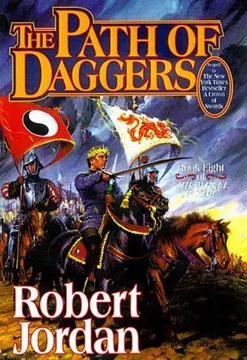


Plot Summary
Prologue
In the Black Hills, Kandor’s Queen Ethenielle and the rulers of Arafel, Shienar, and Saldaea cut their palms and bind themselves by blood to find Rand al’Thor,1 unsure whether they are protecting the world or walking into another trap. Elsewhere, Verin14 questions the Aes Sedai captured by the Aiel, hiding her own methods and gathering knowledge while the prisoners endure humiliating labor.
In a sealed chamber, Moridin16 studies a board game whose central figure resembles Rand1 and decides the Dragon1 is already moving within his designs. The three scenes set the book’s terms: rulers commit before they understand, knowledge is gathered under coercion, and the enemy treats people as pieces.
The prologue makes secrecy feel less like a single conspiracy than a condition shared by every level of power. Ethenielle’s blood pact is an act of responsibility, but it also exposes how little the rulers know about the man they seek. Verin’s interrogation shows intelligence work crossing ethical boundaries even when its goal is survival. Moridin’s game reduces the same human world to a contest he believes he can control. The contrast is not simply good against evil: each scene asks who may impose a plan on others, and what ignorance makes that authority dangerous.
Escape Through the Palace
In Ebou Dar, Elayne,3 Nynaeve,4 and Aviendha5 prepare to leave with the Bowl of the Winds, the ter’angreal they hope will repair the unnatural weather. Their bargain with the Sea Folk requires them to teach Windfinders what they know, while the Kin and several Aes Sedai join the journey with captured Black sister Ispan.
Before departure, Aviendha5 senses a watcher above the palace and warns the others, but the message is too vague to explain the threat. She opens a gateway to a hidden clearing beyond the city, and the party begins filing through. A black figure watches from a tower, while the women carry the Bowl and a collection of other Power-wrought objects into uncertain country.
The escape gathers women with very different kinds of authority into one fragile operation. Elayne and Nynaeve possess formal Aes Sedai standing, the Windfinders have contractual leverage, and the Kin bring numbers and practical experience. Aviendha’s warning shows the limits of perception: she detects danger but cannot make others understand it without proof. The gateway compresses distance while amplifying dependence. It gets the group out of the palace, yet leaves them committed to a bargain and a route whose safety rests on a single weave and a few women’s judgment.
A Gateway Comes Apart
Aviendha5 carefully unweaves the gateway instead of letting it fade, fearing that a trace could let an enemy follow them. The sisters condemn the risk, but her rare ability removes the residue. From a palace tower, Moridin16 sees what she has done and realizes someone has undone a weave thought impossible to dismantle safely.
A servant reports that the women took the Bowl of the Winds, and Moridin16 kills him in a burst of anger before Traveling after them. The gholam, already hunting the women who can channel, finds the servant’s body and follows their trail. What began as a clean escape has now drawn the attention of two predators.
Aviendha’s choice exposes the conflict between inherited rules and practical survival. The Aes Sedai treat unweaving as forbidden because its dangers are real, but the danger of leaving a readable trace is also real. Her skill makes caution possible without making it safe. Moridin’s reaction converts a technical discovery into strategic pursuit, while the gholam follows a more bodily logic of hunger and violence. The same departure therefore produces two forms of threat: an enemy who reads the Pattern as a game and a weapon that tracks its prey.
The Kin’s Hidden Farm
The travelers reach the Kin’s secluded farm, where the sight of Aes Sedai triggers panic among women who have spent years hiding from the Tower. Alise, the farm’s capable manager, challenges Reanne’s return and demands to know whether the Kin will again be rejected. Elayne3 and Nynaeve4 promise that channeling women will have a place in the Tower, though not every Kinswoman trusts the offer.
While the party settles, Elayne3 searches the recovered storehouse goods and finds several ter’angreal and a small angreal shaped like a turtle. The discovery gives her a way to strengthen a circle, but it also tempts her to investigate objects whose uses may be dangerous.
The farm turns the Kin’s long survival into a political question. They have built a functioning community without Tower protection, yet secrecy has also left them convinced they are lesser and disposable. Alise’s challenge makes inclusion more than a generous promise; Elayne must persuade people who have reasons to distrust the institution she represents. The ter’angreal cache mirrors this social inheritance. Objects preserved through fear can become resources, but knowledge does not automatically accompany possession. Elayne’s confidence as a scholar is both an asset and a vulnerability.
The Bowl Changes Weather
On a hill above the farm, Nynaeve,4 Elayne,3 Aviendha,5 Kin, and Windfinders form a circle around the Bowl of the Winds. Caire, a Sea Folk Windfinder, takes control and weaves through the ter’angreal, which draws both halves of the One Power as it alters the weather.
The work appears complete when the Bowl clears and distant lightning flashes, but the women can feel power still moving across the land. Then raken bearing Seanchan riders dive toward the hill. Elayne3 identifies the attackers and orders everyone to flee, while Renaile tries to open a gateway herself and fails. The bargain is unfinished, the enemy is near, and the group must escape at once.
The Bowl’s use is a collective achievement that produces no clean sense of mastery. Caire’s technical command succeeds, yet the artifact draws more power than the circle can contain and continues its effects beyond the hill. The Sea Folk’s confidence and the Aes Sedai’s distrust are both inadequate responses to a device that behaves on a scale neither group controls. The Seanchan attack converts an abstract weather repair into an immediate survival crisis. Power here is not simply a weapon; it is infrastructure with consequences that spread beyond its operators.
The Gateway Explodes
Elayne3 starts carefully unweaving her gateway so the Seanchan cannot read its residue and follow the party. The work becomes increasingly difficult as the flows grow slippery, and a Seanchan force appears through the opening before she can finish. Aviendha5 throws fire through the gateway while Birgitte13 shoots at soldiers entering the meadow.
Crossbow bolts wound both women, and Elayne3 can barely keep hold of the weave. When a damane shields her, the gateway collapses into an explosion that destroys the farm and devastates the surrounding land. Elayne,3 Aviendha,5 and Birgitte13 survive, battered and bleeding. A Seanchan flier later sees the destruction and reports that the enemy has a formidable new weapon.
Elayne’s decision is both an act of strategic foresight and a gamble with other people’s bodies. She understands that leaving a trace could endanger every refugee, but the method she chooses has no predictable outcome. Aviendha and Birgitte refuse to leave her alone with that risk, turning friendship into coordinated physical sacrifice. The explosion saves the survivors from capture while killing those caught within its reach. Its consequences immediately escape the women’s control: the Seanchan interpret the destruction as evidence of a weapon and prepare for a larger conflict.
Perrin’s Roadside Rescue
In Ghealdan, Perrin6 sees armed followers of the Prophet20 trying to breach a goatpen and rides in with Faile,7 Aram, and Warders. Wise Ones frighten the attackers with thunder and a wheel of fire, allowing Perrin6 to rescue a group of exhausted travelers. Their leader, Maighdin,22 bristles at his authority, while Lini scolds her and Tallanvor follows close behind.
At camp, Perrin6 learns that Seanchan have taken Amador. He also discovers that Maighdin22 is Morgase, the former Queen of Andor, hiding under an assumed name after losing her throne. Faile7 offers the group service and shelter, giving Morgase a reason to remain near the Dragon Reborn’s1 followers while she looks for a way to help Elayne.3
Perrin’s authority grows through actions he did not seek: he intervenes in violence, exposes the Prophet’s reach, and becomes the shelter of people with political histories they conceal. His encounter with Morgase is especially charged because both have been displaced from identities others once treated as natural. She wants to act for her daughter but has little power; he has power others attribute to him but still thinks like a blacksmith. Their alliance brings private vulnerability into a campaign already crowded with public claims.
Alliandre Swears Fealty
Faile7 sends her covert followers to survey Bethal while Perrin6 weighs how openly to move against the Prophet.20 When Queen Alliandre arrives in disguise, she swears Ghealdan to Perrin6 because she cannot protect her country alone. Perrin6 accepts before fully grasping the political burden, and Faile7 privately persuades Alliandre to accompany him south, where her presence will make it harder for her to retreat into cautious neutrality.
At the same time, Perrin6 confronts the Prophet’s20 men after they burn a farm and kill its inhabitants. He orders the captured killers hanged, making his opposition to atrocities public. A sudden storm crosses the camp, confirming that the weather has begun to shift.
Faile sees what Perrin’s sincerity cannot: an oath is not merely an expression of trust but a structure that determines future behavior. By bringing Alliandre along, she gives the queen a practical path to honor her commitment and prevents fear from undoing it. Perrin’s execution of the killers likewise converts moral disgust into political action, but it risks deepening the conflict with Masema. The storm complicates the scene, making an immense environmental change arrive alongside small human decisions. The world shifts, but people still choose what they will permit.
Sevanna Binds Galina
Among the scattered Shaido, Sevanna18 tries to keep control after Caddar’s betrayal and the loss of most of the clan. Captured Aes Sedai Galina19 has been reduced to exhausting labor and public humiliation, but Sevanna18 still wants to use her. She produces a white binder marked with the number 111, a device Galina19 mistakes for the Oath Rod, and forces Galina19 to swear obedience to the Wise Ones, especially Sevanna18 and Therava.
The oath takes hold. Therava then asserts authority over Sevanna,18 takes possession of the binder, and advises the Shaido to move east rather than into the mountains. Sevanna18 agrees while concealing a separate ambition to use the device to gain Rand.1
Sevanna’s power depends on keeping others uncertain about the source and limits of her authority. The binder offers a technical shortcut to obedience, but Therava’s intervention shows that a device cannot settle the political struggle around it. Galina’s forced oath is a coercive mirror of the Aes Sedai’s own use of binding, and her humiliation does not erase her capacity for calculation. The Shaido remain fractured, so their leadership must continually turn fear into compliance. No one here mistakes control for trust.
The Shadow Reassigns Its Pieces
Moghedien brings Cyndane to Graendal with word that Moridin16 has been named Nae’blis and now expects obedience. When Graendal resists, Shaidar Haran appears as the Dark One’s direct enforcer, kills two servants, and compels her to submit. She hides a separate scheme to send a forged message to Rodel Ituralde.
In Cairhien, Cadsuane11 studies Rand’s1 condition through Alanna’s Warder bond and confronts the Aes Sedai who serve him. She then allies with Sorilea,21 who teaches her the weave for Traveling. The two women agree to work together to restore Rand’s1 capacity for human feeling, though neither fully trusts the other’s motives.
The Shadow’s hierarchy becomes more direct, replacing the Forsaken’s competitive independence with explicit enforcement. Graendal submits outwardly while keeping a private plan, showing that obedience in this world rarely means loyalty. Cadsuane and Sorilea form a contrasting alliance: rather than seize Rand’s power, they hope to influence how he bears it. Their pact is fragile because it rests on a shared diagnosis, not a shared culture or authority. The section places manipulation and care side by side, each attempting to shape a man who has grown suspicious of both.
The Black Tower Expands
In Illian, Rand1 tries to disarm the men gathered under Sammael’s former command without starting a needless massacre, but he also refuses to let them leave as armed bands. He rebukes Mazrim Taim’s15 messenger for treating rebel Aes Sedai as a threat and learns that the Black Tower is growing rapidly, with deserters killed and men dying in training.
Fedwin Morr then reports Seanchan preparations around Ebou Dar: they are gathering carts and organizing supplies for a march. Rand1 recognizes that the Seanchan intend to move toward Illian. He sends forces in several directions to stabilize the kingdom, while keeping dangerous nobles near him and preparing a campaign against the invaders.
Rand’s rule depends on coercion even when he wants to prevent violence. He offers the rebel soldiers a choice, but not the freedom to remain armed outside his command. At the Black Tower, Taim’s methods make that coercion literal and lethal. The Seanchan’s logistics reveal a different kind of power: disciplined supply and movement rather than sudden conquest alone. Rand recognizes the threat but has little time to address it, and the competing demands on his attention make every decision a triage of dangers rather than a stable plan.
Egwene Claims the War
Egwene2 learns that Andoran Houses are marching to block the rebel Aes Sedai from crossing their land. Rather than fight, she arranges a meeting on a frozen lake and promises not to enter Andor for a month. The Andorans accept, believing the Hall is directing her. At the meeting, Egwene2 announces that the novice book is open to women of every age, then returns to camp and calls the Hall to sit.
She invokes an obscure law requiring the Hall to answer a declaration of war before considering later questions. Ten Sitters support war against Elaida,23 enough for the lesser consensus. The law then gives Egwene2 authority to direct the campaign, and she announces a siege of Tar Valon in one month.
Egwene’s authority is not won by suddenly overpowering the Hall; she changes the sequence in which its power can be exercised. The war law makes procedure a strategic resource, allowing her to act before Romanda or Lelaine can frame the decision. Her promise to the Andorans also buys time without conceding the Tower’s internal legitimacy. Opening the novice book broadens the institution at the same moment she asserts control over it. The result is a transfer of power through rules the Sitters know but have not expected her to use.
The Mountain Campaign Begins
Rand1 gathers nobles, the Legion of the Dragon, Saldaean troops, and Asha’man for a campaign in the Venir Mountains. He secretly has Narishma retrieve Callandor, the crystal sword, while keeping the purpose from the rest of the army. The first attacks hit Seanchan outposts, but the terrain and the damane make each advance costly.
Rand1 captures sul’dam and damane, then learns that some collared women remain loyal to their handlers even after capture. The Asha’man also report that saidin feels unusually volatile near Ebou Dar. Rand1 presses west anyway, hoping to force the Seanchan back toward the city before they can gather their scattered troops into a single force.
Rand treats the campaign as a problem of timing: strike before the enemy concentrates, and accept losses to prevent a larger invasion. The terrain undermines that logic, hiding opponents and making each column vulnerable to unseen attacks. The captured damane reveal that captivity has shaped identity as well as behavior; removing a collar does not instantly undo allegiance or terror. Meanwhile, the strange quality of saidin is a warning Rand cannot yet interpret. His secret retrieval of Callandor offers greater force, but the weapon’s limitations remain dangerously obscure.
Callandor Turns on Rand
When Bashere25 warns that the Seanchan have regrouped, Rand1 refuses to withdraw and channels through Callandor. The unbuffered sa’angreal magnifies his strength, but the taint and the sword’s flaw make his control collapse. Lightning tears through the hills and strikes his own soldiers as well as the enemy.
Bashere25 knocks Rand1 down to stop the destruction, and Rand1 finally releases the Power. Jonan Adley lies dead, and many more defenders are wounded or killed. The Seanchan retreat under the storm, but Rand1 understands that his apparent victory has cost his own army dearly. He orders the survivors to withdraw rather than continue the assault on Ebou Dar.
Callandor turns Rand’s greatest advantage into a failure of governance. The catastrophe is not merely that a powerful tool is flawed; Rand uses it while convinced that resolve can overcome uncertainty. Bashere’s intervention matters because it interrupts the heroic image Rand is trying to inhabit. The dead are not collateral in an abstract war but the result of his own action, and he cannot distribute responsibility elsewhere. The Seanchan retreat gives him a tactical gain, but the victory is morally compromised and strategically incomplete.
The Sea Folk Set Terms
Back in Cairhien, Rand1 reunites with Min8 and hears that Merana and Rafela have secured a fleet for his use. The bargain also grants the Sea Folk protected land in every port he controls, gives their laws authority there, places an ambassador at his side, and obliges him to answer limited summonses from their Mistress of the Ships.
Rand1 is furious but accepts the agreement, recognizing that the ships matter more than the humiliation. He summons Cadsuane,11 who refuses to become his advisor unless he can behave civilly and accept her terms. Before Rand1 can answer, Maidens punish him for abandoning them during battle, beating him for breaking his promise to call them to fight.
The bargain gives Rand a resource he needs by making his sovereignty more negotiated than he wants it to be. His anger is understandable, but Merana and Rafela secured the ships under pressure he himself helped create by leaving the talks. Cadsuane’s refusal compounds the same problem: Rand needs counsel but resists any relationship that could constrain him. The Maidens’ beating offers a different form of accountability. They act not as subjects but as people whose loyalty was earned through a promise, reminding Rand that authority carries obligations even when he is the Dragon Reborn.
The Tower Issues a Decree
In Tar Valon, Elaida’s23 returning Keeper, Alviarin,17 resumes control of the Amyrlin’s decisions. She forces Elaida23 to issue a decree declaring that only the White Tower may approach or protect Rand,1 and that anyone who does otherwise commits treason. Elaida23 recognizes that the proclamation will deepen Rand’s1 distrust, but Alviarin17 makes her sign it.
The Keeper then reveals that Mesaana is hiding within the Tower and assigns Alviarin17 a new task: discover why the heads of several Ajahs have begun meeting privately. Elaida,23 still outwardly the Amyrlin, is reduced to obeying the woman who controls her and trying to preserve the hope that her own Foretelling will eventually vindicate her.
The decree exposes a gap between institutional language and institutional power. Elaida claims to protect Rand while actually restricting every route by which he might choose allies, making the proclamation sound like a threat disguised as care. Alviarin’s control is personal as well as political: she dictates the Amyrlin’s words and uses the Tower’s structures to conceal the Dark One’s agent. Elaida’s dependence on prophecy gives her endurance, but it also leaves her unable to distinguish hope from evidence.
The Oath Rod Becomes a Trap
White Sitter Seaine and Red Sitter Pevara use the Oath Rod to test Zerah, a White sister suspected of being Black Ajah. She swears she is not a Darkfriend, but reveals that she came from the rebel camp to spread the allegation that the Reds made Logain a false Dragon.
Seaine and Pevara recruit her into their secret investigation and obtain the names of nine other rebel sisters. Meanwhile, Logain’s Asha’man capture Toveine Gazal’s party on the road to the Black Tower. Logain bonds Toveine through a coercive weave that leaves her unable to resist him, while the other captured sisters are also taken into Asha’man custody.
The Oath Rod is both a truth test and a mechanism of control. Seaine and Pevara use it because the Tower’s customary assurances no longer feel reliable, but they impose a new oath that binds Zerah before proving her guilt. The inquiry therefore inherits the coercive logic it hopes to expose. Toveine’s capture makes that logic more bodily and explicit: Asha’man power can reverse the usual hierarchy between sisters and men who channel, but reversing domination does not make it just.
Elayne Reaches Caemlyn
After weeks of travel, Elayne’s3 party reaches Caemlyn, where the people blame Rand1 for drought, political disorder, and the loss of Queen Morgase. Rumors say the Dragon Reborn1 means to place Elayne3 on the throne, a claim many Andorans consider an insult to her own right.
The city is crowded with Aiel, and the Kin, Windfinders, and Aes Sedai arrive under strained arrangements. Elayne3 enters the Palace and formally claims the Lion Throne in her own name. Dyelin, a powerful House leader, tells her that several great Houses may oppose her, while others might support her only if she can keep Rand1 from appearing to control Andor.
Elayne’s arrival makes the difference between possessing a claim and possessing legitimacy. She asserts that Andor’s crown is hers by descent, but the population has already absorbed a story in which Rand is an invader and she is his instrument. Dyelin’s information converts that public suspicion into a concrete coalition problem. Elayne’s self-command is tested not only by rivals but by the practical cost of returning with a large, politically complicated entourage. Home is a territory she must persuade, not simply inherit.
The Palace Turns Against Rand
Rand1 returns to the Sun Palace and finds Min8 waiting, but their reunion is interrupted by news that Elayne3 has claimed Andor and rejected his banners. Before he can confront the loss, Asha’man Dashiva, Gedwyn, Rochaid, and Torval attack the Palace, destroying Rand’s1 apartments and killing or scattering those nearby.
Rand1 searches the corridors for the attackers, then reaches Fedwin Morr, whose mind has been reduced to a child’s. To spare the young Asha’man the suffering of madness, Rand1 gives him poisoned wine and holds him as he dies. With Min,8 Rand1 leaves the Palace in secret, carrying only a few essentials and recognizing that the Black Tower has turned into a danger within his own ranks.
Rand’s enemies are no longer only armies or the Forsaken; they are men trained and armed under his own authority. The palace destruction makes the collapse of trust physically visible, while Fedwin’s death forces Rand to choose mercy in a form that resembles killing. His departure with Min is not a strategic victory but an admission that the center of his power has become unsafe. The scene narrows his world to one trusted person and a few belongings, even as his public identity grows larger.
Faile Falls to the Shaido
Perrin6 reaches Abila to bring Masema20 back to Rand,1 but the Prophet20 rejects Traveling because he considers the One Power blasphemous. Perrin6 presses him to come by road, leaving the meeting unresolved as he tries to move Masema20 toward Cairhien. Meanwhile, Faile7 learns that Masema20 has been meeting with the Seanchan and rides out to warn Perrin.6
Shaido warriors ambush her party in the snow. Parelean is killed, while Faile,7 Alliandre, Maighdin,22 Arrela, Lacile, Bain, and Chiad are captured. The Shaido strip the women and claim them as gai’shain, despite the captives’ objections. Faile’s7 attempt to protect Perrin6 has instead placed the people closest to him in enemy hands.
The two strands collide through a failure of timing. Perrin is trying to move a dangerous ally without provoking a battle, while Faile acts on intelligence that cannot wait for him to return. Her captivity is not a punishment for passivity but the consequence of taking responsibility when the situation is unclear. The Shaido’s treatment of captives turns their own moral code into a weapon against outsiders who do not share it. Perrin’s political mission now carries an intimate cost he does not yet know.
Egwene Opens the Siege
After a month of preparation, Egwene2 leads the rebel Aes Sedai army through a gateway toward Tar Valon. The Hall has declared war against Elaida,23 and the former political maneuver has become an actual military campaign. Egwene2 rides ahead into the snow, with Bryne’s soldiers and the Sitters following through. The book closes without showing the siege’s outcome.
Instead, rumors spread across the nations, offering incompatible versions of the battles: Elaida23 victorious or dead, the Black Tower destroyed or ascendant, Rand1 captured or triumphant, the Seanchan routed or conquering. People act on these stories as though they are facts, while the Pattern continues to absorb their choices.
Egwene’s crossing is a beginning rather than a resolution. She has won the authority to direct the war, but the institution she commands remains divided and the outcome is unknown. The closing rumors widen the book’s central concern with interpretation: political actors rarely respond to events as they happened, but to the version that reaches them. The final movement from a visible gateway to contradictory reports makes uncertainty itself consequential. The next choices will be made in a world where information travels faster than verification.
Analysis
The Path of Daggers makes authority a problem of method. Rand,1 Egwene,2 Elayne,3 Perrin,6 and the Seanchan all claim to act for a larger good, but they differ in how much choice they leave to other people. Rand1 accepts alliances and commands armies while resisting the counsel that might limit his control. Egwene2 wins power by using law rather than simply demanding obedience. Elayne3 inherits a legitimate claim yet must persuade a country that associates her return with Rand’s1 influence. Perrin’s6 effort to restrain the Prophet20 founders on the fact that Masema’s20 followers have built their own coercive order.
The book repeatedly tests whether a tool can be separated from the social system using it. The Bowl changes weather, but its consequences land on farmers, armies, and refugees who never consented to its use. Callandor magnifies Rand’s1 power while exposing the insufficiency of will as a safeguard. The a’dam makes a woman’s channeling useful to an empire by turning her into property. The Oath Rod appears to promise truth, yet can bind someone to contradictory commands. In each case, technical control creates new moral obligations that the wielder may not be prepared to meet.
Its emotional movement is from confidence in solutions toward mistrust of their costs. Elayne3 escapes one danger and nearly destroys herself; Rand1 gains ground against the Seanchan and kills his own men; Egwene2 secures authority but can only begin the siege. The ending refuses a clean victory because the characters’ decisions have entered a world of contradictory reports, changing weather, and divided loyalties. The lesson is not that power should never be used. It is that power without accountability turns even rescue, law, and protection into another form of danger.
Review Summary
The Path of Daggers receives mixed reviews, with some praising its epic moments and character development, while others criticize its slow pacing and lack of plot advancement. Many readers find the absence of Mat disappointing. The book explores Rand's struggles with power and madness, Egwene's political maneuvering, and the use of the Bowl of Winds. Despite its flaws, fans appreciate Jordan's world-building and the series' overall complexity. Some consider it part of the series' "slog," but others find it an enjoyable continuation of the Wheel of Time saga.
People Also Read








Characters
Rand al’Thor
The burdened DragonThe Dragon Reborn and King of Illian, Rand carries the expectation that he must prepare the world for the Last Battle while resisting the fear that he is becoming the danger everyone expects. He makes decisions quickly, often from a sense of necessity, yet he has difficulty accepting counsel that might limit his control. His growing isolation is intensified by the taint on saidin, the voices and memories he cannot fully explain, and the deaths caused by his use of power. His relationships with Min8, Elayne3, the Aiel, and the Asha’man reveal different pressures on his idea of responsibility: intimacy asks him to trust, while leadership teaches him to treat people as forces he must manage.
Egwene al’Vere
The rebel AmyrlinEgwene is a young woman placed at the head of a fractured White Tower, where many older sisters assume they can guide or contain her. She studies how authority works and uses procedure, timing, and carefully planted information rather than trying to overpower every opponent. Her ambition is inseparable from institutional loyalty: she wants to restore the Tower, but she is willing to change its customs when they exclude women who might serve it. She respects Siuan’s10 experience while learning not to become dependent on it. Egwene’s private uncertainty persists beneath a public composure she deliberately cultivates.
Elayne Trakand
The returning Daughter-HeirElayne is heir to Andor and an Aes Sedai whose education in courtly duty collides with a world she cannot govern from a distance. She is curious about ter’angreal, quick to accept difficult responsibilities, and increasingly aware that good intentions do not protect others from the consequences of her choices. Her friendship with Nynaeve4 and Aviendha5 gives her a private space to question her ambitions and her feelings for Rand1. Elayne is learning to exercise authority without assuming that rank alone will make people trust her. Her return to Caemlyn makes political legitimacy a practical task rather than an inherited certainty.
Nynaeve al’Meara
The fierce healerNynaeve is a powerful Aes Sedai whose fierce protectiveness often arrives disguised as impatience. She wants to heal what has been harmed and to keep her companions safe, but love for Lan12 can pull her attention away from responsibilities she knows are hers. Her pride makes it hard to admit uncertainty or accept correction, yet she can recognize when she has become unfair and ask for help. Her practical knowledge and force of will are indispensable in crises, even when her temper worsens the negotiations around her. She is learning that leadership sometimes requires listening before acting.
Aviendha
The Aiel apprenticeAviendha is a former Maiden of the Spear learning the customs of wetlander society and the discipline of channeling. She measures herself through ji’e’toh, so mistakes can feel like failures of honor rather than ordinary limits. Her fierce loyalty to Elayne3 coexists with embarrassment about her own vulnerability, especially when love and friendship expose feelings she does not know how to name. She is perceptive about danger and willing to act when others hesitate, though her courage can become a willingness to risk too much. Her bond with Elayne3 gives both women a language for kinship beyond blood.
Perrin Aybara
The reluctant commanderPerrin is a blacksmith turned military leader who distrusts titles and worries that authority will make him resemble the people he opposes. His heightened senses make him unusually alert to fear, anger, and deception, but they do not tell him what to do with what he detects. He tries to protect Faile7 and the people under his command, often at the cost of concealing his own uncertainty. The Prophet’s20 followers force him to decide when restraint becomes complicity. Perrin’s steadiness is real, but the world increasingly demands that he act before he feels ready.
Faile
The strategist beside PerrinFaile is a Saldaean noblewoman with a keen political mind, a strong appetite for risk, and a fierce attachment to Perrin6. She manages people as carefully as she manages her own emotions, using secret agents, household authority, and negotiation to shape events around him. Her pride makes indirectness difficult, especially when she feels Perrin6 does not understand her strength. She respects courage but does not mistake it for sound judgment. Faile’s loyalty to Perrin6 is active rather than submissive: she plans, gathers information, and takes responsibility for decisions that may place her in danger.
Min Farshaw
The reader of visionsMin sees images and auras around people, but their meanings are often incomplete, forcing her to live with knowledge she cannot fully use. Her affection for Rand1 is direct and practical; she wants to comfort him without pretending that his choices are harmless. She is also deeply attached to Elayne3 and feels the strain of loving a man whose fate seems to involve more than one woman. Min’s humor and plain speech give her a way to resist the grand titles surrounding Rand1. Her loyalty does not erase her fear, and she does not confuse endurance with agreement.
Matrim Cauthon
The absent commanderMat is away from the central action for much of the book, yet his promise to protect Elayne3 and Nynaeve4 affects the choices of the women traveling with them. Leader of the Band of the Red Hand, he is associated with practical military judgment and an instinctive reluctance to be drawn into grand causes. Talmanes24 senses that Mat may need the Band, even without knowing where he is. Mat’s absence creates a pressure on the other characters: they must decide what protection means when the person who promised it is not present.
Siuan Sanche
Egwene’s hidden counselorSiuan has lost the authority and physical appearance she once possessed as Amyrlin, but retains a formidable memory for Tower history and political patterns. She advises Egwene2 while publicly appearing diminished, a role that requires her to endure pity and conceal how much influence she still has. Her relationship with Gareth Bryne exposes a vulnerability she finds embarrassing, while her insistence on the Three Oaths reflects a belief that institutional trust depends on limits. Siuan’s skill lies in seeing consequences before others do, though experience has made her wary of her own talent for manipulation.
Cadsuane Melaidhrin
The unbending Aes SedaiCadsuane is an unusually experienced Green sister who expects people to withstand her scrutiny rather than flatter her. She is interested in Rand1 less as a ruler than as a person whose emotional hardening could endanger the world. Her methods are blunt, her independence carefully guarded, and her confidence can appear indistinguishable from contempt. She sees that force may make Rand1 harder rather than stronger, and seeks allies who can reach him by means other than command. Cadsuane does not offer comfort easily, but she is willing to take risks for a goal she considers necessary.
Lan Mandragoran
The guarded WarderLan is a Borderlander king without a throne, a Warder whose discipline has been shaped by years of war and grief. He reads danger in rooms and landscapes before most people notice it, and his steadiness makes him a reliable protector. His marriage to Nynaeve4 has not made him less controlled, but it has made his devotion more visible. He treats her safety as a duty and a desire, even when she resists being protected. Lan’s restraint is not emotional absence; it is a method of surviving feelings he believes he cannot afford to indulge.
Birgitte
Elayne’s sharp-eyed WarderBirgitte is a skilled archer and Warder who combines easy humor with immediate readiness for violence. Her bond with Elayne3 makes their emotions unusually close, yet she still speaks to her as a friend willing to challenge foolishness. She often notices danger before those around her and is quick to turn observation into action. Birgitte is protective without being deferential, a balance Elayne3 needs as she grows into public authority. Her affection appears in teasing, practical care, and a willingness to remain beside Elayne3 when the safer choice would be to leave.
Verin Mathwin
The careful investigatorVerin is a Brown sister whose mild manner conceals an appetite for information and a willingness to pursue knowledge through forbidden methods. She records observations, studies people’s weaknesses, and protects secrets even from allies who believe they understand her. In the Aiel camp, she adapts to a social order that strips Aes Sedai status of its usual force. Her curiosity is not detached; she believes Rand1 must survive until the Last Battle, and she will take risks to preserve that possibility. Verin’s soft voice is a tool, not evidence that she lacks resolve.
Mazrim Taim
The Black Tower commanderTaim leads the Black Tower and presents himself as the organizer who can turn men who channel into a disciplined force. He values rank, recruitment, and obedience, and his confidence often exceeds the authority Rand1 has granted him. His approach to deserters and training losses reveals a willingness to sacrifice men for the Tower’s growth. Taim understands that Rand1 needs the Asha’man, but he also cultivates an identity and hierarchy that may not remain subordinate to Rand1. His politeness is strategic, and his ambitions are not always stated directly.
Moridin
The Shadow’s new strategistMoridin appears as a commanding figure within the Shadow, studying events as though they were moves in a contest. He believes he understands how Rand’s1 choices fit into a larger design and has little patience for disruption. His control depends on fear as much as on knowledge, and he uses intermediaries to enforce his authority among the Forsaken. The game he studies suggests a mind attracted to systems, but his anger exposes how easily that confidence fractures when events exceed his expectations. He is calculating rather than calm.
Alviarin Freidhen
The Keeper behind ElaidaAlviarin is the White Ajah Keeper of the Chronicles, outwardly efficient and inwardly devoted to the Shadow. She controls Elaida23 by exploiting the Amyrlin’s23 fear of exposure and her own dependence on prophecy. Alviarin values access, leverage, and information more than public recognition; she prefers to make another person’s authority serve her purposes. Her calmness can become cruelty when she believes someone has crossed a boundary. She is also careful enough to conceal what she does not know, even from powerful allies.
Sevanna
The ambitious Shaido leaderSevanna wants the authority of a clan chief and the power she believes Rand1 would bring her, despite lacking the ability to channel. She surrounds herself with wealth and followers, using ceremony and threat to disguise the fragility of her position. The Shaido’s losses challenge her control, and she responds by turning captured people and objects into instruments of leverage. Sevanna is adept at reading what others want, but her ambition narrows her judgment. She believes that controlling Rand1 would solve the divisions around her, rather than recognizing how many forces she cannot command.
Galina Casban
The captured Red sisterGalina is a senior Red sister and a Black Ajah leader accustomed to wielding authority through fear. Her capture strips away the institutional protections on which she depends, forcing her to endure the Aiel’s system of public shame and labor. She remains proud and vengeful, but survival increasingly dictates what she is willing to promise. Galina understands how power works when she holds it; her experience as a captive reveals how little that knowledge protects her when another culture controls the terms.
Masema Dagar
The Prophet of the DragonMasema began as a Shienaran soldier and has remade himself into the Prophet of the Dragon Reborn1. His devotion is absolute, but it has become detached from Rand’s1 actual wishes and is enforced through followers who punish anyone judged disloyal. He rejects ordinary limits as irrelevant beside the sacred mission he imagines. Perrin6 sees that the Prophet’s support may damage Rand1 more than it helps him, yet Masema’s influence makes confronting him politically dangerous. His madness is expressed through certainty, not confusion.
Sorilea
The Aiel Wise OneSorilea is an elderly Wise One with little strength in the One Power and immense authority among the Aiel. She values discipline, clear obligations, and the ability to endure discomfort without making it someone else’s problem. Her severity can look cruel, but she acts from a practical understanding of what survival requires. She recognizes that Rand’s1 distrust makes ordinary generosity ineffective and seeks methods that might reach him without provoking further resistance. Sorilea is difficult to impress and harder to intimidate.
Maighdin
A displaced court womanMaighdin travels with a small group of former household retainers and tries to build a life after losing the position and security she once had. She is proud, guarded, and determined to remain useful, even when her choices place her near people more powerful than she is. Her attachment to Tallanvor complicates her efforts to think only about survival and service. She is skilled at hiding distress behind formal manners, but the people around her sometimes see more than she intends.
Elaida do Avriny a’Roihan
The embattled AmyrlinElaida rules the White Tower through certainty, discipline, and an unwavering belief that her visions justify her choices. She expects obedience from the Ajahs and sees dissent as a threat to the Tower’s stability. Her confidence is brittle beneath pressure from Alviarin17 and from the rebel Aes Sedai, but she continues to believe that history will vindicate her. Elaida’s problem is not simply ambition; she cannot distinguish a promised outcome from a wise path toward it.
Talmanes Delovinde
Mat’s measured captainTalmanes commands the Band of the Red Hand in Mat’s9 absence and is more observant than his quiet manner suggests. He reads Egwene’s2 political position accurately and considers the practical consequences of remaining in Murandy. His loyalty to Mat9 matters, but he is not a mindless follower; he weighs risks and makes his own plans. Talmanes values restraint, information, and a clear view of what an army can accomplish. His patience often makes him appear less committed than he is.
Davram Bashere
Rand’s Saldaean generalBashere is a veteran commander whose confidence comes from experience rather than ceremony. He can read a battlefield, question a bad plan, and remain steady when nobles or Asha’man become dangerous. His blunt counsel often checks Rand’s1 impulse to press an advantage past the point of sense. Bashere’s loyalty is practical and personal: he serves Rand1 while retaining the judgment to tell him when a campaign is failing. He treats retreat as a military choice, not a shame.
Plot Devices
The Bowl of the Winds
A machine for weatherThe Bowl is a ter’angreal hidden among the Kin’s objects in Ebou Dar. Used by a circle that includes Aes Sedai, Kinswomen, and Sea Folk Windfinders, it alters the weather over a vast area and appears to draw both saidar and saidin. Its use helps end the unnatural heat, but the weather shifts into storms and snow, disrupting travel and military movement. The Bowl also drives the bargain between Elayne3, Nynaeve4, and the Sea Folk: the Windfinders want access to its power and knowledge, while the Aes Sedai need their expertise to operate it. The device solves one crisis by creating new political and practical costs.
Traveling and Unweaving
Distance with a dangerous seamTraveling creates gateways between places, allowing armies and groups to cross distances in moments. Elayne’s3 party uses the weave to escape Ebou Dar, and later Rand1 uses gateways to move troops against the Seanchan. The weave can leave residues that skilled channelers may read, so Aviendha5 and Elayne3 try to unweave their gateways instead of letting them fade. That process is exceptionally dangerous: a failed attempt can release destructive power. Traveling changes warfare by making supply, pursuit, and surprise possible at unprecedented speed, but it also turns the place of departure and the trace left behind into strategic vulnerabilities.
Callandor
Power without a safeguardCallandor is a powerful sa’angreal that lets Rand1 channel far more of saidin than he otherwise could. He retrieves it secretly before his campaign against the Seanchan, hoping its strength will let him overwhelm an enemy supported by damane. The sword lacks the buffer that makes other sa’angreal safer to use, and its use magnifies the taint’s danger. Rand’s1 attempt to draw on it without the necessary control turns a battle into a disaster for his own forces. Callandor embodies the difference between possessing power and being able to use it safely.
The Oath Rod
Truth enforced by bindingThe Oath Rod binds a woman who swears on it, making her words and future actions subject to the exact terms of the oath. The White Tower uses it to distinguish Aes Sedai, but the book shows how easily a vow can become a tool of coercion. Seaine and Pevara use the Rod to question Zerah while investigating the Black Ajah, requiring her to obey them as well as tell the truth. The encounter reveals that a person can be trapped by incompatible commands even when she sincerely believes both are required. The Rod makes institutional trust measurable, but not morally simple.
The a’dam
A leash for channelersThe Seanchan a’dam links a sul’dam to a damane, allowing the sul’dam to direct and punish the woman who channels. It is central to Seanchan military power and to the fear that follows their return. Rand’s1 forces capture sul’dam and damane, but removing a collar does not necessarily make a damane want freedom or trust her rescuers. The device therefore works on more than the body: training and dependence shape how the captive understands herself. The a’dam makes channeling a form of military property and gives the Seanchan an advantage that ordinary soldiers cannot easily counter.
The Wheel of Time Series








About the Author
Download PDF
Download EPUB
.epub digital book format is ideal for reading ebooks on phones, tablets, and e-readers.








