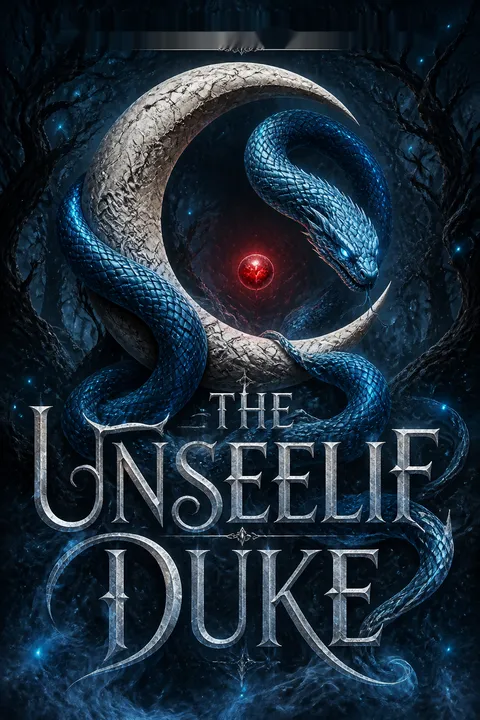


Plot Summary
A Prayer Made From Bones
Alex Hammond has lost her coffee shop job, fallen behind on rent, and watched her car die, while her music degree offers no reliable way out. Alone in her cramped Boston apartment, she turns to the witchcraft she has practiced since childhood. She burns herbs and a rattlesnake skull, then asks any listening power for help and offers whatever she has left.
The ritual opens a door she never expected to be real. Izael, a teal-haired fae duke, appears beside her bed and kisses her while she sleeps. Alex wakes, screams, and drives a knee into him. He vanishes, then reappears in her apartment, leaving her to face the impossible visitor she accidentally summoned.
Alex’s desperation is economic before it is supernatural. Her spell grows from a life in which the ordinary safety nets have already failed: work, savings, family, and the prospect of making music for a living. The bone ritual gives that desperation a concrete form, but it also exposes a gap between symbolic practice and actual power. Alex thinks she is reaching outward; Izael treats the act as a binding invitation. Their first contact establishes the story’s central imbalance: she has agency enough to fight him, but not enough knowledge to understand what she has opened.
Rings Bought With Dinner
Izael insists that Alex summoned him and offers two antique rings in exchange for Chinese food. She sells them to a Boston jeweler for nearly six hundred thousand dollars, enough to erase the immediate threat of homelessness. When Izael returns for his meal, he argues that money will not revive her lost ambition and proposes seven days together: Alex will show him modern Earth, while he introduces her to Tir n’Aill.
If she discovers a wish, she must negotiate a contract granting it; if she has none, he will provide lasting wealth. Alex secures three counteroffers and a spell to expose her lies before agreeing. Izael then obtains King Valroy’s covert permission to continue, despite Anfar’s suspicion.
The rings make the bargain seductive because they solve Alex’s immediate crisis, but they do not address the deeper collapse behind it. Izael recognizes that distinction and turns financial relief into a test of desire. The wager is framed as generous, yet its terms are shaped by his greater knowledge of fae law and his confidence that he can define what Alex wants. Her counteroffers show that desperation has not erased her judgment. The blood spell makes honesty measurable, while the concealed permission from Valroy reveals that even Izael’s apparent freedom depends on political maneuvering.
A Museum, Then Another World
Alex takes Izael to Boston’s Museum of Science, where he devours unfamiliar exhibits, tourist food, and the planetarium’s artificial stars with almost childlike wonder. His delight unsettles her assumptions: he is not merely pretending to enjoy Earth, though she still fears what he wants from her.
Back at her apartment, they watch animated films and share food until Alex falls asleep against him. After sunset, Izael transports her to Tir n’Aill, a realm of blue grass, checkered stone, and a tree supporting his suspended boat-bed. He reveals his enormous serpent body and tells her that he intends to keep her soul. The beauty of his world now sits beside a threat she cannot dismiss.
The museum reverses the usual fantasy-tourism gaze. Alex is the guide, while the centuries-old fae approaches familiar human inventions as astonishing novelties. His wonder gives him emotional texture without making him safe. Tir n’Aill then complicates that attraction: its beauty is not a disguise for danger so much as danger’s natural habitat. Alex’s response to Izael is similarly divided. She can enjoy his curiosity and still recognize his stated intention to possess her. The scene makes enchantment psychologically credible because pleasure and alarm arrive together, not in separate stages.
The Duke Eats His Spy
In Izael’s realm, Alex learns that his body opens along its torso to swallow a captured spy whole. The act is efficient and horrifying, and she faints before she can process it. Izael carries her to his hanging boat-bed, where she wakes wrapped in his coils. Soon Anfar, the Unseelie king’s second-in-command, arrives looking for the missing spy and accusing Izael of hidden dealings on Earth.
Izael admits the spy is dead but evades Anfar’s broader suspicions. Alex sees that Izael’s protection does not make his world humane, and that his appetite is not metaphorical. She has crossed into a court where murder follows its own laws, and her host is among its most dangerous residents.
The spy’s death turns Izael’s eccentricity into a material danger. Until then, his appetite and monstrous shape could be treated as grotesque comedy or erotic spectacle; swallowing a person removes that distance. Alex’s fainting is not a moral verdict so much as a bodily limit reached before her mind can assimilate what she saw. Anfar’s visit widens the danger from personal to political. Izael can shelter Alex from other predators, but he belongs to the same violent order and answers to its power structures only when convenient.
Puck's Impossible Warning
Robin Goodfellow, the silver-haired Seelie trickster known as Puck, abducts Alex to a crystal mine and warns her that Izael dies whether she wins or loses their wager. When Izael catches up and demands to know what Puck revealed, Alex refuses to explain. The magical mine answers her fear: power surges through her and blasts Izael across the chamber, burning his chest.
He recovers, and they return to his home, where he gives her a luxurious Boston condominium and a stray orange cat he has rescued. Alex names the cat Pumpkin. The gifts make her life warmer, but Puck’s warning gives her a new reason to seek a way out of the contract without surrendering her soul.
Puck converts the wager from a personal trap into a moral dilemma. Alex can no longer treat the contract as a simple contest between wealth and ownership, because either ordinary outcome carries a cost to Izael. Her accidental blast shows that Tir n’Aill responds to her in ways she does not understand, while her refusal to disclose the prophecy marks an early shift from reactive victim to strategic participant. Izael’s condo and cat offer comfort, but they also reproduce the very structure she resists: care arrives packaged as possession, and kindness cannot erase the power imbalance.
A Dead Man's New Address
Izael explains that the condominium belonged to a wealthy businessman who traded it for the promise of lasting social admiration. Izael fulfilled that wish by turning the man into a painting displayed at Boston’s Museum of Fine Arts, then placed the property in Alex’s name.
She objects to the murder behind her new home, but accepts the apartment and keeps the stray cat Izael brought her. Pumpkin quickly settles in, giving Alex companionship in a space that feels both lavish and morally compromised.
In the following days, Izael introduces her to city life, buys her electronics and toys, and talks with the cat about her loneliness. Alex begins to enjoy his company, even as she wonders whether being cherished by him will ever mean being free.
The condo crystallizes Izael’s distorted theory of care. He can solve Alex’s housing insecurity, but his method turns another person into an object and treats the result as clever service. Alex’s acceptance is therefore not simple gratitude; she is weighing immediate safety against the ethics of the gift and the danger of dependence. Pumpkin matters because affection toward the cat gives her a less coercive model of companionship, even as Izael uses the adoption to argue that being cared for can coexist with being owned. The scene makes comfort itself part of the conflict.
A Song Ends in Violence
At a Cambridge jazz club, Izael charms the room by singing vintage standards, while Alex watches his delight under the stage lights. They dance and walk home together, briefly resembling an ordinary couple. Four armed men emerge from an alley and demand their money and jewelry.
Alex tries to prevent a confrontation, but Izael breaks the attackers’ bones with a gesture, leaving them twisted and helpless on the pavement. He refuses to eat them, yet the choice does little to soften what she has witnessed. Alex vomits and nearly faints as Izael carries her home. His assurance that he will protect her now has a new meaning: he can guard her by inflicting violence she may never be able to accept.
The club gives Izael a social role that Alex can enjoy: performer, dancer, and attentive companion. The attack tears that frame away. His violence is not an accident caused by losing control; it is a deliberate display of power that he considers proportionate. Alex’s physical reaction matters because it refuses the romance’s temptation to make brutality aesthetically harmless. She may desire him, but her body registers the cost of living beside him. The episode sharpens the book’s distinction between protection and safety: Izael can stop a threat while becoming one himself.
A Bargain Beneath the Tree
The next evening, Alex and Izael watch Tir n’Aill change as sunset divides the realm into Seelie daylight and Unseelie night. From a high platform in Izael’s ash tree, she sees the landscape transform beneath the lengthening shadows. The beauty makes returning to ordinary life feel impossible, but the earlier threats from Puck, Anfar, and the spy have taught her that Izael cannot always be beside her.
She asks him to teach her how to defend herself. Izael offers the Hartsblood, an underground lake said to unlock a soul’s full power, warning that drinking from it binds a person permanently to Tir n’Aill. Alex accepts the risk, recognizing that the strange world has already become part of her life.
The sunset spectacle gives Alex a compelling reason to remain curious about Tir n’Aill, while her request for protection shows that wonder has not displaced caution. She is not simply falling into Izael’s world; she is asking for the capacity to act within it. The Hartsblood bargain makes that agency costly. Its promise is not a clean upgrade but an irreversible affiliation with the realm. Alex’s choice therefore differs from the original summoning: the first invitation came from desperation and ignorance, while this one follows experience and explicit warning.
The Lake's Living Music
The Hartsblood pulls Alex beneath its red, glowing surface, and she returns coughing after an interval she cannot remember. Izael tries to reach her, but the water burns through his skin and scales, exposing bone before he collapses. Alex hears discordant music coming from his wounds and discovers she can alter it.
By changing the notes into harmony, she restores his flesh and wakes him. The effort leaves her exhausted, and Izael carries her back to Earth, where he bathes and cares for her. Her new ability is not just a weapon: it lets her repair the creature who risked himself to retrieve her, deepening a bond neither of them can reduce to the contract.
The lake’s initiation is deliberately opaque: Alex undergoes a transformation without retaining a complete memory of it. Her first use of power is relational rather than aggressive. She does not silence a life or impose a new shape; she repairs Izael by listening closely to what is wrong. This choice complicates the coming fear of her abilities, because the same capacity that could destroy can also restore. Izael’s attempt to enter the lake exposes his own vulnerability, though his rescue does not erase the danger he brought her into.
A Power Too Dangerous
While Izael sleeps, Puck returns and explains that Alex’s musical magic can stop the living rhythms of others, potentially killing even powerful fae and threatening both worlds. He urges her to learn control before anyone discovers what she can do. Alex hides the full warning from Izael, who suspects Puck has meddled again but dismisses his prophecy that the contract will kill him.
At the Arnold Arboretum, Izael begins teaching Alex to hear and shape the music of living things. She changes a patch of grass by shifting its pitch, cautiously testing what her new gift can alter. Her fear is now practical: every experiment could change a life, and the treaty’s approaching deadline leaves little time to master the power.
Puck’s second warning reframes Alex as a potential source of catastrophe, not merely a person threatened by fae politics. The crucial danger lies in the power’s apparent simplicity: listening and changing are continuous actions, so ordinary perception itself may become consequential. Alex’s concealment from Izael is protective but also strains the relationship, since he is both her teacher and a possible future holder of her soul. The training scene makes restraint a learned skill. Her challenge is not to become powerful, but to distinguish the lives she can alter from the lives she has the right to alter.
A Lily Takes Wing
During training, Alex changes a tiger lily into a sparrow, matching its music to the bird’s song. Izael responds with a forceful kiss, and later, after she agrees to be with him, carries her to his hot spring. Their first sexual encounter is intense and rough; Alex initially resists his pace, then responds to the pleasure and demands that overwhelm her.
After she sleeps, Izael prepares her for an Unseelie feast, disguising her as a mute fae named Alaeni. At the gathering, Alex meets the goat-like Lord Bayodan and his glass-bodied mate, Cruinn, while Izael keeps her close. The night offers her a glimpse of his court, but its monstrous beauty is interrupted when King Valroy arrives.
The flower’s transformation is a compact demonstration of Alex’s growing competence: she observes a living pattern, makes a deliberate change, and creates a creature capable of moving on its own. Her intimacy with Izael follows, but does not settle the question of ownership or safety. His intensity draws her in while also testing the boundary between her willingness and his impatience. The feast then places their private relationship inside a public hierarchy. Alex’s disguise lets her observe, yet it also makes her dependent on Izael’s account of what is happening around her.
The King Claims the Dawn
Valroy identifies Alex as the human witch behind Izael’s contract and recognizes that her glamour conceals her identity. He intends to exploit a gap in the treaty by torturing her until she wishes for the agreement to end, which would give him a path toward renewed war. Izael urges Alex to make that wish herself and become his, arguing that it is the only way to spare her torture.
She refuses to risk becoming the cause of devastation across two worlds, and his threat to force the wish destroys what trust remains between them. With no safe choice left, Alex runs into the woods. Izael follows, knowing she is heading toward the Seelie side as dawn approaches.
Valroy’s threat turns the private bargain into a geopolitical weapon. Alex’s body becomes the site where treaty law, political ambition, and magical power converge. Izael’s proposal is emotionally revealing but ethically compromised: he offers protection by asking her to surrender the very autonomy she is defending, then threatens coercion when she refuses. The scene makes his care inseparable from possession. Alex’s flight is not a confident escape plan; it is a refusal to collaborate with either ruler’s use of her, even when the alternative is uncertain danger.
Dawn Splits the Lovers
Izael catches Alex on the road and admits the blood-made orb can locate her, though he insists he never lied about its harmlessness. He binds her in his coils and claims the bone necklace she has worn since childhood marks her as his. Alex rejects his claim, then uses her musical gift to shift herself elsewhere, landing near the Seelie fields.
As sunrise spreads, Izael begs her to return and confesses that he loves her. Alex admits she cares for him but cannot trust a future built on ownership and threats. Daylight forces Izael to retreat, leaving her alone to await the Seelie. Back in his realm, he grieves, then turns his loss into a vow to recover her, ending the book with both lovers separated and the larger danger unresolved.
The final escape is a genuine act of agency, but not a clean liberation. Alex uses the power she has feared to cross a boundary that Izael cannot follow into daylight, choosing uncertainty over a coerced promise. His confession arrives too late to repair the broken trust: love may be sincere, but sincerity does not neutralize control. The ending refuses the usual romantic resolution and leaves both characters exposed. Alex has escaped one captor without knowing whether the Seelie will protect her; Izael responds to loss by renewing his claim, making the next conflict an argument over whether attachment can survive without possession.
Analysis
The novel makes the language of bargains carry both economic and intimate force. Alex’s first agreement begins with a real material crisis: rent, work, debt, and the absence of family support. Izael’s rings offer immediate relief, but the later wager turns that relief into a test whose terms he understands better than she does. The romance therefore develops inside an unequal exchange, where gifts can be generous and controlling at once.
Izael’s central contradiction is not that he feels affection while behaving monstrously. It is that he treats affection as evidence that possession is benevolent. He offers safety, housing, food, and wonder, yet assumes those gifts authorize him to decide what Alex belongs to. Alex’s insistence on counteroffers and her eventual flight challenge a model of care that confuses devotion with ownership. Her attraction remains real, which makes her resistance more complex than simply rejecting a villain.
Magic intensifies this conflict by making agency materially consequential. Alex’s musical gift can mend Izael, transform a flower, or potentially silence life. Its ethical problem is not power alone but the temptation to treat the world as an instrument that can be rearranged at will. The treaty and the Hartsblood enlarge that question from the personal to the political: Alex’s body and choices become leverage in a conflict between courts.
The ending withholds reassurance. Alex has escaped Izael’s immediate grasp, but she has not secured safety, and Izael’s grief quickly becomes renewed possessiveness. The story refuses to equate love with redemption or escape with resolution. Its most consequential question is whether affection can become reciprocal when one person still believes that the other’s freedom is negotiable.
Review Summary
The Unseelie Duke receives mostly positive reviews (4.06/5) for its fun, unhinged protagonist Izael, a snake-like fae character. Readers enjoy the humor, banter, and spicy scenes between Izael and Alex, though some find patterns repetitive across the author's work. Many praise Alex's sharp personality and the vivid world-building. Common criticisms include the cliffhanger ending, insta-attraction romance, and one-dimensional characters compared to the author's previous Maze of Shadows series. Several reviewers note the book works standalone but recommend reading prior series for fuller context.
People Also Read

Characters
Alex Hammond
The desperate witchAlex is a singer with a BFA, a history of witchcraft, and little trust in conventional promises. Financial precarity has narrowed her ambitions until survival feels like the only sensible goal, but she remains observant and quick to challenge terms that seem unfair. Her humor and bluntness help her withstand Izael’s provocation, while her fascination with music and the macabre gives her a strong appetite for wonder. She is not simply fearless: she panics, hesitates, and often questions her own judgment. What distinguishes her is a persistent effort to make choices consciously, even when every available option has been shaped by someone more powerful.
Izael
The Unseelie bone dukeIzael is an Unseelie fae duke whose serpent body, appetite for bones, and command of bone-breaking magic make him a literal predator. Bored by the unchanging customs of Tir n’Aill, he longs to explore modern Earth and is captivated by Alex’s volatility and independence. His humor, curiosity, and delight in new things coexist with possessiveness and a casual acceptance of violence. Izael believes that lavish care can make ownership desirable, a conviction that reveals both his loneliness and his inability to understand human autonomy. He can be tender, but tenderness does not automatically make him safe.
Robin Goodfellow (Puck)
The time-bending tricksterRobin Goodfellow, usually called Puck, is a silver-haired Seelie agent who moves unpredictably between places and possible futures. He treats serious warnings with jokes, sexual teasing, and a performer’s delight in unsettling people. His knowledge is extensive but not straightforwardly reliable, since he describes futures as branching and uncertain. He intervenes in Alex’s situation less from personal loyalty than from concern over what unchecked power might do to the worlds he inhabits. His evasions make him useful and frustrating in equal measure.
King Valroy
The void-born kingValroy rules the Unseelie Court and carries the weight of a past war and a fragile treaty with the Seelie. His patience is limited, his threats are credible, and his fascination with power is tempered by a political intelligence that makes him difficult to predict. He can authorize Izael’s actions when they serve his interests, yet he remains alert to how any mortal contract might alter the balance between courts. Valroy’s composed authority hides an origin and nature far stranger than an ordinary fae ruler.
Anfar
The king's wary enforcerAnfar is a sea-monster fae who serves as Valroy’s second-in-command. Stern, suspicious, and difficult to charm, he monitors Izael’s movements because he expects trouble to follow the duke. His vigilance reflects the court’s political reality: treaties do not end rivalry, they merely give it new rules. Anfar’s history includes a painful connection to the court’s past, which helps explain why he treats disorder as more than a nuisance.
Pumpkin
Alex's orange familiarPumpkin is a stray orange tabby whom Izael brings into Alex’s new home. Affectionate, hungry, and content to accept comfort, he gives Alex a source of companionship that does not demand a bargain in return. His presence also makes the story’s repeated comparisons between pets and people emotionally concrete.
Abigail
The Seelie queenAbigail is Valroy’s wife and the Seelie Queen. Her relationship with him shaped the peace treaty that limits fae interference in the human world. Though she does not appear directly in the present action, her past decisions continue to define the political boundaries that constrain Izael and Alex.
Lord Bayodan
The one-armed courtierBayodan is a goat-legged Unseelie lord with a composed manner and a place among the court’s senior figures. He welcomes Izael and Alex to the feast and treats Alex with more courtesy than she expects from the company around her. His missing arm reflects the court’s history of punishment and political sacrifice.
Cruinn
The glass-bodied mateCruinn is Bayodan’s mate, a fae whose body is made of shifting glass shards. Their warmth toward Alex contrasts with the unsettling fractures and absences in their form. They and Bayodan once stood within Valroy’s political circle, and their present lives bear visible marks of that history.
Perin
Anfar's selkie matePerin is Anfar’s selkie mate, a young man whose friendly presence contrasts with Anfar’s sternness. He appears among the Unseelie gathering, offering a glimpse of the personal bonds that persist within the court.
Olivia
Alex's distant confidanteOlivia is Alex’s longtime friend from high school and their shared interest in witchcraft. Now living in Toronto, she remains the person Alex most wants to trust, though the strangeness of Izael’s arrival makes Alex hesitate to contact her.
Ginzer
Anfar's court spyGinzer is a spy sent to observe Izael’s activities. His brief presence demonstrates how closely the Unseelie court watches its own members and how dangerous a breach of its rules can become.
Bres
The fallen Unseelie kingBres is a former Unseelie king remembered through a statue in Monument Forest. His conflict with the Seelie and his violent end form part of the court’s long memory of dispossession and rivalry.
Lady Astasha
The court's lost heroineAstasha is commemorated in Monument Forest as a beautiful figure caught in the court’s political violence. Her story connects Anfar and Valroy to a history of loyalty, failed protection, and lasting grief.
Plot Devices
The seven-day contract
A wager with no safe outcomeIzael’s contract requires seven days of exploration on Earth and seven nights in Tir n’Aill. Alex must name a wish at the end, after which they will negotiate the price of granting it. If she has no wish, Izael promises wealth instead. The rules make the arrangement look flexible, but Puck warns that either ordinary outcome will kill Izael. The contract drives Alex’s choices while forcing her to search for an alternative the original terms do not provide.
The mortal treaty
A political leash between worldsAfter a war between the Seelie and Unseelie courts, a treaty restricts fae travel and interference on Earth. Fae can cross into the human world through contracts with mortals, which gives Izael a legal reason to keep his agreement with Alex active. The treaty also creates a political weakness: Valroy looks for ways to use the contract to renew conflict. It transforms a romantic bargain into a question of international power and makes Alex’s private decisions consequential beyond herself.
The blood-made orb
A truth test that tracks AlexIzael uses Alex’s blood to create a glass sphere that glows when she lies. He presents it as a limited safeguard for their negotiation, and it becomes a visible sign that the contract is bound to her body. The orb also lets Izael locate her, a capability Alex does not initially understand. Its double function embodies the danger of literal bargains: a promise can be technically truthful while concealing the practical power it gives the other party.
The Hartsblood
A permanent passage into magicThe Hartsblood is an underground lake that connects to the life and magic of Tir n’Aill. Izael brings Alex there after she asks for a way to defend herself, warning that contact will bind her to the realm. The lake nearly drowns Alex and burns Izael when he tries to reach her. Afterward, Alex can hear and alter the music of living things. The lake gives her power, but it also makes her connection to Tir n’Aill irreversible.
Music of life
A power that changes living patternsAlex hears living things as music and can alter their notes, rhythms, or instruments. She first uses the gift to heal Izael’s Hartsblood wounds, then changes grass into a lily and a lily into a bird. Puck warns that she can also silence a living pattern, potentially killing its source and threatening both worlds. The ability externalizes the story’s central question of agency: Alex can intervene in reality, but power does not decide for her when intervention is justified.
About the Author
Other books by Kathryn Ann Kingsley




Download PDF
Download EPUB
.epub digital book format is ideal for reading ebooks on phones, tablets, and e-readers.








