

Key Takeaways
Treat every design as a hypothesis that failure can disprove
Engineering creates the untested. A bridge or building is not simply an application of known science. It is a new arrangement of materials intended to work in a changing world. Petroski frames each design as a hypothesis: this structure, under these expected conditions, will perform its job without failing. A design may be checked on paper, but no calculation can anticipate every future load, construction error, or act of misuse.
Failure gives a sharp answer. A structure that stands for years confirms its design only under the conditions it has encountered so far. A collapse can decisively expose a mistaken assumption. The Hyatt Regency walkways, for example, disproved the belief that their connections could support the crowded walkways. Their failure was tragic, but it revealed what successful structures often conceal: the limits of the designer’s knowledge.
The hypothesis analogy makes engineering’s uncertainty legible without reducing it to guesswork. It resembles scientific testing, but with a crucial difference: a failed experiment can cost lives and leave no clean way to repeat the test. That raises the value of simulations, prototypes, inspections, and careful review before construction. It also clarifies why success is not proof. A design may simply not yet have encountered its most demanding conditions. The analogy has limits, though: failures can have multiple interacting causes, so a collapse rarely identifies one false assumption all by itself.
Design by testing the ways your structure could fail
Begin with the weak points. The engineer’s task is not only to picture what a structure should do, but also to imagine how it might not do it. A floor beam, for instance, can sag, break, or buckle sideways. Each failure possibility becomes a question to analyze, test, or guard against. The process is a series of proposed arrangements, checks, and revisions, rather than a single flash of inspiration.
Good intuition still needs checks. Galileo correctly saw that a beam resists bending better when its deeper side faces the load, but his calculation of the exact strength was wrong. He could give useful qualitative advice while making an inaccurate quantitative prediction. Engineers therefore need their work to be clear enough for others to inspect, challenge, and recalculate.
This approach anticipates modern pre-mortems, where a team imagines a project has failed and works backward to identify plausible causes. Its strength is that it converts vague caution into specific questions. The Galileo example also captures a persistent risk in technical work: a result can look right for the wrong reason, especially when it matches limited experience. Independent review matters because familiarity can make assumptions invisible. Yet exhaustive testing is impossible. Good design requires deciding which failure modes deserve attention, and making that prioritization explicit.
Do not mistake years of success for proof of safety
Safety margins absorb uncertainty. A factor of safety is the load that would cause failure divided by the greatest expected working load. A hoist rope that breaks at 6,000 pounds but is expected to lift 1,000 has a factor of safety of 6. The margin allows for imperfect materials, rough operation, and loads beyond the rating, but it cannot cover every imaginable misuse.
Success can shrink the margin. When familiar structures keep standing, designers may conclude they are too strong and reduce their safety allowances. A failure tends to push standards in the opposite direction. Petroski points to this cycle in bridge design. The Challenger disaster offers a stark parallel: after many successful flights, concerns about O-rings in unusually cold conditions did not prevail over confidence built from the record of past launches.
The cycle links technical choices to institutional memory. A long record of success can be real evidence, but it can also create pressure to treat untested conditions as safe. This is familiar in medicine and aviation, where routine performance can make rare hazards seem less urgent. The factor of safety is valuable precisely because real-world loads and materials vary, but a single number can imply more certainty than the assumptions justify. Safety margins should therefore be treated as reasoned buffers, not as guarantees or as waste waiting to be eliminated.
Track tiny cracks before repeated stress turns them catastrophic
Repetition can be more dangerous than one blow. Fatigue is damage caused by repeated loading. Bend a paper clip sharply back and forth and it breaks; bend it only slightly each time and it may survive thousands or millions of cycles. In a child’s Speak & Spell toy, frequently pressed keys broke at their plastic hinges, while less-used keys remained intact. The manufacturer later replaced the individual hinges with a flexible keyboard sheet.
Cracks need a life plan. Many structural failures involve cracks that grow slowly under repeated stress. Safe-life design estimates how long a part can serve before a crack becomes dangerous. Fail-safe design adds features intended to stop a crack or preserve function if one part is damaged. Neither approach removes uncertainty, so inspection and maintenance remain important.
Fatigue is a useful reminder that damage accumulates even when each individual use seems harmless. It also shows why the same product can fail differently depending on how people use it. The distinction between safe-life and fail-safe thinking is important: one estimates when a part should leave service, while the other tries to limit the consequences of damage. Both depend on realistic information about use and inspection. A hidden crack can evade detection, so scheduled checks reduce risk without turning uncertainty into certainty.
Build alternate routes for loads when one connection gives way
A weak connection can bring down a system. At the Kansas City Hyatt Regency, a proposed change replaced each long support rod for the suspended walkways with two shorter rods. The altered arrangement transferred the lower walkway’s load through the upper walkway’s beam, roughly doubling the force on that connection. Investigators found that the walkways as built were barely able to carry their own weight. Their collapse killed 114 people and injured almost 200.
Redundancy can interrupt collapse. Alternate load paths are other routes through which a structure can carry weight if a connection fails. Without them, one broken part can shift its load to neighboring parts, trigger further failures, and bring down the whole structure. The Mianus River and Silver Bridge collapses show how vulnerable a structure can be when a failed connection has no reliable substitute.
The case shows that safety can hinge on a detail that looks small on a drawing but changes how forces travel through the whole structure. Redundancy is a powerful response, but it is not automatic protection. If multiple backup elements share the same flaw, or depend on the same vulnerable connection, they may fail together. This is the problem of common-cause failure. Reviewing how loads move after damage, not just how they move in normal operation, makes redundancy a real design property rather than a reassuring label.
Make bold innovations earn confidence through tests, not optimism
New ideas can work. Joseph Paxton designed London’s Crystal Palace for the 1851 Great Exhibition, adapting structural ideas from a greenhouse built for giant water lilies. Its iron frame and glass panels used repeated, standardized parts that could be assembled quickly. Before opening, a gallery section was loaded with about 42,000 pounds of workers. They walked, ran, and jumped on it; the greatest measured deflection was about a quarter of an inch.
Testing distinguishes courage from carelessness. The Crystal Palace succeeded despite doubts about its strength, weather performance, and crowded galleries. Its success was not proof that every large glass-and-iron structure would work. It showed that an unfamiliar design can be made credible by testing its parts and considering how it will be used. Copying a successful design without accounting for a new scale or setting can introduce fresh risks.
The Crystal Palace is a useful counterweight to a story told only through disasters. Innovation is not reckless by definition; it can be disciplined through prototypes, load tests, and scrutiny of construction methods. The gallery test is especially revealing because it tested moving people, not merely static weight. Still, a successful test covers only the conditions it actually represents. Scaling a design changes forces, materials, and assembly demands, so confidence should rise with evidence specific to the new project, not simply with resemblance to a previous success.
Treat computer output as an answer to your question, not reality
More calculation is not more understanding. Slide rules forced engineering students to work with a few significant digits and estimate the order of magnitude themselves. Computers can perform far more calculations, but they cannot decide whether the model represents the real structure or whether the right questions were asked. Errors in software can also produce precise-looking but misleading results.
Models need physical judgment. The Hartford Civic Center roof collapsed under snow and ice after its long bars bent and triggered a chain reaction. Investigators found that the original analysis had not adequately captured the structure’s behavior. Computer-aided design can make complex analysis possible, but it can also encourage engineers to trust an oversimplified model or optimize away useful strength. Results still need experienced review and comparison with real behavior.
This is an early warning about automation bias: people can give a machine’s output more authority because it is fast, numerical, and neatly formatted. The deeper issue is model choice. A computer can calculate accurately within its assumptions while those assumptions omit a critical connection or load. Physical tests, independent checks, and comparisons with known cases help expose such gaps. The opposite risk also matters: rejecting useful computational tools out of nostalgia would be unwise. The goal is not less computation, but clearer accountability for the human choices behind it.
Publish failures so the next designer can avoid the same trap
Failure analysis reconstructs what happened. After three early Comet jetliner crashes, investigators first struggled to identify the cause. A retired plane was repeatedly pressurized and depressurized in a water tank. After roughly 3,000 simulated flights, a crack appeared near a cabin window and grew rapidly. The investigation revealed that fatigue around the window openings had been underestimated. The design was strengthened, and the Comet later returned to service.
Share the evidence. Failure analysis is the investigation of a failed structure or machine to determine how and why it failed. Its value reaches beyond assigning blame: the findings can guide changes to similar designs. Petroski argues that reports, technical journals, and archives preserve those lessons. When legal disputes or embarrassment hide the evidence, other designers lose information that could help prevent another failure.
The Comet investigation shows why a plausible explanation should not be mistaken for a proven one. Early conclusions blamed conditions outside the design, yet repeated failures and physical testing exposed a deeper weakness. That is a model of disciplined revision: follow evidence even when it challenges a favored account. Sharing the results also makes safety a collective achievement rather than the private property of one organization. Transparency has limits when investigations are incomplete, so reports should distinguish established findings from uncertainty instead of presenting every early theory as fact.
Name the trade-offs and operating limits before calling a design safe
No design satisfies every demand. A structure must balance safety, cost, appearance, materials, and intended use. Making every bridge ten times stronger could raise its price and make it heavier, while using less material may leave less room for error. The Grumman Flxible buses illustrate how competing demands can collide: a lighter design aimed to save fuel and meet other requirements, but its frames developed fatigue cracks much earlier than expected.
State what the design assumes. Every structure has limits on load, lifetime, maintenance, and conditions of use. Daedalus’s warning to Icarus, in the myth of wings made from feathers and wax, captures the basic point: a workable design can still fail when used beyond its limits. Clear operating instructions and realistic inspection plans are part of making a design safe.
Trade-offs are not merely technical; they decide who receives the benefits and who bears the risks. A lighter bus may save fuel, but passengers and transit agencies inherit the consequences if durability was underestimated. Making assumptions visible gives clients, regulators, and users a chance to challenge them. This also counters the fantasy of a universally safe object. A design can be appropriate for a defined service life and still be unsuitable under neglected maintenance or unexpected use. Safety claims are strongest when their boundaries are stated plainly.
Analysis
Petroski’s central contribution is to make failure part of engineering’s method of knowing, not an embarrassing exception to it. A structure is a claim about how materials and forces will behave. Analysis can test that claim, but a design used in the world meets conditions no drawing fully contains. Failure can reveal a hidden assumption with a clarity that uneventful service cannot. This is why the book moves between ordinary objects, landmark structures, and disasters: each makes the same abstract problem tangible, from a paper clip bending to a bridge connection tearing loose.
The argument is strongest when it distinguishes innovation from negligence. The Crystal Palace shows that an unfamiliar design can succeed through practical tests and careful construction. The Hyatt walkways show the danger of changing a connection without adequately checking its effects. The Comet investigation shows why an initial explanation should remain open to revision. Together, these cases make engineering look less like applying certainty and more like managing uncertainty through models, margins, inspection, and shared experience.
There is also an ethical tension in treating disasters as lessons. A collapse may improve future practice, but the people harmed by it are not instruments in a useful experiment. The responsible implication is not to accept catastrophe as the price of progress. It is to learn from near misses, tests, earlier failures, and transparent investigations before a structure becomes a public trial. The book’s defense of innovation is persuasive when paired with that duty.
Its account also anticipates a lasting problem in technical work: tools can increase calculation without increasing judgment. A computer can handle complexity, but it cannot independently choose a realistic model or decide which questions matter. That decision remains human and organizational. The most durable lesson is therefore not that failure is good, but that evidence of failure must be sought, studied, and circulated, while no record of success should be mistaken for a guarantee.
Review Summary
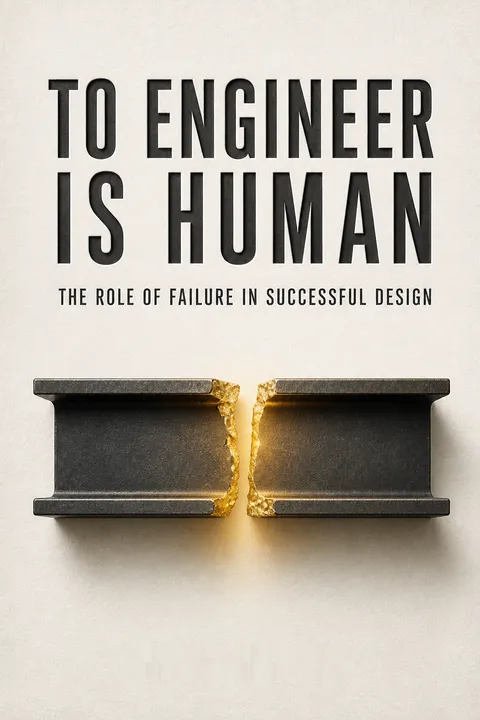
To Engineer Is Human explores how engineering failures lead to innovation and learning. Petroski argues that failure is essential for progress, as it reveals design flaws and pushes engineers to improve. The book examines various case studies, from bridge collapses to aircraft accidents, highlighting the tension between safety and innovation. Readers appreciate Petroski's ability to make engineering accessible to laypeople, though some find the writing repetitive. The book's insights on learning from mistakes and the human aspect of engineering resonate with many, while its dated technology references add historical context.
People Also Read










Glossary
Engineering hypothesis
A testable design claimAn engineering hypothesis is the claim, explicit or implicit, that a designed structure will perform its intended function without failing under expected conditions. Engineers examine the claim through calculations, tests, and experience. Successful service supports it only for the conditions encountered; an early failure can disprove it and expose assumptions that need revision.
Factor of safety
A load capacity marginA factor of safety is the load required to cause failure divided by the maximum load expected in service. It provides room for uncertainty in materials, calculations, construction, and use. Engineers choose the margin through judgment and applicable standards. A larger factor can improve resilience, but it also adds weight and cost, and cannot cover every imaginable condition.
Fatigue
Damage from repeated loadingFatigue is the gradual weakening of a material or structure under repeated cycles of stress. Small cracks can begin at vulnerable spots and grow with continued loading until the remaining material can no longer carry the applied force. The individual cycles may be well below the load that would break an undamaged part in a single event.
Alternate load paths
Backup routes for structural loadsAlternate load paths are other structural routes that can carry weight when a connection or member fails. They can prevent a local defect from causing a larger collapse by allowing forces to shift to surviving parts. Their effectiveness depends on the strength and independence of those parts, as well as on whether the structure can redistribute loads without overloading them.
Fail-safe
Design that limits crack consequencesFail-safe design includes features intended to prevent a local flaw or crack from causing immediate catastrophic failure. Structural obstacles may arrest crack growth, or other parts may continue supporting the load if one component is damaged. The approach depends on inspection and design details, since hidden defects and common weaknesses can still defeat the intended protection.
Safe-life criterion
A defined service lifeThe safe-life criterion is a design approach that estimates a period of service during which a structure should remain safe, with failure expected only beyond that lifetime. Because actual flaws, loads, and crack growth are difficult to predict exactly, the estimate cannot stand alone. Inspection and other protective design measures are needed to address uncertainty.
Failure analysis
Investigation of how failure occurredFailure analysis is the systematic investigation of a failed structure, machine, or component to determine how and why it failed. Investigators examine the broken parts, design records, materials, construction, maintenance, and conditions of use. The findings can guide repairs and future designs, especially when the evidence and conclusions are shared beyond the parties involved.
FAQ
What is To Engineer Is Human: The Role of Failure in Successful Design by Henry Petroski about?
- Exploration of engineering and failure: The book examines how failure is central to the engineering process, arguing that mistakes and breakdowns are not just inevitable but essential for progress and innovation.
- Human aspect of engineering: Petroski emphasizes that engineering is a fundamentally human endeavor, shaped by creativity, judgment, and error.
- Design and learning: The narrative uses historical and contemporary examples to show how engineers learn from failures to create safer, more reliable structures.
Why should I read To Engineer Is Human by Henry Petroski?
- Demystifies engineering: The book provides clear, accessible explanations of what engineers do and why their work matters, making it suitable for both technical and non-technical readers.
- Highlights the value of failure: Petroski shows how failures are not just setbacks but valuable learning opportunities that drive technological advancement.
- Broader implications: The book offers insights into human nature, risk, and the process of learning from mistakes, making it relevant to anyone interested in problem-solving and innovation.
What are the key takeaways from To Engineer Is Human by Henry Petroski?
- Failure as a teacher: Failures reveal design limitations and provide critical lessons that guide safer and more effective engineering.
- Cycle of success and failure: Engineering advances through a cycle where periods of success lower safety margins, eventually leading to failures and subsequent improvements.
- Human factors matter: Many failures stem from human error, economic pressures, or communication breakdowns, highlighting the importance of ethical responsibility and oversight.
What is Henry Petroski’s central thesis about failure in engineering design?
- Failure is inevitable and instructive: Petroski argues that failure is central to engineering because it exposes weaknesses and errors that can be corrected.
- Learning and progress: Failures contribute more to engineering knowledge than successes, leading to improved designs and greater safety.
- Cycle of improvement: The book describes how repeated cycles of failure and success drive technological advancement.
How does To Engineer Is Human by Henry Petroski define the engineering design process?
- Design as hypothesis: Engineering design is likened to a scientific hypothesis, where the engineer predicts that a structure will perform its intended function without failure.
- Testing and revision: Designs are analyzed and revised repeatedly, but absolute certainty is impossible due to unpredictable future conditions.
- Creative and analytical blend: The process combines imaginative leaps with rigorous scientific analysis to create structures that are both functional and elegant.
What role do factors of safety play in engineering, according to Henry Petroski?
- Margin for error: Factors of safety provide a numerical buffer to account for uncertainties in materials, loads, and human error.
- Balancing act: Engineers must balance safety with economic and architectural considerations, as higher safety margins increase cost and bulk.
- Dynamic adjustment: Safety factors tend to fluctuate over time, increasing after failures and decreasing during periods of success, leading to cycles of improvement and risk.
How does Henry Petroski illustrate the human aspect of engineering through childhood experiences?
- Innate engineering instincts: Petroski shows that humans have an intuitive grasp of engineering principles from infancy, as seen in learning to balance, walk, and build.
- Stories and play: Nursery rhymes and fairy tales introduce concepts of structural failure and design, emotionally preparing us for real-world engineering challenges.
- Trial and error: The process of falling and rebuilding in childhood mirrors the iterative, failure-driven nature of engineering.
What are some notable engineering failures discussed in To Engineer Is Human, and what lessons do they provide?
- Hyatt Regency skywalk collapse: A design change led to a weak connection and collapse, highlighting the dangers of unvetted modifications.
- Bridge failures: The Mianus River and Silver Bridge collapses illustrate the consequences of corrosion, fatigue, and lack of redundancy.
- DC-10 engine mount failure: This case shows how maintenance procedures can introduce new risks, emphasizing the need to consider real-world use and human factors.
How does Henry Petroski explain fatigue and crack growth in engineering materials?
- Fatigue as a common failure mode: Many failures result from repeated loading, which causes microscopic cracks to grow until catastrophic failure occurs.
- Laboratory vs. real-world: While fatigue can be studied in controlled settings, real structures face variable loads and imperfections that complicate predictions.
- Design strategies: Engineers use fail-safe and safe-life philosophies, nondestructive testing, and safety factors to manage fatigue risks, but uncertainties remain.
What is the significance of the Crystal Palace story in To Engineer Is Human by Henry Petroski?
- Innovation and risk: The Crystal Palace exemplifies how daring engineering projects can succeed through careful design, testing, and adaptation.
- Legacy: Its modular iron and glass construction pioneered methods still influential in modern architecture and engineering.
- Contrast with failure: Petroski uses the Crystal Palace to show that innovation can lead to both spectacular successes and failures, each offering valuable lessons.
How does Henry Petroski describe the impact of computers on engineering practice in To Engineer Is Human?
- Transformation of calculation: The shift from slide rules to computers has enabled more complex analyses and changed how engineers work.
- Risks of overreliance: Petroski warns that dependence on computers can erode intuition and critical judgment, as engineers may accept outputs without questioning assumptions.
- Need for oversight: Computers are tools that require knowledgeable engineers to interpret results and ensure safety, especially in innovative or complex designs.
What are the limits of design and innovation according to Henry Petroski in To Engineer Is Human?
- Inherent compromises: All designs involve trade-offs among conflicting requirements, making perfect solutions impossible.
- Uncertainty and evolving knowledge: Designs are based on assumptions that may change, leading to surprises and the need for iterative improvement.
- Cycle of progress: Innovation involves risk, and while some projects fail, these failures generate new knowledge and safer designs for the future.
About the Author
Other books by Henry Petroski




Download PDF
Download EPUB
.epub digital book format is ideal for reading ebooks on phones, tablets, and e-readers.








